Creating a bank organizational chart template is also a practical way to improve communication, strengthen accountability, and support regulatory compliance. By mapping leadership positions and key departments, banks can identify reporting gaps, reduce overlapping responsibilities, and make better organizational decisions. This guide explains the typical banking hierarchy, essential departments, and practical steps for building a professional organizational chart.
What Is a Bank Organizational Chart?
A bank organizational chart is a visual representation of a bank’s management structure. It illustrates how authority, responsibilities, and reporting relationships are distributed throughout the institution. The chart usually begins with the board of directors and executive management before branching into departments such as operations, finance, risk management, human resources, and information technology.
The exact structure varies according to the bank’s size, business model, ownership, and regulatory environment. A small community bank may combine several functions under one executive, while a large international bank may maintain separate divisions for corporate banking, retail banking, investment services, compliance, and technology.
A well-designed chart should communicate three essential elements:
- Authority: Who makes strategic decisions and approves major policies.
- Accountability: Which executives and employees are responsible for particular functions.
- Reporting relationships: How departments and teams communicate with their managers.
Typical Bank Organizational Chart Structure
Most traditional banking structures follow a hierarchy that separates governance, executive management, departmental leadership, and daily operations. Although reporting arrangements differ between institutions, the following positions provide a useful starting point.
1. Board of Directors
The board of directors provides oversight, approves strategic direction, and monitors the bank’s overall performance. Its responsibilities commonly include reviewing financial results, overseeing significant risks, appointing or evaluating senior executives, and ensuring that governance arrangements remain effective.
The board generally does not manage routine banking transactions. Instead, it establishes expectations and holds executive management accountable for delivering results while protecting the institution’s long-term interests.
2. Chief Executive Officer
The chief executive officer (CEO) leads the bank’s executive team and translates the board’s strategic priorities into business objectives. The CEO coordinates major departments, monitors performance, and oversees the implementation of policies, growth initiatives, and operational improvements.
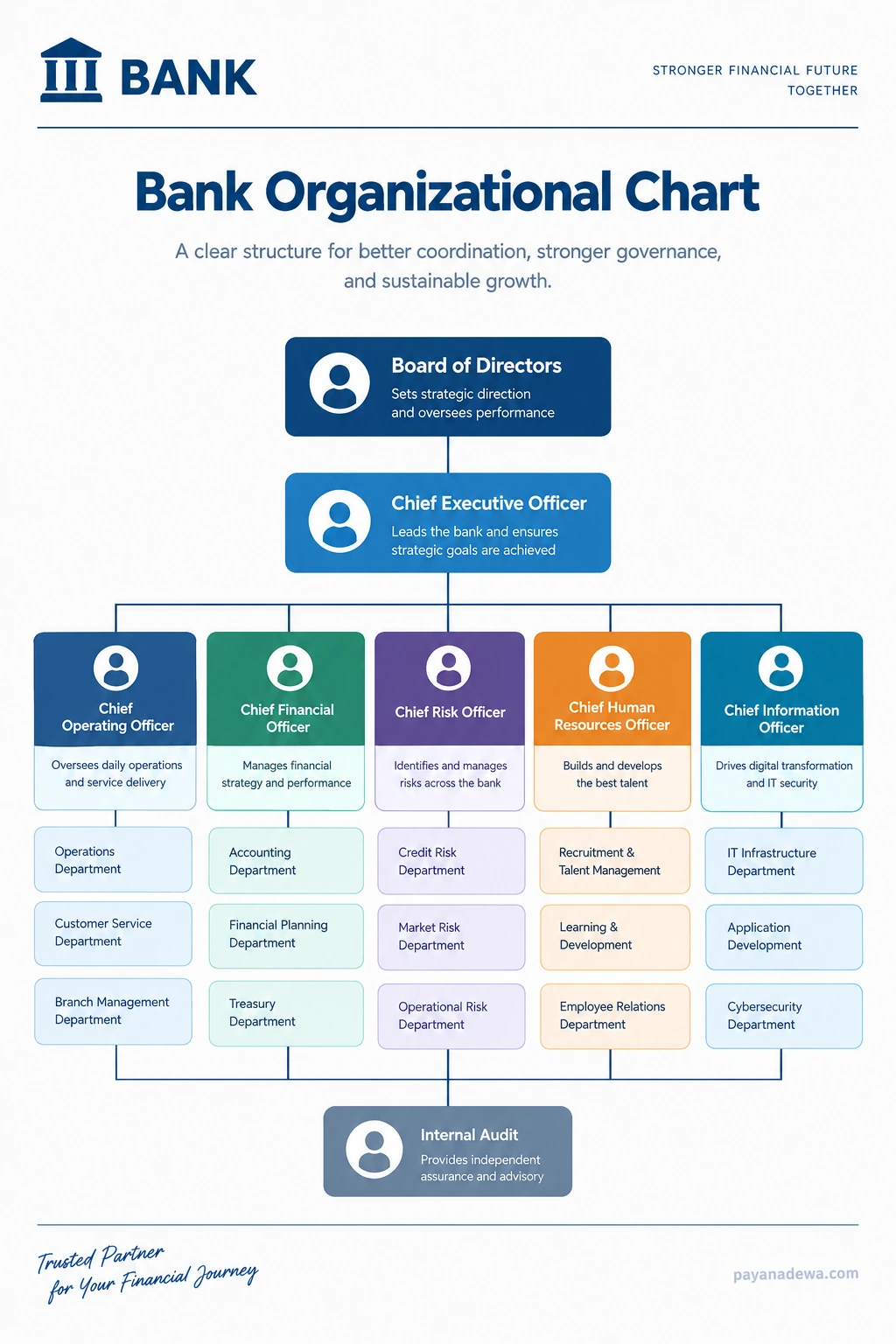
Depending on the institution, the CEO may report directly to the board and supervise several executives, including the chief operating officer, chief financial officer, chief risk officer, chief human resources officer, and chief information officer.
3. Executive Management Team
Executive leaders manage specialized functions and ensure that departmental activities support the bank’s wider objectives. Their responsibilities should be clearly documented to prevent conflicting decisions and gaps in accountability.
- Chief Operating Officer (COO): Oversees daily operations, service delivery, branch administration, and operational efficiency.
- Chief Financial Officer (CFO): Manages financial reporting, budgeting, financial planning, and treasury-related oversight.
- Chief Risk Officer (CRO): Coordinates risk management, risk assessments, and the monitoring of significant exposures.
- Chief Human Resources Officer (CHRO): Leads recruitment, employee development, compensation policies, and workforce planning.
- Chief Information Officer (CIO): Oversees technology strategy, information systems, infrastructure, and digital transformation.
These titles are examples rather than universal requirements. Some banks assign additional responsibilities to existing executives, while others appoint separate leaders for compliance, legal affairs, cybersecurity, or business development.
Key Departments in a Bank Organizational Chart
Departments form the operational foundation of a banking organization. A practical bank organizational structure groups related activities under appropriate leaders while maintaining independent oversight where necessary.
Banking Operations Department
The operations department manages the processes that support everyday banking services. Typical responsibilities include transaction processing, account administration, payment operations, branch coordination, and service quality. Depending on the bank, customer support and back-office processing may operate as separate teams.
Finance and Accounting Department
The finance department manages budgets, financial statements, management reporting, and financial performance analysis. Accounting teams maintain accurate records and support reporting obligations. Treasury functions may manage liquidity, funding, cash positions, and other financial exposures according to the bank’s governance arrangements.
Risk Management Department
Risk management identifies, evaluates, and monitors threats that could affect the bank’s financial stability or business objectives. Important areas include credit risk, market risk, liquidity risk, and operational risk. The department establishes monitoring frameworks and works with business units to keep exposures within approved limits.
Human Resources Department
Human resources supports the employee lifecycle, from recruitment and onboarding to performance management, training, and retention. In a bank, HR also helps maintain professional standards and ensures that employees receive appropriate training for their roles.
Information Technology and Cybersecurity
The IT department maintains the systems and infrastructure that enable secure, reliable banking services. Its responsibilities may include application development, network administration, system availability, access management, data protection, and technology support. Cybersecurity responsibilities should be explicitly assigned, whether they sit within IT or under a separate security function.
Compliance and Internal Audit
Compliance helps the bank meet applicable laws, regulations, internal policies, and ethical standards. Its work may cover customer due diligence, anti-money laundering controls, regulatory reporting, and compliance monitoring.
Internal audit provides independent assurance regarding governance, risk management, and internal controls. It should have sufficient independence from the activities it reviews, with appropriate access to the board or audit committee. Compliance and internal audit serve different purposes and should not automatically be treated as interchangeable functions.
Bank Organizational Chart Template
A bank organizational chart template makes it easier to present reporting relationships in a consistent, professional format. Use the following example as a starting point and adapt the positions to match your institution’s actual structure.
How to Create a Bank Organizational Chart
Building an effective organizational chart requires more than arranging job titles in boxes. The chart should reflect actual responsibilities, approved reporting relationships, and the bank’s operating model.
Step 1: Define the Scope
Decide whether the chart will represent the entire bank, a regional office, a branch, or a specific business division. A bank-wide chart should show the major governance and management levels, while a departmental chart can provide more detailed information about individual teams.
Step 2: Gather Accurate Information
Collect current job titles, department names, reporting lines, and approved leadership assignments. Consult HR records, governance documents, and relevant department heads. Verify the information before publishing the chart to avoid outdated positions or incorrect reporting relationships.
Step 3: Establish the Reporting Hierarchy
Begin with the board and executive leadership, then add departmental heads and their respective teams. Clearly distinguish direct reporting relationships from functional oversight, committee reporting, and independent assurance responsibilities. Avoid presenting every function as a direct report to the CEO unless that arrangement is accurate.
Step 4: Choose a Suitable Design
Use a clean layout with consistent shapes, readable fonts, and simple connecting lines. Apply colors to distinguish departments, but maintain sufficient contrast for accessibility and printing. For complex institutions, separate business units and control functions into clearly labeled sections.
Step 5: Review and Approve the Chart
Ask HR, executive management, and relevant governance representatives to verify the chart. Confirm that it accurately reflects approved responsibilities and does not unintentionally suggest that independent control functions lack appropriate authority or access.
Step 6: Maintain and Update It
Organizational structures change as banks introduce new services, expand into new markets, or adjust their risk management arrangements. Assign an owner to review the chart periodically and whenever significant organizational changes occur. Include a revision date so employees can identify the current version.
Best Practices for an Effective Banking Organizational Structure
A professional bank organizational chart should be easy to understand, accurate, and useful for everyday decisions. Apply these practical recommendations when designing or updating your chart.
- Keep it simple: Show the main hierarchy first and move detailed job assignments into supplementary charts when necessary.
- Use consistent titles: Standardize position and department names across the organization.
- Clarify accountability: Ensure that employees and managers understand their responsibilities and escalation paths.
- Preserve control independence: Reflect appropriate oversight and reporting arrangements for risk management, compliance, and internal audit.
- Protect sensitive information: Share internal charts according to access policies, especially when they contain employee names or confidential reporting details.
- Make it accessible: Use readable text, descriptive labels, sufficient contrast, and a layout that works on both screens and printed pages.
- Review regularly: Update the chart after restructurings, leadership changes, mergers, or significant operational changes.
Common Mistakes to Avoid
Even a visually attractive chart can create confusion when it does not reflect how the bank actually operates. Avoid these common problems:
- Using outdated executive titles or reporting lines.
- Combining independent oversight functions without considering governance requirements.
- Showing departments without identifying their responsible leaders.
- Adding too much detail to a single page, making the chart difficult to read.
- Confusing committee membership with direct managerial authority.
- Publishing internal employee information without appropriate authorization.
Remember that a template is a starting point, not a substitute for the bank’s governance policies or applicable regulatory requirements. The final structure should be reviewed against the institution’s actual operating model.
Benefits of a Bank Organizational Chart
A clear organizational chart supports several important business outcomes. It helps new employees understand where their roles fit within the institution and gives existing staff a reliable reference for identifying the appropriate decision-makers.
It also improves coordination between departments, highlights potential overlaps in responsibility, and supports succession planning. For management, the chart provides a useful overview of leadership coverage and organizational complexity. For governance teams, it can help document reporting arrangements and identify areas that need further review.
However, a chart alone cannot guarantee regulatory compliance or effective internal controls. It works best when supported by clear job descriptions, documented policies, appropriate training, and regular oversight.
Conclusion
A bank organizational chart is an essential tool for explaining leadership, departmental responsibilities, and reporting relationships within a financial institution. From the board of directors and CEO to operations, finance, risk management, human resources, IT, compliance, and internal audit, every function should have a clearly defined place within the bank’s operating model.
By starting with a reliable bank organizational chart template, verifying reporting lines, and reviewing the structure regularly, banks can improve communication, strengthen accountability, and support more effective governance. Customize the chart to fit your institution rather than copying a generic hierarchy, and ensure that the finished document reflects real responsibilities and appropriate oversight.