Watching your baby grow is one of the most rewarding experiences of parenthood. From the first social smile to those exciting first steps, every new skill brings a special moment to celebrate. A Baby Milestones Chart helps parents understand common developmental milestones and track their little one’s progress throughout the early years.
Babies develop at different rates, so there is no need to compare your child with every other baby. However, understanding typical milestones can help you recognize emerging skills, encourage healthy development, and identify when it may be helpful to speak with a healthcare professional.
In this guide, you will discover what to expect at different ages, how to use a baby development chart, and practical ways to support your child’s physical, social, language, and cognitive growth.
What Is a Baby Milestones Chart?
A Baby Milestones Chart is a simple reference that outlines developmental skills children commonly acquire during infancy and toddlerhood. These skills are grouped by age and developmental area, making it easier for parents to observe progress over time.
Developmental milestones generally fall into four main categories:
- Physical development: Rolling, sitting, crawling, standing, walking, and other movements.
- Language and communication: Babbling, responding to sounds, using gestures, and saying words.
- Cognitive development: Exploring objects, solving simple problems, learning cause and effect, and developing curiosity.
- Social and emotional development: Smiling at others, interacting with caregivers, expressing feelings, and engaging in play.
Use this chart as a general guide rather than a strict deadline. Developmental milestones describe skills commonly demonstrated by children at particular ages, not a test that every baby must pass on a specific day.
Baby Milestones Chart by Age
The following age-by-age guide highlights common developmental changes from birth through age three. Individual children may develop certain skills earlier or later, and some milestones may emerge gradually.
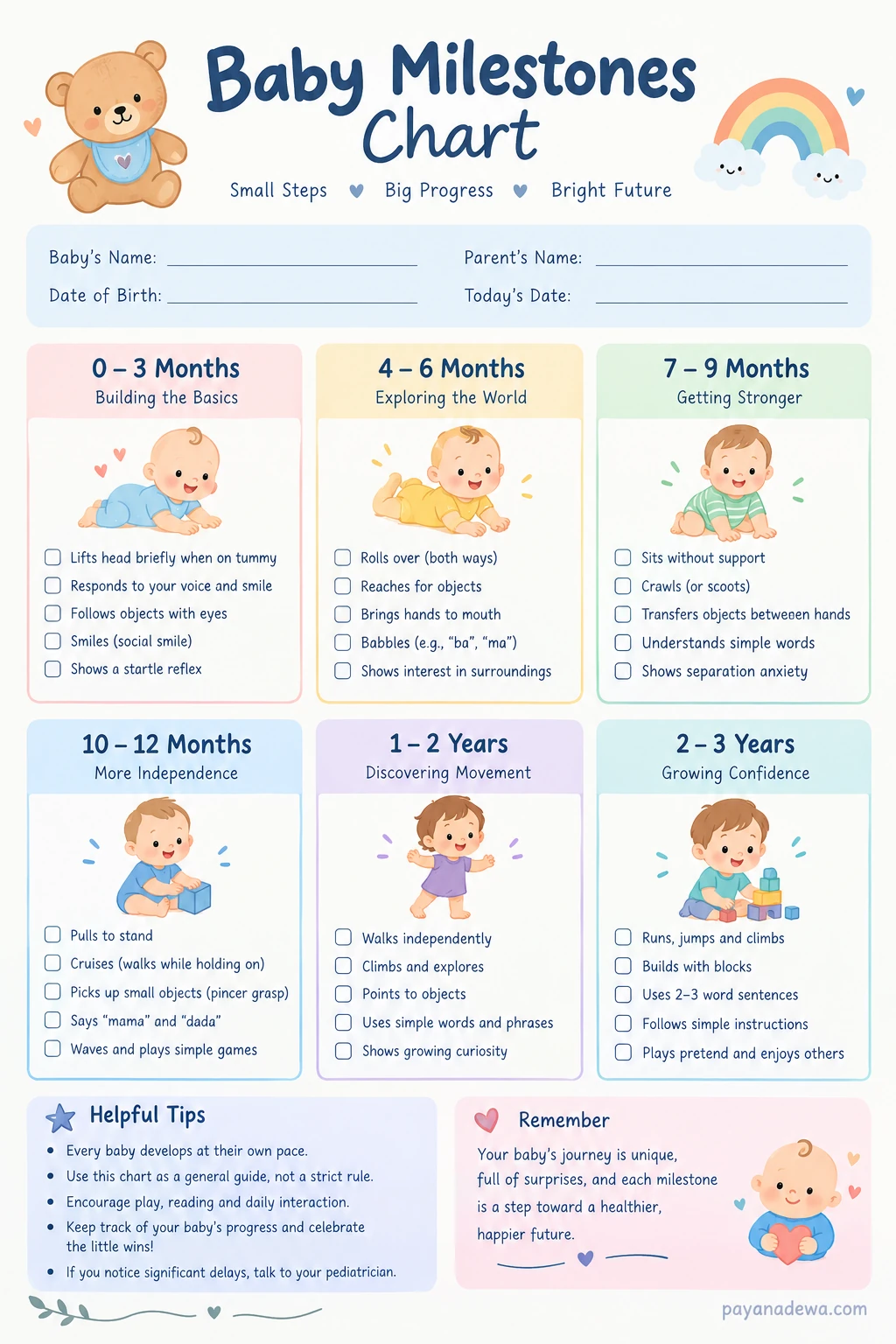
0–3 Months: Building the Basics
During the first three months, babies begin adjusting to their surroundings and building connections with caregivers. Movements may initially appear reflexive, but gradually become more controlled.
- Briefly lifts or holds the head up during supervised tummy time.
- Begins focusing on faces and following nearby objects with the eyes.
- Responds to familiar voices and may calm when hearing a caregiver.
- Develops early social smiles, often around two months.
- Makes small sounds beyond crying.
How to help: Talk, sing, smile, and respond to your baby’s sounds. Offer short, supervised tummy-time sessions while your baby is awake. Always place your baby on their back to sleep.
4–6 Months: Exploring the World
Babies become more curious as their vision, coordination, and interaction skills develop. Many begin reaching for toys and bringing their hands to their mouths.
- Holds the head more steadily.
- Reaches for objects and explores them with the hands and mouth.
- Responds with smiles, laughter, or excited sounds.
- Begins rolling, with the timing and direction varying between babies.
- Recognizes familiar people and shows interest in their surroundings.
How to help: Offer age-appropriate toys within easy reach, talk during everyday activities, and provide safe floor play. Keep small objects and choking hazards away from your baby.
7–9 Months: Getting Stronger
As babies approach the second half of their first year, many develop better balance and coordination. Communication also becomes more expressive, with babbling, gestures, and responses to familiar voices.
- Sits without support, often after practicing with assistance.
- Transfers objects between hands and explores different textures.
- Babbles with repeated sounds such as “ba-ba” or “ma-ma.”
- Responds to their name and familiar voices.
- May show increased caution around unfamiliar people.
How to help: Play simple turn-taking games, read picture books, and let your baby explore safe objects under supervision. Create a safe floor area where movement and exploration are encouraged.
10–12 Months: More Independence
Near the first birthday, many babies become more mobile and purposeful in their movements. Some pull themselves up to stand, move along furniture, or take early steps, while others are still developing the strength and coordination needed for these activities.
- Pulls up to stand using stable support.
- May cruise along furniture or take independent steps.
- Uses the thumb and fingers to pick up small objects.
- Uses gestures such as waving or reaching to communicate.
- Begins understanding familiar words and simple requests.
How to help: Encourage movement in a baby-proofed room, name familiar objects, and respond to pointing and gestures. Avoid using walkers that allow babies to move around on wheels, as they can increase injury risk.
1–2 Years: Discovering Movement and Language
Toddlers increasingly explore their environment, imitate adults, and develop early independence. Walking, climbing, pointing, and using words become important parts of everyday learning.
- Begins walking independently, with timing varying among children.
- Points to interesting objects or items they want.
- Uses familiar words and gradually combines words into short phrases.
- Follows simple instructions as understanding develops.
- Imitates everyday activities, such as feeding a doll or pretending to talk on a phone.
How to help: Read together daily, name objects during routines, encourage safe movement, and let your toddler practice simple tasks. Offer choices, such as selecting between two shirts, to support communication and independence.
2–3 Years: Growing Confidence
Between ages two and three, children’s communication, coordination, and pretend-play skills continue to expand. They often become more interested in other children, although sharing and managing strong emotions may still be challenging.
- Runs, climbs, and develops more coordinated movements.
- Builds towers with blocks and manipulates simple toys.
- Uses increasingly complex phrases and sentences.
- Follows simple instructions appropriate to their understanding.
- Engages in pretend play and gradually develops social play skills.
How to help: Encourage imaginative play, outdoor activity in safe spaces, storytelling, and simple activities such as stacking blocks or sorting large objects. Support emotional development by naming feelings and modeling calm responses.
How to Use a Baby Development Chart Effectively
A milestone checklist works best when it becomes part of your everyday routine rather than a source of pressure. You do not need to test your baby repeatedly or expect every skill to appear exactly when a chart suggests.
1. Record New Skills and Dates
Write down when you first notice a new skill, such as rolling, responding to a name, or using a new word. Brief notes can help you remember changes that might otherwise be difficult to track.
2. Observe Your Baby During Everyday Activities
Watch how your baby moves, communicates, plays, and responds to familiar people. Everyday moments often reveal more about development than formal practice sessions.
3. Look at Overall Progress
Consider your child’s development across different areas instead of focusing on a single skill. A baby may show strong social engagement while still developing particular motor abilities. Your pediatrician can help interpret the overall pattern.
4. Share Your Observations With Your Pediatrician
Bring your completed chart and any questions to routine health visits. Specific examples, dates, and concerns can help your healthcare professional determine whether further screening or assessment would be useful.
Activities That Support Healthy Baby Development
You do not need expensive toys or complicated programs to support your child’s growth. Warm relationships and regular opportunities to explore are valuable throughout infancy and toddlerhood.
- Talk and read every day: Describe what you are doing, name familiar objects, sing songs, and share picture books.
- Provide supervised floor play: Give babies safe opportunities to move, reach, roll, and practice new positions while awake.
- Respond to communication: Answer coos, babbles, gestures, and words to encourage interaction.
- Offer age-appropriate play: Use safe rattles, soft books, stacking toys, and other objects suitable for your child’s abilities.
- Encourage independence: Let toddlers practice simple tasks with appropriate supervision and assistance.
- Maintain healthy routines: Support regular sleep, nutritious age-appropriate feeding, active play, and preventive healthcare.
Always supervise play, follow age recommendations on toys, and keep small objects, loose cords, and other hazards out of reach. Choose activities that suit your child’s current abilities rather than pushing them to perform a skill before they are ready.
When Should You Be Concerned About Developmental Delays?
Children develop at different rates, and one missed milestone does not automatically mean a developmental problem. However, it is important to raise concerns early rather than waiting indefinitely for a skill to appear.
Consider speaking with your child’s pediatrician if your baby:
- Is not showing expected developmental progress for their age.
- Has difficulty with skills involving movement, communication, social interaction, or learning.
- Does not respond consistently to sounds or seems to have difficulty seeing objects.
- Is not using gestures, sounds, or words in ways expected for their developmental stage.
- Loses a skill they previously had, such as words, social responses, or motor abilities.
Loss of previously acquired skills deserves prompt medical evaluation. If you are concerned at any point, contact your child’s healthcare professional instead of waiting for the next milestone on a chart.
Ask about standardized developmental screening at recommended ages and whenever concerns arise. In the United States, the American Academy of Pediatrics recommends general developmental screening at 9, 18, and 30 months, with autism-specific screening at 18 and 24 months. Recommendations and available services may differ by country.
A milestone chart is an educational aid, not a diagnostic tool. Your healthcare professional can consider your child’s medical history, observations, hearing, vision, and other developmental factors when deciding whether additional evaluation is needed.
Tips for Creating a Printable Baby Milestones Chart
A printable chart can make it easier to record progress and keep important observations organized. For the best results, choose a layout that is easy to read and update.
- Choose clear age ranges: Organize milestones into manageable stages from early infancy through toddlerhood.
- Use simple checkboxes: Leave space to mark skills as they emerge.
- Add important dates: Include your baby’s name, date of birth, and observation dates.
- Keep notes flexible: Allow space for comments, questions, and individual differences.
- Use readable colors and fonts: Make the chart comfortable to read on screens and when printed.
- Review it regularly: Update the chart before pediatric appointments or whenever you notice meaningful changes.
Remember that a printable baby development checklist should support observation, not create anxiety. Adapt it to your family’s needs, and use trusted medical guidance when interpreting milestones.
Frequently Asked Questions About Baby Milestones Charts
What are the most important baby milestones to track?
Focus on major developments in movement, communication, thinking, and social interaction. Examples include head control, rolling, sitting, gestures, first words, walking, and pretend play. The most relevant milestones depend on your child’s age.
Do all babies reach milestones at the same age?
No. Development varies from child to child. Milestone ages provide general guidance, not exact deadlines. Premature babies may need their milestones considered using corrected age during early childhood, as advised by their healthcare professional.
Can I use a baby milestones chart to diagnose a delay?
No. A chart can help you notice patterns and prepare questions, but it cannot diagnose a developmental delay. A qualified healthcare professional can recommend appropriate screening and evaluation.
How often should I update my baby’s milestone chart?
You can update it whenever you observe a new skill or review it weekly or monthly. There is no need to check every item daily. Bring relevant notes to routine healthcare visits.
Where can I find reliable developmental milestone information?
Look for guidance from recognized public health organizations and pediatric professionals. In the United States, the Centers for Disease Control and Prevention (CDC) provides age-based developmental milestone checklists and guidance for discussing concerns with a healthcare professional.
Conclusion
A Baby Milestones Chart is a practical way to celebrate your child’s growth and organize observations from birth through the toddler years. By following common developmental stages, providing opportunities for safe play, and encouraging communication, you can support your baby’s learning and independence.
Most importantly, remember that every child has an individual developmental journey. Use your chart as a helpful reference rather than a competition or a rigid checklist. If you notice a delay, have questions, or see your child lose a previously acquired skill, speak with a healthcare professional promptly.
Celebrate the small steps, record the memorable moments, and enjoy watching your baby discover the world one milestone at a time.