A successful business project starts with a clear understanding of what the organization wants to achieve. Without defined goals, agreed expectations, and documented requirements, even a well-funded project can face delays, unnecessary costs, and disappointing results. A Business Requirements Document (BRD) helps prevent these problems by providing a shared understanding of the project’s purpose, scope, and expected business outcomes.
Whether you are launching new software, improving an existing business process, or implementing a digital transformation initiative, a well-prepared BRD keeps stakeholders aligned from the beginning. It also gives project managers, business analysts, developers, and decision-makers a reliable reference throughout the project lifecycle.
In this guide, you will learn what a Business Requirements Document is, why it matters, which sections to include, and how to create one effectively. You can also use the Business Requirements Document template to organize your project information and start documenting your requirements with confidence.
What Is a Business Requirements Document?
A Business Requirements Document is a formal document that describes the business needs, objectives, scope, and expected outcomes of a project. It explains why a project is necessary and what the organization expects to accomplish.
A BRD typically identifies the business problem, project stakeholders, functional and non-functional requirements, assumptions, constraints, and success criteria. These details help everyone understand the project’s purpose before significant time and resources are committed.
For example, a company planning to introduce an online ordering system might use a BRD to explain the need to reduce manual order processing, improve customer satisfaction, and increase operational efficiency. The document would outline the business expectations without necessarily specifying every technical detail of the software solution.
Although a BRD can include detailed requirements, it primarily focuses on what the business needs and why those needs matter, rather than prescribing exactly how the technical team must build the solution.
Why Is a Business Requirements Document Important?
A clear BRD provides structure and direction before a project moves into design, development, or implementation. It also reduces misunderstandings between business stakeholders and technical teams.
1. Aligns Stakeholders
Different stakeholders often have different expectations. A BRD brings those expectations together in one document, helping business leaders, project managers, users, and technical specialists agree on the desired outcomes.
2. Defines Project Scope
Clearly documenting what is included and excluded helps prevent scope creep. As a result, the team can evaluate new requests against the original objectives before approving additional work.
3. Improves Planning and Budgeting
When requirements are understood early, project teams can estimate costs, identify resource needs, assess risks, and establish a more realistic timeline.
4. Supports Better Decision-Making
A BRD provides a reference for evaluating proposed solutions. Decision-makers can compare alternatives against business objectives instead of relying on assumptions or personal preferences.
5. Creates a Shared Reference
Throughout the project, the document helps teams resolve questions, validate changes, and confirm that the final deliverable addresses the original business needs.
What Should a Business Requirements Document Include?
The structure of a BRD depends on the project’s size, complexity, and industry. However, most effective documents include the following sections.
1. Project Overview
Begin with a brief explanation of the project. Include the project name, background, business problem, purpose, and a summary of the proposed initiative. This section gives readers the context they need before reviewing detailed requirements.
2. Business Objectives
Describe the results the organization wants to achieve. Whenever possible, use measurable objectives rather than vague statements.
- Reduce manual processing time by 30% within six months.
- Improve customer satisfaction scores by 15%.
- Reduce data entry errors by 25%.
- Increase online sales conversion rates by 10%.
These examples provide a clearer direction because the team can measure progress against specific targets.
3. Project Scope
Define the project’s boundaries by identifying the activities, processes, departments, or systems covered by the initiative. Also, document what is explicitly excluded.
A clearly defined scope helps stakeholders understand the limits of the project and reduces the risk of unexpected requirements appearing later.
4. Stakeholders and Responsibilities
List the people or groups who influence the project or will be affected by its outcome. Common stakeholders include the project sponsor, business analyst, project manager, department heads, end users, and technical team.
Record their responsibilities, decision-making authority, and approval requirements. This makes communication more efficient and helps prevent delays caused by unclear ownership.
5. Functional Requirements
Functional requirements describe the capabilities or activities the solution must support to satisfy business needs. They should be specific enough to understand and verify.
For an inventory management system, functional requirements might include tracking stock levels, recording incoming shipments, generating low-stock alerts, and producing inventory reports.
Number each requirement and assign a priority, such as high, medium, or low. This helps the team determine which capabilities are essential for project success.
6. Non-Functional Requirements
Non-functional requirements describe the quality, performance, security, and operational characteristics expected from the solution. They complement functional requirements by defining how well the solution should perform.
- Performance: Pages should load within an agreed response time under normal operating conditions.
- Security: Sensitive information must be protected through appropriate access controls.
- Usability: Users should be able to complete key tasks with minimal training.
- Scalability: The system should support expected increases in users or transaction volume.
- Compliance: The solution must meet applicable legal, regulatory, and industry requirements.
Where possible, include measurable acceptance thresholds instead of relying on general terms such as fast, secure, or user-friendly.
7. Assumptions and Constraints
Assumptions are conditions the team expects to be true, while constraints are limitations that affect project execution. Examples include a fixed budget, a mandatory launch date, limited staff availability, or dependence on an existing software platform.
Documenting these factors early helps the team identify potential risks and prepare realistic plans.
8. Risks and Dependencies
Identify factors that could prevent the project from achieving its objectives. These may include supplier delays, data migration issues, integration challenges, or changing business priorities.
Also, document dependencies on other projects, systems, teams, or external vendors. Assign owners to significant risks and outline appropriate mitigation measures.
9. Success Criteria and Approval
Explain how the organization will determine whether the project has achieved its intended outcomes. Success criteria should connect directly to the business objectives and include measurable indicators wherever practical.
Finally, provide an approval section for the relevant stakeholders. Formal sign-off confirms that authorized representatives have reviewed the requirements and agreed on the documented baseline.
Business Requirements Document Template
Using a structured template makes it easier to prepare a consistent and professional BRD. Rather than starting with a blank page, you can follow predefined sections and focus on collecting accurate project information.
The template below is designed to organize project details, business objectives, functional requirements, non-functional requirements, constraints, assumptions, and approvals in a clean, printable format.
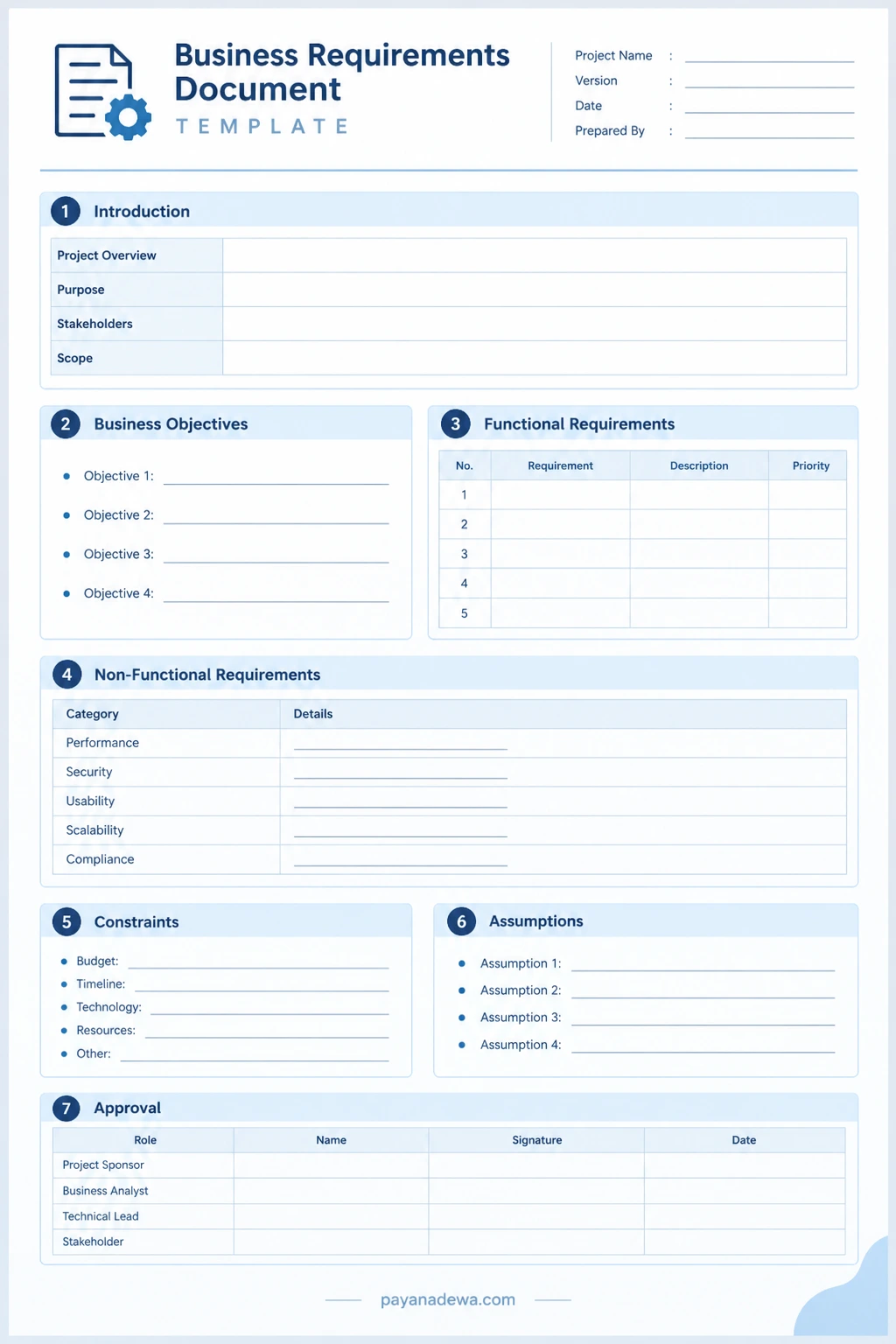
To use the template effectively, complete the project overview first, then work with stakeholders to define objectives and requirements. Review each section for accuracy before submitting the document for approval.
How to Create a Business Requirements Document Step by Step
Step 1: Identify the Business Problem
Start by understanding the problem or opportunity that justifies the project. Gather relevant information from stakeholders, existing reports, customer feedback, and current business processes.
Step 2: Interview Key Stakeholders
Ask targeted questions about business needs, current challenges, expected outcomes, and operational limitations. Workshops, interviews, and process reviews can help uncover requirements that may otherwise be overlooked.
Step 3: Define Measurable Objectives
Translate business needs into clear objectives. Establish baseline measurements and target outcomes so that the team can evaluate success after implementation.
Step 4: Document and Prioritize Requirements
Record each requirement in clear, unambiguous language. Assign unique identifiers and priorities, and distinguish essential requirements from desirable enhancements. Where useful, include acceptance criteria to explain how a requirement will be verified.
Step 5: Review Scope, Risks, and Dependencies
Confirm the project boundaries and identify assumptions, constraints, risks, and external dependencies. Check that the requirements are realistic given the available budget, schedule, and resources.
Step 6: Validate and Obtain Approval
Share the draft with relevant stakeholders and resolve conflicting expectations. Once the requirements are reviewed and agreed upon, obtain formal approval and establish a process for managing future changes.
Best Practices for Writing an Effective BRD
A useful Business Requirements Document should be easy to understand, practical to maintain, and detailed enough to guide decisions. Follow these best practices to improve its quality.
- Use clear language. Avoid unnecessary jargon, vague descriptions, and overly complicated sentences.
- Keep requirements testable. Define observable outcomes or measurable criteria wherever possible.
- Involve the right stakeholders. Include people who understand the business process and those responsible for approving the outcome.
- Maintain traceability. Connect requirements to business objectives and, where appropriate, to test cases or acceptance criteria.
- Control document changes. Record revisions, dates, owners, and approval status to avoid confusion between versions.
- Focus on business value. Prioritize requirements according to their contribution to the organization’s goals.
- Review the document regularly. Update the BRD when approved changes affect scope, priorities, or expected outcomes.
Remember that a longer document is not automatically a better document. The goal is to provide enough detail for informed decisions without overwhelming readers with irrelevant information.
Business Requirements Document vs. Functional Requirements Document
A Business Requirements Document and a Functional Requirements Document serve related but different purposes. Understanding the distinction helps teams choose the right level of detail for each stage of a project.
A BRD focuses on business needs, objectives, scope, and expected outcomes. A Functional Requirements Document (FRD), by comparison, typically explains the system behaviors and capabilities needed to satisfy those requirements.
For example, a BRD might state that a business needs to reduce order processing time. An FRD could describe the required order validation, status updates, and automated notifications that support that objective.
In some organizations, these documents are combined or replaced by other requirements-management formats. The best approach depends on the project’s methodology, governance requirements, and stakeholder needs.
Common Mistakes to Avoid
Even a well-structured BRD can become ineffective when important information is missing or unclear. Watch out for these common mistakes:
- Writing objectives that cannot be measured or evaluated.
- Leaving project scope open to interpretation.
- Recording solutions before understanding the underlying business problem.
- Ignoring non-functional requirements, risks, or dependencies.
- Failing to involve stakeholders who must approve or use the solution.
- Allowing changes without documenting their impact or approval.
To avoid these problems, review the document from both business and implementation perspectives. Ask whether each requirement is understandable, relevant, achievable, and connected to an identified business need.
Conclusion
A Business Requirements Document provides a practical foundation for successful project planning and execution. By documenting business objectives, scope, stakeholder expectations, functional and non-functional requirements, constraints, and success criteria, organizations can reduce misunderstandings and make better decisions.
Creating an effective BRD does not have to be complicated. Start by identifying the business problem, collaborate with the right stakeholders, write clear and measurable requirements, and obtain approval before moving forward.
Use the Business Requirements Document template to organize your information and build a consistent starting point for your next project. With a clear understanding of what the business needs and why it matters, your team will be better prepared to deliver meaningful, measurable results.