Creating a professional business quotation does not have to be complicated. With the right structure, clear pricing, and transparent terms, you can prepare a document that makes your offer easier to understand and helps customers make confident purchasing decisions.
In this guide, you will learn what a business quotation is, what information to include, how to create one, and how to avoid common mistakes. You will also discover practical tips for preparing a business quotation template that you can adapt to your company’s needs.
What Is a Business Quotation?
A business quotation is a formal document that outlines the estimated or agreed price of products, services, or a specific project offered to a potential customer. It usually includes a description of the work, quantities, unit prices, total costs, payment terms, and the period during which the offer remains valid.
Businesses commonly prepare quotations before a customer places an order or agrees to a project. The document allows both parties to review the proposed costs and expectations before moving forward.
For example, a web design agency might send a quotation that lists website development, domain registration, hosting, and maintenance services. A construction company might provide a quotation covering materials, labor, equipment, and project completion estimates.
A business quotation is more than a list of prices. It is also a communication tool that demonstrates professionalism, clarifies expectations, and reduces the risk of misunderstandings.
Why Is a Business Quotation Important?
A clear quotation can improve the customer experience and make your sales process more organized. It gives potential customers the information they need to compare options and evaluate your proposal.
1. Builds Customer Trust
Transparent pricing helps customers understand what they are paying for. When your quotation includes detailed descriptions, clear calculations, and relevant terms, your business appears more reliable and organized.
2. Prevents Pricing Disputes
Written quotations document the proposed scope of work and its associated costs. This makes it easier to identify what is included in the offer and which services may require additional payment.
3. Improves Business Efficiency
A reusable quotation template allows you to prepare proposals more quickly. Instead of creating every document from scratch, you can update customer details, item descriptions, prices, and terms as needed.
4. Supports Sales and Negotiations
A professional quotation gives customers a clear basis for discussing budgets, delivery schedules, and service options. It also helps your team track opportunities and follow up with prospective buyers.
What Should a Business Quotation Include?
A professional business quotation should contain enough information for the customer to understand the offer without needing to ask basic questions. Although the exact format depends on your industry, most quotations include the following elements.
- Business information: Include your company name, business address, phone number, email address, and website where appropriate.
- Quotation number: Assign a unique reference number to help identify and track the document.
- Issue date: State the date the quotation was prepared.
- Validity period: Specify the date until which the quoted prices and terms remain valid.
- Customer details: Include the customer’s name, company, address, and contact information when relevant.
- Product or service descriptions: Explain each item, deliverable, or task included in the proposal.
- Quantity and unit price: Show the quantity of each item and its corresponding price.
- Cost breakdown: Calculate subtotals, applicable discounts, taxes, additional fees, and the final total.
- Payment terms: Explain deposit requirements, payment deadlines, accepted methods, and any installment arrangements.
- Delivery or completion details: Provide estimated delivery dates, project milestones, or service schedules when applicable.
- Terms and conditions: Explain exclusions, revisions, cancellation rules, warranties, and other relevant conditions.
- Approval section: Include a space for the customer’s signature or another suitable method of acceptance if needed.
Keep the layout organized and easy to read. Use clear headings, consistent formatting, and a logical order so customers can find important details quickly.
How to Create a Business Quotation Step by Step
Preparing a business quotation becomes easier when you follow a consistent process. Use these steps to create an accurate, professional document.
Step 1: Understand the Customer’s Requirements
Before calculating prices, clarify what the customer needs. Ask about the project scope, quantities, preferred specifications, deadlines, and any special requirements. Missing information can lead to inaccurate estimates or unexpected costs later.
Step 2: Calculate Your Costs
Identify all costs associated with delivering the product or service. Depending on your business, these may include materials, labor, transportation, software, subcontractors, and administrative expenses.
Set a price that covers your expected costs and desired profit margin. Review the calculations carefully before sending the quotation.
Step 3: Describe Each Item Clearly
Avoid vague descriptions such as “design service” or “maintenance package.” Instead, explain the specific deliverables, quantities, service duration, or included features. Detailed descriptions help customers understand the value of your offer.
Step 4: Prepare the Price Breakdown
List each product or service with its quantity and unit price. Multiply the quantity by the unit price to calculate the line total, then add all line totals to determine the subtotal.
Apply discounts, taxes, and additional charges where appropriate. Make sure the final amount is mathematically correct and that the currency is clearly identified.
Step 5: Add Payment Terms and Conditions
Specify when payment is due, whether a deposit is required, and what happens if the project scope changes. State the quotation’s expiration date and identify any items that are excluded from the proposed price.
Step 6: Review and Send the Document
Check the spelling of names, contact information, item descriptions, calculations, and dates. Save the quotation in a convenient format, such as PDF, and send it through the customer’s preferred communication channel.
Keep a copy for your records so you can follow up, revise the proposal, or refer to the original terms later.
Business Quotation Example
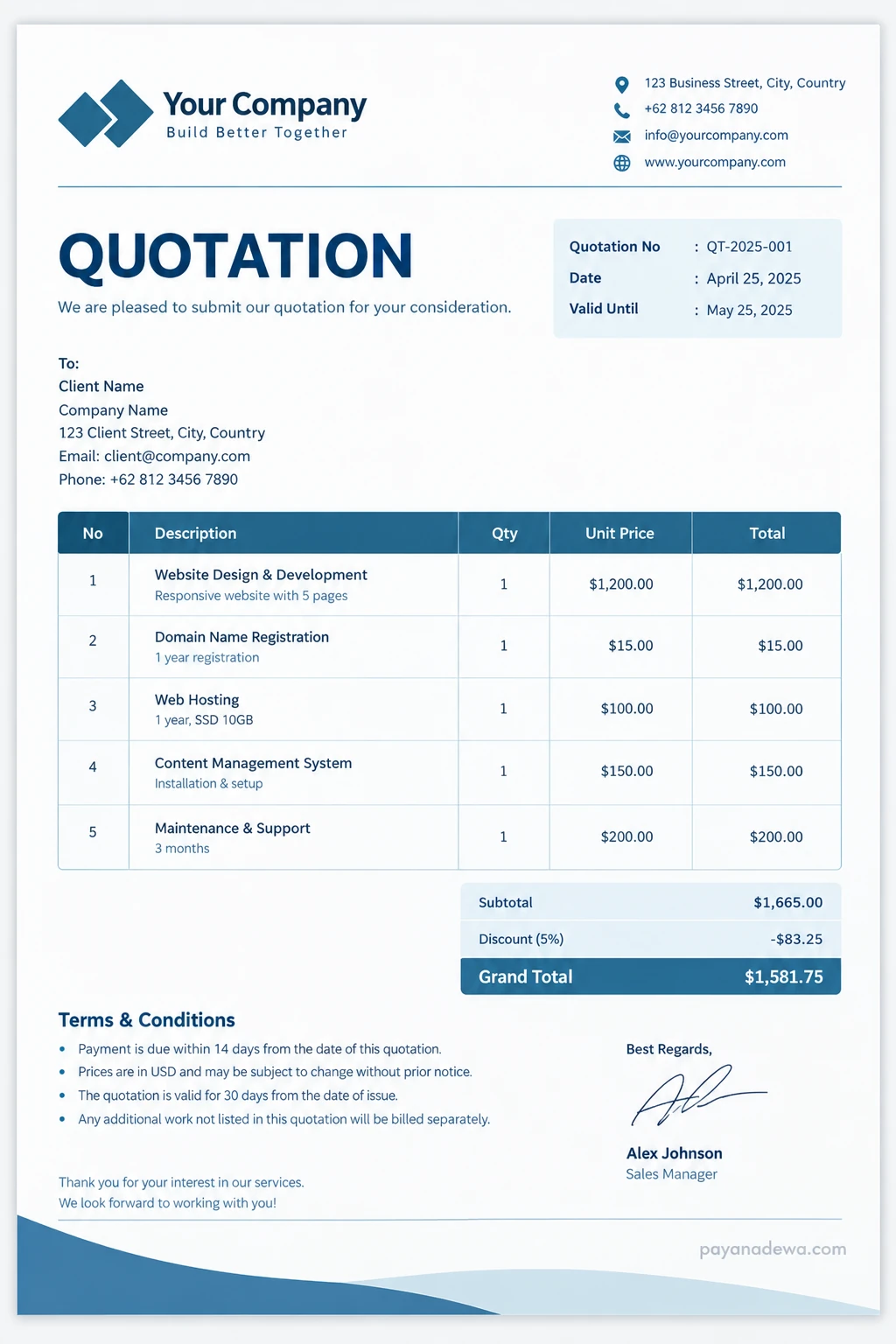
The following example shows how a quotation might be structured for a small web development project. The figures are illustrative and should be adjusted to match your actual services and pricing.
- Website design and development: 1 project at $1,200.00 = $1,200.00
- Domain registration: 1 year at $15.00 = $15.00
- Web hosting: 1 year at $100.00 = $100.00
- Content management system setup: 1 service at $150.00 = $150.00
- Maintenance and support: 1 package at $200.00 = $200.00
Subtotal: $1,665.00
Discount (5%): $83.25
Total after discount: $1,581.75, before any applicable taxes or additional charges.
This example illustrates the importance of transparent calculations. In an actual quotation, specify whether taxes are included and ensure the payment terms, project scope, and validity period are clearly stated.
A structured business quotation template makes it easier to present this information consistently. It also helps customers compare individual costs rather than relying on a single unexplained total.
Business Quotation vs Invoice: What Is the Difference?
A business quotation and an invoice serve different purposes, even though both documents contain pricing information.
A business quotation presents a proposed price and the conditions under which a business is willing to supply products or services. It is generally issued before the customer commits to the purchase or project.
An invoice requests payment for products or services supplied, or according to an agreed billing schedule. It typically includes an invoice number, the amount due, payment instructions, and a payment deadline.
For example, a freelancer might send a quotation before starting a design project. Once the customer accepts the proposal, the freelancer can proceed under the agreed terms and issue an invoice according to the payment arrangement.
In short, a quotation proposes the price, while an invoice requests payment. The precise legal and accounting treatment of these documents depends on the transaction and the applicable rules in your jurisdiction.
Common Business Quotation Mistakes to Avoid
Even a well-designed quotation can create problems if important details are missing. Avoid these common mistakes when preparing your document.
- Using unclear descriptions: Explain exactly what the customer receives rather than relying on broad service names.
- Making calculation errors: Verify quantities, unit prices, discounts, taxes, and totals before sending the quotation.
- Forgetting the validity date: Set a reasonable expiration period so customers know how long the offer applies.
- Leaving out additional costs: Disclose relevant delivery charges, optional services, and other fees before the customer accepts.
- Using complicated language: Write in plain English and avoid unnecessary jargon.
- Failing to define the scope: Identify exclusions and explain how changes to the original request will be handled.
- Ignoring follow-up: Contact the customer politely after sending the quotation to answer questions and understand their decision.
Addressing these issues helps you produce quotations that are easier to understand and more useful during the sales process.
Tips for Creating a Professional Business Quotation Template
A good quotation template should be practical, consistent, and easy to customize. Consider the following tips when designing your own document.
- Use consistent branding: Add your company logo, brand colors, and contact details to make the document recognizable.
- Prioritize readability: Choose legible fonts, adequate spacing, and clear section headings.
- Make pricing easy to scan: Use a structured table for descriptions, quantities, unit prices, and line totals.
- Highlight the final price: Make the grand total easy to locate without overwhelming the rest of the page.
- Standardize your terms: Create reusable wording for payment conditions, validity periods, and project exclusions, then adapt it when necessary.
- Keep a quotation register: Track reference numbers, customers, issue dates, expiration dates, and proposal status.
- Use a suitable file format: PDF is often convenient for sending a quotation because it preserves the document’s layout across devices.
- Protect customer information: Share quotations only with the intended recipients and store copies securely.
For recurring work, consider creating different quotation templates for products, consulting, construction, digital services, or other activities. Tailored templates help ensure that each quotation includes the information relevant to the specific transaction.
Frequently Asked Questions About Business Quotations
Is a business quotation legally binding?
It depends on the wording, the circumstances, whether the offer has been accepted, and the applicable law. A quotation may form part of a binding agreement when the relevant legal requirements are met. Clearly state your terms and seek qualified legal advice when necessary.
How long should a business quotation remain valid?
There is no universal validity period. Some businesses use 7, 14, or 30 days, while others choose a different period based on price volatility, supplier conditions, and project requirements. Always specify the exact expiration date.
Can I create a business quotation in Excel or Word?
Yes. Microsoft Excel is useful for automated calculations, while Microsoft Word is convenient for formatted documents. You can also use Google Docs, Google Sheets, or dedicated quotation software. Choose a tool that supports your workflow and allows you to produce clear, accurate documents.
Should I include tax in a business quotation?
Include the applicable tax information required for your transaction and jurisdiction. Clearly distinguish the subtotal, taxes, other charges, and final amount payable. If a tax treatment is uncertain, confirm the requirements with a qualified accountant or relevant tax authority.
What should I do after sending a quotation?
Confirm that the customer received the document, offer to clarify any questions, and follow up at an appropriate time. If the customer requests changes, issue a revised quotation with a clear reference or version number to avoid confusion.
Conclusion
A professional business quotation helps companies communicate prices, define project expectations, and build stronger relationships with potential customers. By including accurate pricing, detailed descriptions, clear payment terms, and a reasonable validity period, you can make your proposals easier to understand and evaluate.
Use a reusable business quotation template to save time, maintain consistent branding, and reduce administrative errors. Before sending each document, review the calculations and confirm that the proposed scope matches the customer’s requirements.
Whether you operate a small business, freelance independently, or manage a larger company, a well-organized quotation is a practical tool for presenting your offer professionally and moving potential customers toward an informed purchasing decision.