A well-prepared catering business plan turns your food business idea into a practical roadmap. It helps you define the customers you want to serve, choose the right services, estimate startup costs, and build a reliable path toward profitability. Whether you plan to cater weddings, corporate lunches, private parties, or community events, a written plan helps you make decisions with greater confidence.
Fortunately, your first plan does not need to be complicated. Start with clear goals, realistic numbers, and a strong understanding of your local market. Then review and update the plan as you learn from customers and actual sales. The sections below explain what to include and how to make each part useful.
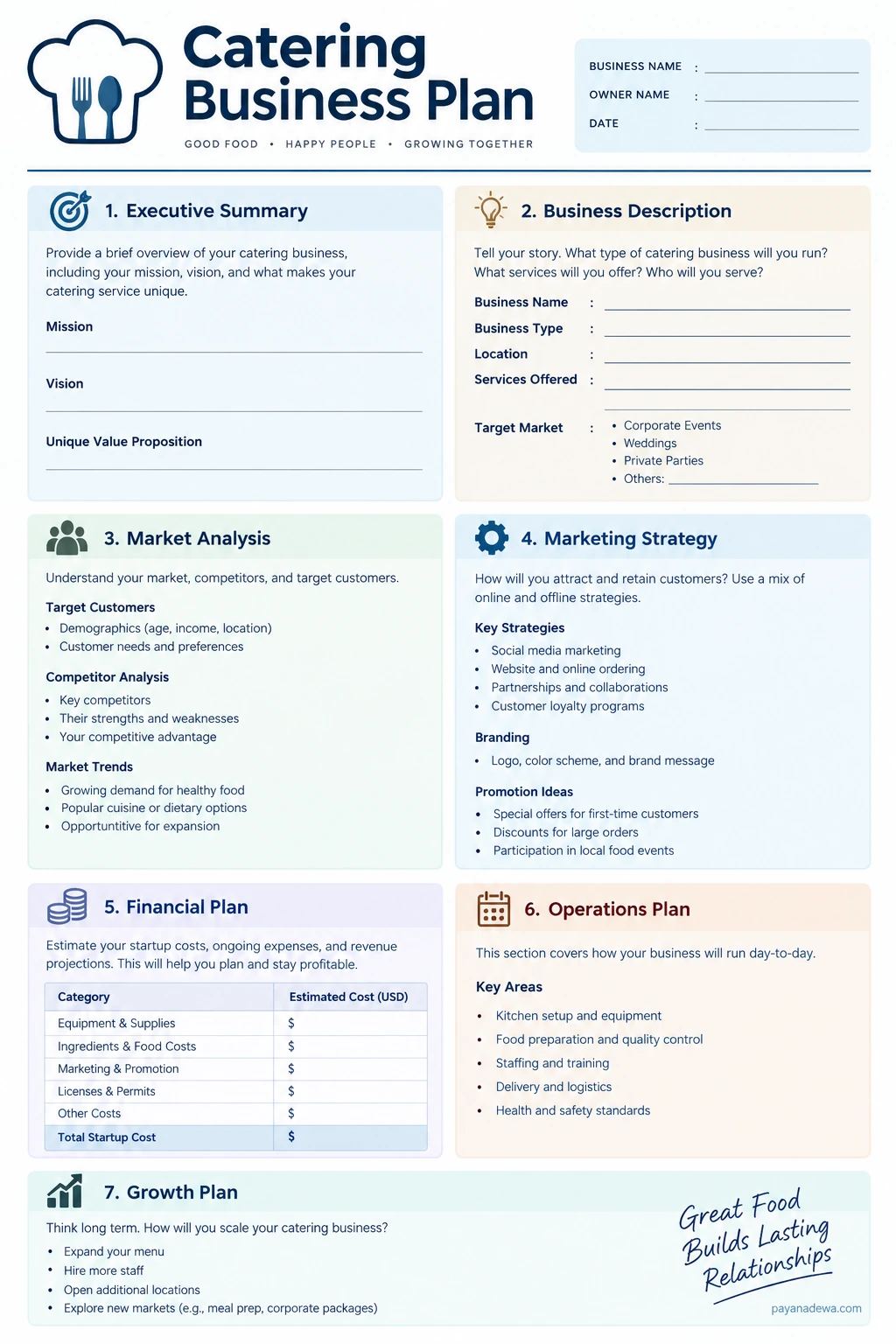
1. Write an Executive Summary
The executive summary introduces your catering company and highlights the most important points in your plan. Although it appears first, it is often easier to write this section after you have completed the other sections.
Keep it concise and explain:
- Business concept: What kind of catering company are you building?
- Target customers: Who is most likely to book your services?
- Service area: Which towns, neighborhoods, or venues will you cover?
- Competitive advantage: What makes your food, service, or customer experience distinctive?
- Financial goals: What sales, profit, or booking milestones do you want to reach?
For example, your company might specialize in fresh, seasonal lunch catering for small offices and training events. A focused description makes it easier for potential partners, lenders, and customers to understand what you offer. Avoid promising results you cannot support; use measurable goals and review them regularly.
2. Describe Your Catering Business
This section explains how the business will operate and what customers can expect. Choose a business model that fits your experience, budget, equipment, and available time. You can expand later once demand and cash flow support growth.
Choose Your Catering Niche
Catering covers several markets, and each has different service needs. Common options include:
- Wedding catering: Multi-course meals, receptions, tastings, and coordinated service.
- Corporate catering: Office lunches, meetings, conferences, and recurring meal orders.
- Private events: Birthdays, anniversaries, family gatherings, and celebrations.
- Specialty catering: Plant-based menus, regional cuisine, dietary-conscious meals, or themed menus.
- Drop-off catering: Prepared food delivered in trays or individual portions, often with fewer staffing needs.
Next, define the services you will provide. Will you deliver food only, supply servers, rent tableware, manage setup, or offer full event coordination? Clear service boundaries help prevent misunderstandings and make pricing easier.
Set Your Mission and Value Proposition
Your mission describes the purpose of the business. Your value proposition explains why customers should choose you instead of another caterer. You might focus on dependable delivery, flexible menus, locally sourced ingredients, polished presentation, or transparent packages. Support each promise with a process your team can consistently deliver.
3. Research Your Market and Competitors
Market research helps you understand who buys catering, what they value, and how much competition exists in your service area. Begin with practical, low-cost research before committing to major equipment or a large kitchen lease.
Identify Your Ideal Customer
Create a simple profile of your most promising customer. Consider event type, guest count, budget, location, dietary needs, booking lead time, and preferred service style. For example, a small business arranging monthly team lunches has different priorities from a couple planning a formal wedding reception.
Speak with potential customers, review local event listings, and ask venues what clients commonly request. These conversations can reveal useful opportunities, such as reliable breakfast catering or clearly labeled meals for common dietary requirements.
Evaluate Local Competitors
Compare several catering businesses on menu range, package prices, service area, online reviews, presentation, and booking process. Look for patterns rather than copying another company’s offer. If competitors have long lead times or unclear packages, you may be able to stand out through responsive communication and simple, transparent quotes.
Use your research to define a realistic market position. You do not need to be the cheapest provider. Instead, explain the value behind your price, whether that means consistent quality, convenient ordering, specialized menus, or attentive event service.
4. Build a Menu and Pricing Strategy
Your menu should reflect your niche, kitchen capacity, ingredient availability, and customer budget. Begin with a manageable selection of dishes that can be prepared consistently at the expected volume. A smaller, well-tested menu is often easier to cost and deliver than a long menu with many special ingredients.
Calculate the True Cost of Each Menu
Include more than the cost of ingredients. Estimate packaging, preparation labor, delivery, kitchen use, equipment wear, payment processing, and a fair share of overhead. For staffed events, account for setup, service, and cleanup time as well.
Then set prices that cover those costs and contribute to profit. A useful starting calculation is:
Estimated event profit = event revenue − direct event costs − allocated overhead.
For instance, if a booking brings in $1,200, list the food, labor, transport, rentals, and other event-specific expenses before estimating the amount left over. Treat any example figures as planning estimates, not guaranteed industry benchmarks. Update your calculations using supplier quotes and actual results.
Create Clear Packages
Offer packages that make it easy to compare options. You might provide a basic drop-off menu, a staffed buffet, and a premium event package. State what each package includes, the minimum guest count, delivery fees, service duration, and any optional extras. Also explain how substitutions, cancellations, deposits, and final guest counts are handled.
5. Prepare a Financial Plan
A financial plan shows how much money you need to start, what it costs to operate, and how the business can earn a profit. Use conservative estimates and revisit them as you receive real quotes and customer orders.
Estimate Startup Costs
Depending on your model, initial expenses may include:
- Kitchen rental, deposits, or approved kitchen upgrades.
- Cooking equipment, utensils, storage, and temperature-control supplies.
- Initial ingredients, packaging, and serving materials.
- Licenses, permits, insurance, and professional advice.
- Website, branding, photography, and launch marketing.
- Transportation, delivery containers, and fuel.
- Working capital for wages, utilities, and bills before revenue becomes steady.
Separate one-time startup expenses from recurring monthly costs. Get written estimates where possible and include a contingency for unexpected costs. Before preparing or selling food, confirm the food-safety, business registration, insurance, and permit requirements that apply in your location.
Forecast Revenue and Cash Flow
Build a monthly forecast using realistic assumptions about the number of bookings, average order value, seasonal demand, and available production capacity. Include quiet periods as well as busy months. Cash flow matters because you may need to pay suppliers and staff before receiving the final payment from a client.
Track revenue, food cost, labor, overhead, outstanding invoices, and cash on hand. Review the figures at least monthly. If costs rise or bookings fall short, adjust your menu, package prices, marketing, or spending before the problem becomes urgent.
6. Plan Your Marketing and Sales
A strong catering marketing strategy makes it easy for potential customers to discover your business, trust your work, and request a quote. Focus on the channels your target customers actually use rather than trying to be everywhere at once.
- Build a clear website: Show menus, service areas, sample packages, event photos, FAQs, and a simple inquiry form.
- Use local SEO: Include relevant phrases such as “corporate catering in [city]” naturally on suitable pages, and keep your business details consistent.
- Share useful social content: Post menu previews, preparation highlights, event setups, and seasonal offerings with permission from clients.
- Develop partnerships: Connect with venues, event planners, offices, community organizations, and rental providers.
- Request reviews: After successful events, invite customers to share honest feedback.
- Follow up professionally: Respond to inquiries promptly and make quotes easy to understand.
Measure results instead of relying on likes alone. Track where inquiries originate, how many become bookings, the average booking value, and repeat-customer rates. Over time, invest more effort in the channels that produce profitable customers.
7. Define Operations and Food Safety Procedures
Excellent food is only one part of a successful catering business. Customers also expect punctual delivery, safe food handling, accurate orders, and calm coordination. Write down your core processes so service quality does not depend on memory alone.
Map the Event Workflow
Create a repeatable workflow that covers inquiry, quote, contract, deposit, menu confirmation, purchasing, preparation, packing, transport, setup, service, cleanup, and final payment. Use a checklist for each booking and confirm important details with the client before the event.
Plan Staff, Equipment, and Compliance
Estimate staffing needs based on guest count, menu complexity, venue access, and service style. Train staff on responsibilities, hygiene, allergen communication, and customer service. Maintain equipment and keep backup supplies for common problems.
Food safety must be built into daily operations. Follow the applicable rules for approved preparation facilities, safe storage and transport temperatures, sanitation, allergen handling, and recordkeeping. Requirements vary by location, so verify them with the relevant local authorities before launch.
8. Set Goals and Plan for Growth
Choose a small set of measurable goals for the first year. Examples include reaching a target number of monthly bookings, improving quote-to-booking conversion, increasing repeat orders, reducing food waste, or building a certain number of venue partnerships. Give each goal a deadline and review progress regularly.
Grow only when your systems can support more work. Before adding a new menu line, buying a delivery vehicle, or hiring a larger team, check demand, cash flow, production capacity, and expected profit. Small experiments—such as a seasonal menu or a pilot corporate lunch package—can help you test demand without taking on unnecessary risk.
Common Catering Business Plan Mistakes to Avoid
- Underpricing: Forgetting labor, delivery, waste, and overhead can make busy events unprofitable.
- Serving everyone: An overly broad offer can make your marketing less clear and your operations harder to manage.
- Ignoring cash flow: Profitable bookings do not automatically mean cash is available when bills are due.
- Overlooking compliance: Confirm local food business rules, permits, insurance, and facility requirements early.
- Skipping follow-up: A clear post-event process can help turn a one-time customer into a repeat client.
Conclusion
A useful catering business plan connects your menu, target market, pricing, finances, marketing, and daily operations into one practical strategy. Start with a focused service offering, research local demand, cost every menu carefully, and establish safe, repeatable workflows. Then measure results and update your assumptions as the business grows.
Use the printable template alongside this guide to organize your first draft. A realistic plan will not remove every risk, but it can help you make better decisions, communicate your value, and build a catering company that serves customers well while working toward sustainable profit.