A successful farm begins with more than fertile soil and a good harvest. It needs a clear business strategy, realistic financial estimates, and an understanding of the customers who will buy its products. A well-prepared farming business plan helps turn an agricultural idea into an organized, sustainable business. It can also help you identify risks, estimate startup costs, and explain your goals to lenders, investors, partners, or grant providers.
Whether you plan to grow vegetables, raise livestock, operate an orchard, or combine several agricultural activities, this guide explains how to build a practical farm business plan. Use the sections below as a checklist, adapt them to your operation, and update the plan as your farm grows.
What Is a Farming Business Plan?
A farming business plan is a written document describing what your farm will produce, who will buy it, how daily operations will work, and how the business will earn enough money to remain viable. It connects your production goals with market demand and financial planning.
The plan does not need to be complicated to be useful. A small family farm may need a concise document with a budget and seasonal production schedule, while a larger commercial operation may require detailed cash-flow forecasts, staffing plans, and financing projections.
1. Write an Executive Summary
The executive summary introduces your farm and highlights the most important parts of your plan. Although it appears first, it is often easiest to write after completing the other sections.
Include the farm name, location, business structure, main products, target customers, key goals, and a brief summary of expected funding needs. Explain what makes your business distinctive, such as locally grown produce, pasture-raised livestock, specialty crops, or direct-to-consumer sales.
- Business concept: What will the farm produce or provide?
- Customers: Who is most likely to buy your products?
- Goals: What do you want to achieve in the first one to three years?
- Funding: How much capital may be needed, and how will it be used?
2. Describe Your Farm Business
This section explains what your farm will do and how it will operate. Identify the type of agriculture you intend to practice, the size and location of the land, and whether you own, lease, or plan to acquire it.
Choose a farming model
Your model could focus on field crops, vegetables, fruit, dairy, poultry, beef, aquaculture, flowers, herbs, or mixed farming. Choose an approach that fits your land, climate, water access, experience, available labor, and local demand. Avoid selecting a crop or livestock enterprise solely because its market price looks attractive; production requirements and risks matter just as much.
Set measurable objectives
Turn broad ambitions into goals that can be tracked. For example, you might aim to serve a set number of weekly customers, bring a defined area into production by the second season, reduce post-harvest losses, or reach operating break-even by a target date. Make each objective specific and realistic.
3. Research Your Market and Competitors
Market research helps you understand whether customers want what you plan to produce and what they are willing to pay. Look beyond general demand for food or agricultural products. Study the specific buyers, products, quality standards, volumes, and delivery schedules relevant to your farm.
Identify your target customers
Potential buyers include households, restaurants, grocery stores, wholesalers, food processors, farmers’ markets, cooperatives, and institutional buyers. Talk to prospective customers before planting or expanding. Ask about preferred varieties, packaging, order sizes, seasonal needs, and purchasing requirements.
Evaluate competing farms and suppliers
Compare competitors’ prices, product quality, availability, delivery options, and reputation. Your advantage might be freshness, reliable supply, a specialty variety, convenient delivery, transparent growing practices, or strong relationships with local buyers. Avoid assuming that lower prices are the only way to compete.
Estimate demand carefully
Use interviews, local market visits, historical sales where available, and credible agricultural data to estimate realistic demand. If possible, secure expressions of interest or trial orders before committing to a large production volume.
4. List Your Products and Services
Describe the products you will sell and the value each offers to customers. A vegetable farm might sell fresh produce boxes, individual crops, seedlings, or preserved products where permitted. A livestock farm may sell animals, meat, eggs, milk, or breeding stock, subject to applicable regulations and processing requirements.
For each product, note the expected season, estimated volume, quality specifications, packaging, selling price, and intended sales channel. Start with a manageable product range; too many products can complicate planting schedules, storage, marketing, and cash flow.
5. Build a Marketing and Sales Strategy
A marketing plan explains how customers will discover your farm, understand your offer, and place orders. Match your sales channels to the type and volume of products you can reliably supply.
- Direct sales: Sell through farm stands, farmers’ markets, subscriptions, or an online store.
- Business customers: Approach restaurants, retailers, wholesalers, or processors with clear pricing and delivery terms.
- Digital marketing: Use a simple website, local search listings, email updates, and social media to share availability and build trust.
- Customer retention: Maintain consistent quality, communicate supply changes early, and make ordering straightforward.
Calculate prices using production costs, packaging, transport, labor, spoilage, fees, and a reasonable margin. Check market prices too, but do not price below your sustainable cost without a deliberate reason and a plan to cover the difference.
6. Prepare an Operations Plan
The operations plan describes how the farm will function throughout the year. Include the land and facilities required, equipment, inputs, labor, production methods, storage, transport, and quality-control procedures.
Plan the production calendar
Map out key activities such as land preparation, planting or breeding, feeding, irrigation, pest monitoring, harvesting, grading, packing, and delivery. Build in time for maintenance, weather delays, and other seasonal uncertainties. For crops, consider rotation and soil health; for livestock, plan feed, housing, veterinary care, biosecurity, and animal welfare.
Identify resources and compliance needs
List essential equipment and decide what should be purchased, rented, shared, or contracted. Check local requirements for land use, water access, business registration, worker safety, food handling, animal health, environmental protection, and product sales. Requirements vary by location and farm type, so confirm them with the relevant authorities.
7. Create a Financial Plan
The financial section tests whether your farm idea is economically realistic. Use estimates supported by supplier quotations, local wage rates, expected yields, buyer discussions, and credible market information. Record your assumptions so you can revise them when conditions change.
Estimate startup costs
Possible startup expenses include land purchase or rent, soil preparation, seeds or breeding stock, machinery, irrigation, fencing, buildings, tools, storage, permits, insurance, packaging, and initial labor. Separate one-time investments from recurring operating costs.
Forecast revenue and operating expenses
Estimate sales by product, expected volume, and realistic selling price. Then budget for inputs, feed, fertilizer, utilities, fuel, repairs, labor, transport, marketing, insurance, loan payments, and losses. Avoid assuming that every crop reaches its ideal yield or that every product sells at the highest market price.
Plan cash flow and break-even
Farms often spend money months before receiving sales revenue. Prepare a monthly or seasonal cash-flow forecast that reflects planting cycles, harvest dates, payment terms, and debt obligations. Keep a reserve for emergencies where possible.
Break-even analysis estimates the sales level needed to cover costs. For a simple product calculation, divide fixed costs by the contribution per unit, which is the selling price per unit minus variable cost per unit. For mixed farms, use separate product estimates and review the overall result with an accountant or agricultural business adviser when needed.
8. Identify Risks and Contingency Plans
A credible farming business plan acknowledges uncertainty and explains how you will respond. Common risks include drought, flooding, pests, disease, changing input prices, equipment failure, labor shortages, market fluctuations, and buyer cancellations.
- Use soil testing, water planning, and appropriate conservation practices to protect production capacity.
- Review suitable insurance options and understand exclusions before buying a policy.
- Consider multiple buyers or sales channels to reduce dependence on one customer.
- Maintain equipment, keep important records, and identify backup suppliers.
- Prepare alternative actions for poor harvests, delayed deliveries, or sudden cost increases.
Do not rely on a single optimistic forecast. Test a conservative scenario with lower yields, lower prices, or higher expenses to see whether the business can withstand a difficult season.
Free Farming Business Plan Template: How to Use It
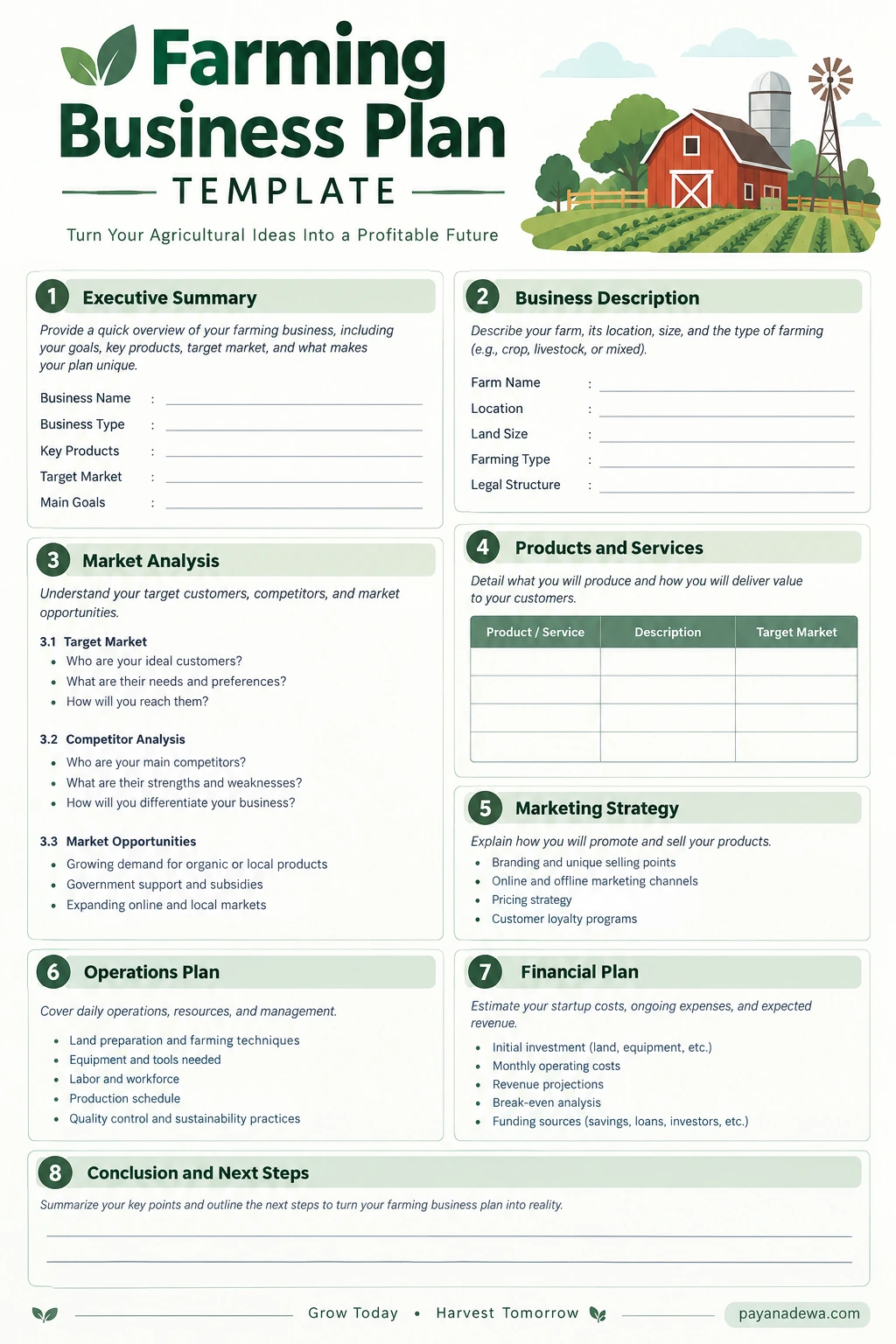
The printable template below organizes the main sections of a farm business plan, from the executive summary and business description to market analysis, products, marketing, operations, finances, and next steps. Use it to collect your initial ideas, then expand each section with supporting figures, quotations, schedules, and research.
For the strongest result, keep your plan specific to your farm. Replace broad statements with measurable targets, document the assumptions behind your numbers, and review the plan at least once each season or whenever your costs, products, or markets change.
Common Mistakes to Avoid
Even a well-written plan can be weakened by unrealistic assumptions. Watch for these common mistakes:
- Overestimating sales: Base forecasts on buyer evidence and realistic production capacity.
- Ignoring working capital: Include the money needed to operate between planting and payment.
- Forgetting hidden costs: Account for repairs, packaging, transport, waste, insurance, and your own labor.
- Expanding too quickly: Test demand and refine production before making large investments.
- Leaving the plan untouched: Update budgets and schedules using actual results.
Conclusion
A practical farming business plan connects your agricultural goals with customer demand, daily operations, realistic costs, and a strategy for managing risk. Start with a clear description of your farm, research the market, build a seasonal operations schedule, and prepare conservative financial forecasts. Use the printable template as a starting point, then tailor every section to your land, products, resources, and local requirements. With regular reviews and careful records, your plan can become a working tool for making better decisions and building a more resilient farm business.