Writing an essay is an essential skill for students, professionals, and anyone who wants to communicate ideas clearly. Whether you are preparing a school assignment, writing an academic paper, or sharing your personal opinion, understanding how to structure an essay can make the entire process easier. A well-written essay presents ideas logically, supports arguments with relevant evidence, and keeps readers interested from beginning to end.
However, many people find essay writing challenging. They may struggle to choose a topic, organize their thoughts, develop strong arguments, or write an effective conclusion. The good news is that essay writing becomes much more manageable when you understand its basic structure and follow a clear writing process.
In this comprehensive guide, you will learn what an essay is, explore different essay types, understand the standard essay structure, and discover practical techniques for improving your writing. You will also find a simple essay template that can help you organize your ideas and create a more polished final draft.
What Is an Essay?
An essay is a structured piece of writing that presents information, explains an idea, explores a topic, or argues for a particular position. Essays are commonly used in schools, colleges, universities, and professional environments to evaluate a person’s ability to communicate, research, analyze, and think critically.
Most essays focus on one central topic and develop it through several connected paragraphs. The writer introduces the subject, explains important points, provides supporting details, and finishes with a conclusion that reinforces the main message.
Although essays can differ in length and style, effective essay writing generally includes three important qualities:
- Clarity: Ideas are explained in language that readers can easily understand.
- Organization: Information follows a logical structure with a clear beginning, middle, and ending.
- Supporting evidence: Main ideas are developed through examples, facts, research, or logical explanations.
Different Types of Essays
Before starting an essay, it is important to understand what type of writing your assignment requires. Each essay type has a different purpose, writing style, and approach to presenting information.
1. Narrative Essay
A narrative essay tells a story about an experience, event, or personal situation. It often uses descriptive language, characters, and a sequence of events to help readers understand what happened.
Common narrative essay topics include childhood memories, unforgettable experiences, personal challenges, and important life lessons.
2. Descriptive Essay
A descriptive essay focuses on describing a person, place, object, experience, or situation. The goal is to help readers imagine the subject through detailed descriptions and sensory language.
For example, you might write about a peaceful beach, a memorable family celebration, or your favorite place to study.
3. Expository Essay
An expository essay explains a subject using facts, examples, and logical information. Unlike persuasive writing, its main purpose is to inform readers rather than convince them to accept a particular opinion.
Popular topics include environmental protection, technological development, education, healthy lifestyles, and historical events.
4. Persuasive Essay
A persuasive essay attempts to convince readers to agree with a specific opinion or take a particular action. Writers support their position with logical arguments, reliable evidence, and relevant examples.
For instance, an essay might argue that schools should provide more physical education classes or that communities should invest in renewable energy.
5. Argumentative Essay
An argumentative essay presents a clear position on a debatable issue and supports it with credible evidence. It also considers opposing viewpoints and explains why the writer’s position is reasonable.
This essay type is especially common in higher education because it develops research, critical thinking, and analytical writing skills.
The Basic Structure of an Essay
Most academic essays follow a three-part structure: introduction, body paragraphs, and conclusion. Understanding these sections helps you organize your thoughts and maintain a consistent flow throughout your writing.
1. Introduction
The introduction is the first section of your essay. It introduces the topic, provides necessary background information, and explains the main purpose of the writing.
A strong introduction usually contains three elements:
- Opening sentence: An interesting statement, question, or fact that introduces the topic.
- Background information: Brief context that helps readers understand the subject.
- Thesis statement: A clear sentence that communicates the main argument or central idea.
Keep your introduction focused. Avoid including too much detail because the body paragraphs are where you will explain your ideas more fully.
2. Body Paragraphs
The body is the main section of an essay. It develops the central argument or explains the topic through several organized paragraphs. Each paragraph should focus on one main idea that supports the thesis statement.
A useful body paragraph structure includes:
- Topic sentence: Introduces the paragraph’s main point.
- Explanation: Develops the idea with clear reasoning.
- Evidence: Provides facts, examples, research, or supporting details.
- Transition: Connects the paragraph to the next idea.
For longer academic essays, you may need several body paragraphs. Make sure every paragraph contributes something meaningful to the overall discussion instead of repeating information.
3. Conclusion
The conclusion brings your essay to a natural ending. It summarizes the most important points and reminds readers of the main message.
An effective conclusion should:
- Restate the thesis using different words.
- Summarize the most important arguments or findings.
- Explain the broader importance of the topic when appropriate.
- Finish with a strong final statement.
Avoid introducing completely new arguments in the conclusion. Instead, use this section to create a satisfying ending that connects with the introduction.
How to Write an Essay Step by Step
Creating a good essay does not have to be difficult. Following a consistent writing process can help you work more efficiently and avoid common mistakes.
Step 1: Understand the Assignment
Read the instructions carefully before writing. Identify the topic, essay type, required length, formatting guidelines, and submission deadline.
Pay attention to instruction words such as explain, compare, discuss, evaluate, and analyze. These words tell you what the assignment expects.
Step 2: Choose and Research Your Topic
If you can choose your own topic, select something relevant, interesting, and manageable. A topic that is too broad can make your essay unfocused, while an overly narrow topic may not provide enough information.
Research your subject using trustworthy sources, including academic journals, books, educational websites, and official publications. Record important facts and source details so you can cite them correctly.
Step 3: Create an Essay Outline
An essay outline is a simple plan that organizes your main ideas before you begin writing. It helps you identify the points you want to discuss and arrange them in a logical order.
A basic outline might look like this:
- Introduction: Introduce the topic and state your thesis.
- Body Paragraph 1: Present your first main argument or point.
- Body Paragraph 2: Explain your second supporting idea.
- Body Paragraph 3: Develop another important argument or example.
- Conclusion: Summarize your discussion and reinforce your main message.
Step 4: Write the First Draft
Use your outline as a guide when writing the first draft. Focus on expressing your ideas rather than trying to make every sentence perfect immediately.
Write clear topic sentences, explain your reasoning, and include relevant supporting evidence. Use transition words such as furthermore, however, therefore, and in addition to connect related ideas.
Step 5: Revise and Edit Your Essay
After completing your first draft, review the entire essay. Check whether your arguments are clear, your paragraphs are logically organized, and your writing answers the assignment question.
Next, correct spelling, punctuation, grammar, and sentence structure. Remove unnecessary words, replace unclear expressions, and make sure your introduction and conclusion support the same central message.
Printable Essay Template for Better Organization
A printable essay template is a practical tool for planning and organizing your writing. Instead of starting with a blank page, you can use a prepared layout to record your title, introduction, main points, and conclusion.
The template below is designed to make the essay writing process easier for students, teachers, and anyone who wants a simple writing guide. You can use it for school assignments, practice exercises, brainstorming, or personal writing projects.
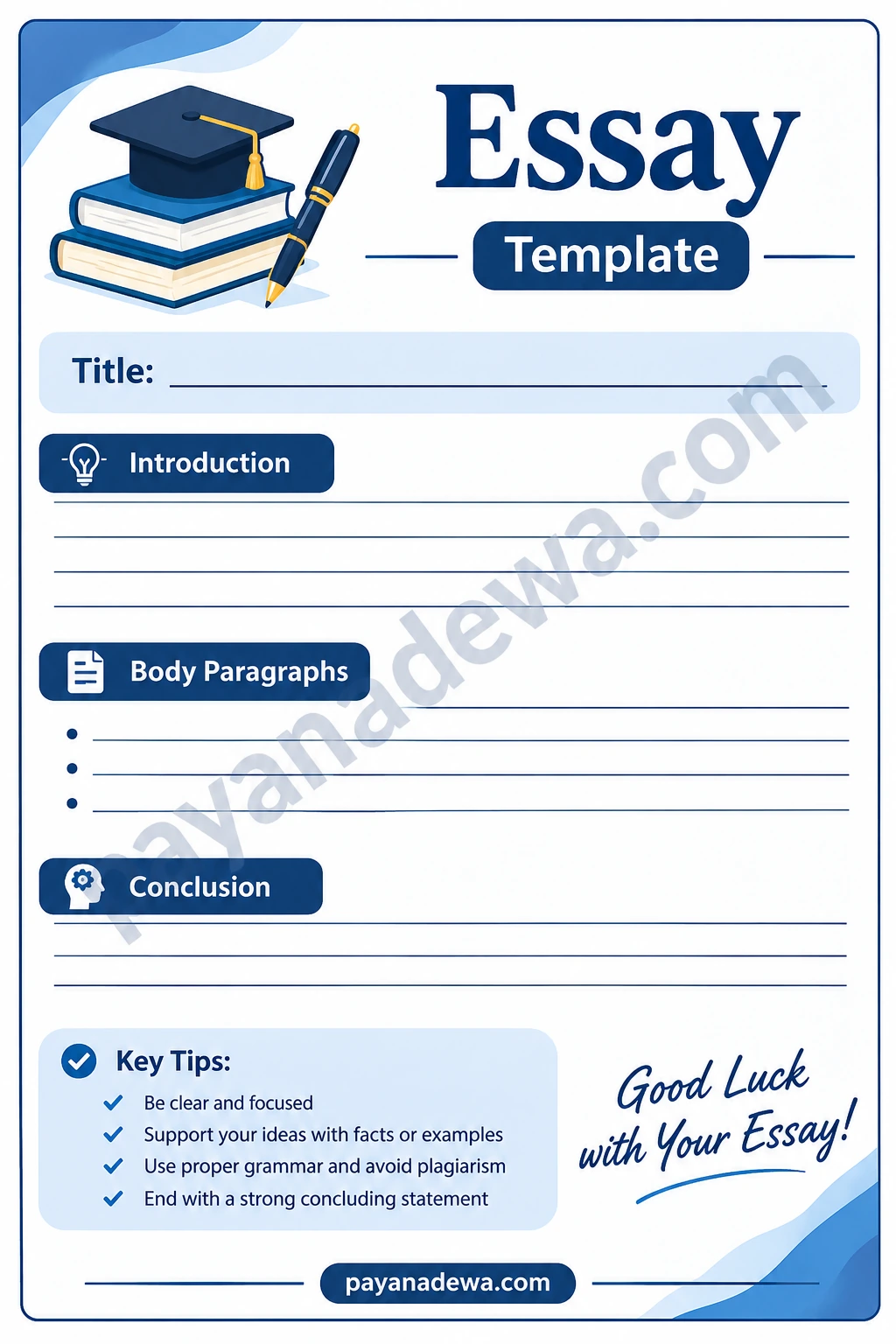
To get the best results from this template, follow these simple suggestions:
- Write your essay topic or title in the designated space.
- List the main idea you want to introduce in the introduction section.
- Organize your supporting arguments or examples in the body paragraph section.
- Write a short summary of your main message in the conclusion section.
- Review your notes before turning them into complete paragraphs.
Using a writing organizer can reduce confusion, improve paragraph organization, and help you stay focused on your topic.
Practical Tips for Writing a Better Essay
Good essay writing is a skill that improves with practice. The following tips can help you create writing that is more engaging, organized, and effective.
Use Clear and Simple Language
You do not need complicated vocabulary to write an impressive essay. Choose words that communicate your ideas accurately. Clear sentences are usually more effective than unnecessarily complicated expressions.
Stay Focused on Your Main Topic
Every paragraph should support your central idea or answer the assignment question. Avoid including unrelated information simply because it is interesting.
Support Your Arguments with Evidence
Strong essays do more than make statements. They explain why those statements are reasonable and support them with reliable facts, examples, research, or logical reasoning.
Use Transition Words Naturally
Transition words help readers follow the connection between sentences and paragraphs. Useful examples include firstly, similarly, in contrast, consequently, and finally. Use them where they improve clarity rather than adding them to every sentence.
Check Grammar and Formatting
Before submitting your essay, check spelling, punctuation, paragraph spacing, headings, and citation style. Follow the formatting requirements provided by your teacher or institution.
Avoid Plagiarism
Always acknowledge the original sources of information, quotations, and ideas that are not your own. Paraphrase carefully, use quotation marks when necessary, and include citations according to the required academic style.
Common Essay Writing Mistakes to Avoid
Even experienced writers can make mistakes that weaken an essay. Recognizing these problems can help you improve your writing and produce more professional results.
- Writing without a plan: Skipping the outline can lead to disorganized ideas and repetitive paragraphs.
- Using a weak thesis statement: An unclear central argument makes it difficult for readers to understand the essay’s purpose.
- Repeating the same information: Each paragraph should contribute a new point or useful explanation.
- Ignoring the assignment instructions: Always check the required essay type, word count, and formatting rules.
- Using unreliable sources: Research should come from credible and relevant references.
- Skipping proofreading: Grammar and spelling mistakes can reduce the overall quality of your work.
Why Essay Writing Skills Matter
Essay writing is valuable beyond academic assignments. It helps people develop communication, research, critical thinking, and problem-solving skills that are useful in many areas of life.
Students learn to explain complex ideas, evaluate information, and build logical arguments. Professionals can use similar skills to prepare reports, proposals, business documents, and presentations.
Regular writing practice also improves confidence. As you become more familiar with planning, drafting, and revising, expressing your thoughts in a structured way becomes easier.
Conclusion
Learning how to write an effective essay is a valuable skill that can benefit students and professionals alike. By understanding the different types of essays, following a clear introduction-body-conclusion structure, and using a step-by-step writing process, you can create more organized and engaging content.
Remember to research your topic carefully, develop a useful outline, support your arguments with evidence, and revise your work before submitting it. A printable essay template can also make the planning process simpler by giving you a clear place to organize your ideas.
Whether you are writing your first school assignment or improving your academic writing skills, consistent practice is the key to progress. Start with a simple outline, develop your ideas one paragraph at a time, and keep improving with every essay you write.