Writing a successful essay starts long before you write the first sentence. One of the most effective ways to organize your thoughts, develop strong arguments, and create a clear structure is by preparing an essay outline. Whether you are writing an academic assignment, persuasive paper, argumentative essay, or personal essay, a well-organized outline can make the entire writing process easier.
An essay outline serves as a roadmap for your writing. It helps you arrange your main ideas, identify supporting evidence, and ensure that every paragraph contributes to your central argument. Instead of struggling to decide what to write next, you can follow a clear plan from the introduction to the conclusion.
In this guide, you will learn what an essay outline is, why it matters, how to create one step by step, and how to use a practical essay outline template to organize your next writing project.
What Is an Essay Outline?
An essay outline is a structured plan that organizes the main ideas and supporting details of an essay before the actual writing begins. It provides a clear overview of the essay’s organization, including the introduction, body paragraphs, and conclusion.
Think of an outline as a blueprint for your essay. Just as a builder follows a plan before constructing a house, a writer uses an outline to develop a logical and coherent piece of writing.
A typical essay outline includes:
- Introduction: Introduces the topic, provides background information, and presents the thesis statement.
- Body paragraphs: Explain the main arguments or ideas using evidence, examples, and analysis.
- Conclusion: Summarizes the central points and reinforces the main message.
The level of detail depends on the assignment and the type of essay. Some outlines contain only short phrases, while others include complete topic sentences and supporting evidence.
Why Is an Essay Outline Important?
Creating an outline before writing offers several benefits. It helps you work more efficiently and improves the overall quality of your essay.
1. Organizes Your Ideas Clearly
When you have several ideas about a topic, it can be difficult to decide where each one belongs. An outline helps you group related information and arrange it in a logical order. As a result, your essay becomes easier to understand.
2. Saves Time During Writing
Writing without a plan often leads to unnecessary revisions and repeated ideas. With an outline, you already know what each paragraph should discuss. This allows you to focus on developing your sentences rather than constantly deciding what comes next.
3. Strengthens Your Main Argument
A strong essay needs a clear central argument. An outline allows you to check whether your supporting points actually connect to your thesis statement. If an idea does not support your argument, you can revise or remove it before writing the complete essay.
4. Improves Essay Structure
A well-planned outline creates a natural flow between paragraphs. It helps readers follow your explanations and understand how each point contributes to the overall discussion.
Basic Essay Outline Structure
Most academic essays follow a three-part structure: introduction, body, and conclusion. Understanding these sections will help you create an effective writing plan.
1. Introduction
The introduction is the opening section of your essay. Its purpose is to capture the reader’s attention, introduce the subject, and explain the main argument.
Your introduction should generally include:
- Hook: An interesting statement, question, fact, or quotation that attracts attention.
- Background information: Brief context that helps readers understand the topic.
- Thesis statement: A clear sentence that communicates the main argument or purpose of the essay.
A focused introduction gives readers a reason to continue and prepares them for the discussion that follows.
2. Body Paragraphs
The body is the main part of your essay. Each paragraph should focus on one central idea that supports the thesis statement.
A useful body paragraph structure includes:
- Topic sentence: Introduces the main point of the paragraph.
- Supporting evidence: Provides facts, research, examples, or relevant information.
- Explanation: Explains how the evidence supports your argument.
- Transition: Connects the paragraph to the next idea when appropriate.
For a standard five-paragraph essay, writers usually include three body paragraphs. However, longer assignments may require additional sections depending on the topic and instructions.
3. Conclusion
The conclusion brings your essay to a meaningful ending. It reminds readers of the main argument without simply repeating the entire introduction.
A strong conclusion should:
- Restate the thesis using different words.
- Summarize the most important supporting points.
- Explain the significance of the discussion.
- End with a final thought or recommendation when appropriate.
Avoid introducing completely new arguments in your conclusion. Instead, focus on reinforcing the ideas you have already explained.
How to Write an Essay Outline Step by Step
Creating an effective outline does not need to be complicated. Follow these practical steps to develop a clear plan for your essay.
Step 1: Understand the Essay Assignment
Before brainstorming ideas, read the assignment carefully. Identify the topic, required word count, essay type, formatting rules, and submission deadline.
Pay attention to instruction words such as analyze, compare, explain, discuss, or persuade. These words help determine the purpose and structure of your writing.
Step 2: Research Your Topic
Gather reliable information from books, academic journals, educational websites, and other credible sources. Take notes on useful facts, examples, statistics, and quotations.
Organize your research so you can easily identify which information supports each main point. Remember to record source details if your assignment requires citations.
Step 3: Develop a Thesis Statement
Your thesis statement should communicate the central idea of your essay. It acts as a guide for selecting and organizing your supporting arguments.
For example, if your topic is the importance of reading, your thesis might explain how regular reading improves vocabulary, strengthens critical thinking, and expands knowledge.
Step 4: Identify Your Main Points
List the strongest ideas that support your thesis. Each major point can become the focus of a separate body paragraph or section.
Choose points that are relevant, distinct, and supported by sufficient evidence. Avoid including too many unrelated ideas because they can weaken the overall structure.
Step 5: Add Supporting Details
Under each main point, write down examples, explanations, research findings, or other supporting information. These details will help you develop complete and convincing paragraphs.
Step 6: Arrange Ideas in a Logical Order
Organize your points so the essay flows naturally. Depending on your topic, you might use chronological order, general-to-specific organization, problem-and-solution structure, or order of importance.
Step 7: Review and Improve Your Outline
Read your outline from beginning to end. Check whether every section supports your thesis, whether the ideas are logically connected, and whether important information is missing.
Make adjustments before drafting the essay. A few minutes spent improving your outline can save considerable time during revision.
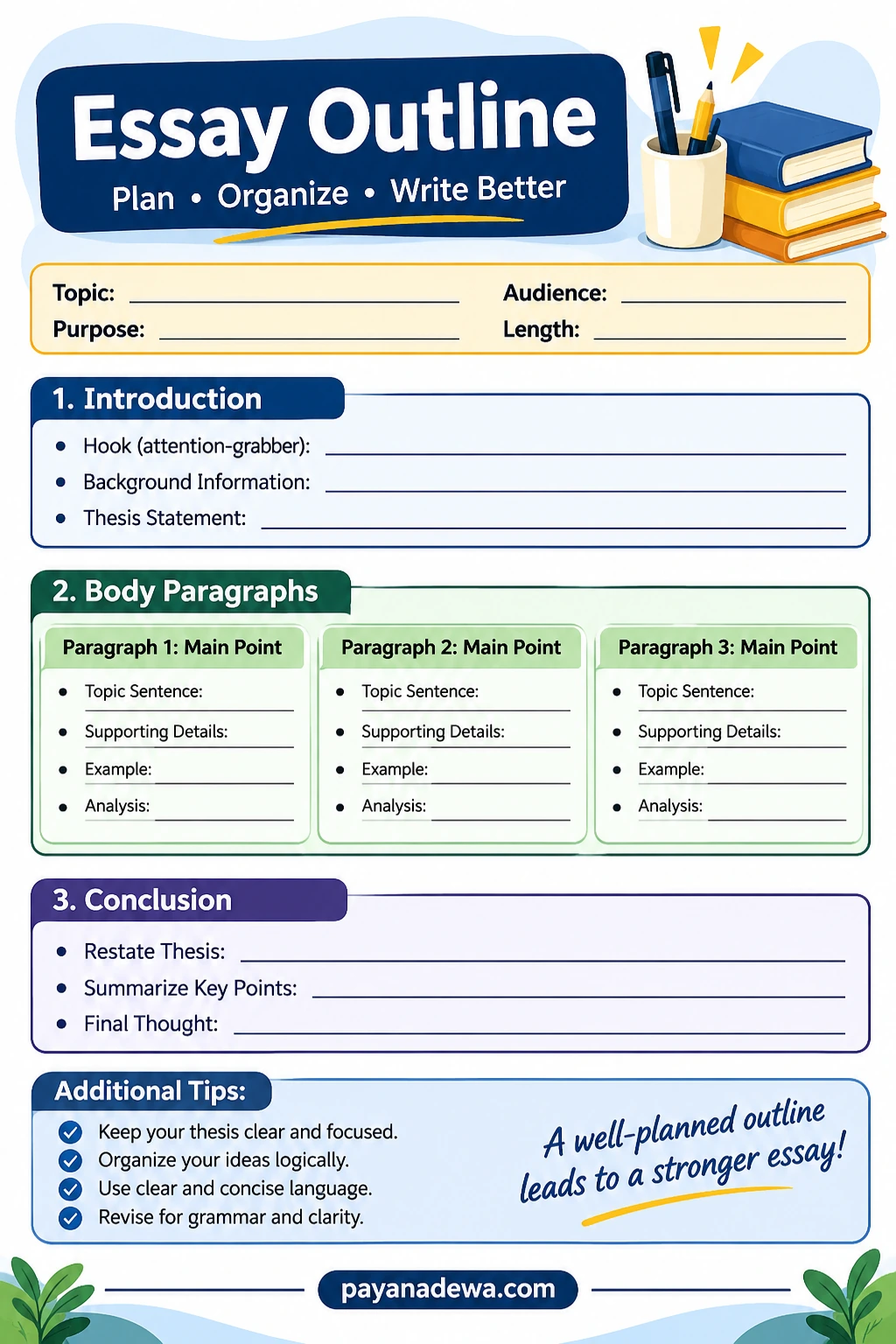
Essay Outline Template You Can Use
Using a ready-made essay outline template makes planning easier, especially when you are working on a school assignment, college paper, or academic writing project.
The following basic template can help you organize your ideas before starting your first draft.
Essay Information
- Essay Topic: __________________________
- Purpose: ______________________________
- Target Audience: _______________________
- Required Length: _______________________
I. Introduction
- Hook or opening statement
- Background information
- Thesis statement
II. Body Paragraph 1
- First main point
- Supporting evidence
- Example or explanation
- Connection to the thesis
III. Body Paragraph 2
- Second main point
- Supporting evidence
- Example or explanation
- Connection to the thesis
IV. Body Paragraph 3
- Third main point
- Supporting evidence
- Example or explanation
- Connection to the thesis
V. Conclusion
- Restate the thesis
- Summarize the main points
- Provide a final thought
This structure works well for many standard essays. You can add or remove body paragraphs depending on the requirements of your assignment.
Different Types of Essay Outlines
Not every essay follows exactly the same structure. The outline should match the purpose and requirements of your writing.
Argumentative Essay Outline
An argumentative essay outline focuses on presenting a clear position supported by logical reasoning and credible evidence. It may include a counterargument and a response explaining why your position remains convincing.
Persuasive Essay Outline
A persuasive essay outline organizes arguments designed to influence the reader’s opinion or encourage a particular action. Strong evidence, emotional appeals, and logical explanations can help support your position.
Expository Essay Outline
An expository essay outline focuses on explaining a subject using facts, examples, and clear descriptions. The goal is to inform readers rather than persuade them to accept a particular opinion.
Compare and Contrast Essay Outline
This outline organizes similarities and differences between two or more subjects. You can discuss each subject separately or arrange the essay by specific comparison points.
Narrative Essay Outline
A narrative essay outline helps organize a story in a meaningful sequence. It often includes the setting, characters, main events, conflict, and resolution.
Practical Tips for Creating a Better Essay Outline
A useful outline should be simple enough to follow but detailed enough to guide your writing. Keep these tips in mind:
- Keep your thesis focused: Make sure your central argument is specific and manageable.
- Use clear headings: Label each section so you can quickly identify its purpose.
- Avoid unnecessary details: Include information that directly supports your main ideas.
- Maintain logical connections: Arrange paragraphs in an order that makes sense to readers.
- Use credible sources: Support important claims with reliable evidence.
- Stay flexible: Update your outline when research or new ideas improve your argument.
- Check assignment requirements: Make sure your outline matches the instructor’s expectations.
Remember that an outline is a working document, not a fixed set of rules. You can change its structure as your understanding of the topic develops.
Common Essay Outline Mistakes to Avoid
Even a simple writing plan can become ineffective when it lacks focus or organization. Avoid these common mistakes:
- Writing without a thesis: Without a central argument, your essay may lose direction.
- Including unrelated points: Every main idea should contribute to the purpose of the essay.
- Repeating the same information: Give each paragraph a distinct role.
- Ignoring supporting evidence: Main arguments need relevant examples and explanations.
- Creating an overly complicated outline: Use a structure that makes planning easier rather than more confusing.
- Skipping the review process: Check your organization before beginning the full draft.
By avoiding these problems, you can create a more effective writing plan and produce an essay that is easier to read and understand.
Conclusion
An essay outline is an essential tool for planning, organizing, and improving your writing. It provides a clear structure for the introduction, body paragraphs, and conclusion while helping you develop stronger arguments and maintain a logical flow.
Whether you are preparing an argumentative essay, persuasive paper, narrative assignment, or academic report, creating an outline before writing can make the process more manageable and productive.
Start by understanding your assignment, researching the topic, developing a thesis statement, and arranging your main points. Then use a practical essay outline template to organize your supporting details and review your plan before drafting.
With consistent practice and a well-organized approach, you can write clearer, stronger, and more effective essays. Start planning your next writing project with an essay outline and turn your ideas into a well-structured piece of writing.