An appendix is an important part of many academic papers, reports, research projects, business documents, and professional presentations. It provides supporting information that is useful to readers but may be too detailed or lengthy to include in the main body of a document. A well-organized appendix can make a document easier to understand while keeping the primary discussion focused and readable.
Whether you are preparing a research paper, thesis, business report, project proposal, or technical document, knowing how to create an appendix correctly can improve the structure and professionalism of your work. This guide explains what an appendix is, what information belongs in one, how to format it, and how to use an appendix template to organize supporting material effectively.
What Is an Appendix?
An appendix is a supplementary section placed at the end of a document. It contains additional information that supports the main content without interrupting the flow of the primary discussion.
For example, a research paper may mention the results of a survey in the main text while placing the complete questionnaire, detailed responses, or raw data in an appendix. Similarly, a business report might summarize financial findings in the main sections and provide detailed tables in an appendix.
The plural form is appendices, although the word “appendix” can also refer generally to a supplementary section.
What Should Be Included in an Appendix?
The content of an appendix depends on the purpose and type of document. The general rule is simple: include material that supports the reader’s understanding but is not essential to following the main argument.
Common examples include:
- Survey questionnaires and interview questions
- Raw research data
- Detailed statistical tables
- Charts and graphs
- Technical specifications
- Calculations and formulas
- Detailed research methodology
- Supporting documents
- Long quotations or transcripts
- Additional photographs or illustrations
- Maps, diagrams, or technical drawings
- Reference materials that support the main document
Before adding something to an appendix, ask whether the information directly supports the main document. If it does not provide useful context or evidence, it may not need to be included.
When Should You Use an Appendix?
An appendix is particularly useful when additional information is valuable but would make the main document unnecessarily long or difficult to read.
Academic Research
Students and researchers often use appendices for supporting research materials. A thesis or dissertation may contain several appendices for questionnaires, interview transcripts, calculations, datasets, or additional research results.
Business Reports
Businesses can use an appendix to provide detailed financial statements, market research, technical information, project documentation, or supporting calculations. This approach allows executives and other readers to review the important findings first and examine the supporting details when necessary.
Technical Documentation
Technical reports may include an appendix containing specifications, configuration information, testing procedures, source data, formulas, diagrams, or other detailed documentation.
How to Format an Appendix
Good formatting makes supplementary information easier to navigate. The exact formatting requirements may vary depending on the organization, institution, or style guide being followed.
A basic appendix structure can include the following elements:
- Appendix label: Identify the section clearly, such as Appendix A.
- Title: Give the appendix a descriptive title that tells readers what it contains.
- Introduction: Briefly explain the purpose of the supplementary material.
- Main content: Present the supporting information in an organized format.
- References: Include relevant sources when required.
For documents containing multiple appendices, use a consistent labeling system. For example, you might use Appendix A for a questionnaire, Appendix B for additional tables, and Appendix C for supporting calculations.
Appendix vs. Main Body: What Goes Where?
One of the most common challenges is deciding whether information belongs in the main body or an appendix. The distinction is based primarily on how important the information is to the reader’s understanding of the main argument.
Main body: Include information that readers need to understand your primary argument, findings, conclusions, or recommendations.
Appendix: Include supporting details that are useful for verification or deeper analysis but are not necessary for understanding the central message.
For example, a report could state a survey’s key findings in the main body while placing the complete survey questionnaire and detailed response tables in an appendix.
How to Create an Appendix Step by Step
1. Identify the Supporting Material
Start by reviewing your document and identifying information that supports your discussion but would interrupt the main narrative if placed directly in the body.
2. Group Related Information
Organize similar materials together. For example, questionnaires can be grouped separately from financial tables, while technical diagrams can have their own appendix.
3. Give Each Appendix a Clear Title
Use descriptive titles instead of vague labels. A title such as Appendix A: Customer Survey Questionnaire immediately tells readers what they will find in that section.
4. Reference the Appendix in the Main Text
Readers should know when additional information is available. Refer to the relevant appendix from the main document when appropriate. For example, you might write, “The complete questionnaire is provided in Appendix A.”
5. Check the Formatting
Make sure headings, fonts, spacing, numbering, tables, and page numbers follow the same general formatting rules as the rest of the document unless your required style guide specifies otherwise.
Tips for Creating a Professional Appendix
A useful appendix should be easy to understand and easy to navigate. Consider these practical tips when preparing your document:
- Keep it relevant: Only include information that supports the main document.
- Use descriptive headings: Clear headings help readers locate specific information quickly.
- Maintain consistency: Use consistent fonts, spacing, numbering, and formatting.
- Label tables and figures: Give supporting charts, tables, and illustrations clear labels.
- Use logical organization: Arrange supplementary materials in an order that makes sense.
- Cross-reference important information: Mention relevant appendices within the main text.
- Check accessibility: Make sure tables, images, and documents remain readable for all users.
Using an Appendix Template
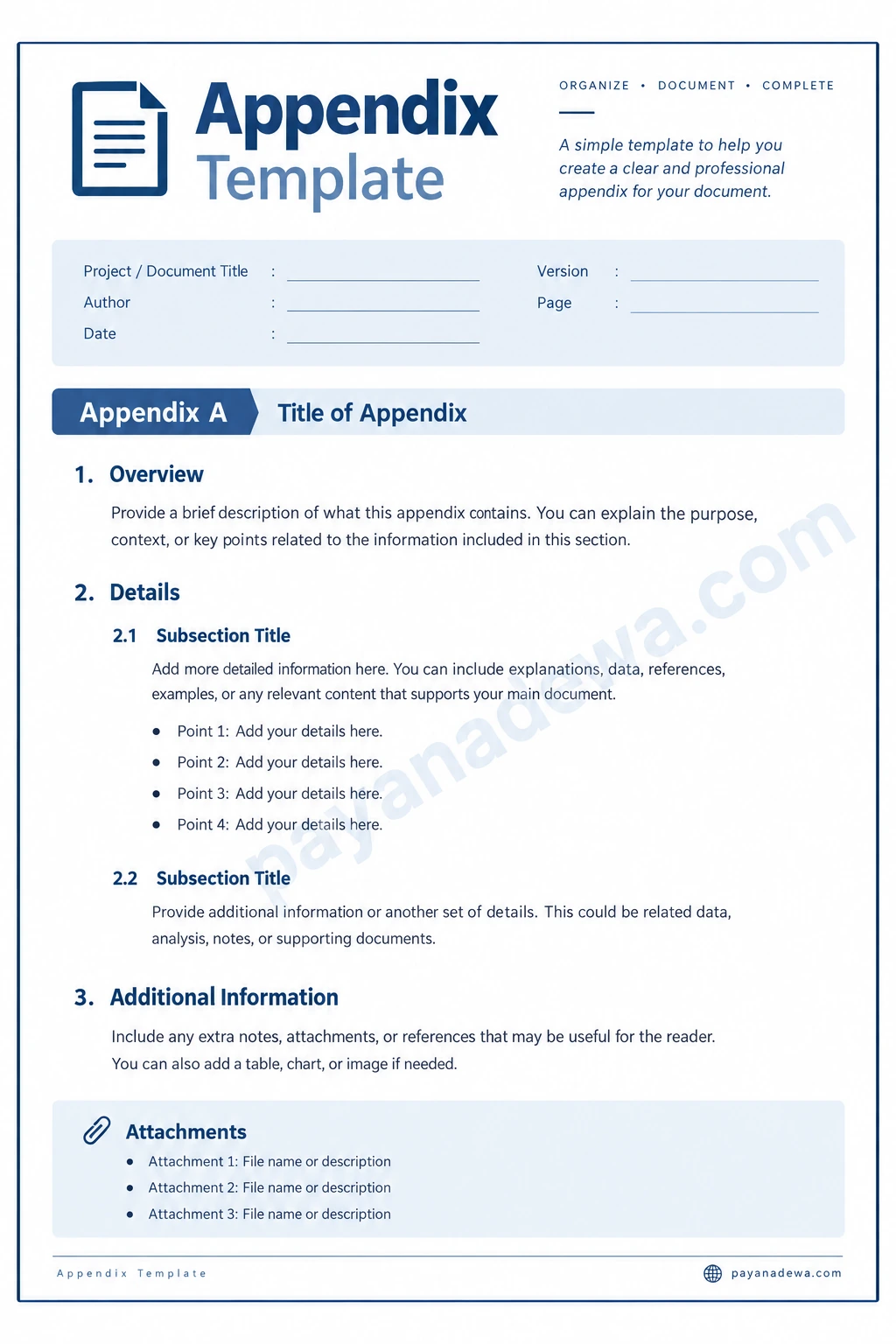
An appendix template can simplify the process of creating a professional supplementary section. Instead of designing the structure from scratch, you can start with predefined areas for the document title, author, date, appendix heading, supporting details, and attachments.
A template is especially useful when creating multiple appendices because it helps maintain a consistent appearance throughout a report or project. You can customize the headings and sections according to your specific requirements.
When using a template, remove placeholder text and replace it with information relevant to your document. You should also adjust the structure when necessary rather than adding unnecessary sections simply because they appear in the template.
Common Appendix Mistakes to Avoid
Even a well-written document can become difficult to use if its appendix is poorly organized. Avoid these common mistakes:
- Including information that has no connection to the main document
- Adding an appendix without referring to it in the main text
- Using unclear or generic appendix titles
- Repeating large sections of the main document unnecessarily
- Ignoring required formatting guidelines
- Leaving placeholder text in a finished document
- Using inconsistent numbering or headings
- Adding excessive information that does not provide additional value
Appendix Formatting Checklist
Before submitting or publishing your document, use this checklist to review your appendix:
- Is the appendix clearly labeled?
- Does it have a descriptive title?
- Is every included item relevant?
- Is the appendix referenced where appropriate in the main text?
- Are tables, figures, and attachments labeled correctly?
- Is the formatting consistent with the rest of the document?
- Are page numbers and headings correct?
- Have all placeholder instructions been removed?
- Have spelling, grammar, and formatting been checked?
Frequently Asked Questions About an Appendix
What is the purpose of an appendix?
The purpose of an appendix is to provide additional supporting information without overcrowding the main body of a document. It can contain detailed data, documents, calculations, tables, questionnaires, or other relevant material.
Can a document have more than one appendix?
Yes. A document can contain multiple appendices when there are different categories of supporting information. These sections can be labeled Appendix A, Appendix B, Appendix C, and so on.
Should an appendix be included in the table of contents?
In many formal documents, appendices are included in the table of contents. However, requirements can vary depending on the academic institution, publication, organization, or formatting style being used.
What is the difference between an appendix and an attachment?
An appendix is generally part of the document itself and provides supporting information related to the main content. An attachment is usually a separate file or document supplied alongside the primary document. The exact distinction can vary by context.
Conclusion
An appendix provides a practical way to include valuable supporting information without disrupting the flow of a document. Whether you are preparing an academic paper, research project, business report, or technical document, a well-structured appendix can make your work more complete and easier to navigate.
The key is to keep supplementary information relevant, organize it logically, use clear titles, and reference it from the main content when necessary. An appendix template can make this process faster by providing a professional structure that you can customize for your specific needs.