An apology letter is a thoughtful way to say sorry after a mistake. It can help you express regret, accept responsibility, and repair a relationship. You can write an apology letter to a friend, family member, partner, teacher, coworker, customer, or anyone you have hurt.
Sometimes, saying sorry in person is difficult. You may feel nervous or struggle to find the right words. In that case, a written apology can help. You have time to think about what happened and choose your words carefully.
A good apology letter does not need complicated language. Instead, it should be honest, specific, and respectful. The goal is to show that you understand what went wrong and that you truly regret it.
An apology letter template can make the process easier. You can use a template as a starting point and then add your own details. This helps your letter sound personal while keeping a clear structure.
What Is an Apology Letter?
An apology letter is a written message that expresses regret for something you did or said. It can also acknowledge the effect your actions had on another person.
Unlike a short text message, a letter gives you more space to explain yourself. It also gives the other person time to read your words without feeling pressured to respond immediately.
A strong apology letter usually contains these important parts:
- A clear statement of regret
- A description of what happened
- Acceptance of responsibility
- Recognition of the other person’s feelings
- A sincere explanation when needed
- A plan to improve
- A respectful closing
Most importantly, the apology should sound genuine. Simple words are often more powerful than complicated phrases.
When Should You Write an Apology Letter?
There are many situations where an apology letter can be useful. It can be especially helpful when you need time to organize your thoughts.
Apology to a Friend
You may need to apologize after an argument, a misunderstanding, or a broken promise. In this situation, focus on your actions. Also, explain why the friendship is important to you.
For example, you can mention that you regret speaking harshly. You can also explain what you plan to do differently next time.
Apology to a Family Member
Family disagreements can become emotional. Therefore, a calm letter can sometimes be easier than a difficult conversation.
Keep your message focused on the issue. Avoid bringing up old arguments. Instead, explain what you regret and how you want to improve the relationship.
Apology to a Partner
An apology to a partner should show that you understand their feelings. Do not focus only on your intentions. Instead, recognize how your words or actions may have affected them.
In addition, explain what you will do to avoid repeating the same mistake. Your actions should support your apology.
Professional Apology
You may also need an apology letter at work. Common reasons include missing a deadline, making an error, or causing inconvenience.
A professional apology should be polite and direct. State what happened, accept responsibility, and explain the solution. Finally, describe how you will prevent the problem in the future.
How to Write an Apology Letter
Writing an apology letter does not have to be difficult. You can follow a simple step-by-step process.
1. Start With a Clear Apology
Begin by saying that you are sorry. Do not make the reader guess why you are writing.
For example, you can write, “I am writing to sincerely apologize for the way I spoke to you yesterday.” This opening is direct and clear.
2. Explain What You Are Sorry For
Next, describe the situation. Be specific about the action or words that caused the problem.
Avoid vague statements. Instead of saying, “I am sorry about everything,” explain what you regret. This shows that you understand the situation.
3. Take Responsibility
A sincere apology accepts responsibility. Therefore, avoid blaming another person for your actions.
You can say, “I should have handled the situation differently.” Another option is, “I take responsibility for what happened.” These phrases show accountability.
4. Acknowledge Their Feelings
Your actions may have caused sadness, anger, disappointment, or frustration. A good apology recognizes that effect.
For example, you can say that you understand why the person felt hurt. This does not mean that you agree with every part of the situation. Instead, it shows that you recognize their experience.
5. Avoid Excuses
Sometimes, there is a reason behind a mistake. However, an explanation should not become an excuse.
For example, you can explain that you were under pressure. At the same time, you should still accept responsibility for your behavior.
A useful rule is simple: explain the situation, but do not use it to avoid responsibility.
6. Explain How You Will Improve
A strong apology should look toward the future. Tell the reader what you will do differently.
For example, you may promise to communicate sooner when you have a problem. You may also decide to listen more carefully before responding.
Choose actions that are realistic. A small and honest commitment is better than a dramatic promise that you cannot keep.
7. End With Respect
Finally, close the letter in a respectful way. You can express hope for the future. However, do not demand immediate forgiveness.
Everyone needs a different amount of time to process an apology. Therefore, give the other person space to decide how they want to respond.
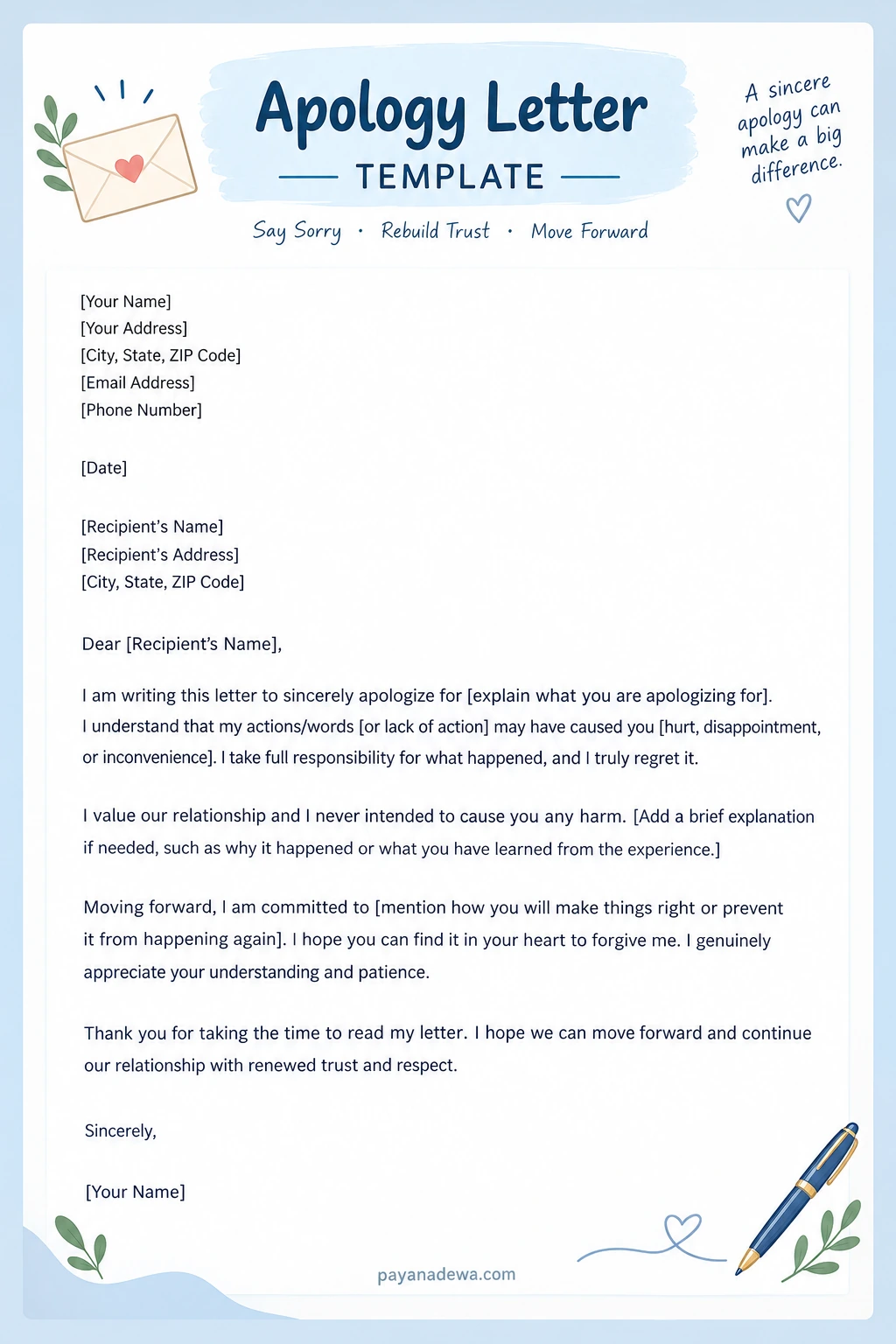
Simple Apology Letter Template
You can use the following apology letter template as a starting point. Replace the words in brackets with details from your own situation.
Dear [Recipient’s Name],
I am writing to sincerely apologize for [describe what happened]. I understand that my words or actions may have caused you [describe the impact]. I truly regret what happened.
I take responsibility for my actions. Looking back, I know that I should have [explain what you should have done differently]. I understand why this situation was difficult for you.
I value our relationship, and I am sorry that my actions caused hurt or disappointment. Moving forward, I will [describe what you will do differently]. I want to learn from this experience and make better choices in the future.
Thank you for taking the time to read my letter. I sincerely apologize, and I hope we can move forward with greater understanding and respect.
Sincerely,
[Your Name]
Apology Letter Examples
The best apology letter depends on the situation. Therefore, your tone should match the relationship and the seriousness of the mistake.
Short Personal Apology
A short apology works well when the situation is simple. For example, you may want to apologize for forgetting a promise or speaking without thinking.
Keep the message honest. Clearly state what you regret and show that you understand the other person’s feelings.
Apology for Hurting Someone
When you hurt someone’s feelings, focus on the impact of your actions. Avoid spending most of the letter defending yourself.
Instead, acknowledge the pain you caused. Then, explain how you plan to behave differently in the future.
Apology for a Mistake at Work
A workplace apology should remain professional. First, explain the mistake. Next, accept responsibility. Then, describe the solution.
For example, if you missed a deadline, explain what you have done to correct the problem. Also, mention how you will improve your planning in the future.
Apology to a Teacher
An apology to a teacher should be respectful and direct. Explain what happened and acknowledge the behavior that was inappropriate.
Then, explain what you have learned. Finally, state how you will follow the rules in the future.
Useful Apology Phrases
If you do not know how to start an apology letter, the following phrases can help. Choose the ones that match your situation.
- “I sincerely apologize for…”
- “I am truly sorry for…”
- “I take responsibility for…”
- “I understand that my actions hurt you.”
- “I regret what happened.”
- “I should have handled the situation differently.”
- “I understand why you were disappointed.”
- “I will work hard to avoid making the same mistake.”
- “I hope I can earn back your trust.”
These phrases are only starting points. Add specific details to make your apology sound personal.
What to Avoid in an Apology Letter
Some common phrases can make an apology sound weak. Therefore, read your letter carefully before sending it.
Avoid Conditional Apologies
Try not to say, “I am sorry if you were offended.” This wording can sound as though the problem is the other person’s reaction.
Instead, identify what you did and apologize for it directly.
Avoid “But” After Your Apology
Be careful with sentences such as, “I am sorry, but you also made me angry.” This can turn an apology into an argument.
If you need to discuss another issue, consider doing it separately. Keep the apology focused on your own actions.
Avoid Blaming the Other Person
An apology is not the right place to list someone else’s mistakes. Instead, focus on your own responsibility.
Avoid Demanding Forgiveness
You can hope for forgiveness, but you should not demand it. The other person may need time to process what happened.
Tips for Writing a Heartfelt Apology
A heartfelt apology does not need to be long. In fact, a clear and honest message can be more effective.
- Be specific. Explain exactly what you regret.
- Be honest. Use natural words that sound like you.
- Take responsibility. Accept your part in the situation.
- Show empathy. Think about how your actions affected the other person.
- Keep your promises realistic. Only promise actions you can actually take.
- Give them time. Do not pressure the person to forgive you.
- Let your actions speak. Show through your behavior that you mean what you wrote.
Before sending your letter, read it again. Ask yourself whether it sounds sincere. Also, check whether any sentence sounds defensive or blaming.
Why Write an Apology Letter?
Writing an apology can provide several benefits. First, it gives you time to organize your thoughts. As a result, you may communicate more calmly.
Second, a written apology gives the other person time to read your message privately. They do not have to respond immediately.
Third, writing can help you understand your own actions. When you put your thoughts on paper, you may see the situation more clearly.
However, an apology letter cannot guarantee forgiveness. The other person has the right to decide how they feel and whether they are ready to move forward.
How to Make Your Apology More Meaningful
The words in an apology are important. However, your actions matter too.
If you promise to change, follow through with that promise. If you caused a problem, take reasonable steps to fix it. If you damaged someone’s trust, understand that rebuilding trust may take time.
In addition, avoid repeating the same behavior. A consistent change can show that your apology was genuine.
Printable Apology Letter Template
If you prefer to write your apology by hand, a printable template can make the process easier. You can print the template, fill in the recipient’s information, and write your personal message in the available space.
A printable apology letter template can be useful for personal apologies, family situations, school matters, and other everyday situations.
Remember to personalize the template. Add the specific details that explain what happened and why you are sorry. This small step can make the letter feel much more sincere.
Conclusion
An apology letter is a simple way to communicate regret and take responsibility. It can help you express feelings when speaking face to face feels difficult.
To write a meaningful apology, start with a clear apology. Then, explain what happened and accept responsibility. Next, acknowledge the other person’s feelings. Finally, explain how you plan to improve.
Most importantly, keep your words honest and respectful. Do not make excuses or demand forgiveness. Instead, give the other person time and let your future actions support your apology.
With the right structure, an apology letter template can help you turn difficult feelings into a clear, thoughtful, and sincere message.