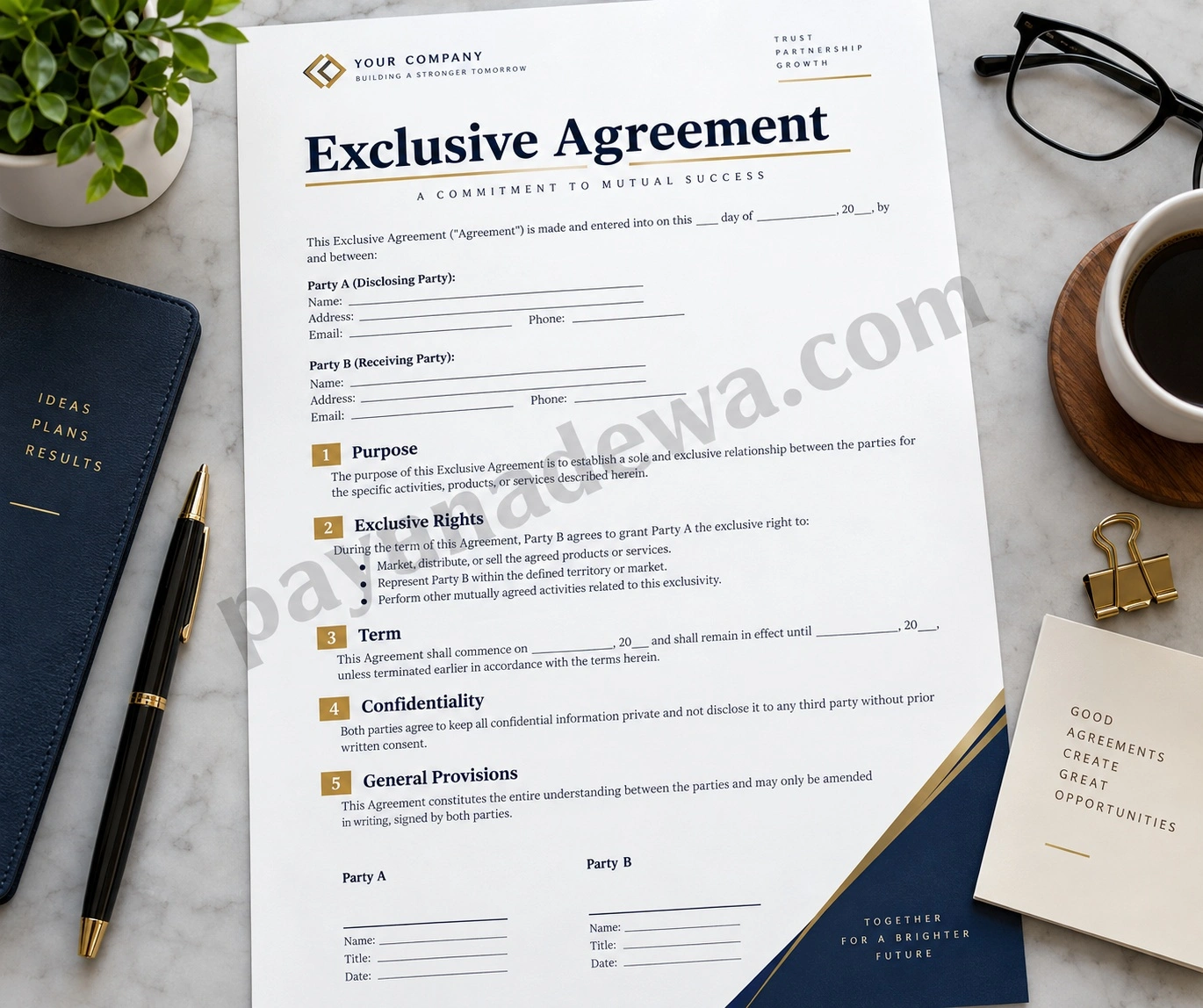
An Exclusive Agreement Template provides a practical starting point for businesses, independent professionals, partners, and organizations that need to establish an exclusive working relationship. Instead of creating every section from scratch, a structured template can help organize important information such as the parties involved, exclusive rights, responsibilities, duration, confidentiality, and termination terms.
A well-prepared exclusive agreement should be easy to understand and specific enough to reduce confusion between the parties. Whether the arrangement involves distribution, sales, representation, services, licensing, or another business relationship, documenting expectations in writing can make the working arrangement more organized and easier to manage.
The template can also save time during the drafting process. Users can customize the names, dates, territories, products, services, obligations, payment terms, and other provisions according to the particular relationship. Before signing, however, the completed document should be reviewed carefully to make sure that its terms accurately reflect the agreement between all parties.
In this guide, you will learn what an Exclusive Agreement Template is, what sections it should contain, how to customize it, and practical tips for preparing a professional agreement.
What Is an Exclusive Agreement?
An exclusive agreement is a written contract in which the parties establish specific exclusive rights, obligations, or restrictions. The exact meaning of exclusivity depends on the relationship and the terms written into the contract.
For example, a company may appoint one distributor to sell a particular product within a defined territory. Another business may grant an exclusive representative the right to promote certain services. In each situation, the agreement should clearly explain what is exclusive, who receives the exclusive rights, where those rights apply, and how long they remain effective.
Why Use an Exclusive Agreement Template?
Starting with a template can make the drafting process more efficient. A structured document gives users a framework for identifying the essential elements of the relationship before the agreement is finalized.
- Save drafting time: Start with an organized structure instead of a blank document.
- Improve consistency: Keep important agreement details in clearly defined sections.
- Clarify expectations: Define responsibilities and exclusive rights in writing.
- Support customization: Adapt the document to different business relationships.
- Improve document organization: Present terms, dates, obligations, and signatures in a logical format.
Key Sections of an Exclusive Agreement Template
A useful Exclusive Agreement Template should contain sections that address the core elements of the relationship. The exact provisions will vary depending on the transaction, industry, and applicable law.
1. Parties and Effective Date
The agreement should identify every party involved. Include legal names, business names where appropriate, addresses, contact information, and the effective date. Accurate identification helps prevent confusion about who is bound by the agreement.
2. Purpose of the Agreement
The purpose section explains why the parties are entering into the relationship. Keep this section clear and specific. It can describe the products, services, business activities, or commercial relationship covered by the agreement.
3. Exclusive Rights
This is one of the most important sections. Clearly describe the rights being granted and the activities covered by exclusivity. Avoid vague language that could create different interpretations.
For example, the agreement might specify exclusive rights to distribute a particular product within a defined geographical area. It may also establish whether the exclusivity covers online sales, physical stores, specific customer groups, or particular channels.
4. Responsibilities of Each Party
Every party should understand what it is expected to do. Responsibilities may include marketing, sales, product delivery, customer support, reporting, payment, inventory management, or maintaining certain standards.
Specific responsibilities are generally easier to manage than broad promises. Consider including measurable requirements when they are relevant to the relationship.
5. Territory and Scope
If exclusivity applies only to a particular market or geographical area, define that scope precisely. Depending on the arrangement, the territory could be a country, region, city, sales channel, customer segment, or online marketplace.
6. Term and Renewal
The agreement should explain when it begins and when it ends. If the parties intend to renew the arrangement, describe the renewal process and any notice requirements.
A clear term helps both parties understand how long the exclusive relationship will remain in effect and when they should review its continuation.
7. Confidentiality
Business relationships may involve confidential pricing, customer information, product plans, strategies, financial information, or other sensitive business material. A confidentiality section can establish how such information should be handled.
8. Payment and Commercial Terms
When the relationship involves compensation, the agreement should describe the applicable payment terms. Depending on the arrangement, this may include prices, commissions, fees, payment schedules, expenses, taxes, or other commercial provisions.
9. Termination
The termination section explains how the agreement may end before or at the conclusion of its term. It may address termination for convenience, material breach, failure to meet specified obligations, insolvency, or other circumstances relevant to the relationship.
Notice periods and post-termination responsibilities should also be considered when appropriate.
10. Signatures
The final section should provide appropriate signature fields for the parties. Include printed names, titles when applicable, dates, and signature lines. Electronic signatures may also be appropriate depending on the circumstances and applicable requirements.
How to Customize an Exclusive Agreement Template
A template should be treated as a starting framework rather than a document that automatically fits every situation. Before using it, replace generic fields with information that accurately describes the actual relationship.
Define the Exclusive Relationship Clearly
Start by identifying exactly what the exclusivity covers. Ask practical questions such as: What product or service is involved? Which party receives the exclusive right? What activities are restricted? Does exclusivity apply to a particular territory or customer group?
Answering these questions can help make the agreement more precise and reduce unnecessary ambiguity.
Set Specific Performance Expectations
If one party must achieve sales targets, maintain inventory, provide marketing support, or perform another measurable obligation, describe the requirement clearly. Consider including deadlines, reporting procedures, or performance standards when appropriate.
Review All Dates and Conditions
Check the effective date, expiration date, renewal conditions, notice periods, and other time-sensitive provisions. A simple date error can create confusion about when contractual obligations begin or end.
Use Consistent Terminology
Use the same defined names throughout the agreement. For example, if the document defines two organizations as “Party A” and “Party B,” use those terms consistently instead of switching between several descriptions.
Benefits of Using a Printable Agreement Template
A printable agreement template can be useful when the parties prefer a straightforward document that can be reviewed, signed, stored, and shared. A clean layout also makes important sections easier to locate.
- Easy to review before signing
- Simple to print and store with business records
- Convenient for handwritten or electronic signature workflows
- Professional appearance for business documentation
- Easy to customize for different agreements
A well-designed layout should prioritize readability rather than unnecessary decoration. Headings, spacing, signature areas, and clearly separated clauses can make the document easier to navigate.
Practical Tips for Writing an Exclusive Agreement
Before finalizing your document, review each provision from the perspective of both parties. The goal is to make the agreement understandable, internally consistent, and aligned with the commercial arrangement.
- Be specific: Clearly define products, services, territories, and exclusive rights.
- Avoid unnecessary ambiguity: Use straightforward language wherever possible.
- Document responsibilities: State what each party must provide or perform.
- Check dates: Confirm the effective period and notice requirements.
- Review termination provisions: Make the process understandable before signing.
- Protect confidential information: Identify relevant information and handling expectations.
- Keep records: Store the signed agreement and relevant amendments securely.
- Seek professional review when appropriate: Legal requirements can differ by jurisdiction and transaction type.
Common Mistakes to Avoid
Even a professional-looking contract can create problems if important terms are incomplete. One common mistake is using the word “exclusive” without defining exactly what the exclusivity means.
Another mistake is failing to establish a clear territory or scope. If the agreement involves sales or distribution, uncertainty about where exclusive rights apply can lead to disagreements.
It is also important not to overlook termination and renewal provisions. Both parties should know what happens when the initial term ends and what procedures apply if either party wants to end the relationship early.
Finally, avoid assuming that a general template automatically satisfies every legal requirement. Contract rules can vary according to jurisdiction, industry, transaction type, and the specific circumstances of the parties.
When Should You Use an Exclusive Agreement?
An exclusive agreement may be useful when the parties intentionally want to establish a defined exclusive business relationship. Potential applications include distribution arrangements, sales representation, licensing relationships, supplier relationships, marketing arrangements, and other commercial collaborations.
The suitability of exclusivity depends on the specific circumstances. The parties should understand both the rights being granted and any restrictions created by the agreement before signing.
Frequently Asked Questions About Exclusive Agreement Templates
Is an Exclusive Agreement Template legally binding?
A template itself is generally a drafting tool. Whether a completed agreement becomes legally binding depends on factors such as the terms, applicable law, execution, consideration where required, and the circumstances surrounding the contract. Professional legal advice can help determine whether a specific agreement is appropriate.
Can I edit an Exclusive Agreement Template?
Yes. Templates are designed to provide a framework that can be customized. Replace placeholders and adjust provisions so they accurately reflect the actual business relationship.
What should an exclusive agreement include?
Common sections include the parties, purpose, exclusive rights, scope, territory, responsibilities, term, payment terms, confidentiality, termination, dispute provisions, and signatures. The appropriate contents depend on the particular transaction.
Can an exclusive agreement have an expiration date?
Yes. An agreement can specify a defined term and may include renewal procedures. The parties should clearly identify the beginning and ending dates and any applicable notice requirements.
Should an exclusive agreement be reviewed by a lawyer?
For important commercial arrangements, legal review can help identify jurisdiction-specific requirements, potential conflicts, and provisions that may need additional clarification. This is particularly relevant when the agreement creates significant financial, territorial, or long-term obligations.
Conclusion
An Exclusive Agreement Template can provide a practical foundation for documenting a clearly defined exclusive business relationship. By organizing the parties, purpose, exclusive rights, responsibilities, territory, term, confidentiality, termination provisions, and signatures, the template makes it easier to create a structured agreement.
The most important step is customization. Every exclusive relationship has different commercial requirements, so the completed document should accurately describe what the parties have agreed to. Review the wording carefully, confirm all important details, and consider professional legal advice when the agreement involves significant rights or obligations.
With a clear structure and thoughtful customization, an Exclusive Agreement Template can make the drafting process more efficient while helping both parties understand the terms of their business relationship.