An exchange agreement provides a clear written record of what two or more parties agree to exchange and the conditions that apply to the transaction. Whether the arrangement involves products, services, business resources, intellectual property, or other valuable items, documenting the terms can help everyone understand their responsibilities from the beginning.
Using Exchange Agreement Templates can make this process easier. Instead of creating an agreement from a blank document, you can start with an organized structure and customize the important details for your specific arrangement. A well-prepared template can also help reduce misunderstandings by clearly identifying the parties, exchanged items or services, deadlines, conditions, and signatures.
For businesses, freelancers, organizations, and individuals, an exchange agreement template can provide a practical starting point for documenting a mutual arrangement. However, the template should always be reviewed and adapted to the circumstances of the transaction and any applicable legal requirements.
Exchange Agreement Template
What Is an Exchange Agreement?
An exchange agreement is a written document that records the terms under which parties agree to exchange goods, services, assets, or other forms of value. The agreement explains what each party is expected to provide and what they will receive in return.
Unlike an informal verbal arrangement, a written exchange agreement creates a shared reference that the parties can review later. It can describe the scope of the exchange, estimated values, delivery requirements, deadlines, conditions, and other provisions that are important to the relationship.
The exact content depends on the type of exchange. For example, a business exchanging marketing services for professional consulting may need different provisions from two companies exchanging physical products.
Why Use Exchange Agreement Templates?
Creating an agreement from scratch can take time, particularly when you are unsure which sections should be included. An exchange agreement template provides a structured framework that can be customized to fit the transaction.
Save Time When Preparing an Agreement
A template gives you a starting point instead of requiring you to design the document from an empty page. You can fill in the parties, exchange details, dates, responsibilities, and other relevant information while keeping the document organized.
Keep Important Information Organized
A professional template separates information into logical sections. This makes it easier for both parties to find important details and confirm what has been agreed upon.
Create Consistent Documentation
Businesses that regularly use exchange arrangements can benefit from a consistent document format. A standardized agreement can make internal recordkeeping easier while still allowing specific terms to be customized for each transaction.
Reduce Misunderstandings
Clear documentation can help prevent confusion about what each party is providing, when the exchange must occur, and what conditions apply. Written terms are especially useful when multiple products, services, or responsibilities are involved.
What Should an Exchange Agreement Include?
A useful exchange agreement should contain enough information to clearly describe the arrangement. The appropriate provisions will vary depending on the transaction, but several sections are commonly helpful.
- Party information: Identify each person, business, or organization involved.
- Purpose: Explain why the agreement is being created.
- Items or services: Describe exactly what each party will provide.
- Estimated value: Include a value or valuation method when relevant.
- Delivery requirements: State when, where, and how the exchange will take place.
- Responsibilities: Explain the obligations of each party.
- Terms and conditions: Include conditions, limitations, and additional requirements.
- Modification process: Explain how changes to the agreement should be approved.
- Signatures: Provide space for authorized parties to sign and date the document.
Key Sections of an Exchange Agreement Template
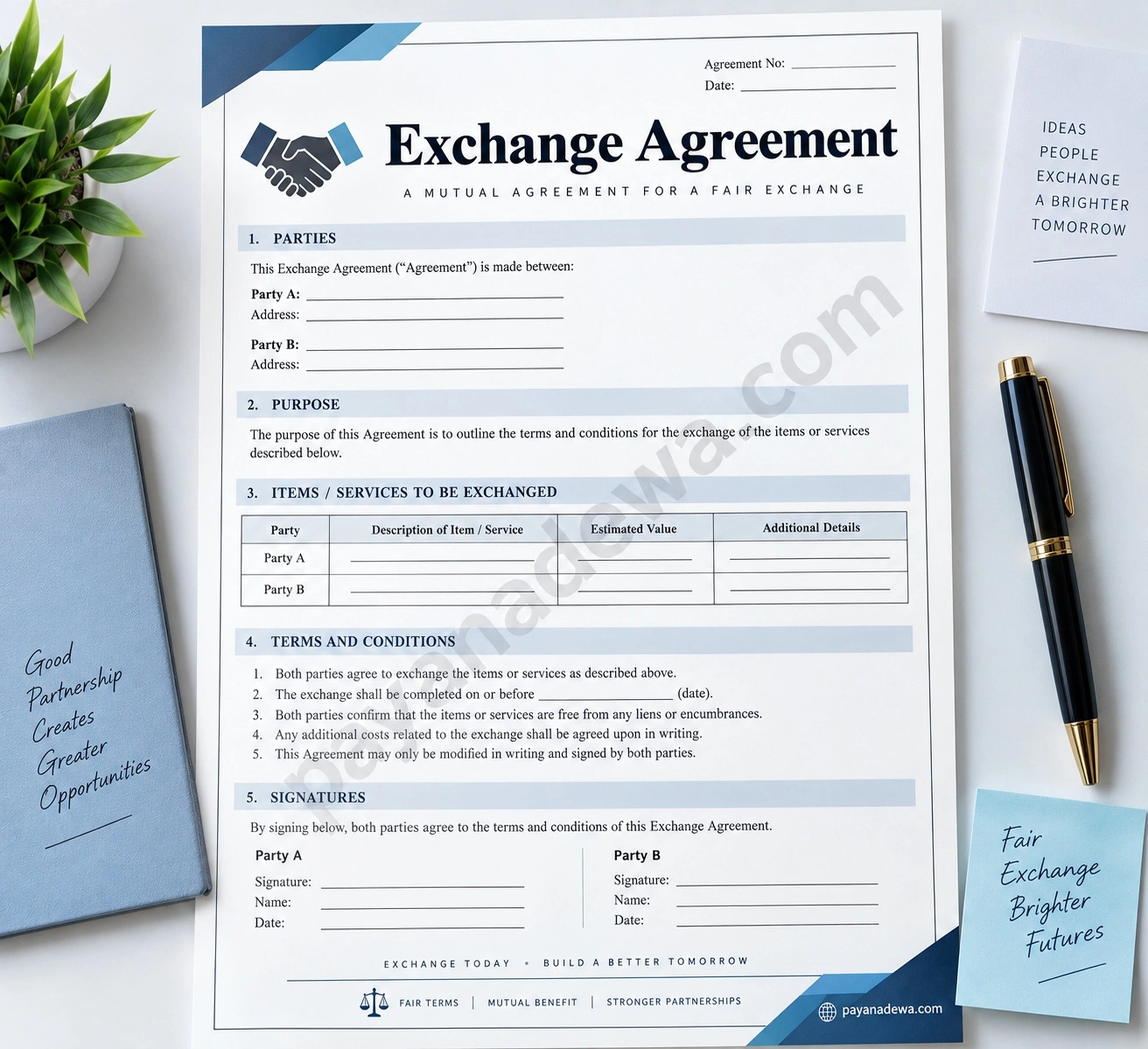
1. Parties to the Agreement
Begin by identifying everyone involved in the exchange. For businesses, this may include the legal business name, address, and the name or role of the authorized representative. For individuals, the template may simply require names and contact information.
2. Purpose of the Exchange
A short purpose statement explains the reason for the arrangement. Keep this section specific enough to provide context without adding unnecessary language.
3. Description of the Exchange
This is one of the most important parts of the document. Describe the goods, services, assets, or other value being exchanged. Specific descriptions can make the agreement easier to understand and administer.
For example, instead of writing “marketing services,” the agreement could identify the expected deliverables, such as a defined number of promotional posts, design assets, or consulting sessions.
4. Timing and Delivery
Specify important dates and deadlines. If the exchange occurs in stages, identify the expected schedule for each stage. Depending on the transaction, the agreement may also address delivery locations, methods, acceptance requirements, or completion criteria.
5. Terms and Conditions
This section can contain additional rules governing the exchange. The parties may address quality requirements, permitted use, confidentiality, ownership, cancellation, expenses, responsibilities, or other relevant conditions.
6. Signatures
Signature blocks provide a place for the parties to confirm their agreement. Include names, signatures, roles when applicable, and dates. Electronic signatures may also be appropriate depending on the circumstances and applicable requirements.
Common Uses for Exchange Agreement Templates
Exchange agreements can be adapted for many different situations. Common examples include business-to-business arrangements, professional services, creative collaborations, and asset exchanges.
- Trading products between businesses
- Exchanging professional services
- Barter arrangements
- Marketing and promotional collaborations
- Creative service exchanges
- Business resource exchanges
- Equipment or asset exchanges
- Collaborative projects involving multiple deliverables
The template should be customized according to the actual transaction rather than used as a one-size-fits-all legal document.
How to Customize an Exchange Agreement Template
Start With the Parties and Purpose
Enter the correct legal names of the parties and describe the purpose of the arrangement. Double-check spelling and business details before finalizing the document.
Describe Each Side of the Exchange Clearly
Write down exactly what each party is expected to provide. When possible, include measurable quantities, specifications, deliverables, dates, or acceptance criteria.
Clarify Responsibilities
Make sure each party’s responsibilities are easy to identify. Avoid vague language that could create different interpretations. If one party must provide information, materials, access, payment for expenses, or approvals, consider documenting those responsibilities.
Review the Completed Agreement
Before signing, both parties should carefully review the document. Confirm that names, descriptions, dates, quantities, responsibilities, and other important terms are accurate.
Tips for Creating a Professional Exchange Agreement
A professional agreement should be easy to read and practical to use. The following tips can improve the quality of your document.
- Use clear language: Write terms that the parties can understand without unnecessary complexity.
- Be specific: Include measurable details wherever possible.
- Avoid contradictions: Check that dates and obligations do not conflict with one another.
- Keep records: Store the signed agreement and supporting documents in a secure location.
- Document changes: Keep written records of approved modifications.
- Review unusual transactions: Consider obtaining professional legal advice when the arrangement involves significant value or complex obligations.
Exchange Agreement Template vs. Informal Arrangement
An informal arrangement may be convenient for simple exchanges between people who already know each other. However, relying entirely on informal communication can make it harder to establish exactly what was agreed upon if questions arise later.
An exchange agreement provides a centralized written record. It can identify the parties, describe the exchange, establish deadlines, and document additional conditions. This does not automatically make every agreement legally enforceable in every jurisdiction, but it can provide useful documentation of the parties’ intended arrangement.
When Should You Use an Exchange Agreement?
Consider using a written exchange agreement when the transaction involves meaningful value, multiple obligations, deadlines, business interests, intellectual property, or responsibilities that could be misunderstood.
For very simple exchanges, a shorter written document may be sufficient. For complex arrangements, additional provisions may be necessary. The more significant the transaction, the more important it becomes to make the terms precise and appropriate to the circumstances.
Frequently Asked Questions About Exchange Agreement Templates
What is an Exchange Agreement Template?
An Exchange Agreement Template is a reusable document framework for recording the terms of an exchange between parties. It can include sections for party information, exchanged goods or services, responsibilities, conditions, dates, and signatures.
Can I customize an Exchange Agreement Template?
Yes. Templates are generally intended to be customized. Replace placeholder information with the actual details of the transaction and add or remove sections as appropriate.
Does an exchange agreement need signatures?
Many written agreements include signature sections so the parties can indicate their acceptance of the documented terms. Whether signatures are legally required depends on the nature of the agreement and applicable law.
Can an exchange agreement be used for services?
Yes. An exchange agreement can be adapted for services, including arrangements where one professional provides services in return for services, products, or another agreed form of value.
Is an Exchange Agreement Template a legal document?
A template is a starting point for preparing an agreement, not a substitute for legal advice. The legal effect of a completed agreement depends on its wording, the circumstances, and the laws that apply to the transaction.
Final Thoughts on Exchange Agreement Templates
Exchange Agreement Templates provide a practical way to organize the details of a mutual exchange. By clearly identifying the parties, describing what will be exchanged, establishing responsibilities, documenting timing, and providing signature sections, a template can help create a more structured business or personal arrangement.
The most effective template is one that accurately reflects the specific transaction rather than simply being copied without review. Take time to customize the document, confirm every important detail, and obtain appropriate professional advice when the agreement involves significant risks or complex legal requirements.
With a clear structure and carefully reviewed terms, an Exchange Agreement Template can serve as a useful foundation for documenting mutually agreed responsibilities and expectations.