Creating a professional Accountant CV is an important step toward securing your next accounting job. Whether you are a recent graduate or an experienced financial professional, your CV should demonstrate your technical knowledge, attention to detail, and ability to manage financial information accurately.
Recruiters often receive hundreds of applications for accounting positions. Therefore, a well-organized CV can help you stand out from other candidates. It should highlight your qualifications, relevant experience, accounting software skills, and measurable achievements.
In this guide, you will learn how to write an effective accountant resume, choose the right format, highlight essential skills, and present your professional experience. You will also find practical examples and tips to help you create a CV that attracts employers.
What Is an Accountant CV?
An Accountant CV is a professional document that summarizes your education, work experience, technical abilities, certifications, and career achievements. It helps employers evaluate whether you have the knowledge and experience required for an accounting position.
A strong accounting CV should communicate more than your previous job responsibilities. It should also demonstrate how your work contributed to financial accuracy, improved reporting processes, reduced costs, or supported business decisions.
Depending on your career goals, you may create a CV for several accounting positions, including:
- Staff Accountant
- Senior Accountant
- Junior Accountant
- Financial Accountant
- Management Accountant
- Tax Accountant
- Accounts Payable Specialist
- Accounts Receivable Specialist
- Auditor
- Accounting Manager
Although these positions share similar responsibilities, each requires different strengths. Tailor your CV to the specific job description whenever possible.
What to Include in an Accountant CV
A professional accountant resume should be easy to read and logically organized. Each section should provide relevant information that helps recruiters understand your qualifications.
1. Contact Information
Begin your CV with your essential contact details. Make it easy for employers to reach you for an interview.
- Full name
- Professional email address
- Phone number
- City and country
- LinkedIn profile, if available
Avoid including unnecessary personal information. Your home address, identification number, marital status, and other sensitive details are generally not required unless an employer specifically requests them.
2. Professional Summary
Your professional summary should introduce your accounting background in three or four sentences. Highlight your experience, strongest technical skills, and most relevant accomplishments.
Example for an experienced accountant:
“Detail-oriented Accountant with over five years of experience in financial reporting, general ledger management, budgeting, and tax compliance. Skilled in Microsoft Excel, QuickBooks, and financial analysis. Proven ability to improve reporting accuracy, streamline accounting procedures, and support strategic business decisions.”
Example for an entry-level accountant:
“Motivated Accounting graduate with a strong understanding of financial reporting, bookkeeping, and basic taxation. Proficient in Microsoft Excel and familiar with accounting software. Eager to apply analytical skills and academic knowledge in a professional accounting environment.”
3. Work Experience
Your employment history is one of the most important parts of an Accountant CV. List your previous positions in reverse chronological order, starting with your most recent role.
For each position, include:
- Job title
- Company name
- Employment dates
- Key responsibilities
- Measurable accomplishments
Use action verbs such as managed, prepared, analyzed, reconciled, monitored, and improved. These words make your experience sound more specific and professional.
Example:
Senior Accountant | ABC Financial Services
January 2021 – Present
- Prepare monthly and annual financial statements in accordance with applicable accounting standards.
- Manage general ledger accounts and perform monthly reconciliations.
- Monitor operating expenses and support annual budgeting activities.
- Coordinate internal and external audit requirements.
- Improve financial reporting procedures to increase accuracy and efficiency.
Whenever possible, include numbers to demonstrate your impact. For example, mention how much you reduced processing time or improved reporting accuracy. Only include figures that you can confidently support.
4. Education
List your educational qualifications, starting with the highest or most recent degree. Include your institution, qualification, and graduation year.
Example:
- Bachelor of Accounting, University of Indonesia, 2022
- Diploma in Accounting, Business College, 2019
Recent graduates can also include relevant coursework, academic projects, internships, and honors.
5. Accounting Skills
Employers look for candidates who combine accounting knowledge with strong analytical and communication abilities. Your skills section should reflect the requirements of the position.
Technical accounting skills:
- Financial reporting and analysis
- General ledger management
- Accounts payable and receivable
- Bank reconciliation
- Budget preparation and forecasting
- Tax preparation and compliance
- Auditing and internal controls
- Payroll processing
- Cost accounting
Software and digital skills:
- Microsoft Excel
- QuickBooks
- SAP
- Xero
- Oracle Financials
- Microsoft Office
Soft skills:
- Attention to detail
- Analytical thinking
- Problem-solving
- Time management
- Communication
- Organization
- Teamwork
Prioritize the skills mentioned in the job advertisement. Avoid listing software or qualifications you have never used.
6. Certifications and Professional Memberships
Professional certifications can strengthen your accountant resume. They demonstrate your commitment to learning and developing industry knowledge.
Depending on your career path and location, relevant qualifications may include:
- Certified Public Accountant (CPA)
- Association of Chartered Certified Accountants (ACCA)
- Certified Management Accountant (CMA)
- Chartered Accountant (CA)
- Certified Internal Auditor (CIA)
Only list certifications you have earned. If you are currently studying for a qualification, clearly indicate that it is in progress.
Accountant CV Template and Example
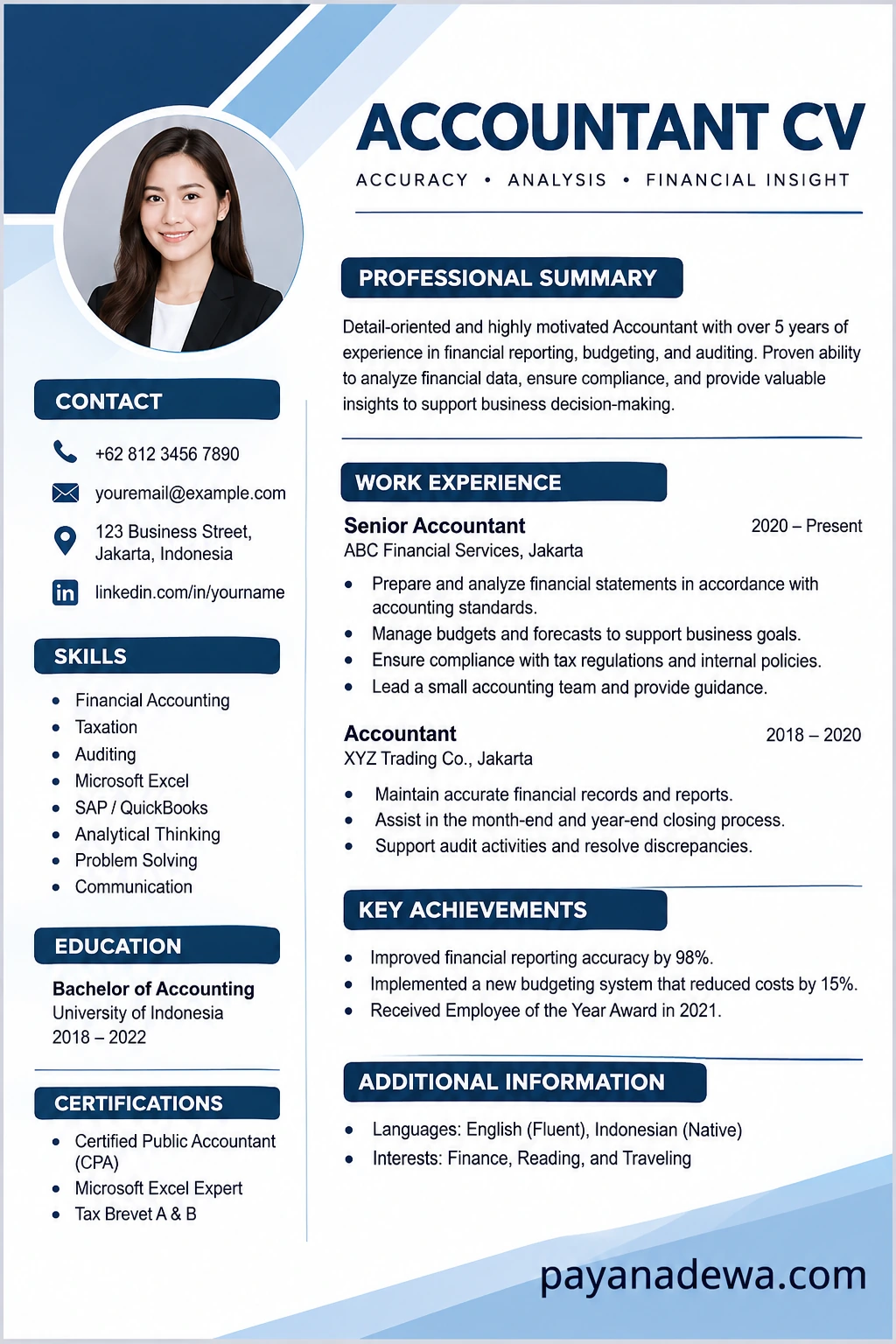
Using a professional CV template can make the writing process easier. A good template provides a consistent structure and ensures that important information is easy to find.
Below is a simple example of how to organize your accounting resume.
Professional Accountant CV Example
- Name: Your Full Name
- Job Title: Professional Accountant
- Email: [email protected]
- Phone: Your Contact Number
- Location: Your City, Country
Professional Profile
Experienced accounting professional with a background in financial reporting, bookkeeping, tax compliance, and financial analysis. Strong knowledge of accounting principles and financial software, with excellent organizational and problem-solving abilities.
Employment History
- Senior Accountant – ABC Company (2022–Present)
- Junior Accountant – XYZ Company (2020–2022)
Education
- Bachelor’s Degree in Accounting
Key Skills
- Financial reporting
- Microsoft Excel
- Bookkeeping
- Tax preparation
- Account reconciliation
Customize this structure using your actual qualifications and professional achievements. A template should guide your presentation, not replace your personal experience.
How to Write an Accountant CV With No Experience
Starting an accounting career without professional experience can feel challenging. However, employers also consider education, practical knowledge, internships, and transferable skills.
Instead of focusing on your lack of employment history, highlight evidence of your accounting abilities.
Highlight Your Academic Background
Include relevant subjects such as financial accounting, auditing, taxation, business finance, and management accounting. Mention academic projects that demonstrate your ability to analyze financial information.
Include Internships and Volunteer Work
Internships, student organizations, and volunteer activities can demonstrate practical experience. For example, managing event budgets or maintaining financial records for a student organization can provide useful evidence of your skills.
Demonstrate Your Technical Knowledge
List accounting software and spreadsheet tools you understand. You can also mention relevant online courses and professional training programs.
Most importantly, write a professional summary that focuses on your potential, accuracy, willingness to learn, and understanding of accounting principles.
Tips to Make Your Accountant CV Stand Out
A well-written CV should communicate your value quickly. Use these practical tips to improve your application.
1. Customize Your CV for Each Job
Read the job description carefully before submitting your application. Identify the required qualifications, responsibilities, and software knowledge. Then adjust your professional summary and skills section to match the position.
2. Use Measurable Achievements
Recruiters appreciate specific results. Instead of simply stating that you prepared financial reports, explain how your work improved accuracy, reduced errors, or saved time.
3. Choose a Professional Layout
Use clear headings, readable fonts, and consistent spacing. Avoid excessive colors, decorative graphics, and complicated layouts that distract from your qualifications.
4. Optimize Your CV for Applicant Tracking Systems
Many employers use Applicant Tracking Systems (ATS) to organize and screen applications. A simple, readable format can help these systems identify your qualifications.
For better ATS compatibility:
- Use standard section headings.
- Include relevant accounting keywords naturally.
- Avoid placing essential information inside images.
- Use a clean, single-column layout when possible.
- Follow the employer’s requested file format.
Remember that no particular template guarantees ATS approval. The quality and relevance of your content remain essential.
5. Proofread Before Submitting
Accounting requires accuracy, and your CV should reflect that quality. Check spelling, grammar, dates, company names, and numerical information carefully.
Ask someone you trust to review your document before sending it to potential employers.
Common Accountant CV Mistakes to Avoid
Even qualified candidates can weaken their applications through avoidable mistakes. Pay attention to these common problems:
- Using a generic CV: Customize your content for the specific accounting position.
- Including irrelevant details: Focus on qualifications and experience related to the job.
- Writing long paragraphs: Use concise descriptions and bullet points.
- Ignoring achievements: Show the results of your work instead of listing duties alone.
- Exaggerating skills: Be honest about your software knowledge and professional experience.
- Using an unprofessional email: Choose a simple email address that includes your name.
- Submitting an unedited document: Check formatting and spelling before applying.
Avoiding these mistakes can make your CV more professional and easier for recruiters to evaluate.
What Is the Best Format for an Accountant CV?
The reverse chronological format is often a practical choice for accounting professionals. It places your most recent experience first, allowing employers to understand your career progression quickly.
However, other formats may be suitable depending on your background.
- Reverse chronological: Best for candidates with consistent accounting experience.
- Functional: Useful for emphasizing relevant skills when employment history is limited, although some recruiters prefer traditional formats.
- Combination: Suitable for professionals who want to highlight both technical skills and employment history.
For most applicants, a clean and straightforward layout is a reliable starting point. Keep your CV focused, relevant, and easy to scan.
Final Thoughts on Creating a Professional Accountant CV
A strong Accountant CV can help you communicate your professional value and move closer to your career goals. By presenting your education, accounting skills, work experience, and measurable achievements clearly, you make it easier for employers to recognize your potential.
Start with a professional summary, organize your employment history, and highlight relevant technical abilities. Then customize your CV for each position and proofread the document carefully before submitting it.
Whether you are applying for your first accounting job or pursuing a senior position, a well-structured accountant resume can make a positive impression. Use a professional template as your starting point, add your genuine accomplishments, and create a CV that reflects your strengths with confidence.