However, writing a CV as a college student can feel challenging, especially when you have limited professional experience. You might wonder what information to include, how to organize your achievements, and how to present your academic background professionally.
The good news is that you do not need years of work experience to create an impressive CV. Your education, academic projects, volunteer activities, extracurricular involvement, technical skills, and personal achievements can all demonstrate your potential.
In this guide, you will learn how to create a professional college student CV, what sections to include, how to describe your experience, and how to make your application more attractive to recruiters. You will also find practical examples and a free college CV template to help you get started.
What Is a College CV?
A college CV, or curriculum vitae, is a professional document that presents your educational background, skills, experience, achievements, and qualifications. College students typically use it when applying for internships, entry-level positions, scholarships, academic programs, and other professional opportunities.
Unlike an experienced professional’s CV, a student CV often places greater emphasis on education, academic accomplishments, relevant coursework, extracurricular activities, and transferable skills.
Its main purpose is to show potential employers or academic institutions what you can contribute, even if you have not yet developed an extensive employment history.
Depending on the country and application requirements, the terms CV and resume may have different meanings. In the United States, a resume is generally shorter and tailored to a specific job, while an academic CV can be more comprehensive. In many other countries, CV is the standard term for a job application document.
Why Do College Students Need a Professional CV?
A professional CV is more than a list of your qualifications. It is an opportunity to communicate your strengths and demonstrate your readiness for new challenges.
Here are several reasons why creating a college CV is worthwhile:
- Apply for internships: Present your education, relevant skills, and projects to organizations offering internship opportunities.
- Find part-time jobs: Show employers that you have the communication, organization, and teamwork skills needed in the workplace.
- Secure scholarships: Highlight your academic performance, leadership experience, awards, and extracurricular involvement.
- Build professional connections: Share your qualifications with professors, recruiters, mentors, and potential employers.
- Prepare for graduation: Develop a professional document that you can update as your experience grows.
More importantly, preparing your CV early helps you understand your strengths. It also encourages you to recognize achievements that you might otherwise overlook.
What to Include in a College CV
A strong college student CV should be organized, easy to read, and relevant to the opportunity you are pursuing. You do not need to include every detail about your life. Instead, focus on information that demonstrates your qualifications.
1. Contact Information
Start your CV with your full name and professional contact details. Make it easy for recruiters to reach you.
Include the following information:
- Full name
- Professional email address
- Phone number with the appropriate country code
- City and country
- LinkedIn profile, if available
- Portfolio or personal website, when relevant
Avoid unnecessary personal details such as your identification number, marital status, or full home address unless the application specifically requires them.
2. Professional Summary or Career Objective
A professional summary is a short introduction that explains who you are, what you study, and what you can offer. For students with limited experience, a career objective can also communicate your professional interests and goals.
For example:
Example: “Motivated Business Administration student with strong communication, analytical, and organizational skills. Experienced in academic research, group projects, and student organization activities. Seeking an internship opportunity to apply classroom knowledge and develop practical business experience.”
Keep this section concise. Aim for two to four sentences that connect your qualifications to the opportunity.
3. Education
Education is one of the most important sections of a college CV. Since you may have limited professional experience, your academic background helps demonstrate your knowledge and commitment.
Include:
- Name of your college or university
- Degree or academic program
- Major or field of study
- Expected graduation date or graduation year
- GPA, if strong and relevant
- Academic honors or relevant coursework
Example:
Bachelor of Science in Computer Science
Springfield University
Expected Graduation: May 2027
Relevant Coursework: Programming, Database Management, Web Development, and Data Structures.
If you have received academic awards or scholarships, consider including them here or in a separate achievements section.
4. Work Experience and Internships
Do not worry if you have never held a full-time job. Part-time employment, internships, freelance assignments, and temporary positions can all demonstrate valuable experience.
For each position, provide:
- Job title or internship position
- Company or organization name
- Employment dates
- Two to four bullet points describing your responsibilities and accomplishments
Use action verbs such as managed, assisted, organized, developed, researched, coordinated, and supported.
Example:
Marketing Intern
ABC Digital Agency | June 2025 – August 2025
- Assisted with social media content planning and campaign preparation.
- Conducted competitor research to identify marketing trends.
- Collaborated with team members to prepare weekly performance reports.
Whenever possible, include measurable results. For example, explain how many events you organized, how many participants you supported, or how much work you completed.
5. Skills and Competencies
Your skills section should highlight abilities that are relevant to your target opportunity. A balanced CV includes both technical and interpersonal skills.
Technical skills may include:
- Microsoft Word, Excel, and PowerPoint
- Graphic design software
- Programming languages
- Data analysis
- Social media management
- Research and presentation tools
Soft skills may include:
- Communication
- Problem-solving
- Teamwork
- Time management
- Adaptability
- Leadership
Only list skills you can genuinely demonstrate. If possible, connect each important skill to an experience, project, or achievement elsewhere in your CV.
6. Academic Projects and Research
Academic projects are especially valuable for students who do not have much employment experience. They demonstrate your ability to apply classroom knowledge to practical situations.
Include projects that are relevant to the position you want. Describe the project’s purpose, your contribution, and the outcome.
Example:
Student Portfolio Website
Computer Science Department | 2025
- Developed a personal portfolio website using HTML, CSS, and JavaScript.
- Created responsive layouts for desktop and mobile devices.
- Improved practical knowledge of front-end development and website design.
If you have completed research papers, laboratory work, presentations, or collaborative assignments, consider including your strongest examples.
7. Extracurricular Activities and Volunteer Experience
Participation in student organizations, campus events, volunteer programs, and community activities can reveal qualities that employers value.
For example, joining a student association may demonstrate leadership and teamwork. Volunteering at community events may show communication skills, responsibility, and initiative.
Include the organization name, your position, dates of involvement, and a short description of your contribution.
8. Awards, Certifications, and Achievements
Use this section to showcase accomplishments that strengthen your application.
Examples include:
- Academic excellence awards
- Scholarships
- Professional certifications
- Competition achievements
- Leadership recognition
- Online course certificates
Whenever possible, mention the organization that issued the award and the year you received it.
College CV Template: A Simple and Professional Example
Using a ready-made template can make the writing process easier. A good college CV template provides a clear structure, consistent formatting, and enough space to present your qualifications.
The following example shows how you can organize your information into a professional student CV. Replace the sample information with your own details before submitting your application.
Recommended College CV Template:
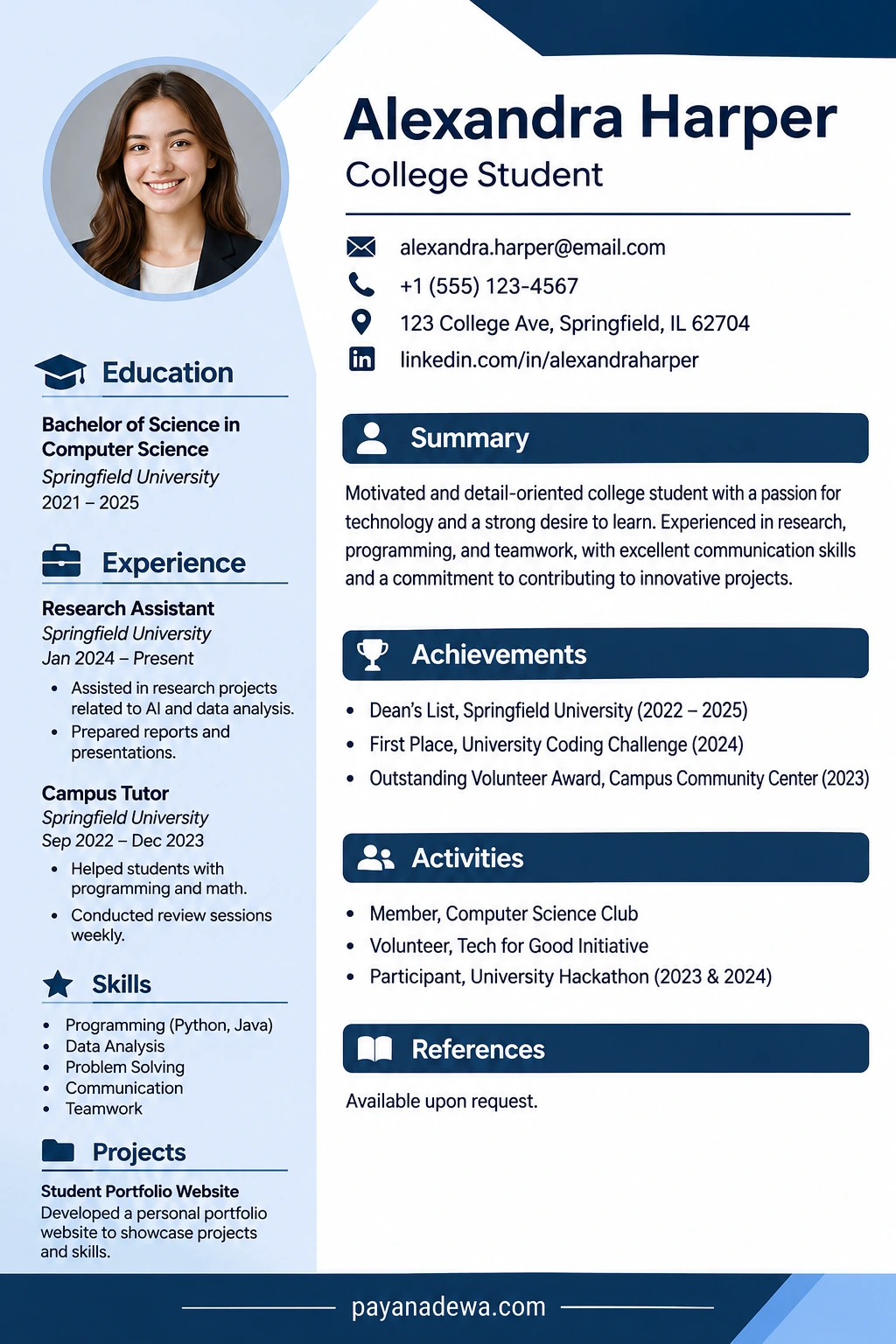
When using this template, keep the information relevant to your target position. You can remove sections that do not apply to your background and add other relevant sections when necessary.
How to Write a College CV With No Work Experience
One of the biggest challenges for college students is creating a CV without a formal employment history. Fortunately, employers understand that students are still developing their professional experience.
The key is to demonstrate your potential through relevant activities and accomplishments.
Focus on Transferable Skills
Think about the abilities you have developed through your studies, group assignments, presentations, and extracurricular activities. Communication, research, organization, and problem-solving are examples of transferable skills that apply to many professional environments.
Highlight Academic Projects
Choose projects that demonstrate practical knowledge. Explain your responsibilities and the skills you used to complete each assignment.
Include Volunteer Experience
Volunteer activities can provide valuable examples of responsibility, teamwork, and community involvement. Even short-term experiences may strengthen your application when described clearly.
Showcase Online Learning
Online courses and relevant certifications demonstrate initiative. Include completed programs from reputable educational platforms, particularly when they relate to your desired career.
Remember, a strong student CV is not about having the longest experience list. It is about presenting your most relevant qualifications effectively.
Tips for Creating an Outstanding College CV
After completing your content, take time to improve the design and overall presentation. A professional CV should be attractive without becoming difficult to read.
- Keep the layout simple: Use clear headings, consistent spacing, and readable fonts.
- Choose an appropriate length: For many internship and entry-level applications, one page is a practical starting point. Use additional pages when relevant experience requires them.
- Customize your CV: Adjust your summary, skills, and experience to match each opportunity.
- Use action verbs: Start bullet points with strong verbs that describe what you accomplished.
- Include relevant keywords: Review the job description and naturally incorporate skills and qualifications that genuinely match your background.
- Check spelling and grammar: Proofread carefully to avoid mistakes that may affect your professional impression.
- Use a professional email: Choose an email address that includes your name rather than an informal nickname.
- Save your document as PDF: Unless the employer requests another format, PDF helps preserve your formatting across devices.
Also, consider how applicant tracking systems (ATS) process documents. A simple, single-column layout with standard section headings is generally easier for these systems to read. Avoid excessive graphics, complicated tables, and decorative elements that may interfere with text extraction.
Common College CV Mistakes to Avoid
Even a well-qualified student can weaken an application through avoidable CV mistakes. Before sending your document, review it for these common problems.
- Including irrelevant information: Focus on qualifications that support your application.
- Using a generic objective: Explain your interests and how they relate to the opportunity.
- Exaggerating experience: Be honest about your responsibilities, achievements, and skill level.
- Ignoring formatting: Inconsistent fonts, spacing, and headings can make your CV difficult to read.
- Writing long paragraphs: Use concise descriptions and bullet points to improve readability.
- Forgetting contact details: Check that your email address and phone number are correct.
- Submitting the wrong file: Follow the employer’s instructions for document format and file naming.
A final review can make a significant difference. Ask a professor, career adviser, or trusted friend to check your CV before submitting it.
Frequently Asked Questions About College CVs
How long should a college CV be?
For most internship and entry-level applications, one page is a useful target. However, students with substantial research, academic publications, or relevant experience may need additional pages. Follow the requirements of the organization or institution.
Should college students include their GPA on a CV?
You can include your GPA if it is strong, relevant, or specifically requested by the employer. If it does not strengthen your application, you can leave it out and emphasize other academic accomplishments instead.
Can I create a college CV without work experience?
Yes. You can use academic projects, volunteer activities, extracurricular involvement, certifications, and transferable skills to demonstrate your abilities. Formal employment is not a requirement for creating a useful student CV.
What is the best format for a college student CV?
A clean, professional layout with clearly labeled sections is a reliable choice. Use readable fonts, consistent spacing, and a logical order. For online applications, a simple layout that supports ATS readability is often preferable.
Should I include a photo in my college CV?
It depends on the country, industry, and application requirements. In some countries, photographs are commonly included. In others, employers prefer CVs without photographs to support fair recruitment practices. Always check local expectations before adding one.
Conclusion
Creating an impressive College CV does not require years of professional experience. With the right structure and carefully selected information, you can present your academic background, skills, projects, volunteer activities, and achievements in a professional way.
Start by identifying your strongest qualifications. Next, organize your information into clear sections, use concise descriptions, and customize your document for each opportunity. Finally, proofread everything and choose a clean layout that makes your qualifications easy to understand.
Most importantly, do not wait until graduation to prepare your CV. Building it while you are still in college gives you more time to identify opportunities, develop new skills, and strengthen your professional profile.
Use a professional college CV template as your starting point, personalize it with your own accomplishments, and take the next step toward your academic and career goals.