A well-designed Corporate CV is essential for anyone who wants to build a successful career in today’s competitive business environment. Whether you are applying for a management position, an office role, a finance opportunity, or an executive position, your CV should communicate your professional value clearly and confidently.
Recruiters often receive hundreds of applications for a single vacancy. Therefore, a professional CV must do more than list your previous jobs and qualifications. It should highlight your achievements, demonstrate your expertise, and show employers why you are the right candidate.
In this guide, you will discover how to create an effective corporate resume, what information to include, how to organize each section, and how to make your application stand out. You will also find practical tips and a corporate CV template to help you get started.
What Is a Corporate CV?
A Corporate CV is a professional document that presents your employment history, qualifications, skills, and career achievements in a structured format. It is commonly used when applying for positions in established companies, financial institutions, multinational organizations, and other professional business environments.
Unlike a creative resume, which may use colorful graphics and unconventional layouts, a corporate CV typically follows a clean and organized design. Its main purpose is to make your professional experience easy to understand.
A strong corporate CV usually includes:
- Personal information: Your name, professional email address, phone number, and location.
- Professional summary: A short introduction describing your experience and career strengths.
- Work experience: Previous positions, responsibilities, and measurable achievements.
- Education: Academic qualifications, degrees, and relevant certifications.
- Professional skills: Technical abilities and important workplace competencies.
- Additional information: Languages, professional memberships, or relevant training.
Each section should provide useful information without overwhelming the reader. Remember, clarity and relevance are more important than unnecessary design elements.
Why a Professional Corporate CV Matters
Your CV is often the first impression an employer has of you. Before meeting you in person, recruiters use this document to evaluate your qualifications and decide whether your background matches their requirements.
A professional corporate resume offers several important benefits.
1. Creates a Strong First Impression
A clean layout, consistent formatting, and well-written content immediately communicate professionalism. Employers can quickly identify your experience and understand your career background.
2. Highlights Your Professional Value
A good CV focuses on results rather than simply listing daily responsibilities. For example, instead of writing that you managed customer accounts, explain how you improved customer retention or increased sales performance.
3. Supports Applicant Tracking Systems
Many companies use Applicant Tracking Systems (ATS) to organize and screen applications. A simple, text-based CV with clear headings and relevant keywords can make it easier for these systems to identify your qualifications.
4. Demonstrates Attention to Detail
Accurate information, consistent dates, and professional language show that you take your career seriously. These qualities are especially important for corporate positions that require organization and communication skills.
Essential Sections to Include in a Corporate CV
Before choosing a design, organize the information that employers need to see. A logical structure makes your application easier to read and improves its overall impact.
1. Professional Header and Contact Details
Start with your full name in a prominent position. Underneath, include your professional contact information.
- Full name.
- Professional email address.
- Phone number with the appropriate country code.
- City and country.
- LinkedIn profile or professional portfolio, if relevant.
Avoid unnecessary personal details. Information such as marital status, religion, and identification numbers is generally not required unless an employer specifically requests it and local regulations permit it.
2. Professional Summary
Your professional summary should introduce your experience, strongest qualifications, and career focus in approximately three to five sentences.
For example:
Professional Summary Example: Results-driven business professional with over five years of experience in project coordination, business development, and operational management. Skilled in improving business processes, managing cross-functional teams, and supporting strategic objectives. Strong communication and analytical abilities with a proven commitment to delivering measurable results.
Customize this section for every position you apply for. Focus on the qualifications that matter most to the employer.
3. Work Experience
Work experience is one of the most important parts of a corporate CV. List your employment history in reverse chronological order, starting with your most recent position.
For each role, include:
- Job title.
- Company name and location.
- Employment dates.
- Main responsibilities.
- Important achievements and measurable results.
Use strong action verbs such as managed, developed, coordinated, implemented, improved, and achieved.
Whenever possible, include numbers to demonstrate your contribution. For instance, you could write that you reduced administrative costs by 15% or improved customer satisfaction by 20%.
4. Education and Certifications
List your academic qualifications, starting with the most recent. Include the institution, degree or qualification, and graduation year.
You can also include relevant professional certifications, industry training, and specialized courses. These qualifications help demonstrate your commitment to continuous learning.
5. Professional Skills
Choose skills that match the position you want. A balanced corporate CV should include both technical and interpersonal abilities.
Examples of useful corporate skills include:
- Project management.
- Business communication.
- Leadership and team management.
- Microsoft Office and spreadsheet applications.
- Data analysis and reporting.
- Problem-solving and critical thinking.
- Strategic planning.
- Time management.
- Customer relationship management.
- Financial and administrative management.
Only include skills that you genuinely possess. Be prepared to discuss your abilities during an interview.
How to Choose the Best Corporate CV Template
The right corporate CV template makes your information easier to navigate. However, the most attractive design is not always the most effective one.
For most corporate applications, choose a professional layout that balances appearance and readability.
Keep the Design Simple and Professional
Use a clean layout with sufficient white space. Navy blue, dark gray, black, and white are suitable colors for a professional business document.
Avoid excessive decorations, multiple font styles, and distracting graphics. Your experience and qualifications should remain the main focus.
Choose Readable Fonts
Use professional fonts such as Arial, Calibri, Aptos, or Helvetica. Keep body text consistent, with headings slightly larger to establish a clear visual hierarchy.
Use Consistent Formatting
Make sure your dates, headings, bullet points, and spacing follow the same style throughout the document. Consistency creates a polished appearance and makes information easier to scan.
Consider ATS Compatibility
If you are applying through an online recruitment platform, prioritize an ATS-friendly CV. Use standard section headings, selectable text, and a straightforward layout.
Although visual templates can look impressive, complex tables, decorative icons, text boxes, and multiple columns may sometimes cause parsing problems. A simple single-column version is often a safer choice for online applications.
Corporate CV Template: A Practical Example
Use the following corporate CV layout as a visual reference when preparing your own professional document.
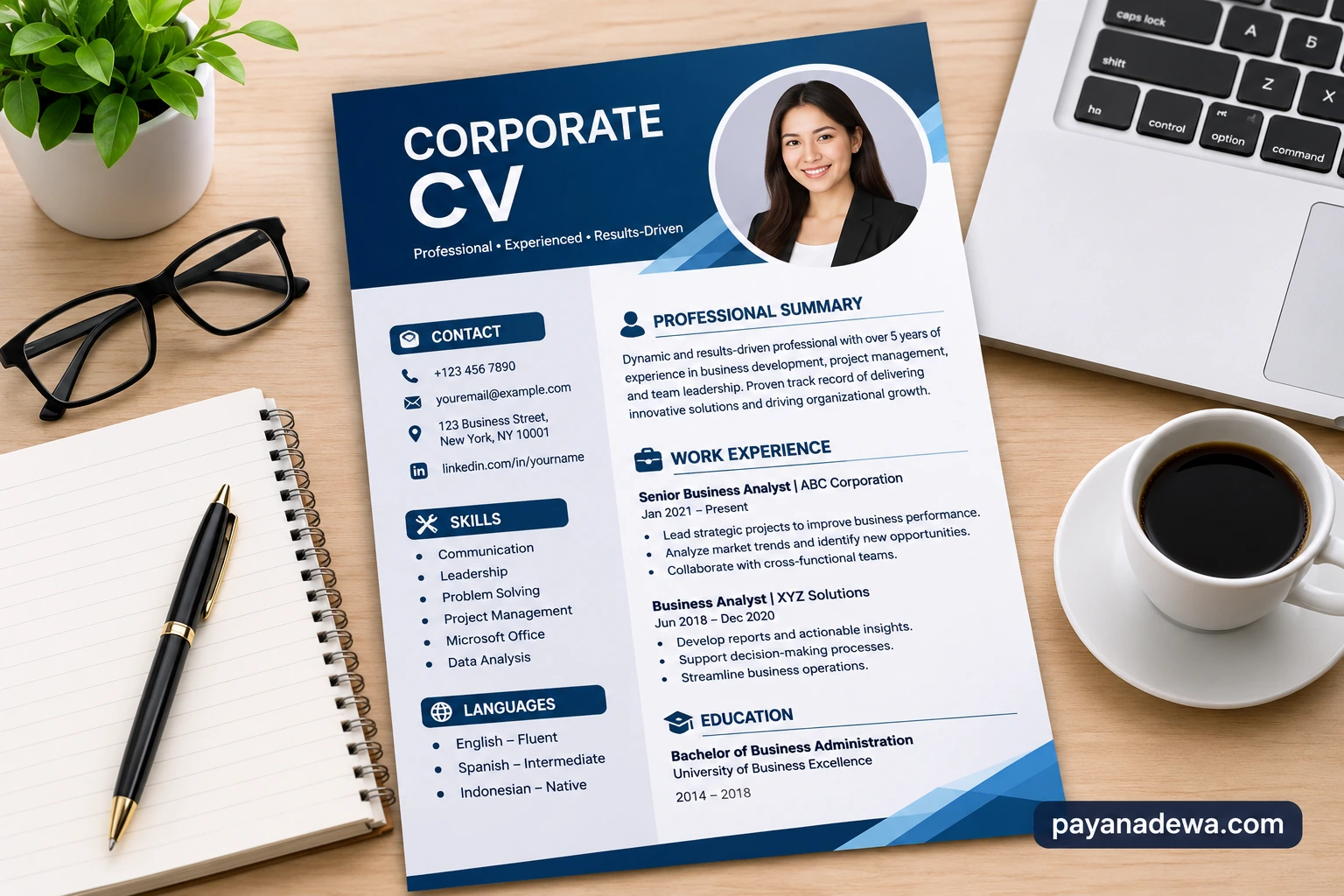
The example demonstrates how to arrange important information into clearly defined sections. You can adapt the structure to match your career level, industry, and target position.
Practical Tips to Make Your Corporate CV Stand Out
A professional design is a good starting point. However, the quality of your content ultimately determines how effectively your CV communicates your value.
Tailor Your CV to Every Job Application
Read the job description carefully before submitting your application. Identify the required qualifications, responsibilities, and skills. Then adjust your professional summary and work experience to reflect the most relevant requirements.
Use Relevant Industry Keywords
Include important terms naturally throughout your CV. For example, business development, project management, financial reporting, operations management, and strategic planning may be relevant to certain corporate positions.
However, avoid repeating keywords unnecessarily. Your content should remain natural and easy to understand.
Focus on Achievements Instead of Duties
Employers want to understand the results you can deliver. Therefore, describe what you accomplished rather than simply explaining your daily tasks.
For example:
- Basic: Responsible for managing company reports.
- Stronger: Developed monthly performance reports that improved management visibility and supported business decisions.
Keep Your CV Concise
For many professionals, one or two pages are sufficient. However, experienced executives and applicants with extensive relevant experience may need additional space.
Remove outdated information and unrelated responsibilities. Every sentence should contribute something valuable to your application.
Proofread Before Sending
Spelling mistakes, incorrect dates, and inconsistent formatting can damage an otherwise excellent application.
Before submitting your CV, check the following:
- All contact details are accurate.
- Employment dates are consistent.
- Job titles and company names are correct.
- Grammar and spelling have been checked.
- All achievements are truthful and supported by your experience.
- The final document opens correctly on different devices.
Common Corporate CV Mistakes to Avoid
Even qualified candidates can weaken their applications through avoidable mistakes. Fortunately, most problems can be corrected with a careful review.
- Using a generic CV: Customize your application for the position instead of sending identical content to every employer.
- Including irrelevant information: Prioritize experience and qualifications that support your career objective.
- Writing long paragraphs: Use concise sentences and bullet points to improve readability.
- Adding too many design elements: Keep the document professional and easy to navigate.
- Exaggerating achievements: Present your experience honestly and use realistic measurements.
- Ignoring ATS requirements: Check the application instructions and use a compatible file format.
By avoiding these mistakes, you can create a more effective application that communicates your professional strengths.
Should You Save Your Corporate CV as PDF or Word?
The best file format depends on the employer’s application requirements.
PDF format is generally suitable when you want to preserve the document’s layout, fonts, and spacing across different devices. It is also convenient for emailing a finished application.
Microsoft Word format may be preferable when an employer specifically requests an editable document or uses a recruitment system that requires DOCX files.
Always follow the employer’s instructions. If there are no specific requirements, a text-based PDF is often a practical option. Keep an editable Word version as your master copy so you can update it whenever necessary.
Conclusion: Create a Corporate CV That Opens Career Opportunities
A professional Corporate CV is more than a summary of your employment history. It is an opportunity to demonstrate your qualifications, communicate your achievements, and show employers the value you can bring to their organization.
Start with a clean and professional template, organize your information into clear sections, and highlight measurable accomplishments. Additionally, customize your CV for each position and review it carefully before submitting your application.
Whether you are starting your corporate career or applying for a senior management position, a well-prepared CV can help you make a stronger first impression. Use the template and practical recommendations in this guide to create a professional resume that reflects your experience, skills, and career ambitions.