Writing your first CV after graduation can feel challenging, especially when you have limited professional experience. You may wonder what employers expect, which skills to highlight, and how to make your application stand out when other candidates have more work experience. The good news is that you do not need years of employment history to create a strong graduate CV.
A well-written graduate CV focuses on your education, transferable skills, academic achievements, internships, volunteering, and personal projects. It demonstrates your potential and shows employers why you are a suitable candidate for an entry-level position. With the right structure and carefully selected information, you can create a professional CV that makes a positive first impression.
In this guide, you will learn how to write a graduate CV step by step, what sections to include, how to describe your achievements, and how to avoid common mistakes. You will also discover practical tips and a graduate CV template to help you prepare an effective job application.
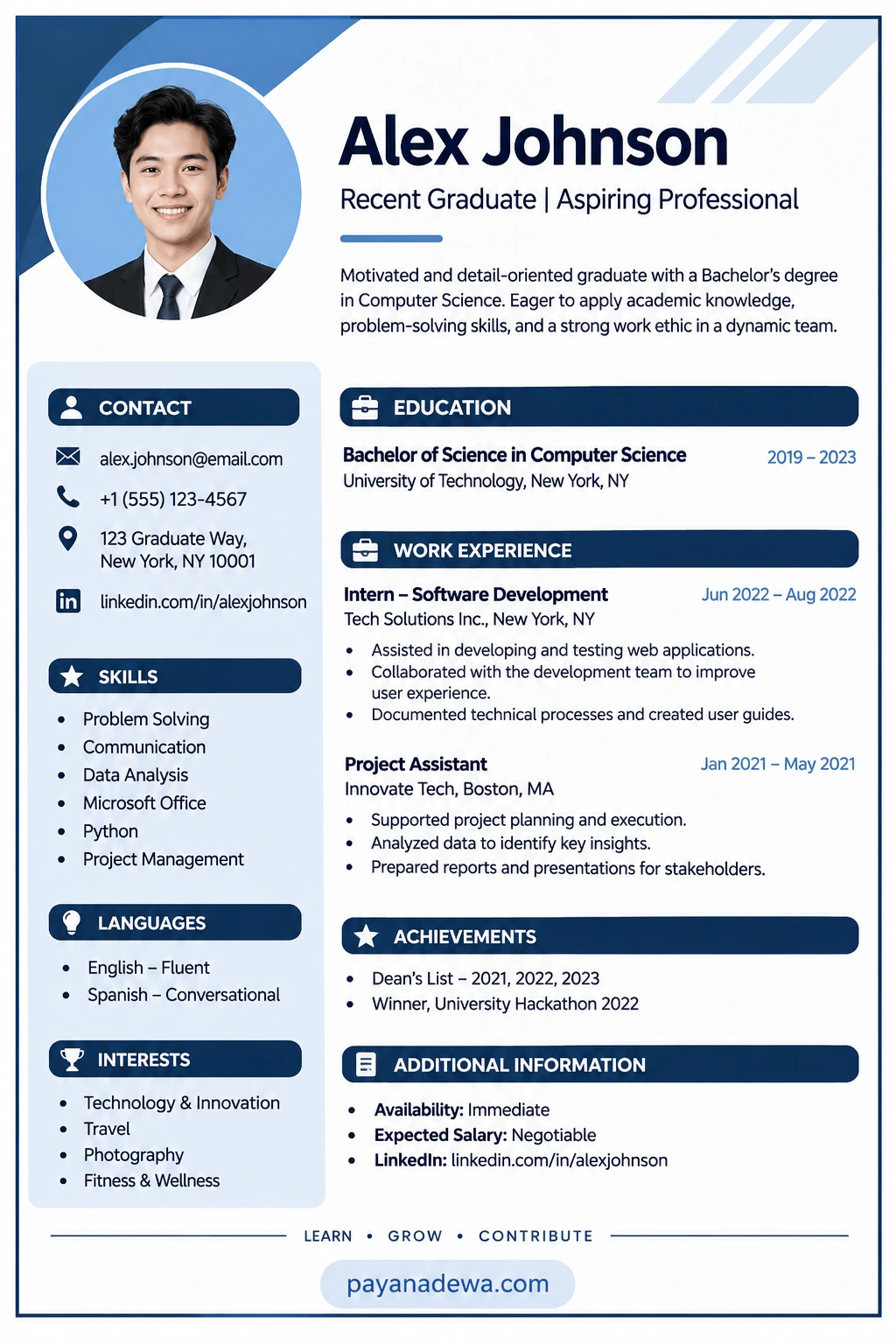
What Is a Graduate CV?
A graduate CV is a professional document that introduces your qualifications, education, skills, and relevant experiences to potential employers. It is commonly used by university graduates and recent college leavers who are applying for their first professional jobs, graduate schemes, internships, or entry-level positions.
Unlike an experienced professional’s CV, a graduate CV does not need to focus heavily on a long employment history. Instead, it highlights evidence of your abilities and potential. This can include university projects, research assignments, extracurricular activities, volunteer work, part-time employment, and relevant training.
The main purpose is to show employers that you have the knowledge, attitude, and transferable skills required to succeed in the workplace.
What to Include in a Graduate CV
A strong graduate CV should be easy to read, logically organized, and relevant to the position you want. Although the exact structure may vary depending on your industry and experience, the following sections are useful for most recent graduates.
1. Contact Information
Start your CV with your essential contact details so recruiters can easily reach you. Include:
- Full name.
- Professional email address.
- Phone number with the appropriate country code.
- City or general location.
- LinkedIn profile URL, if relevant.
- Portfolio or personal website, if applicable.
Keep this section simple and professional. You generally do not need to include sensitive personal information such as your national identification number, marital status, or full residential address unless an employer specifically requests it.
2. Professional Profile or Personal Summary
Your professional profile is a short introduction that explains who you are, what you studied, and what you can offer an employer. Place it near the top of your graduate CV, directly below your contact information.
A good graduate CV summary should be approximately three to four sentences. Mention your degree, relevant strengths, career interests, and the value you could bring to the organization.
Example:
“Motivated Business Administration graduate with strong analytical, communication, and problem-solving skills. Experienced in academic research, collaborative projects, and organizing student activities. Eager to apply business knowledge and develop professional expertise in a dynamic organization.”
Avoid generic statements such as “I am hardworking and looking for a job.” Instead, use specific strengths that relate to the position you are applying for.
3. Education and Academic Qualifications
Education is particularly important in a graduate CV because it may be your strongest qualification. List your most recent qualification first and include relevant details such as:
- Degree or qualification title.
- Name of the university or educational institution.
- Graduation date or expected graduation date.
- Relevant academic achievements.
- Important coursework or specialization.
- Final grade or GPA, when appropriate.
You can also mention a dissertation, thesis, or major research project if it demonstrates skills relevant to the job.
For example, a Computer Science graduate applying for a software development role could highlight programming projects, database coursework, and software engineering assignments.
4. Work Experience, Internships, and Volunteering
Do not worry if you have never held a full-time professional position. Employers understand that recent graduates are often beginning their careers.
Include any experience that demonstrates useful workplace skills, such as:
- Internships and industrial placements.
- Part-time or temporary employment.
- Volunteer activities.
- Student organization responsibilities.
- Freelance assignments.
- Relevant university projects.
For each experience, provide the organization name, role, dates, and two or three bullet points describing your responsibilities and achievements.
Whenever possible, explain the results of your work rather than simply listing duties.
Weak example: Responsible for helping with social media posts.
Stronger example: Assisted with planning and publishing weekly social media content, contributing to improved audience engagement during a three-month internship.
5. Key Skills
Your skills section should demonstrate that you have abilities relevant to the advertised position. Graduate employers often look for a combination of technical knowledge and transferable skills.
Examples of transferable skills include:
- Written and verbal communication.
- Teamwork and collaboration.
- Critical thinking and problem-solving.
- Time management and organization.
- Research and analytical abilities.
- Adaptability and willingness to learn.
Examples of technical skills include:
- Microsoft Excel, Word, and PowerPoint.
- Programming languages such as Python, Java, or JavaScript.
- Data analysis and visualization.
- Graphic design software.
- Digital marketing tools.
- Industry-specific software and applications.
Choose skills that you can demonstrate through your education, projects, or experience. Avoid listing abilities you cannot confidently discuss during an interview.
6. Certifications and Additional Achievements
Certifications can strengthen your graduate CV by showing that you have taken additional steps to develop your knowledge. Include relevant online courses, professional training, workshops, and recognized qualifications.
You can also mention academic awards, scholarships, competition results, leadership positions, and other meaningful achievements.
For example:
- Received an academic excellence award in the final year of university.
- Completed a professional digital marketing certification.
- Led a university team project involving five students.
- Participated in a national business case competition.
Prioritize achievements that demonstrate initiative, responsibility, leadership, or professional knowledge.
How to Write a Graduate CV Without Work Experience
One of the biggest concerns among recent graduates is having little or no professional experience. However, a lack of full-time employment does not mean you have nothing valuable to offer.
The key is to identify experiences that demonstrate your abilities and present them in a way that connects with the job requirements.
Highlight University Projects
University assignments can provide excellent examples of practical experience. Explain the purpose of the project, your contribution, and the skills you developed.
For instance, a marketing graduate could describe a research project that involved analyzing consumer behavior and preparing a marketing strategy. This demonstrates research, communication, and analytical skills.
Include Volunteer and Extracurricular Activities
Volunteering, student clubs, and community activities can demonstrate teamwork, leadership, organization, and communication. Employers often value these experiences because they provide evidence of your ability to work with others and take responsibility.
Showcase Personal Projects
Personal projects are particularly valuable for graduates pursuing careers in technology, design, writing, marketing, and creative industries.
You could include a personal website, programming portfolio, design collection, research blog, or freelance project. Provide a link when possible so recruiters can review your work.
How to Format a Professional Graduate CV
Good formatting makes your CV easier to read and helps recruiters find important information quickly. A professional design should be clean, consistent, and free from unnecessary visual distractions.
Choose a Simple Layout
Use clear section headings, consistent spacing, and an easy-to-read font. Avoid excessive colors, complicated graphics, and decorative elements that distract from your qualifications.
Keep the Length Appropriate
For many recent graduates, a one-page CV is a practical starting point. However, two pages can be appropriate when you have substantial relevant projects, research, internships, or other qualifications. Prioritize useful information rather than trying to fill every available space.
Use Professional Fonts
Choose readable fonts such as Arial, Calibri, Aptos, or Helvetica. Keep the font size consistent and make section headings slightly more prominent than the body text.
Save Your CV in the Correct Format
PDF is generally a good choice because it preserves your document’s layout across different devices. However, always follow the employer’s application instructions. If a company specifically requests a Word document, submit the requested format.
Practical Tips to Make Your Graduate CV Stand Out
A well-structured CV is a good start, but thoughtful customization can make your application more competitive. Use the following tips before submitting your document.
- Tailor every application: Adjust your professional summary, skills, and experience to match the specific job description.
- Use relevant keywords: Include appropriate skills, qualifications, and industry terms that appear in the vacancy description. This can help your CV communicate its relevance to applicant tracking systems.
- Focus on achievements: Explain what you accomplished instead of only describing your responsibilities.
- Use action verbs: Start bullet points with words such as developed, organized, analyzed, coordinated, researched, or implemented.
- Include measurable results: Where possible, use numbers, percentages, or project outcomes to provide evidence of your contribution.
- Proofread carefully: Check grammar, spelling, punctuation, dates, and contact details before sending your CV.
- Maintain consistency: Use the same formatting style, date format, and heading structure throughout the document.
- Be honest: Never exaggerate qualifications, employment history, or technical abilities.
Common Graduate CV Mistakes to Avoid
Even a qualified graduate can weaken an application by making avoidable CV mistakes. Pay attention to these common problems:
- Using one CV for every job: A generic CV may fail to highlight the experience and skills an employer needs.
- Writing a lengthy personal statement: Recruiters need a concise introduction, not a long autobiography.
- Including irrelevant information: Focus on details that support your professional profile and career objectives.
- Using unprofessional email addresses: Create an email address that includes your name or a professional variation.
- Adding unsupported claims: Provide examples that demonstrate your abilities rather than relying on vague descriptions.
- Ignoring formatting and readability: A cluttered document can make important information difficult to find.
- Forgetting to update contact details: Make sure your email address and phone number are correct.
Graduate CV Checklist Before Applying for a Job
Before submitting your application, review your CV using this simple checklist:
- My name and contact information are correct.
- My professional summary clearly explains my strengths.
- My education and qualifications are easy to find.
- My relevant projects, internships, or volunteering are included.
- My skills match the position I am applying for.
- My achievements include specific examples where possible.
- My CV uses a clean and professional layout.
- My document has been checked for spelling and grammar.
- My CV is saved in the format requested by the employer.
- My information is accurate and up to date.
Conclusion
Creating an effective graduate CV is an important step toward starting your professional career. Even if you have limited work experience, you can build a compelling application by highlighting your academic qualifications, transferable skills, university projects, internships, volunteering, and personal achievements.
Remember that a successful CV is not simply a list of everything you have done. It is a carefully organized presentation of the qualities and experience that make you a suitable candidate for a particular position.
Start with a clean graduate CV template, customize your content for each opportunity, and proofread your document before submitting it. With a professional layout and relevant information, you can make a stronger first impression and take a confident step toward your career goals.