Whether you are a manufacturer, supplier, importer, quality manager, or business owner, understanding how a conformance certificate works can help you manage documentation more effectively. It can also reduce misunderstandings during purchasing, production, inspection, and delivery. However, the document’s meaning and legal significance depend on the applicable requirements and who issues it.
In this guide, you will learn what a conformance certificate means, what information it should contain, how it differs from related compliance documents, and how to prepare a practical certificate template for your business.
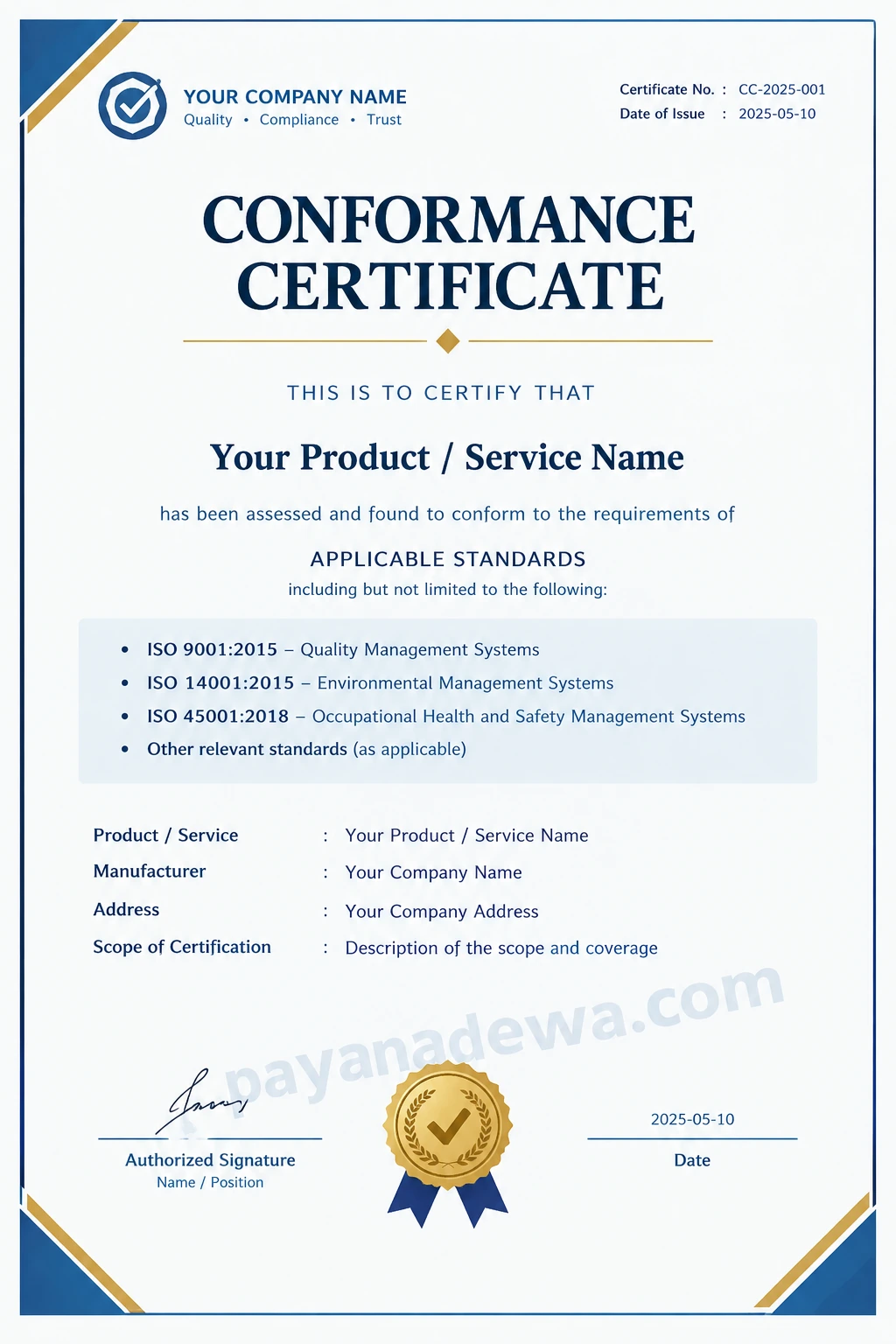
What Is a Conformance Certificate?
A conformance certificate is a formal statement confirming that a specified product, batch, service, material, or process meets identified requirements. It is commonly used in manufacturing, construction, engineering, procurement, international trade, and quality management.
The certificate typically identifies the item being assessed, the applicable specifications or standards, the responsible organization, and the supporting verification information. Depending on the arrangement, it may be issued by a manufacturer, supplier, authorized representative, inspection organization, or certification body.
For example, a manufacturer supplying steel components may provide a certificate stating that a particular batch meets the dimensional and material requirements in a purchase order. A supplier of electrical equipment may provide documentation showing that the product has been assessed against specified safety requirements.
A conformance certificate does not automatically prove compliance with every regulation or guarantee that an independent certification body has inspected the product. Its credibility depends on the evidence, verification process, scope, and authority of the issuer.
Why Is a Conformance Certificate Important?
Clear documentation helps businesses establish trust and demonstrate that agreed requirements have been addressed. A properly prepared certificate can support several important business activities.
- Quality assurance: Records whether products or services meet defined acceptance criteria.
- Customer confidence: Gives buyers documented information about the supplied goods or services.
- Regulatory documentation: Supports compliance records when a particular certificate is required by applicable rules.
- Supply chain management: Helps purchasing and receiving teams verify product identity, batches, and specifications.
- Traceability: Connects a certificate to an order, shipment, inspection report, or production lot.
- Audit preparation: Provides supporting documentation for quality reviews and applicable audits.
- Dispute prevention: Clarifies which requirements were declared to have been met and what evidence supports that declaration.
Although a certificate can simplify verification, it should not replace the inspections, test reports, permits, or independent assessments required for a particular product or industry.
What Information Should a Conformance Certificate Include?
The exact format depends on the product, customer, industry, and applicable standard. Nevertheless, a useful certificate generally contains the following information.
1. Certificate Title and Identification Number
Use a clear title, such as “Certificate of Conformance” or “Conformance Certificate.” Assign a unique certificate number so the document can be tracked, retrieved, and checked against the organization’s records.
2. Issuing Organization Details
Include the company name, business address, and contact information. If the certificate is issued by an authorized representative or independent organization, identify that party and its role accurately.
3. Product or Service Identification
Describe the product, material, service, or process covered by the certificate. Relevant details may include the product name, model number, part number, serial number, batch number, quantity, or purchase order reference.
4. Applicable Standards and Requirements
List the specific standards, technical specifications, contractual requirements, or regulatory provisions used to assess conformance. Include the correct edition or revision where necessary. Do not list a standard simply because it appears relevant; ensure that the claimed requirements actually apply.
5. Verification and Supporting Evidence
Identify the inspection, testing, review, or other verification process used to support the declaration. Where appropriate, reference inspection reports, laboratory results, quality records, or material test certificates. State the scope and limitations of the evidence clearly.
6. Declaration and Authorization
Include a concise statement identifying what has been assessed and which requirements it meets. Add the authorized person’s name, position, signature, and date when required by the relevant procedure or customer agreement.
7. Validity and Scope
Specify the products, batches, services, or activities covered. If the certificate has an expiry date, renewal condition, or other limitation, state it clearly. Not every conformance certificate has a universal expiry period, so avoid adding one without a valid reason.
Conformance Certificate vs. Certificate of Conformity
The terms conformance certificate and certificate of conformity are often used similarly. Both may describe documentation declaring that a product or other specified subject meets defined requirements.
However, terminology can vary between industries, countries, customers, and regulatory systems. Some organizations distinguish between a supplier’s declaration, a certificate issued following independent assessment, and a document specifically prescribed by law.
For that reason, do not assume that two documents are interchangeable just because their names are similar. Check the required document type, issuer qualifications, applicable standards, testing evidence, and acceptance criteria before submitting a certificate.
Who Can Issue a Conformance Certificate?
The authorized issuer depends on the purpose of the certificate and the applicable requirements.
- Manufacturers: May declare that their products meet specified production and technical requirements.
- Suppliers or distributors: May provide certificates when permitted by the customer agreement or relevant rules and supported by appropriate records.
- Inspection organizations: May issue inspection documentation within their authorized scope.
- Testing laboratories: Commonly provide test reports that support a conformance claim, although a test report is not automatically a certificate.
- Certification bodies: May issue formal certification when they are qualified and authorized for the relevant certification scheme.
Before issuing or accepting a certificate, confirm whether self-declaration is permitted or whether independent testing, third-party certification, registration, or regulatory approval is required.
How to Obtain a Conformance Certificate
The process usually begins by identifying the applicable requirements and gathering evidence that the product or service meets them. The following steps provide a practical starting point.
Step 1: Identify the Applicable Requirements
Review the purchase order, customer specifications, technical drawings, relevant standards, and applicable regulations. Determine precisely which requirements must be demonstrated.
Step 2: Confirm the Required Document Type
Ask the customer, purchasing department, regulator, or certification organization whether a supplier declaration is sufficient. Establish the required format, issuer, language, and supporting documents before beginning the process.
Step 3: Collect Verification Evidence
Gather the necessary inspection records, test results, material documentation, production records, and quality checks. Ensure that the evidence corresponds to the specific product, service, or batch covered by the certificate.
Step 4: Complete the Certificate
Enter accurate identification details, applicable requirements, the scope of conformance, and supporting document references. Avoid unsupported claims or vague statements that do not identify what was verified.
Step 5: Review and Authorize
Have an authorized person review the certificate against the supporting records. Confirm that the details are accurate and that the issuer has the authority required for the intended purpose.
Step 6: Distribute and Retain Records
Send the certificate to the intended recipient using the agreed submission method. Retain a controlled copy and related evidence according to the organization’s document retention policy and any applicable legal requirements.
How to Use a Conformance Certificate Template
A printable conformance certificate template can save time and help maintain consistent documentation across orders, products, and projects. However, a template should be treated as a starting point rather than proof of compliance.
Use the following checklist when preparing your own certificate:
- Replace every placeholder with accurate company and product information.
- Assign a unique certificate number and issue date.
- Identify the exact product, service, batch, or shipment covered.
- List only the standards and specifications that genuinely apply.
- Reference supporting inspection or test records where appropriate.
- Use the declaration wording required by the customer or relevant scheme.
- Obtain the necessary review, signature, or authorization.
- Check whether additional approvals or official forms are mandatory.
- Save the final document in a format that preserves readability and traceability.
Template note: A generic certificate design is not an official certification form. Adapt it to your organization’s quality procedures and the requirements of the intended recipient. Do not use certification logos, accreditation marks, or regulatory approval claims without permission and valid authorization.
Common Mistakes to Avoid
Even a professionally designed certificate can be rejected if its information is incomplete or its claims cannot be verified. Avoid these common mistakes:
- Incorrect product details: A mismatched batch number, model, or quantity can make the document unreliable.
- Vague compliance claims: Saying a product meets all standards without identifying the applicable requirements may create confusion.
- Unsupported statements: Every declaration should be backed by suitable evidence.
- Unauthorized signatures: The signatory should have the appropriate authority under the applicable procedure.
- Outdated references: Check standard editions, specifications, and regulatory requirements before issuing the document.
- Missing traceability: Ensure that the certificate can be linked to the relevant product, batch, order, or supporting records.
- Confusing conformance with certification: A supplier declaration does not automatically establish independent certification or regulatory approval.
Frequently Asked Questions
Is a conformance certificate mandatory?
Not in every situation. It may be required by a regulation, contract, purchase order, customer specification, or industry procedure. Confirm the requirements that apply to your specific product or service.
Is a conformance certificate the same as a quality certificate?
Not necessarily. A conformance certificate generally addresses specified requirements for a defined product, service, or process. A quality certificate may refer to other documentation, including evidence of a quality management system certification. Always check the document’s scope and purpose.
Does a conformance certificate expire?
There is no single expiry rule for every conformance certificate. Some documents apply to a specific batch or shipment, while others are subject to validity periods or renewal requirements established by a particular scheme, contract, or regulation.
Can I create my own conformance certificate?
In some cases, yes. A manufacturer or supplier may prepare a declaration if self-declaration is permitted and the necessary evidence is available. Other situations require an authorized third party, prescribed documentation, or additional regulatory approval.
What documents support a conformance certificate?
Depending on the requirements, supporting records may include inspection reports, laboratory test reports, material certificates, production records, technical specifications, risk assessments, and quality control documentation.
Conclusion
A Conformance Certificate helps communicate that a defined product, service, material, or process meets specified requirements. When prepared carefully, it supports quality assurance, traceability, customer confidence, and effective documentation throughout the supply chain.
To create a reliable certificate, identify the applicable requirements, verify the supporting evidence, provide accurate product details, and obtain the necessary authorization. Use a conformance certificate template to improve consistency, but always adapt it to the intended purpose and confirm whether additional testing, independent certification, or official approval is required.
With accurate information and a clearly defined scope, a conformance certificate becomes a useful part of a well-managed quality and compliance process.