A filmmaker business card is more than a simple piece of paper. It is a professional introduction that helps directors, cinematographers, video editors, and videographers connect with potential clients. A well-designed card communicates your creative style, showcases your brand, and makes it easier for people to contact you after a meeting, film screening, or networking event.
Whether you work on independent films, commercials, weddings, documentaries, or online video projects, the right business card can help you stand out in a competitive industry. Fortunately, you do not need an expensive design agency to create a memorable card. With a suitable template, thoughtful typography, and clear contact information, you can build a professional design that reflects your filmmaking identity.
In this guide, you will discover filmmaker business card design ideas, essential information to include, practical printing tips, and ways to customize a template for your creative business.
What Is a Filmmaker Business Card?
A filmmaker business card is a compact marketing tool used by film professionals to introduce their services and share their contact details. It typically includes a name, professional title, phone number, email address, website, and sometimes a portfolio link or QR code.
Unlike a generic business card, a filmmaking business card can incorporate visual elements inspired by cinema. Camera icons, film strips, cinematic photography, and carefully selected colors help communicate your profession at a glance.
For example, a cinematographer might choose a dark design with a dramatic film still. Meanwhile, a wedding videographer may prefer a clean layout with elegant typography and warm colors. The best choice depends on your audience, specialty, and personal brand.
Why a Professional Filmmaker Business Card Matters
Building relationships is an important part of working in the film industry. A strong business card gives people a convenient way to remember you and find your work later.
- Creates a professional first impression: A polished design demonstrates attention to detail and helps establish trust.
- Promotes your creative brand: Consistent colors, fonts, and visual elements make your identity easier to recognize.
- Encourages networking: You can share your details quickly during film festivals, industry events, and client meetings.
- Connects people to your portfolio: A website or QR code lets potential clients explore your previous projects.
- Supports business growth: Clear contact information makes it easier for producers, agencies, and clients to reach you.
Although digital networking is increasingly common, a physical card remains useful in face-to-face situations. It gives people something tangible to keep, especially when they meet several creative professionals at once.
Filmmaker Business Card Design Ideas
Your business card should reflect the kind of work you want to attract. Start with a visual direction that complements your services, then keep the layout simple enough for people to read quickly.
1. Minimalist Black and Gold Design
Black and gold create a cinematic, sophisticated appearance. Use a dark background, white lettering, and a small gold accent to highlight your name or logo. This style works particularly well for directors, cinematographers, production companies, and commercial filmmakers.
For the best result, avoid adding too many decorative elements. A simple camera symbol or aperture graphic can provide enough visual interest without distracting from your information.
2. Clean White and Neutral Design
A white or ivory background offers a fresh, professional appearance. It also provides excellent contrast for dark text, making the card easy to read. This style suits freelance videographers, video editors, corporate filmmakers, and creative consultants.
Consider adding a thin border, subtle geometric shapes, or a small film-inspired icon to give the layout personality.
3. Cinematic Photography Design
Using a film still or a behind-the-scenes photograph can immediately communicate your creative approach. Choose an image that represents your specialty, such as a camera on set, a dramatic landscape, or a carefully composed scene.
However, keep the image secondary to the essential contact information. Use a dark overlay or a contrasting text area when necessary to maintain readability.
4. Film Strip and Camera-Inspired Design
Film strips, camera silhouettes, and aperture symbols are recognizable visual references to filmmaking. They can make a business card feel relevant to your profession without requiring a large photograph.
Use these graphics sparingly. A small icon beside your name or a film-strip detail along one edge often looks more professional than a crowded collection of illustrations.
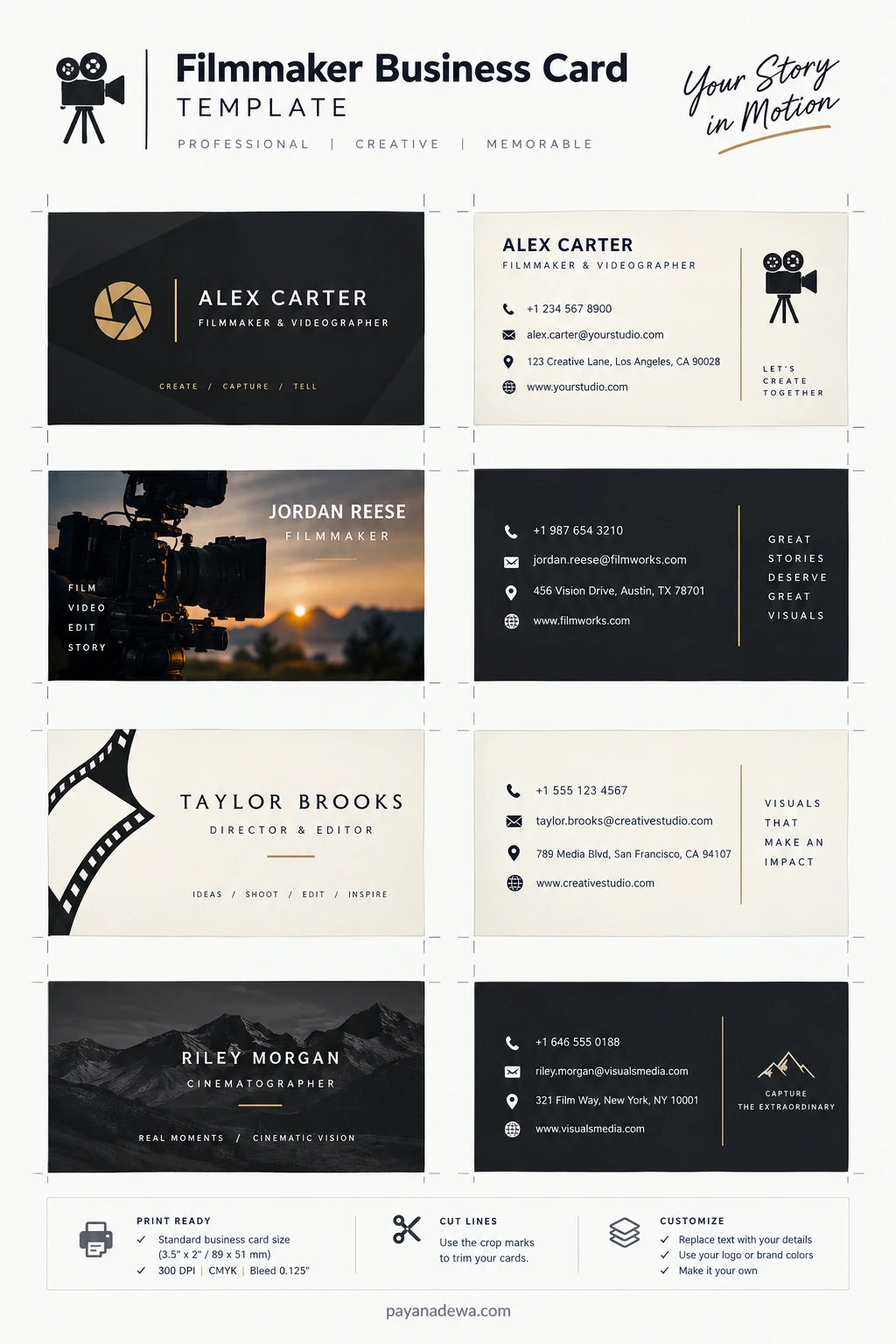
Use this filmmaker business card template as a starting point for creating a consistent, professional identity. The printable layout features cinematic colors, camera-inspired graphics, example contact details, and different front-and-back design concepts. Customize the placeholders with your own name, job title, contact information, and brand colors before printing.
What Information Should a Filmmaker Business Card Include?
A business card has limited space, so every element should serve a purpose. Prioritize the details that help potential clients understand your services and contact you.
Your Name and Professional Title
Make your name one of the most visible elements. Add a clear professional title, such as filmmaker, film director, cinematographer, videographer, video editor, or director of photography.
If you offer several services, select the two or three most relevant to your target audience rather than listing every skill you possess.
Contact Information
Include the details people need to reach you. Depending on your business, these may include:
- Professional email address
- Business phone number
- Portfolio website
- Production company name
- Social media handle for professional work
- QR code linking to your showreel or portfolio
Before sending the design to print, check every link, email address, and phone number. A visually attractive card cannot deliver results if the contact details are incorrect.
Logo and Visual Identity
If you already have a logo, place it where it supports the overall layout. Keep its proportions consistent and ensure it remains clear at a small size. If you do not have a logo yet, a distinctive typographic treatment of your name can work just as well.
How to Customize a Filmmaker Business Card Template
Using a template makes the design process faster. It also helps you maintain a balanced layout while focusing on the information that matters most.
- Step 1: Choose your template. Select a layout that fits your filmmaking specialty and personal brand.
- Step 2: Replace the sample details. Add your name, job title, phone number, email address, and website.
- Step 3: Adjust the colors. Use your existing brand palette or choose two or three complementary colors.
- Step 4: Add your logo or image. Include a high-quality graphic that supports your professional identity.
- Step 5: Check the typography. Ensure that all text is readable and that headings are visually distinct from supporting details.
- Step 6: Review the layout. Check spacing, alignment, spelling, and contrast on both sides of the card.
- Step 7: Export and print. Prepare a high-resolution file using the dimensions and specifications required by your printer.
Keep an editable copy of your final design. That way, you can update your portfolio URL, job title, or branding without rebuilding the entire card.
Printing Tips for High-Quality Business Cards
A great design needs careful printing to look its best. Before placing an order, confirm the printer’s requirements and inspect the exported file.
Choose the Correct Size and Bleed
Standard business card dimensions vary by country. A common US size is 3.5 by 2 inches, while a common European size is 85 by 55 millimeters. Choose the format that suits your audience and local printing services.
Include bleed when your design extends to the edge of the card. Many printers request approximately 3 millimeters of bleed, although their exact specifications may differ. Keep important text and logos inside the safe area to prevent accidental trimming.
Use High-Resolution Artwork
For conventional print production, 300 DPI at the final print dimensions is a common target. If your design includes photographs, use high-quality image files and avoid enlarging small images excessively.
Ask your printer whether they prefer PDF, TIFF, or another production format. A web-ready image can be useful for previews, but it may not be suitable as the final print file.
Select Suitable Paper and Finishes
Thick cardstock often feels more substantial than lightweight paper. Matte finishes can complement minimalist designs, while gloss finishes may enhance colorful photography. Specialty finishes, such as foil accents, can add visual impact when used selectively.
Request a sample or proof whenever possible. It helps you evaluate the color, text size, paper texture, and overall appearance before ordering a large quantity.
Common Filmmaker Business Card Mistakes to Avoid
Even a creative design can lose its impact when the layout is difficult to understand. Avoid these common problems:
- Too much information: Keep the card focused on your main services and essential contact details.
- Unreadable fonts: Avoid overly decorative typefaces for small contact information.
- Poor contrast: Make sure the text stands out clearly against the background.
- Low-resolution images: Use crisp artwork that will remain sharp in print.
- Unclear professional positioning: Tell people whether you specialize in directing, cinematography, editing, or video production.
- Broken QR codes: Test your QR code with multiple devices before printing.
- Inconsistent branding: Match your card to your website, portfolio, and other professional materials.
Most importantly, avoid choosing style over usability. A successful filmmaker business card should look creative while making your information easy to find.
How to Make Your Business Card More Effective
Your card becomes more valuable when it supports a clear networking strategy. Instead of handing it out without context, use it as a starting point for a professional conversation.
For example, after meeting a producer, briefly explain your specialty and mention a relevant project. Then share your card so the producer can revisit your portfolio later. A QR code leading directly to your best showreel can make that process even easier.
Keep your online portfolio updated and ensure that it works well on mobile devices. Your business card may introduce you, but your projects, experience, and communication help potential clients decide whether to work with you.
It is also worth reviewing your card periodically. Update outdated links, replace old branding, and revise your professional title as your services evolve.
Conclusion
A well-designed filmmaker business card helps you present your creative identity, share essential contact details, and build valuable industry connections. Whether you prefer a minimalist black-and-gold layout, a clean neutral design, or a cinematic photographic style, the key is to balance visual appeal with readability.
Start with a customizable filmmaker business card template, add your professional details, and choose design elements that reflect your filmmaking specialty. Then check the print specifications and proofread everything before ordering.
With a thoughtful design and an up-to-date portfolio, your business card can become a practical part of your marketing toolkit and help potential clients remember your work.