: Complete Guide, Key Terms, and Free Template
A Transfer Agreement is a written document used to record and define the transfer of an asset, right, interest, responsibility, or other legal subject from one party to another. It helps both parties understand exactly what is being transferred, when the transfer takes effect, and what obligations apply after the transaction.
Whether you are transferring property, business interests, contractual rights, intellectual property, equipment, or another valuable asset, a clear agreement can reduce misunderstandings and provide useful evidence of the parties’ intentions. The exact requirements can vary depending on the type of transfer and the applicable jurisdiction.
This guide explains what a Transfer Agreement is, what it should contain, how to prepare one, and the common mistakes to avoid. A practical template is also included as a visual reference.
Important: This article provides general information and is not a substitute for legal advice. For significant or legally complex transfers, consider having the agreement reviewed by a qualified legal professional.
What Is a Transfer Agreement?
A Transfer Agreement is a formal document that establishes the terms under which something moves from a transferor to a transferee. The transferor is generally the person or organization giving, assigning, selling, or otherwise transferring the relevant asset or right. The transferee is the party receiving it.
The agreement creates a written record of the transaction. It can identify the parties, describe the subject of the transfer, establish the effective date, explain payment terms when applicable, and specify the responsibilities of each party.
Depending on the transaction, a Transfer Agreement may also be known as an asset transfer agreement, assignment agreement, rights transfer agreement, ownership transfer agreement, or another specialized legal document.
Why Is a Transfer Agreement Important?
A verbal understanding may seem sufficient for a simple transaction. However, written documentation becomes particularly valuable when an asset has significant financial, commercial, or legal importance.
A well-prepared Transfer Agreement can help:
- Identify the parties: It clearly establishes who is transferring and receiving the asset or right.
- Define the transferred item: The agreement explains exactly what is included in the transaction.
- Set expectations: Both parties can understand their rights, duties, and responsibilities.
- Record the effective date: The document can specify when ownership or rights change.
- Reduce disputes: Clear written terms can minimize disagreements about what the parties agreed to.
- Create evidence: A signed document provides a record of the transaction and its terms.
For these reasons, a Transfer Agreement should be specific rather than relying on vague descriptions or informal promises.
Key Elements of a Transfer Agreement
Although the contents vary according to the transaction, most agreements benefit from several essential sections.
1. Identification of the Parties
Begin by identifying the transferor and transferee. For individuals, this may include their full legal names and contact information. For businesses, the agreement may identify the legal entity name, registered address, and authorized representative.
Accurate identification is important because the agreement should make it clear exactly who is bound by its terms.
2. Description of the Transfer
The agreement should describe the asset, right, interest, or obligation being transferred as precisely as possible.
For example, an agreement involving equipment could identify the manufacturer, model, serial number, condition, and related accessories. An intellectual property transfer may need to identify specific copyrights, trademarks, designs, or other rights.
The more valuable or complex the subject of the transfer is, the more important it becomes to use an unambiguous description.
3. Consideration and Payment
If the transfer involves payment, the agreement should explain the purchase price or other consideration. It can also state the payment schedule, payment method, deposit requirements, taxes, fees, and consequences of non-payment.
Some transfers occur without monetary consideration. In that situation, the document should clearly state the nature of the transfer and whether it is being made as a gift, assignment, contribution, exchange, or another arrangement.
4. Effective Date
The effective date determines when the transfer becomes legally or contractually effective under the agreement.
The parties should avoid ambiguity by specifying the exact date and, when necessary, the conditions that must be satisfied before the transfer takes effect.
5. Rights and Responsibilities
A good Transfer Agreement should explain what happens after the transfer. This may include possession, control, maintenance, confidentiality, liabilities, continuing obligations, or other responsibilities.
For example, if an asset has outstanding obligations, the agreement should clarify whether those obligations remain with the transferor or become the responsibility of the transferee.
6. Representations and Warranties
Depending on the transaction, the parties may include statements confirming ownership, authority, accuracy of information, absence of undisclosed claims, or other relevant matters.
These provisions can be especially important when transferring valuable assets or contractual rights.
7. Governing Law
A Transfer Agreement commonly identifies the law or jurisdiction that will govern its interpretation. This provision can become important if the parties are located in different jurisdictions or if a dispute occurs.
Because legal requirements differ between jurisdictions, the governing-law provision should be appropriate for the specific transaction.
8. Signatures
The agreement should provide appropriate signature sections for the parties and, when required, witnesses, representatives, or other authorized signatories.
Before signing, each party should carefully review the complete document and confirm that the names, dates, descriptions, and commercial terms are accurate.
Common Types of Transfer Agreements
The term Transfer Agreement can describe several different types of transactions. The appropriate document depends on what is being transferred.
- Asset Transfer Agreement: Used to transfer specific business or personal assets.
- Ownership Transfer Agreement: Used when ownership of an asset or interest changes hands.
- Contract Assignment Agreement: Used to transfer contractual rights or interests where assignment is permitted.
- Intellectual Property Transfer Agreement: Used for the transfer of intellectual property rights.
- Business Interest Transfer Agreement: Used for certain transfers involving shares, membership interests, or other business interests.
- Property Transfer Agreement: Used to document certain property-related transfers, subject to applicable legal requirements.
These categories can overlap. Therefore, choosing the correct type of agreement is important, particularly when registration, government filings, consent, or special legal formalities are involved.
Transfer Agreement Template
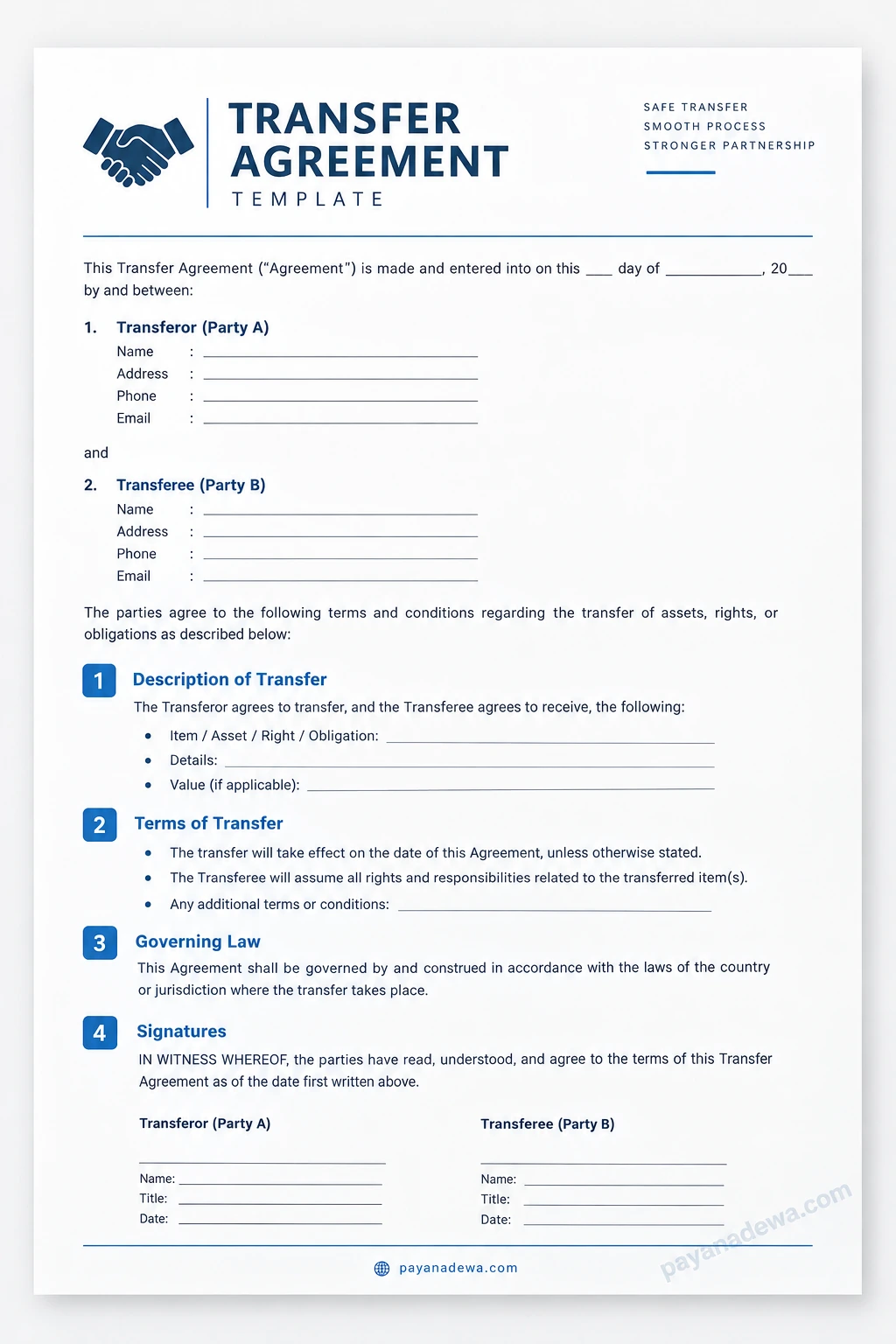
A basic template can provide a useful starting point for organizing the essential information. However, a template should be adapted to the actual transaction rather than copied without review.
The following visual shows a clean example of the information that can appear in a basic Transfer Agreement.
How to Create a Transfer Agreement
Step 1: Identify the Transaction
First, determine exactly what is being transferred and why. Identify whether the transaction concerns an asset, ownership interest, contractual right, intellectual property, responsibility, or another subject.
Step 2: Verify the Parties
Confirm the legal names and authority of everyone involved. If a company is a party, verify that the person signing the agreement has appropriate authority to do so.
Step 3: Describe the Subject Clearly
Write a detailed description of the asset or right. Include identifying numbers, documents, specifications, quantities, locations, or other information that helps distinguish the subject from similar items.
Step 4: Define the Financial Terms
If money or other consideration is involved, document the amount and payment arrangements. Be specific about deadlines and any conditions associated with payment.
Step 5: Establish Responsibilities
Explain which party is responsible for taxes, fees, delivery, insurance, maintenance, liabilities, documentation, and other relevant obligations.
Step 6: Review Legal Requirements
Some transfers require additional documents, registrations, notices, approvals, or third-party consent. Check the rules that apply to the particular asset and jurisdiction.
Step 7: Sign and Retain Copies
Once both parties are satisfied with the terms, complete the required signatures. Each party should retain a complete copy of the signed agreement together with relevant supporting documents.
Common Mistakes to Avoid
Even a straightforward transfer can become complicated when important details are omitted. Watch for these common problems:
- Using incomplete or incorrect legal names.
- Providing an unclear description of the transferred asset or right.
- Failing to specify the effective date.
- Leaving payment or consideration terms ambiguous.
- Ignoring existing liens, claims, restrictions, or contractual obligations.
- Failing to obtain required third-party consent.
- Using a generic template without adapting it to the transaction.
- Forgetting signatures or required supporting documents.
- Failing to keep a complete copy of the executed agreement.
These issues can often be reduced through careful preparation and review before signing.
Practical Tips for a Clear Transfer Agreement
Keep the language straightforward wherever possible. A legally useful agreement does not need to be unnecessarily complicated. Each provision should communicate a specific obligation, right, condition, or responsibility.
Use consistent terminology throughout the document. If the agreement defines one party as the “Transferor” and another as the “Transferee,” use those terms consistently instead of switching between different labels.
Attach supporting schedules when the transferred property or rights are too detailed to describe conveniently in the main agreement. For example, an asset list can provide item numbers, descriptions, values, and other identifying information.
Finally, review the completed document carefully before signing. Check names, dates, numbers, payment terms, attachments, and signature blocks. For high-value transactions, professional legal review can provide additional protection.
Frequently Asked Questions About Transfer Agreements
Is a Transfer Agreement legally binding?
A signed Transfer Agreement may be legally binding when the applicable requirements for a valid contract are satisfied. However, the requirements vary depending on the transaction and jurisdiction.
Can I use a Transfer Agreement template?
Yes. A template can help organize the transaction and identify common provisions. However, it should be customized to the specific transfer and reviewed for applicable legal requirements.
What is the difference between a transfer and an assignment?
The terms can have different meanings depending on the legal context. An assignment commonly refers to transferring contractual rights, while a transfer can be broader and may involve ownership, assets, interests, or other rights. The applicable contract and law should be reviewed to determine the correct terminology.
Do both parties need to sign a Transfer Agreement?
Whether both parties must sign depends on the agreement, transaction, and applicable law. Having the relevant parties sign the document can provide clear evidence that they agreed to the stated terms.
Conclusion
A Transfer Agreement provides a structured way to document the movement of assets, rights, interests, or responsibilities between parties. By clearly identifying the parties, describing the subject of the transfer, defining financial terms, establishing responsibilities, and recording the effective date, the agreement can create a clearer record of the transaction.
A template is useful as a starting point, but every transaction has its own circumstances. Before using a Transfer Agreement for an important transaction, make sure the document reflects the actual arrangement and complies with applicable requirements. When the transfer involves substantial value, complex rights, regulated property, or significant legal consequences, professional legal review is a sensible step.