A Management Agreement is a written contract between a business owner and a manager or management company. It explains what each party must do and what each party can expect. It can also define management fees, responsibilities, authority, confidentiality, and termination terms.
Businesses use management agreements in many industries. These include property management, hospitality, entertainment, real estate, professional services, and general business operations. Each agreement can be different because every management relationship has different needs.
A clear agreement helps both parties avoid confusion. It also creates a useful reference when questions or disagreements arise. Therefore, the contract should use simple language and clearly defined responsibilities.
A Management Agreement template can make the drafting process easier. However, a template should only provide a starting point. The final agreement should match the actual business relationship and applicable laws.
What Is a Management Agreement?
A Management Agreement is a contract that gives one party responsibility for specific management activities. The other party usually owns or controls the business, property, project, or assets involved.
The manager may handle daily operations, employees, finances, suppliers, customers, or other business activities. The exact duties depend on the agreement.
For example, a property owner may hire a management company to collect rent and coordinate maintenance. Likewise, a business owner may appoint a manager to oversee employees and daily operations.
In both cases, the agreement explains the working relationship. It also sets boundaries for decision-making and financial responsibilities.
Why Is a Management Agreement Important?
A written management contract creates a clear framework for the relationship. Both parties can review the same document when they need to confirm their responsibilities.
It Clarifies Responsibilities
The agreement identifies the manager’s duties. It can also explain which tasks remain the owner’s responsibility. As a result, both parties can understand who handles each activity.
It Defines Management Authority
A manager may need authority to make routine decisions. However, major decisions may require approval from the owner. The agreement should explain these limits clearly.
It Establishes Compensation
The contract can explain how the manager gets paid. For example, compensation may include a fixed fee, percentage, commission, or performance bonus.
It Protects Confidential Information
Managers may receive access to financial information, customer records, business plans, and other confidential materials. A confidentiality clause can establish clear rules for handling this information.
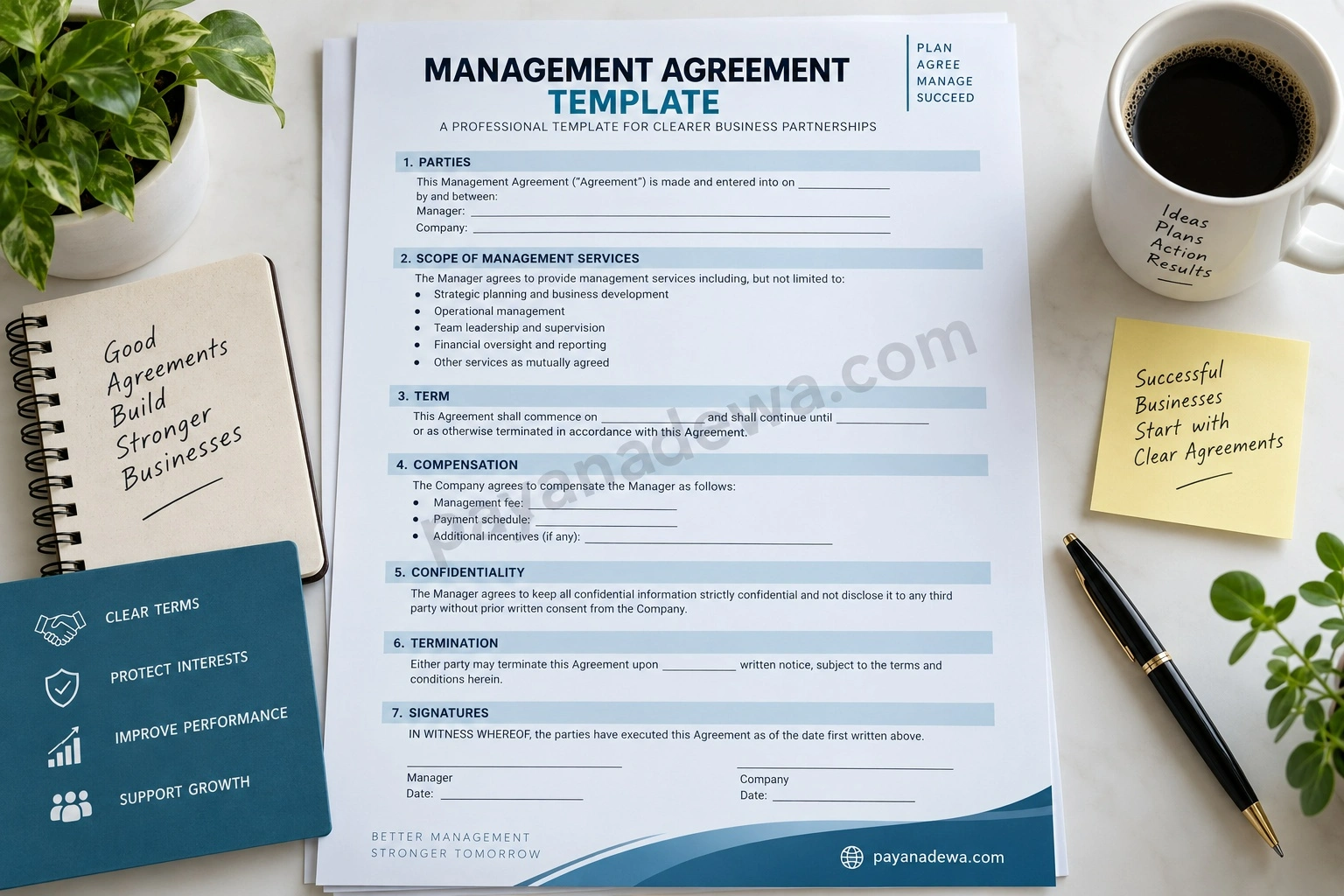
Key Elements of a Management Agreement
A complete management agreement usually contains several important sections. The exact content will depend on the industry and the services involved.
- Parties: Identify the owner, manager, company, or management provider.
- Management services: Describe the services the manager will provide.
- Authority: Explain what decisions the manager can make.
- Owner responsibilities: State what the owner must provide or approve.
- Term: Identify the start date and contract duration.
- Compensation: Explain fees, commissions, bonuses, and payment dates.
- Expenses: State which expenses can be reimbursed.
- Confidentiality: Explain how sensitive information must be protected.
- Reporting: Describe required reports and records.
- Termination: Explain how the agreement can end.
- Dispute resolution: Describe how disputes should be handled.
- Signatures: Provide space for authorized parties to sign.
How to Define Management Services
The scope of services is one of the most important sections in a management contract. It should explain exactly what the manager is expected to do.
A vague statement such as “provide management services” may create confusion. Instead, list the main responsibilities in clear terms.
Examples of Management Duties
- Managing daily business operations
- Supervising employees and contractors
- Coordinating suppliers and service providers
- Preparing operational reports
- Monitoring budgets and expenses
- Supporting business development
- Handling customer or client communications
- Managing approved projects
The list should match the actual services. Do not include responsibilities that the manager will not perform.
Set Clear Boundaries
The agreement should also identify tasks that require owner approval. These may include large purchases, loans, long-term contracts, major hiring decisions, or asset sales.
Clear boundaries reduce uncertainty. They also help the manager understand when additional approval is necessary.
Management Fees and Payment Terms
Payment terms should be easy to understand. The agreement should explain how the management fee is calculated and when payment is due.
Some managers receive a fixed monthly fee. Others receive a percentage of revenue or assets under management. Some agreements also include incentives based on specific performance goals.
If the fee depends on a formula, define that formula clearly. State the relevant calculation period and payment date as well.
Expense Reimbursement
The agreement should explain how business expenses are handled. For example, routine expenses may be included in the management fee. Other expenses may require separate reimbursement.
If approval is required, the agreement can establish an approval limit. This makes expense management easier for everyone.
Term and Renewal of the Agreement
The term explains how long the Management Agreement remains active. Some contracts have a fixed end date. Others continue until one party provides notice.
A renewal clause can explain whether the agreement renews automatically. It can also state how much notice is required before the renewal date.
These details are useful because they give both parties time to plan. They also reduce uncertainty about the future of the management relationship.
How to Handle Termination
Every management contract should explain how the relationship can end. This section is important because termination can affect money, records, employees, customers, and business operations.
Common Reasons for Termination
- The contract reaches its expiration date.
- Both parties agree to end the relationship.
- One party commits a material breach.
- A required notice period expires.
- A party fails to meet an important contractual obligation.
- Another termination event stated in the agreement occurs.
The contract should also explain the required notice period. In addition, it should address what happens after termination.
For example, the manager may need to return company property, transfer records, settle outstanding expenses, and protect confidential information after the relationship ends.
Practical Tips for Creating a Management Agreement
A strong agreement should be specific and easy to follow. Before signing, both parties should read every section carefully.
Use Simple and Direct Language
Write each responsibility in clear terms. Avoid unnecessary legal jargon when a simpler phrase can express the same idea.
Short sentences also make important clauses easier to understand. Therefore, each provision should focus on one main point whenever possible.
Define Decision-Making Authority
Identify routine decisions that the manager can make independently. Then identify major decisions that require owner approval.
This approach creates a practical decision-making structure. It can also reduce disagreements about authority.
Review Financial Terms
Check every financial provision before signing. Confirm the management fee, payment schedule, commissions, bonuses, and reimbursable expenses.
Also make sure the parties understand how calculations will be made. Clear financial terms can prevent avoidable disputes.
Include a Change Process
Business needs can change over time. Therefore, the agreement should provide a way to update the scope of services or other important terms.
Written amendments can help keep the contract accurate when responsibilities change.
Keep Signed Copies
Each party should keep a complete copy of the signed agreement. Digital copies can also make future access easier.
What Should a Management Agreement Template Include?
A Management Agreement template can provide a useful structure for drafting a contract. A basic template may include the parties, services, authority, compensation, expenses, confidentiality, term, termination, dispute resolution, and signatures.
However, the template should be customized before use. A property management contract will need different terms from a business management contract.
For example, a property agreement may address rent collection, maintenance, inspections, and tenants. In contrast, a business agreement may focus on employees, operations, budgets, suppliers, and strategic planning.
Therefore, do not rely on a generic template without reviewing its contents. Every provision should reflect the actual relationship.
Common Management Agreement Mistakes
Small omissions can create significant confusion later. Fortunately, most common problems can be avoided through careful review.
- Using vague descriptions of management services
- Leaving payment calculations unclear
- Failing to define management authority
- Ignoring expense reimbursement rules
- Using unclear termination procedures
- Failing to establish reporting requirements
- Copying a generic template without customization
- Ignoring applicable legal requirements
- Failing to update the agreement after major changes
Before signing, both parties should confirm that the document reflects their actual business arrangement. If an important term is unclear, it should be discussed and revised before execution.
Management Agreement vs. Other Business Contracts
A Management Agreement focuses on an ongoing management relationship. It may differ from an employment agreement, independent contractor agreement, service agreement, partnership agreement, or operating agreement.
The correct contract depends on the actual relationship and applicable law. For example, using the word “manager” does not automatically determine whether someone is legally an employee or an independent contractor.
Therefore, businesses should review the complete working arrangement rather than relying only on the contract title.
How to Create an Effective Management Agreement
Start by identifying why management services are needed. Next, list the services and responsibilities that the manager will handle.
Then define decision-making authority. After that, establish compensation, expenses, reporting requirements, confidentiality rules, and the contract term.
Next, review the termination provisions. Make sure the agreement explains notice requirements and post-termination responsibilities.
Finally, review the complete document with all parties. Make any necessary changes before signing.
When Should You Use a Management Agreement?
A management contract can be useful whenever one party will manage important business activities for another party.
It may be appropriate when an owner wants to delegate daily operations. It can also help when a professional management company takes responsibility for a property, business, project, or group of assets.
The agreement becomes especially useful when the relationship involves ongoing services, payment obligations, access to confidential information, or significant decision-making authority.
Final Thoughts on Management Agreements
A well-structured Management Agreement creates a clear framework for a professional management relationship. It explains responsibilities, authority, compensation, confidentiality, reporting, and termination procedures.
A Management Agreement template can save time during the drafting process. Still, customization is essential because management relationships can vary significantly.
Use clear language, define important responsibilities, and explain financial terms in detail. Also, review termination and decision-making provisions carefully.
For complex arrangements, professional legal review can help identify issues that may require special attention. With careful preparation, a management agreement can provide both parties with a clearer understanding of their roles and obligations.