Every family has its own routines, expectations, values, and challenges. However, when those expectations are not clearly communicated, small misunderstandings can quickly become repeated conflicts. Family Agreement Templates provide a simple and practical way to bring everyone together, discuss what matters, and create shared guidelines for everyday family life.
A family agreement does not need to feel like a strict legal contract. Instead, it can be a friendly household document that helps family members understand their responsibilities, respect one another, and work toward common goals. Parents and children can participate in creating the agreement, making it easier for everyone to understand and support the final rules.
Whether you want to establish household rules, organize chores, improve communication, or encourage positive behavior, a printable family agreement can become a useful reference for the entire household.
What Is a Family Agreement Template?
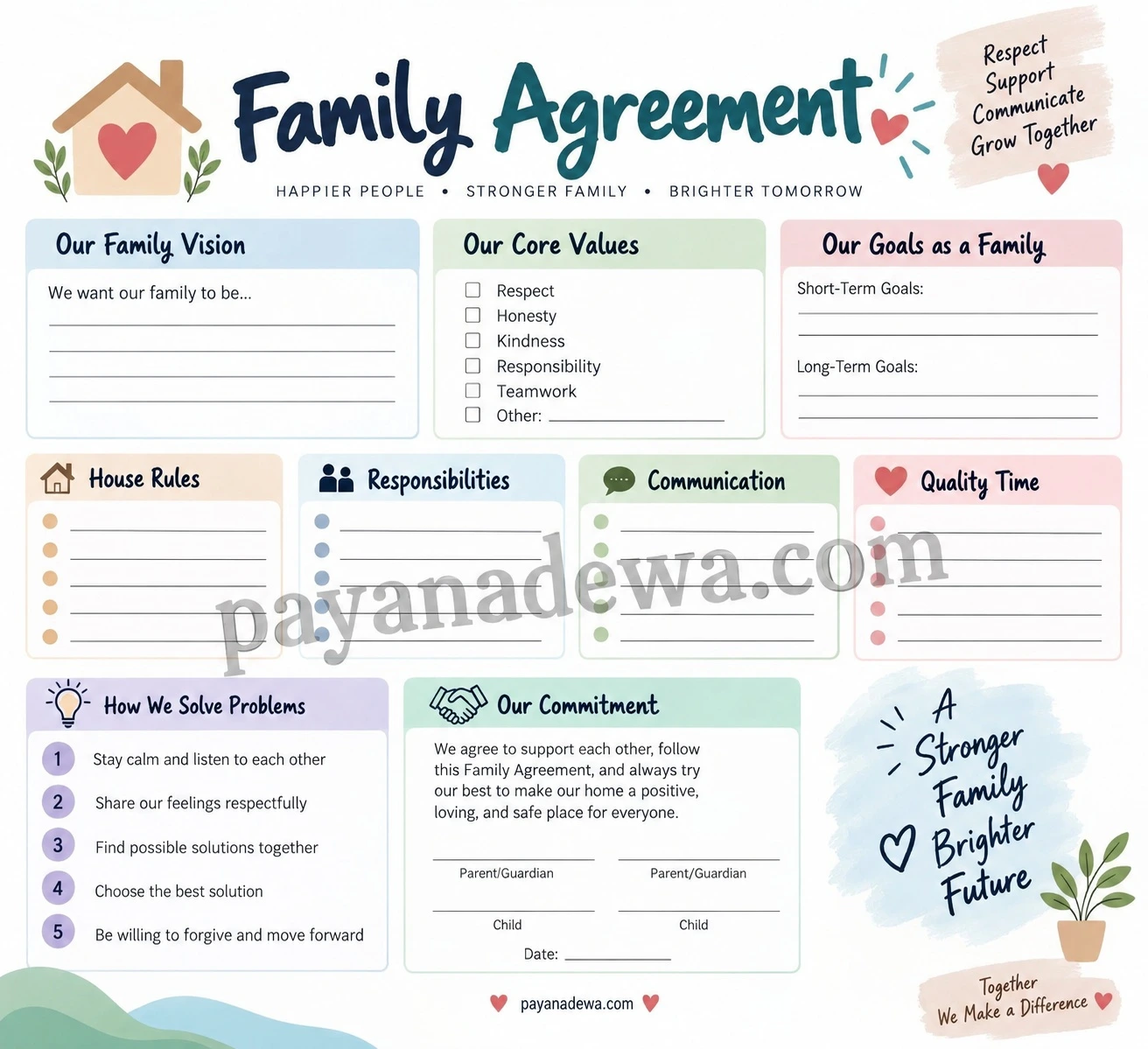
A Family Agreement Template is a structured document that families can customize to establish shared expectations and responsibilities. It typically provides sections for family values, household rules, individual responsibilities, commitments, communication guidelines, and signatures.
Because the template is customizable, families can choose the topics that are most relevant to their circumstances. A family with young children may focus on bedtime routines, screen time, chores, and respectful behavior. Families with teenagers may include privacy, technology use, school responsibilities, communication, and independence.
Why Use a Family Agreement?
The main purpose is to make expectations visible and easier to discuss. Instead of relying on assumptions, family members can work together to decide what they believe is important.
- Creates clear household expectations
- Encourages respectful communication
- Defines individual responsibilities
- Promotes teamwork and cooperation
- Provides a reference when disagreements occur
- Encourages children to participate in family decisions
- Helps families establish shared values
What Should Be Included in a Family Agreement?
A useful agreement should reflect the needs of the people who live together. You do not need to include every possible rule. A shorter agreement with clear and realistic expectations is often easier to follow than a document filled with complicated instructions.
1. Family Vision and Values
Start by asking what kind of family everyone wants to create. Words such as respect, honesty, kindness, responsibility, teamwork, gratitude, and communication can provide a foundation for the agreement.
Writing these values down gives the household a shared direction. Instead of focusing exclusively on rules, the family can connect everyday behavior to broader principles.
2. Household Rules
Household rules should be specific enough that everyone understands what is expected. For example, rather than writing “Be responsible,” a family could establish a practical rule such as completing agreed household tasks before recreational activities.
Rules may cover areas such as meals, bedtime, homework, screen use, personal spaces, guests, household chores, and respectful communication.
3. Family Responsibilities
Responsibilities help distribute household tasks fairly. A family agreement can include a simple table where each family member records the responsibilities they have agreed to handle.
Responsibilities might include cleaning shared spaces, taking care of pets, preparing school items, putting away personal belongings, helping with meals, or completing other age-appropriate tasks.
4. Communication Guidelines
Healthy communication is an important part of a successful household agreement. Families can establish expectations for how disagreements should be handled.
- Listen without interrupting
- Speak respectfully
- Explain concerns calmly
- Avoid insults or personal attacks
- Give everyone an opportunity to speak
- Focus on solutions instead of blame
How to Create a Family Agreement
Creating the agreement can be just as valuable as having the finished document. The process gives family members an opportunity to express their needs and understand other perspectives.
Step 1: Gather the Family
Choose a time when everyone can participate without unnecessary distractions. Explain that the purpose is not to create a list of punishments but to make family life more organized, respectful, and supportive.
Step 2: Discuss What Is Working
Before creating new rules, talk about the things that already work well. Recognizing positive habits can make the conversation more balanced and encourage everyone to build on existing strengths.
Step 3: Identify Common Problems
Discuss recurring issues that create stress in the household. These could include unfinished chores, arguments about devices, morning routines, shared spaces, or communication problems.
Step 4: Turn Problems Into Clear Agreements
Transform each major issue into a realistic expectation. Keep the language positive and easy to understand. Every agreement should be something the family can reasonably follow.
Step 5: Review the Agreement Together
Read the completed family agreement aloud. Give each person an opportunity to ask questions or suggest changes. Once everyone understands the document, family members can sign it as a symbol of their shared commitment.
Using a Printable Family Agreement Template
A printable format makes the agreement convenient to use at home. Families can print the document, complete it by hand, and place it somewhere accessible. A visible agreement can serve as a gentle reminder of the commitments everyone made.
The Family Agreement Template featured in this article uses sections for family identity, vision, core values, commitments, responsibilities, household rules, problem-solving, and signatures. Its clean printable design makes it suitable for family discussions and household planning.
Tips for Making Family Agreements Work
A family agreement is most effective when it becomes part of everyday family life rather than a document that is created once and forgotten.
Keep the Rules Realistic
Avoid creating too many rules. Focus on the expectations that genuinely matter to the household. Clear and achievable commitments are easier to remember and maintain.
Use Positive Language
Whenever possible, describe the behavior you want to encourage. Positive language can make the agreement feel collaborative rather than punitive.
Make Responsibilities Age Appropriate
Children and teenagers can participate in household responsibilities, but their tasks should match their age and abilities. Adjust responsibilities as family members grow and circumstances change.
Review the Agreement Regularly
Family circumstances change over time. A useful agreement should be flexible enough to evolve. Consider reviewing it monthly, seasonally, or whenever there is a major change in the household.
Family Agreement Ideas for Different Households
There is no single format that works for every family. The best family contract template is one that reflects the household’s actual needs.
- Families with young children: bedtime, toys, chores, kindness, meals, and screen time
- Families with teenagers: privacy, technology, schoolwork, curfews, responsibilities, and communication
- Blended families: shared expectations, personal boundaries, communication, and household responsibilities
- Busy households: schedules, chores, shared spaces, appointments, and weekly planning
- Families working on communication: listening, conflict resolution, emotional respect, and problem-solving
Benefits of Family Agreement Templates
One of the biggest benefits of using a template is that it provides structure without requiring families to start from a blank page. A well-designed document can prompt useful conversations that might otherwise be overlooked.
It can also encourage a sense of shared ownership. When family members contribute to the agreement, they are not simply receiving rules created by someone else. They are participating in a conversation about how the household should function.
Another benefit is consistency. When expectations are written down, family members have a common reference point. This can reduce confusion and make it easier to revisit an agreement when circumstances change.
Common Mistakes to Avoid
Creating a family agreement should be collaborative and practical. Avoid turning the document into an excessively long list of restrictions.
- Do not create rules that are impossible to maintain
- Do not make the agreement one-sided
- Do not use confusing or overly complicated language
- Do not rely exclusively on consequences
- Do not ignore the opinions of children and teenagers
- Do not forget to update the agreement when circumstances change
Make Your Family Agreement a Shared Commitment
The most valuable part of a family agreement is not the paper itself. It is the conversation behind it. When family members sit together, identify their values, discuss responsibilities, and agree on practical expectations, they create an opportunity for better understanding and cooperation.
A Family Agreement Template makes this process easier by providing a clear structure that families can personalize. Whether you are creating household rules for young children, establishing expectations with teenagers, or simply looking for a better way to organize family life, a printable agreement can provide a useful starting point.
Keep the final document simple, realistic, and flexible. Review it together, celebrate improvements, and adjust it as your family grows. With consistent communication and shared responsibility, a family agreement can become a practical tool for creating a more organized, respectful, and connected home.
Conclusion
Family Agreement Templates provide an easy way to organize household expectations, define responsibilities, establish shared values, and encourage respectful communication. By creating the agreement together, families can turn everyday expectations into clear commitments that everyone understands.
The goal is not perfection. The goal is to create a practical framework that supports cooperation and helps family members work through everyday challenges together. A simple printable family agreement can be the starting point for better conversations, clearer expectations, and stronger family relationships.