A Resolution Agreement is a written document that records how two or more parties have agreed to resolve a dispute, disagreement, claim, or other issue. By putting the agreed terms in writing, the parties can create a clear record of what each side has promised to do and what happens after the matter is resolved.
Whether the issue involves a business relationship, payment disagreement, service problem, workplace matter, contract dispute, or another private conflict, a carefully prepared agreement can help reduce misunderstandings. It can also provide a useful reference if questions arise about the resolution later.
This guide explains what a Resolution Agreement typically contains, when to use one, how to structure the document, and practical considerations to review before signing.
What Is a Resolution Agreement?
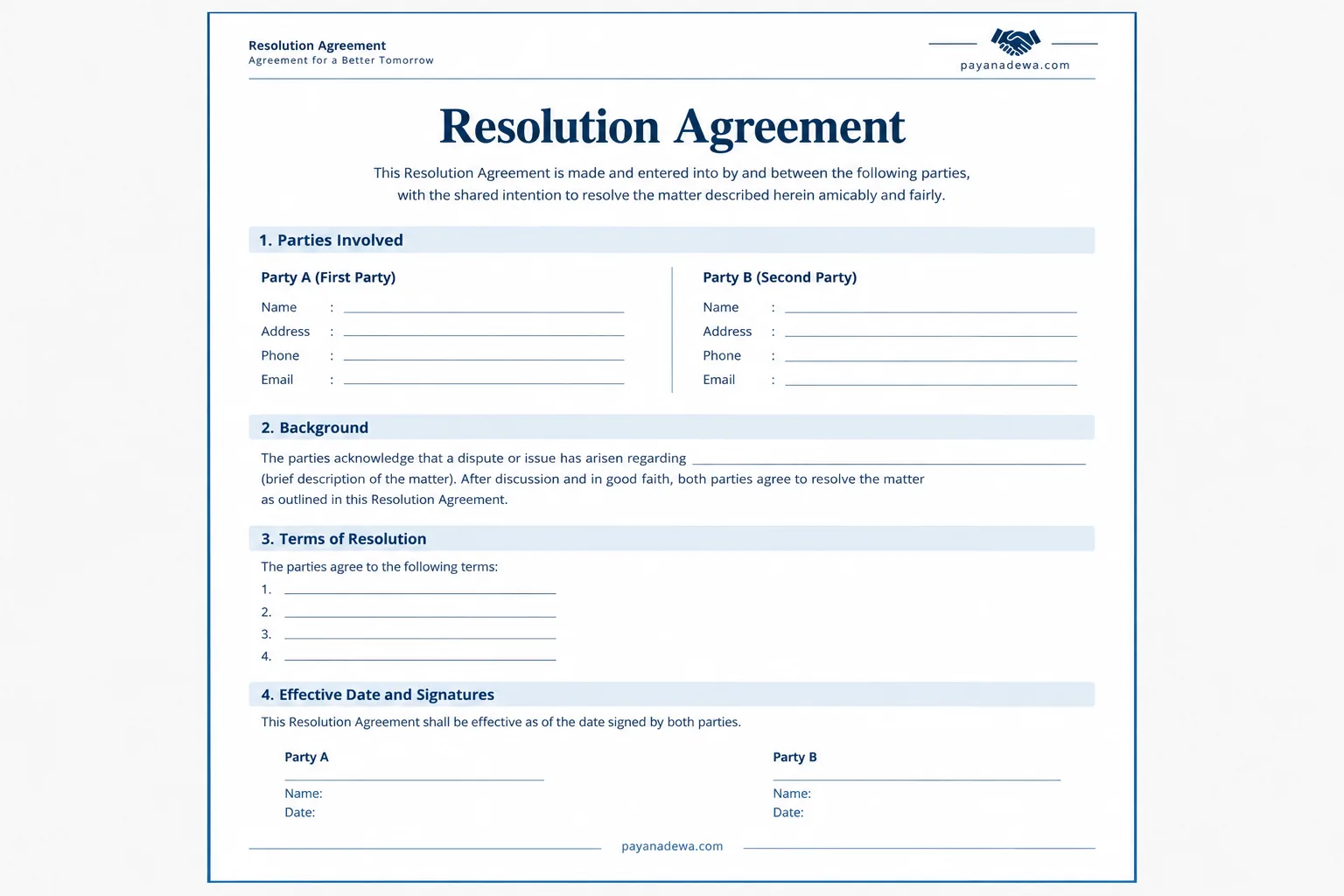
A Resolution Agreement is a written agreement in which the parties document the terms they have accepted to resolve a particular matter. The document generally identifies the parties, explains the issue being resolved, states the agreed obligations, and establishes when the agreement becomes effective.
The exact legal effect of the document depends on the wording, applicable law, the circumstances, and the jurisdiction involved. For that reason, a general template should be treated as a starting point rather than a substitute for legal advice when the matter is complex or significant.
When Should You Use a Resolution Agreement?
A written resolution agreement can be useful when the parties have reached an understanding but want a clear record of their arrangement. Common situations include:
- Resolving a payment or invoice dispute.
- Documenting an agreement after a business disagreement.
- Confirming corrective actions following a service issue.
- Recording mutually agreed changes to an existing arrangement.
- Documenting how a contractual disagreement will be resolved.
- Establishing responsibilities after a negotiation or mediation.
- Confirming the completion of agreed actions between two parties.
A written document is especially useful when the agreement contains several obligations, deadlines, payments, confidentiality requirements, or other details that could otherwise be forgotten or interpreted differently.
Key Elements of a Resolution Agreement
A useful Resolution Agreement should be specific enough that both parties can understand their responsibilities without relying on verbal explanations.
1. Identify the Parties
Begin by clearly identifying everyone who is entering into the agreement. Depending on the circumstances, this may include individuals, companies, organizations, or authorized representatives.
Include relevant information such as full legal names, addresses, and contact details when appropriate. If a company is involved, verify its correct legal name and make sure the person signing has appropriate authority.
2. Describe the Background
The background section briefly explains why the agreement is being created. Keep this section factual and focused on the matter being resolved.
For example, the document might state that a disagreement arose concerning a particular service, payment, contract, or transaction. The purpose is to provide context without unnecessarily adding lengthy arguments or accusations.
3. State the Resolution Terms
This is usually the most important part of the document. Clearly describe what each party agrees to do.
Specific terms are generally more useful than vague promises. If one party must make a payment, specify the amount, due date, and payment method where appropriate. If a party must provide a service or complete an action, describe what must be completed and by when.
- What each party must do.
- Any payment amounts and deadlines.
- Delivery or performance requirements.
- Responsibilities that continue after signing.
- Any agreed deadlines or milestones.
- What happens if an agreed obligation is not completed.
4. Include the Effective Date
The agreement should indicate when it becomes effective. In some cases, this may be the date of the final signature. In other situations, the parties may agree to a specific future or past effective date, subject to applicable law.
Using a clear date can prevent uncertainty about when the obligations begin.
5. Add Signature Sections
Each party should have an appropriate signature section. Depending on the circumstances, include the signer’s printed name, title or role, signature, and date.
If a representative signs for an organization, the document should make that representative’s role clear. Electronic signatures may also be appropriate depending on the applicable law and circumstances.
How to Write Clear Resolution Terms
The strongest agreements are usually written in plain, precise language. Avoid terms that could reasonably have multiple meanings.
Instead of writing, “The payment will be made soon,” specify the agreed amount and deadline. Instead of saying, “The issue will be corrected,” explain the specific action that must be completed.
Before signing, each party should be able to answer these questions:
- What exactly am I agreeing to?
- What must I do?
- What must the other party do?
- When must each obligation be completed?
- Are there any continuing obligations?
- What conditions must be satisfied?
Resolution Agreement vs. Settlement Agreement
The terms Resolution Agreement and Settlement Agreement can overlap, but their usage may vary depending on the situation and jurisdiction.
A settlement agreement commonly refers to an agreement resolving a legal claim or dispute, often in exchange for defined consideration or other commitments. A resolution agreement can be broader and may simply document how parties have agreed to resolve a particular issue.
The title alone does not determine the legal effect of a document. The actual provisions, surrounding circumstances, applicable law, and intentions of the parties are important.
Practical Tips Before Signing
Review Every Obligation
Read the agreement carefully and confirm that every obligation accurately reflects what was negotiated. Pay particular attention to dates, amounts, names, and conditions.
Remove Ambiguous Language
If a sentence could reasonably be interpreted in more than one way, consider rewriting it. Clear language reduces the risk of future disagreement.
Check Consistency
Make sure the dates, names, payment amounts, deadlines, and defined terms are consistent throughout the document. A small inconsistency can create unnecessary confusion.
Keep Copies
Each party should retain a complete copy of the final signed agreement and any documents that are expressly incorporated into it. Store the document securely so it can be retrieved if needed later.
Consider Professional Review
For substantial disputes, business matters, employment-related issues, significant financial obligations, or agreements involving legal claims, professional legal review may be appropriate before signing.
Common Mistakes to Avoid
Even a simple resolution document can become problematic if important details are missing. Common mistakes include:
- Using incomplete or incorrect party names.
- Leaving payment amounts or deadlines unclear.
- Relying on verbal promises that are not included in the document.
- Using vague descriptions of required actions.
- Failing to state when obligations begin.
- Signing without reviewing attachments or referenced documents.
- Assuming a template automatically satisfies local legal requirements.
How to Customize a Resolution Agreement Template
A printable template can provide a useful framework, but it should be adapted to the specific circumstances. Start by replacing the placeholder information with the correct party details and a concise description of the matter.
Next, customize the resolution terms. List each material obligation separately, including relevant amounts, dates, deliverables, and conditions. Finally, review the signature and effective-date sections before the parties execute the document.
If the agreement involves multiple claims or complicated legal rights, a simple template may not contain all of the provisions required for the situation. Additional clauses may be appropriate depending on the purpose and governing law.
Frequently Asked Questions
Is a Resolution Agreement legally binding?
It may be legally binding when the applicable requirements for an enforceable contract are satisfied, but the answer depends on the agreement, the circumstances, and applicable law. The document’s title by itself does not guarantee enforceability.
Can I use a Resolution Agreement template?
Yes. A template can provide a practical structure for organizing party information, background details, resolution terms, dates, and signatures. However, the template should be customized to the actual situation and reviewed carefully before signing.
Should both parties sign the agreement?
When the agreement is intended to record mutual commitments, signatures from the relevant parties are commonly used to demonstrate acceptance. The appropriate signing requirements can vary according to the circumstances and applicable law.
Can a Resolution Agreement resolve a dispute without going to court?
Parties can sometimes resolve disputes through negotiation, mediation, or another private process without proceeding to litigation. Whether a particular agreement fully resolves a legal claim depends on its terms and applicable law.
Conclusion
A well-organized Resolution Agreement can give parties a clear written record of how they intend to resolve a disagreement or other matter. The most useful documents identify the parties, explain the background, state precise obligations, establish an effective date, and provide appropriate signature sections.
Using a Resolution Agreement template can make the drafting process easier, particularly when the situation is straightforward. However, important agreements should be customized carefully, and professional legal advice can be valuable when significant rights, money, claims, or ongoing obligations are involved.