A Royalty Agreement provides a structured way for one party to grant another party permission to use intellectual property, products, creative works, or other assets in exchange for agreed royalty payments. Because royalty arrangements can involve recurring payments, usage rights, reporting duties, and intellectual property ownership, a clear written agreement helps both parties understand their responsibilities from the beginning.
Whether you are licensing music, artwork, photographs, software, inventions, written content, trademarks, or another form of intellectual property, a well-organized royalty contract can make the business relationship easier to manage. The document should clearly identify the parties, define the licensed rights, explain how royalties are calculated, establish payment schedules, and address what happens when the agreement ends.
A carefully prepared agreement also reduces ambiguity. Instead of relying on informal conversations or assumptions, both parties can refer to the same written terms when questions arise about permitted use, payments, reporting, ownership, or termination.
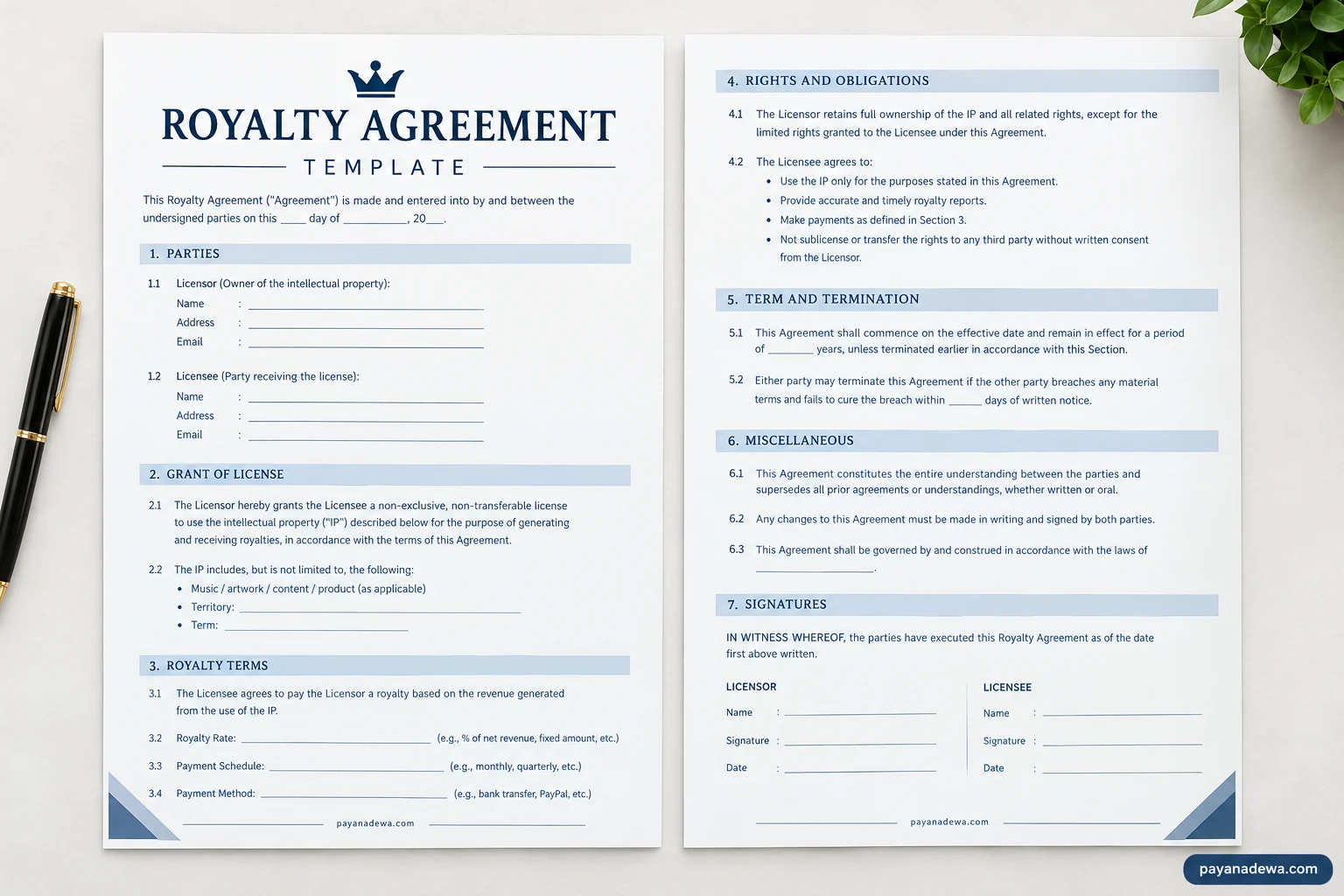
Below is an example of the structure and information commonly included in a royalty agreement template.
What Is a Royalty Agreement?
A royalty agreement is a legal contract in which a rights owner, commonly called the licensor, gives another party, known as the licensee, permission to use specified intellectual property or assets under defined conditions. In return, the licensee typically pays royalties based on revenue, sales, units sold, usage, or another agreed calculation.
For example, a musician may authorize a company to use a song in commercial content in exchange for royalties. Similarly, an inventor may license a patented product to a manufacturer and receive a percentage of qualifying sales.
The agreement does not necessarily transfer ownership of the underlying intellectual property. Instead, it generally establishes specific usage rights while allowing the owner to retain ownership unless the contract states otherwise.
Why Use a Royalty Agreement Template?
Creating a contract from a blank page can make it easy to overlook important provisions. A Royalty Agreement Template provides a practical framework that helps organize the essential terms before the parties finalize their contract.
A template can be particularly useful when the agreement needs to address several related issues, such as licensing scope, royalty calculations, reporting periods, payment deadlines, intellectual property rights, and termination.
- Better organization: Important provisions are arranged in a logical order.
- Clearer expectations: Both parties can identify their responsibilities and rights.
- Efficient drafting: A structured starting point can reduce the time needed to prepare the document.
- Easier review: Missing information can be identified before signing.
- Consistent documentation: Similar licensing arrangements can follow a comparable structure.
A template should be treated as a drafting framework rather than a substitute for professional legal advice. The appropriate provisions can vary considerably depending on the asset, jurisdiction, industry, and commercial arrangement.
Key Elements of a Royalty Agreement
A strong royalty contract should clearly explain the commercial relationship. While specific requirements vary, several sections are commonly useful.
1. Identification of the Parties
The agreement should identify the licensor and licensee using their correct legal names and relevant contact information. If a company is involved, the contract may also identify its business address and authorized representative.
Accurate identification is important because it establishes exactly who is granting the rights and who is receiving them.
2. Description of the Licensed Property
The agreement should describe the intellectual property or asset being licensed. Depending on the transaction, this could include a song, photograph, design, trademark, patent, software application, written work, product formula, or other protected material.
The description should be specific enough that both parties can determine exactly what is covered by the contract.
3. Grant of License
The license section explains what the licensee is permitted to do. It may address reproduction, distribution, display, performance, modification, manufacturing, publication, commercialization, or other forms of use.
The agreement should also clarify whether the license is exclusive or non-exclusive. Geographic territory, approved platforms, product categories, and other usage limitations may also need to be specified.
4. Royalty Calculation
The royalty clause is one of the most important parts of the contract. It should explain precisely how the payment is calculated.
Depending on the arrangement, royalties may be based on a percentage of gross revenue, net revenue, sales, units sold, licensing fees, or another defined metric. If deductions are permitted, the agreement should identify which deductions can be applied before calculating the royalty.
For example, a contract might state that the licensee pays a specified percentage of defined net sales generated from products incorporating the licensed intellectual property. The parties should ensure that terms such as net sales, gross revenue, or qualifying sales have clear meanings within the agreement.
5. Payment Schedule
The contract should establish when royalties are due. Common schedules include monthly, quarterly, or annual payments.
It can also specify the payment method, reporting deadline, currency, invoicing procedure, and consequences of late payment where appropriate.
6. Reporting and Records
Royalty arrangements often require the licensee to provide periodic reports showing how payments were calculated. The agreement can state what information must be included and when reports must be delivered.
For more complex licensing relationships, recordkeeping and audit provisions can help the licensor verify royalty calculations. The contract may establish how an audit can be requested, who pays the associated costs, and how discrepancies are handled.
Exclusive vs Non-Exclusive Royalty Agreements
The nature of the license can significantly affect the parties’ rights. In an exclusive license, the licensee may receive exclusive rights within the defined scope, territory, or market. The exact meaning of exclusivity should be stated carefully.
A non-exclusive license generally allows the rights owner to grant similar rights to other parties, subject to the specific contract terms.
Before selecting either structure, the parties should define the relevant territory, industry, product category, media, platform, and duration. Clear boundaries can prevent disagreements about what exclusivity actually covers.
Term and Termination Provisions
A royalty agreement should explain when the contract begins and how long it remains effective. Some arrangements have a fixed term, while others continue until one party provides notice or a specified event occurs.
Common Termination Events
- Expiration of the agreed contract term.
- Material breach that is not corrected within the specified period.
- Failure to make required royalty payments.
- Unauthorized use or transfer of licensed rights.
- Other termination events specifically defined in the agreement.
The contract should also explain what happens after termination. For example, it may address whether the licensee must stop using the intellectual property, remove products from certain channels, submit final royalty reports, or pay outstanding amounts.
Common Mistakes to Avoid
Even a simple royalty arrangement can become difficult to administer when key terms are vague. Several common drafting problems are worth considering before signing.
- Using vague royalty definitions: Explain exactly what revenue or sales figures are used.
- Failing to define licensed rights: Specify what the licensee may and may not do.
- Ignoring territory: State where the rights can be exercised.
- Leaving reporting requirements unclear: Establish reporting periods and required information.
- Overlooking intellectual property ownership: State who retains ownership and what rights are actually licensed.
- Skipping termination procedures: Explain how the agreement can end and what happens afterward.
- Using inconsistent terminology: Define important terms and use them consistently throughout the document.
How to Customize a Royalty Agreement Template
Start by identifying the parties and the exact asset involved. Next, define the license scope, including permitted uses, territory, duration, exclusivity, and any restrictions.
Then establish the financial terms. Determine the royalty rate or payment formula, reporting frequency, payment deadline, applicable deductions, and recordkeeping requirements. Make sure the calculation can be understood by someone reviewing the agreement later.
Finally, review provisions concerning confidentiality, intellectual property ownership, warranties, liability, dispute resolution, governing law, amendments, termination, and signatures where appropriate for the transaction.
For complicated commercial arrangements, having the completed document reviewed by a qualified attorney in the relevant jurisdiction can help identify legal issues that a general template may not address.
Practical Checklist Before Signing
Before finalizing the agreement, both parties can use a simple checklist to confirm that the essential business terms are addressed.
- Are the legal names of both parties correct?
- Is the licensed property clearly identified?
- Are permitted uses and restrictions clearly stated?
- Is the license exclusive or non-exclusive?
- Is the geographic territory defined?
- Is the contract term clearly stated?
- Is the royalty formula easy to calculate?
- Are reporting and payment deadlines included?
- Are audit or recordkeeping requirements addressed when necessary?
- Are termination conditions explained?
- Is intellectual property ownership clearly addressed?
- Are governing law and dispute provisions appropriate?
- Have all required parties signed and dated the agreement?
Final Thoughts on Royalty Agreements
A well-structured Royalty Agreement turns a potentially complicated licensing relationship into a clearly documented set of rights, responsibilities, and payment obligations. The most important goal is clarity: both parties should understand what is being licensed, how the property may be used, how royalties are calculated, when payments are due, and what happens when the relationship ends.
A Royalty Agreement Template can provide a useful starting structure for organizing these provisions. However, every licensing arrangement has different commercial and legal considerations. Before relying on a finalized agreement, review the terms carefully and obtain appropriate professional legal guidance when the transaction involves significant intellectual property, financial obligations, exclusivity, or regulatory considerations.