An ecomap is a powerful visual tool used to understand the relationships between an individual, their family, and the wider social environment. Commonly used in social work, counseling, healthcare, and family therapy, an ecomap helps professionals and individuals identify supportive connections, stressful relationships, and important community resources.
By mapping these connections visually, an ecomap provides a clearer picture of how people interact with their surroundings. It can reveal valuable information about emotional support, social challenges, family dynamics, and opportunities for improvement.
Whether you are a social worker, therapist, healthcare professional, student, or someone interested in personal development, learning how to create and interpret an ecomap can help you better understand relationships and social support networks.
What Is an Ecomap?
An ecomap is a visual diagram that illustrates the relationships between an individual or family and their external environment. It typically places a person or household in the center of a page and connects them to important people, organizations, institutions, and community resources.
These connections may include family members, friends, schools, workplaces, healthcare providers, religious organizations, social services, and neighborhood communities.
The purpose of an ecomap is to identify how these relationships influence an individual’s well-being. Some connections provide strong emotional or practical support, while others may contribute to stress, conflict, or isolation.
Unlike a family tree, which focuses primarily on family structure and generations, an ecomap emphasizes relationships between people and their broader social environment.
What Is an Ecomap Used For?
Ecomaps are used in many professional and personal settings to understand social connections, assess support systems, and identify areas where additional assistance may be beneficial.
1. Social Work Assessment
Social workers frequently use ecomaps to understand a client’s support network and environmental circumstances. The diagram can help identify protective factors, social isolation, stressful relationships, and available community resources.
2. Family Therapy and Counseling
In family counseling, an ecomap can help explore how relationships outside the household influence family interactions. It may reveal supportive friendships, workplace pressures, school concerns, or conflicts with extended family members.
3. Healthcare and Patient Support
Healthcare professionals may use ecomaps to understand the social circumstances affecting a patient’s health. This includes identifying caregivers, community services, transportation support, and emotional resources that may influence recovery or ongoing care.
4. Community Resource Planning
An ecomap can help identify whether an individual or family has access to adequate community support. It may highlight opportunities to connect people with educational programs, healthcare services, financial assistance, or community organizations.
5. Personal Reflection and Relationship Awareness
Individuals can also create ecomaps to reflect on their personal relationships. Visualizing connections may help them recognize supportive people, understand sources of stress, and consider ways to strengthen their social network.
Key Components of an Ecomap
A typical ecomap contains several essential elements that make relationships and social connections easier to understand.
- Central individual or family: The person or household being assessed, usually positioned in the center of the diagram.
- External systems: Important people, organizations, institutions, and community resources surrounding the central individual.
- Relationship lines: Lines connecting the central person or family to external systems.
- Connection symbols: Different line styles representing supportive, stressful, weak, or conflicting relationships.
- Directional arrows: Arrows showing the direction of support, energy, communication, or influence.
- Labels: Short descriptions identifying people, organizations, or resources.
These components work together to create a visual overview of the individual’s social environment.
How to Read Ecomap Symbols
One of the most important features of an ecomap is its relationship notation. Different line styles help distinguish the quality and direction of connections.
- Solid line: Often represents a strong or supportive relationship.
- Dashed line: Commonly represents a weak, limited, or less active connection.
- Zigzag line: Often indicates conflict, tension, or a stressful relationship.
- Arrow: Indicates the direction of support, resources, or influence.
- Multiple lines: May represent particularly strong or significant connections.
Important: Ecomap symbols are not universally standardized. Social workers, agencies, educators, and practitioners may use different conventions. Always include a legend explaining the symbols used in your diagram.
How to Create an Ecomap Step by Step
Creating an ecomap is relatively simple when you follow a structured process. You can draw one by hand, use a printable ecomap template, or create a digital diagram.
Step 1: Identify the Individual or Family
Begin by placing the person or family being assessed in the center of the page. Use a circle or another clearly defined shape and label it with an appropriate name or description.
Step 2: Identify Important External Relationships
List the people, organizations, and institutions that play a meaningful role in the individual’s life.
Consider including:
- Immediate and extended family
- Friends and social groups
- School or workplace
- Healthcare providers
- Religious or spiritual communities
- Social service organizations
- Neighborhood and community resources
Step 3: Draw Connections
Connect the central individual or family to each external system using lines. Choose appropriate line styles to represent the strength or quality of each relationship.
Step 4: Add Directional Arrows
Use arrows to illustrate how support or influence moves between the individual and other systems. For example, a family member may provide emotional support, while a workplace may contribute both income and stress.
Step 5: Include a Legend
Add a small legend explaining the meaning of your lines, arrows, and symbols. This ensures that anyone reviewing the ecomap can interpret it accurately.
Step 6: Review the Diagram
Look at the completed ecomap and identify patterns. Consider which relationships are supportive, which are stressful, and whether important resources are missing.
Printable Ecomap Template
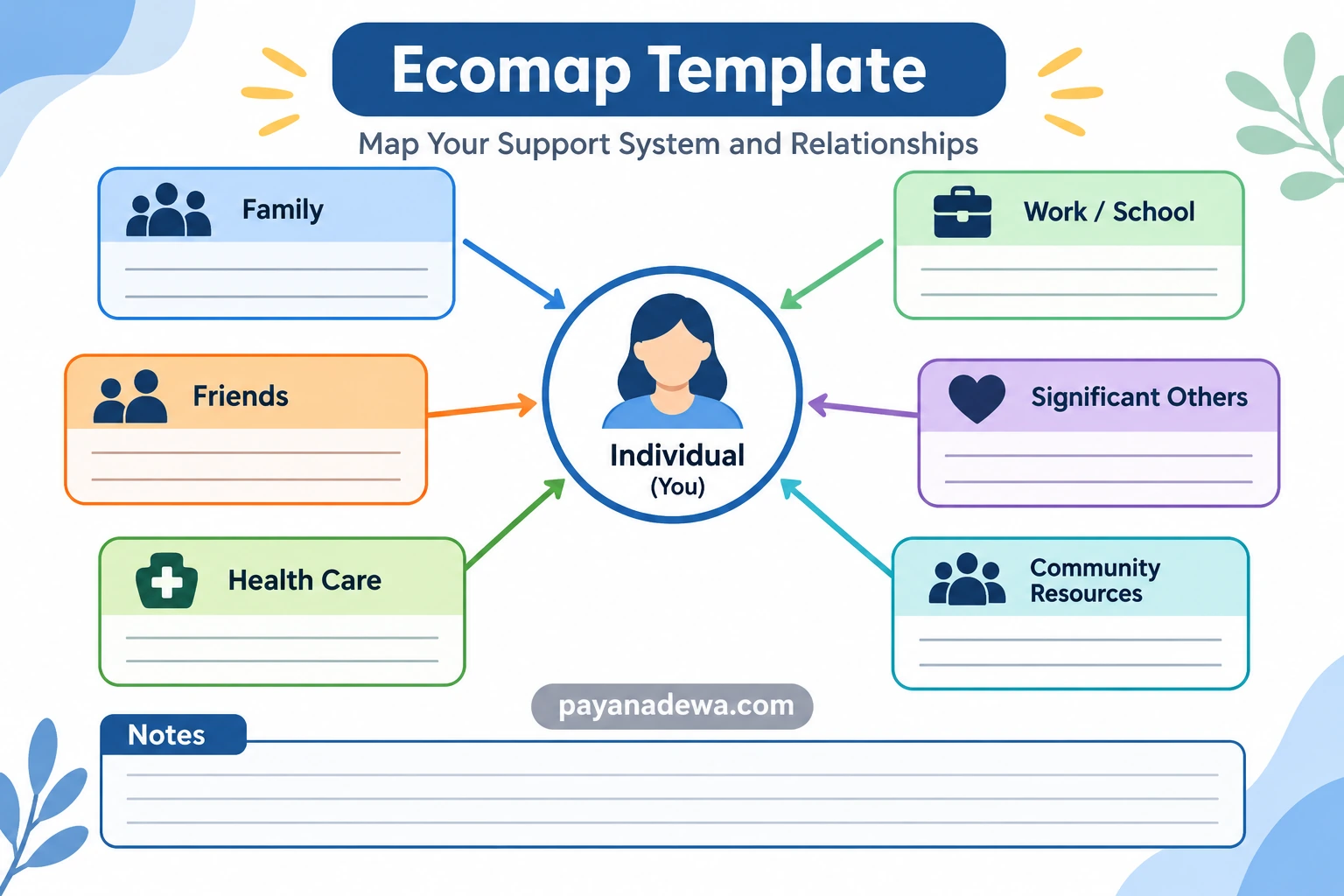
A printable ecomap template can make the assessment process faster and easier. Instead of creating the entire diagram from scratch, you can use a ready-made layout to organize relationships and community connections.
The following ecomap worksheet provides a visual structure for mapping an individual’s support system, including family, friends, work or school, healthcare providers, significant others, and community resources.
Use it as a starting point for personal reflection, educational exercises, or professional assessment. Customize the categories and relationship symbols according to your specific needs.
Ecomap Example: Understanding a Support Network
Consider a college student experiencing academic stress and difficulty balancing responsibilities.
The student’s ecomap might include the following connections:
- Family: Provides emotional encouragement and occasional financial assistance.
- Friends: Offer companionship and help reduce stress.
- University: Provides educational opportunities but also contributes to academic pressure.
- Part-Time Workplace: Offers income while creating scheduling challenges.
- Counseling Center: Provides professional emotional support.
- Community Group: Creates opportunities for social interaction and belonging.
By examining these relationships together, the student and a counselor can identify supportive resources and recognize areas that may require attention.
This example demonstrates how an ecomap can reveal both positive and challenging influences within a person’s environment.
Benefits of Using an Ecomap
Ecomaps offer several practical benefits for individuals, families, and professionals.
- Improved understanding of relationships: Visual diagrams make complex social connections easier to recognize.
- Identification of support systems: They help highlight people and organizations that provide emotional, practical, or financial assistance.
- Recognition of stressors: Difficult relationships and environmental pressures become easier to identify.
- Better assessment planning: Professionals can use the information to guide discussions and identify potential interventions.
- Community resource awareness: Ecomaps can reveal opportunities to connect individuals with additional support.
- Clearer communication: A visual representation can help clients and professionals discuss relationships more effectively.
Ecomap vs. Genogram: What Is the Difference?
Although ecomaps and genograms are both used in social work and family assessment, they serve different purposes.
- Ecomap: Focuses on relationships between an individual or family and their external social environment.
- Genogram: Focuses on family structure, relationships across generations, and relevant family patterns.
A genogram may include grandparents, parents, siblings, marriages, and significant family events. An ecomap extends beyond the family to include workplaces, schools, friends, healthcare providers, and community institutions.
Both tools can complement one another. Using a genogram alongside an ecomap can provide a more comprehensive understanding of family history and current social relationships.
Practical Tips for Creating an Effective Ecomap
To make your ecomap more useful, keep the following recommendations in mind:
- Keep the diagram readable: Avoid overcrowding the page with too many labels or connections.
- Use consistent symbols: Apply the same line styles throughout the diagram.
- Explain your notation: Include a legend so readers understand each symbol.
- Focus on meaningful relationships: Include connections that have a relevant influence on the individual or family.
- Encourage collaboration: When appropriate, involve the individual in identifying and interpreting relationships.
- Update regularly: Social relationships and support systems change over time.
- Respect privacy: Obtain appropriate consent and protect sensitive personal information, particularly in professional settings.
Frequently Asked Questions About Ecomaps
What is the main purpose of an ecomap?
The main purpose of an ecomap is to visually assess relationships between an individual or family and their surrounding social environment, including supportive connections, stressful relationships, and available resources.
Who can use an ecomap?
Social workers, therapists, healthcare professionals, educators, students, families, and individuals can use ecomaps for assessment, relationship exploration, and support planning.
What should be included in an ecomap?
An ecomap generally includes a central individual or family, external social systems, connecting lines, directional arrows, labels, and a legend explaining relationship symbols.
Can I make an ecomap online?
Yes. You can create an ecomap using diagramming software, presentation tools, drawing applications, or printable worksheets that allow you to organize and label relationships.
Is an ecomap the same as a genogram?
No. An ecomap focuses on relationships with external systems and the social environment, while a genogram primarily illustrates family structure and intergenerational relationships.
Conclusion
An ecomap is a valuable visual tool for understanding how individuals and families interact with their social environments. By mapping relationships with family, friends, workplaces, healthcare providers, and community resources, it becomes easier to recognize sources of support and identify areas of stress.
Whether you are conducting a professional assessment, studying social work, or exploring your own relationships, an ecomap can provide meaningful insights into your support network.
Start with a simple ecomap template, identify your important connections, and use the resulting diagram to build a clearer understanding of the relationships and resources that shape everyday life.