An academic CV is an essential document for students, researchers, lecturers, professors, and other professionals pursuing opportunities in higher education and research. Whether you are applying for a university position, a research fellowship, a PhD program, or an academic grant, a well-organized curriculum vitae can help demonstrate your qualifications, experience, and contributions to your field.
Unlike a traditional resume, an academic curriculum vitae focuses on your educational background, research experience, publications, teaching activities, academic achievements, and professional contributions. It provides a detailed overview of your academic journey and demonstrates your potential as a researcher, educator, or scholar.
Creating an effective academic CV does not have to be complicated. With the right structure, relevant information, and professional formatting, you can create a document that communicates your strengths and makes a positive impression on academic recruiters.
In this guide, you will learn how to write an academic CV, which sections to include, how to organize your achievements, and how to use an academic CV template to create a professional document.
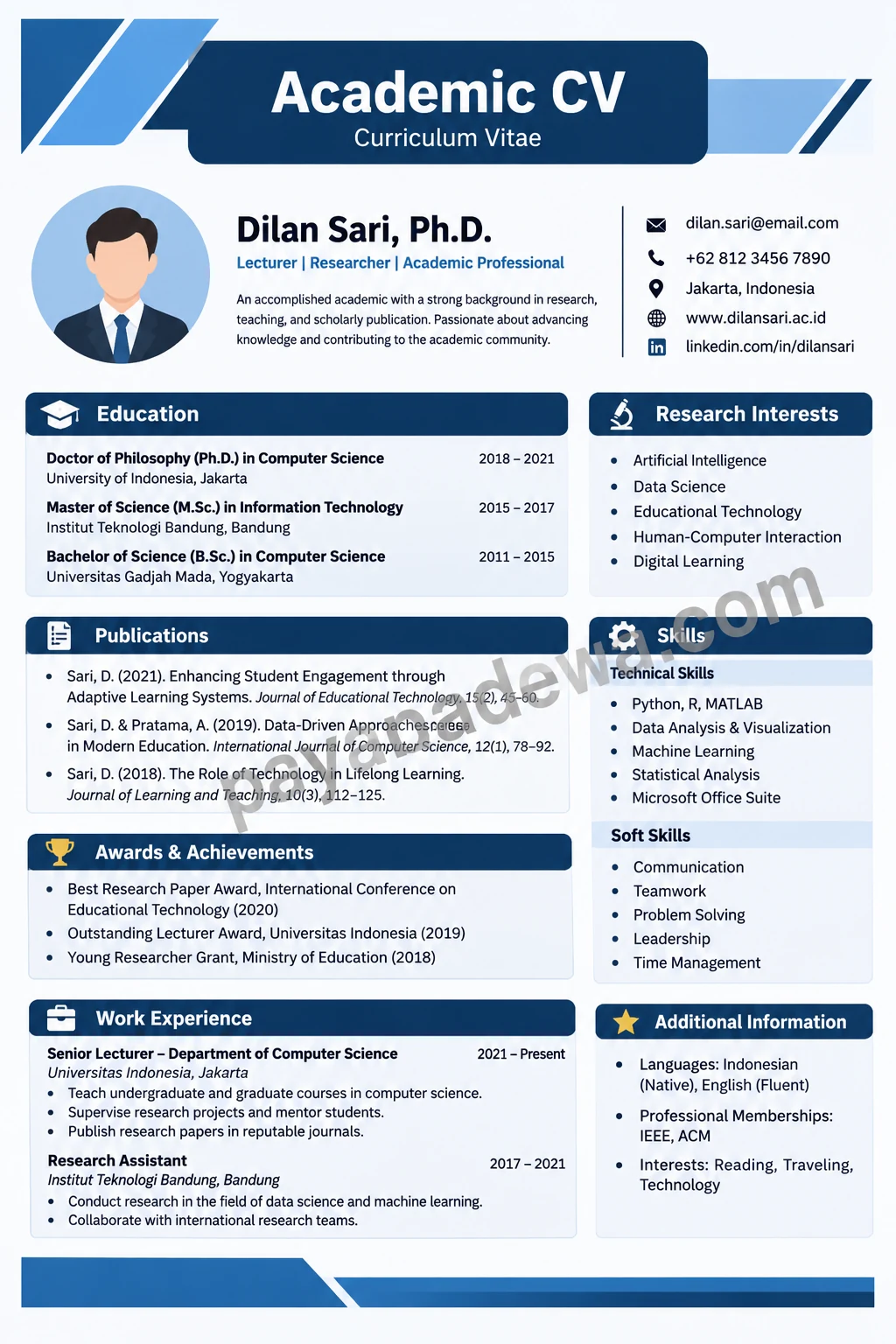
What Is an Academic CV?
An academic CV, also known as an academic curriculum vitae, is a detailed document that presents a person’s educational qualifications, research activities, teaching experience, publications, awards, and other academic accomplishments.
It is commonly used when applying for positions or opportunities in universities, research institutions, academic organizations, and educational institutions. Unlike a standard resume, which usually highlights selected professional experience, an academic CV can include a broader record of scholarly activities.
The length of an academic CV depends on your experience and career stage. An undergraduate student may need only two pages, while an experienced professor or researcher may have a much longer document because of extensive publications, research projects, and academic appointments.
An effective academic CV should communicate three important things:
- Academic qualifications: Your degrees, institutions, academic training, and certifications.
- Research and teaching experience: Your scholarly interests, research projects, publications, and teaching contributions.
- Professional achievements: Your awards, grants, presentations, memberships, and academic recognition.
Academic CV vs. Resume: What Is the Difference?
Although an academic CV and a resume may contain similar information, they serve different purposes. Understanding the difference helps you choose the right document for your application.
Academic CV
An academic CV provides a comprehensive overview of your academic and professional background. It emphasizes research, education, publications, teaching experience, conferences, and scholarly achievements.
Academic CVs are commonly requested for:
- University lecturer and professor positions.
- Research assistant and research fellow opportunities.
- PhD and postgraduate applications.
- Academic scholarships and fellowships.
- Research grants and academic collaborations.
Professional Resume
A professional resume is generally shorter and tailored to a specific job. It highlights relevant employment history, professional skills, measurable accomplishments, and qualifications that match the position.
In general, use an academic CV when applying for research or higher education opportunities. Use a resume when applying for most industry and business positions, unless the employer specifically requests a CV.
Essential Sections to Include in an Academic CV
A strong academic CV should be easy to navigate and contain information relevant to the opportunity. You do not need to include every possible section. Instead, choose the sections that best represent your academic background and professional experience.
1. Contact Information
Start with your full professional name and relevant contact details. Make it easy for recruiters, professors, and research institutions to contact you.
- Full name.
- Professional email address.
- Phone number, including country code when appropriate.
- City and country.
- Professional website or academic portfolio, if available.
- ORCID, Google Scholar, or LinkedIn profile, when relevant.
Keep this section simple. Avoid unnecessary personal details such as marital status, religion, or identification numbers unless they are specifically required by the application.
2. Professional Profile or Academic Summary
An academic profile is a short introduction that summarizes your background, research interests, expertise, and career goals. It should help readers understand your academic focus within a few sentences.
For example:
Example: Early-career researcher in environmental science with experience in climate data analysis, sustainability research, and academic writing. Interested in developing evidence-based solutions through interdisciplinary research and international collaboration.
Make your profile specific to your experience. Avoid vague statements that could describe almost any applicant.
3. Education
Education is one of the most important sections of an academic CV. List your degrees in reverse chronological order, starting with your most recent qualification.
For each qualification, include:
- Degree or qualification title.
- Name of the university or institution.
- Location of the institution.
- Graduation date or study period.
- Thesis or dissertation title, if relevant.
- Academic distinctions or honors, when applicable.
If you are applying for a research position, including your dissertation topic can help demonstrate your research expertise and academic interests.
4. Research Experience and Interests
This section is particularly important for research-focused academic applications. Describe your research projects, responsibilities, methodologies, and contributions.
Include relevant information such as:
- Research project titles and objectives.
- Your role and responsibilities.
- Research methods, tools, or techniques used.
- Research supervisors or collaborating institutions, where appropriate.
- Important findings or outcomes.
You can also include a separate research interests section to highlight the subjects you want to investigate in the future. Keep your interests focused and relevant to the position or institution.
5. Publications and Academic Writing
Publications demonstrate your ability to contribute to academic knowledge. Include journal articles, books, book chapters, conference papers, and other scholarly work.
Organize publications into categories when you have several entries, such as:
- Peer-reviewed journal articles.
- Books and book chapters.
- Conference proceedings.
- Working papers and preprints.
- Other scholarly publications.
Use a consistent citation style, such as APA, MLA, Chicago, or the style commonly used in your academic discipline. Include accurate publication details and identify your contribution when necessary.
If a paper has been accepted but not yet published, label it accurately as accepted or forthcoming. Do not present work in progress as a published article.
6. Teaching Experience
If you are applying for a teaching or university position, include your teaching experience. This section can demonstrate your ability to explain complex subjects, support students, and contribute to academic programs.
Relevant information may include:
- Courses taught or assisted.
- Academic institution and department.
- Teaching position or role.
- Student supervision and mentoring.
- Curriculum development and assessment activities.
- Teaching methods or educational technologies used.
Students with limited formal teaching experience can include tutoring, laboratory assistance, teaching assistantships, or academic mentoring when relevant.
7. Awards, Scholarships, and Grants
Academic awards and funding achievements help demonstrate recognition of your academic performance and research potential.
Include the award or grant name, awarding organization, year received, and a brief explanation when necessary. Examples include research grants, merit scholarships, academic excellence awards, and competitive fellowships.
8. Conferences and Presentations
Academic conferences provide opportunities to share research findings and connect with other scholars. List relevant conference presentations, invited talks, seminars, and workshops.
For each entry, include the presentation title, conference name, location, date, and presentation format when useful. Distinguish between invited presentations, oral presentations, and poster presentations.
9. Skills and Professional Memberships
Highlight skills that support your academic and research activities. These may include:
- Research design and methodology.
- Statistical analysis and data visualization.
- Academic writing and literature reviews.
- Laboratory techniques or specialized equipment.
- Programming and research software.
- Foreign languages and communication skills.
You can also list relevant memberships in professional associations, academic societies, and research organizations. Include only memberships that are genuine and relevant to your academic profile.
How to Write an Academic CV Step by Step
Once you understand the essential sections, you can begin creating your document. Follow these practical steps to produce a clear and professional academic CV.
Step 1: Identify Your Purpose
Before writing, determine why you need an academic CV. A document for a PhD application may emphasize education, research interests, and academic potential. A CV for a university lecturer position may require more attention to teaching experience, publications, and academic service.
Review the application requirements carefully and identify the qualifications that matter most to the institution.
Step 2: Gather Your Academic Information
Prepare a list of your degrees, research projects, publications, teaching activities, awards, and professional achievements. Check dates, institution names, publication titles, and other details to ensure accuracy.
Keeping this information in one place makes updating your academic CV much easier.
Step 3: Choose a Professional Format
Use a clean and readable layout. Select a professional font such as Arial, Calibri, or Times New Roman, and maintain consistent heading styles, spacing, and alignment.
For most academic applications, a simple single-column layout is a reliable choice because it is easy to read and generally works well with applicant tracking systems.
Step 4: Organize Information in Reverse Chronological Order
Within most experience and education sections, list your most recent activities first. This allows readers to identify your latest qualifications and academic contributions quickly.
Step 5: Use Specific and Evidence-Based Descriptions
Describe your responsibilities and achievements using clear, active language. Whenever possible, provide measurable evidence of your contributions.
For example, instead of writing “Assisted with research activities,” consider “Collected and analyzed survey data from 250 participants for a university research project.”
Only include figures and results that you can verify.
Step 6: Proofread and Save Your Document
Check your spelling, grammar, formatting, dates, and publication references. Ask an academic mentor or colleague to review your document if possible.
Save your CV as a PDF when submitting it, unless the application specifically requests a Word document or another format. Use a clear filename, such as Academic_CV_YourName.pdf.
Practical Tips for Creating a Professional Academic CV
A well-written academic CV is not simply a collection of qualifications. It should present your academic journey in a logical and convincing way.
Use these tips to improve your document:
- Tailor your CV to each opportunity: Highlight research, teaching, and academic achievements that match the application requirements.
- Prioritize relevant information: Place the most important sections near the beginning of your document.
- Maintain consistent formatting: Use the same font styles, heading sizes, date formats, and spacing throughout.
- Be accurate and transparent: Never exaggerate your responsibilities, qualifications, or publication status.
- Use professional language: Write concise descriptions and avoid unnecessary jargon.
- Include relevant academic links: Add your ORCID or Google Scholar profile when it helps readers verify your research contributions.
- Update your CV regularly: Add new publications, presentations, teaching experience, awards, and research activities.
- Keep the layout readable: Avoid excessive colors, decorative graphics, and complicated formatting.
Common Academic CV Mistakes to Avoid
Even qualified candidates can weaken their applications with avoidable CV mistakes. Pay attention to the following issues before submitting your document.
- Including irrelevant information: Focus on qualifications and achievements that support your academic goals.
- Using an inconsistent format: Different date styles, heading formats, and spacing can make your document look unprofessional.
- Listing publications incorrectly: Verify author names, publication titles, journal details, and publication status.
- Writing overly long descriptions: Keep explanations informative without making every section difficult to scan.
- Ignoring application instructions: Follow any specific requirements concerning document length, file format, and requested sections.
- Failing to proofread: Spelling errors and incorrect dates can affect your professional credibility.
Who Should Use an Academic CV Template?
An academic CV template can be useful for people at different stages of their academic careers. A structured template provides a starting point and helps ensure that important sections are not overlooked.
It can be particularly helpful for:
- Undergraduate students: Students preparing for research internships, scholarships, or postgraduate applications.
- Graduate students: Master’s and PhD candidates applying for academic opportunities or research funding.
- Early-career researchers: Researchers building their publication records and professional academic profiles.
- University lecturers: Teaching professionals applying for academic positions or promotions.
- Experienced academics: Professors and senior researchers organizing extensive research, teaching, and publication histories.
Remember that a template is a guide, not a fixed rule. Adapt the structure to your experience, discipline, and the requirements of the opportunity you are pursuing.
Conclusion
Creating a strong academic CV is an important step toward achieving your educational, research, and professional goals. A well-structured document helps universities, research institutions, and academic recruiters understand your qualifications, research experience, teaching contributions, and scholarly achievements.
Start by organizing your contact information, academic profile, education, research experience, publications, and other relevant accomplishments. Use clear formatting, accurate descriptions, and a consistent structure to make your document easy to read.
Whether you are a student, researcher, lecturer, or experienced academic, an effective academic CV should reflect your real achievements and be tailored to each opportunity. Use a professional academic CV template as your starting point, review your information carefully, and update your document as your academic career develops.
A thoughtful and professional academic CV can help you present your experience with confidence and take the next step in your academic journey.