A well-designed travel organizational chart helps a travel agency, tour operator, corporate travel department, or destination management company show who is responsible for each part of the customer journey. From planning itineraries and confirming bookings to managing finances and supporting travelers during a trip, clear reporting lines make everyday work easier to coordinate.
As a travel business grows, responsibilities can overlap. Sales may promise a service that operations has not confirmed, customer support may not know who can approve a change, or finance may struggle to track supplier costs. An organizational chart makes the structure visible, helping team members understand their roles, reporting relationships, and points of contact. Use the template below as a starting point, then adapt it to your company size, services, and operating model.
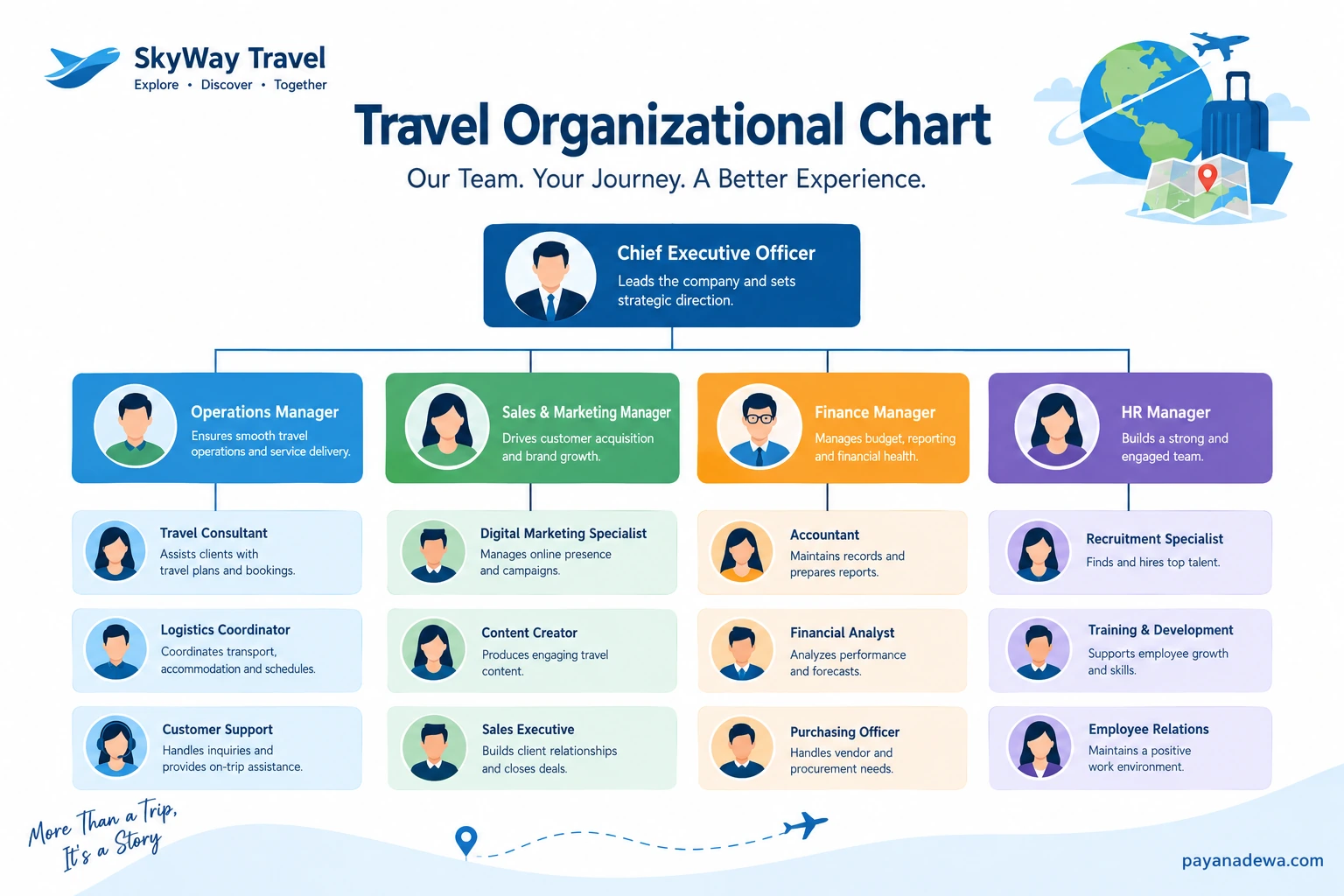
What Is a Travel Organizational Chart?
A travel organizational chart is a visual diagram of the people, teams, and reporting relationships within a travel-related business. It usually begins with an owner, general manager, or chief executive and branches into departments such as operations, sales and marketing, finance, and human resources. Smaller businesses may combine several functions under one manager, while larger companies may include specialist teams for reservations, product development, supplier relations, and traveler support.
The chart is more than a list of job titles. It explains how work is organized, who makes decisions, and where employees should go for approvals or help. It can also show functional relationships between teams that need to work together even when they report to different managers.
Why a Travel Company Needs an Organizational Chart
Clarifies roles and accountability
When every task has a clear owner, employees are less likely to duplicate work or assume someone else is handling an issue. A chart helps identify who manages bookings, negotiates with suppliers, approves refunds, oversees marketing campaigns, and handles urgent traveler requests.
Improves communication between departments
Travel services depend on coordinated handoffs. Sales gathers customer requirements, operations confirms availability, finance processes payments, and support helps when plans change. A visible structure gives employees a starting point for questions and helps managers spot communication gaps before they affect customers.
Supports growth and staffing decisions
A chart can reveal when one person is responsible for too many functions or when a growing team needs a dedicated reservations coordinator. It is useful for onboarding, succession planning, assigning coverage during busy seasons, and explaining the business structure to partners.
Common Travel Agency Organizational Structure
There is no single structure that fits every travel company. The right design depends on the number of employees, destinations served, customer types, and complexity of the services offered. The following departments are a practical model to adapt.
1. Executive Leadership or General Management
The owner, managing director, or chief executive sets business goals, approves budgets, monitors performance, and makes major strategic decisions. In a small agency, this person may also manage key accounts or oversee daily operations.
2. Travel Operations and Reservations
The operations team turns bookings into deliverable travel arrangements. Typical responsibilities include itinerary coordination, reservation checks, supplier communication, ticketing processes where applicable, accommodation arrangements, schedule updates, and contingency planning.
- Operations Manager: Coordinates service delivery and resolves workflow issues.
- Travel Consultant: Prepares itineraries and manages booking details.
- Logistics Coordinator: Tracks transfers, schedules, accommodation, and tour arrangements.
- Customer Support Specialist: Assists travelers before, during, and after their trips.
3. Sales and Marketing
This team attracts customers, develops travel packages, communicates the company’s value, and builds long-term client relationships. Depending on the business, it may manage digital advertising, social media, content, partnerships, group travel sales, and corporate accounts.
- Sales and Marketing Manager: Sets acquisition goals and brand strategy.
- Digital Marketing Specialist: Manages online campaigns and performance tracking.
- Content Creator: Produces destination guides, package descriptions, and promotional content.
- Sales Executive: Responds to leads, prepares proposals, and maintains client relationships.
4. Finance and Administration
Finance keeps the business financially organized. Responsibilities may include budgeting, bookkeeping, supplier payments, invoicing, payroll coordination, expense tracking, commission reconciliation, and management reports. Assign approval limits clearly, particularly for refunds, customer credits, and unexpected trip expenses.
5. Human Resources and People Development
In a larger travel company, human resources manages recruitment, onboarding, training, performance reviews, staff policies, and employee relations. In a small agency, these responsibilities may sit with the owner or an office manager. Regardless of the reporting line, staff should know who handles workplace questions and training needs.
6. Product Development and Supplier Relations
Tour operators and companies that sell their own packages may need a team to research destinations, design itineraries, negotiate supplier agreements, check service quality, and review product profitability. This function may report to operations or commercial leadership, depending on the company’s priorities.
How to Create a Travel Organizational Chart
Step 1: List Your Business Functions
Start with activities rather than job titles. List tasks such as lead generation, itinerary design, booking confirmation, supplier payment, emergency assistance, and post-trip feedback. Group related tasks into functions before assigning them to roles.
Step 2: Identify Decision-Makers and Reporting Lines
Choose who is accountable for each function and who approves important decisions. Use solid lines for direct reporting relationships. If two departments collaborate closely but do not share a manager, describe that relationship in a note or use a clearly explained dotted line.
Step 3: Match Responsibilities to Available Staff
Do not create unnecessary management layers simply to make the chart look complete. In a small agency, one employee may handle sales, social media, and customer follow-up. Show the person’s primary reporting line and document their additional responsibilities in a role description.
Step 4: Design the Chart for Quick Reading
Place senior leadership at the top, departments in the next row, and specialist or frontline roles beneath their relevant manager. Keep job titles short, use consistent shapes, and choose readable colors with strong contrast. Avoid crisscrossing connectors and overly detailed text inside boxes.
Step 5: Validate the Chart with Your Team
Ask department leads and employees whether the chart reflects how decisions and work actually move. Confirm that every key responsibility has an owner and that staff know whom to contact for urgent booking changes, complaints, payment approvals, and supplier issues.
Step 6: Review It Regularly
Update the chart after hiring, restructuring, adding a new service, or changing reporting relationships. Assign an owner to maintain the latest version and include a review date so employees can distinguish the current chart from an outdated copy.
Travel Organizational Chart Examples by Business Size
Small Travel Agency
A small agency may use a simple structure: Owner or General Manager, with three functional areas beneath—Sales and Customer Relations, Booking and Operations, and Finance and Administration. One person may cover more than one area. This model keeps the chart compact while making ownership clear.
Growing Tour Operator
A growing operator may separate Operations, Sales and Marketing, Finance, and People Operations. Operations can then branch into reservations, tour coordination, logistics, and traveler support. Sales and Marketing may include digital campaigns, partnerships, and account management.
Corporate Travel Management Company
A corporate travel provider may organize teams around client accounts, travel consultants, after-hours support, supplier management, reporting, and account implementation. The chart should show both management responsibility and the escalation path for time-sensitive traveler issues.
Best Practices for a Useful Organizational Chart
- Keep it accurate: Show real roles and reporting relationships rather than an idealized structure.
- Make ownership obvious: Assign an accountable role to every essential business function.
- Protect employee privacy: Share only the contact and role information needed by the intended audience.
- Use consistent job titles: Avoid giving the same responsibility several different names across teams.
- Separate structure from procedures: The chart shows who reports to whom; a separate workflow explains how to complete a booking or approve a refund.
- Plan for emergencies: Identify the escalation contact for missed connections, supplier failures, and urgent customer concerns in an appropriate internal guide.
- Make it accessible: Use readable fonts, clear contrast, and a digital version that staff can open on different devices.
Common Mistakes to Avoid
A chart becomes less useful when it is too complicated, outdated, or disconnected from day-to-day work. Avoid adding every task to each box, creating unnecessary layers, or leaving important responsibilities without a clear owner. Do not assume that a reporting line automatically explains every cross-team process. Document shared workflows separately and make sure staff know where to find them.
Another common mistake is treating the chart as a one-time design project. A new service, seasonal team, or change in supplier operations can make the chart inaccurate. Set a review schedule and invite employees to flag changes when responsibilities shift.
How to Customize the Printable Travel Organizational Chart Template
Use the sample chart as a visual starting point, not a fixed rule. Replace the sample company name and job titles with your own, remove departments that do not apply, and add functions that are essential to your business. For a small team, combine related boxes; for a larger operation, create separate charts for each department and keep one high-level overview for the whole company.
Before sharing the final version, check that names and titles are current, the reporting lines are unambiguous, and the layout remains readable when printed. Add a version date and, if appropriate, the name of the person responsible for updates. Keep a master copy in a shared location so staff do not rely on conflicting versions.
Conclusion
A clear travel organizational chart helps a travel agency or tour operator define responsibilities, strengthen communication, and deliver a more consistent customer experience. Begin with the work your business needs to perform, group related functions into departments, and show straightforward reporting lines. Then customize the template to fit your team and review it whenever the business changes. The best chart is not necessarily the most complex—it is the one employees can understand and use every day.