A well-designed Warehouse Organizational Chart helps businesses organize warehouse operations, define employee responsibilities, and improve communication between departments. Whether you manage a small storage facility or a large distribution center, a clear organizational structure makes it easier to coordinate daily activities, manage inventory, and maintain productivity.
Without a defined reporting structure, warehouse employees may experience confusion about their responsibilities, supervisors may struggle to coordinate tasks, and operational problems can take longer to resolve. A warehouse organization chart provides a visual overview of the workforce, showing who reports to whom and how different teams contribute to the overall operation.
In this guide, you will learn what a warehouse organizational chart is, which positions to include, how to structure warehouse departments, and how to create a practical chart for your business. You will also discover useful tips for adapting the structure to your warehouse size, operational needs, and staffing requirements.
What Is a Warehouse Organizational Chart?
A warehouse organizational chart is a visual diagram that illustrates the hierarchy of employees, supervisors, managers, and departments within a warehouse. It identifies reporting relationships and clarifies how responsibilities are distributed throughout the facility.
Depending on the business, the chart may include warehouse management, receiving, inventory control, order picking, packing, shipping, transportation, and equipment maintenance. Each department has specific responsibilities that support the movement of goods from arrival to storage and final delivery.
A warehouse organization chart can be designed as a traditional hierarchy, with a warehouse manager at the top, or as a more flexible structure in which several teams collaborate under shared management.
Companies use warehouse organizational charts to:
- Clarify job responsibilities and reporting relationships.
- Improve communication between warehouse departments.
- Identify staffing gaps and overlapping responsibilities.
- Support employee onboarding and training.
- Improve accountability and operational efficiency.
- Make workforce planning and performance management easier.
Warehouse Organizational Chart Template
A warehouse organizational chart template provides a convenient starting point for building a clear and professional team structure. Instead of creating a diagram from scratch, you can use a predefined layout and customize it with your employees, job titles, and department responsibilities.
The following warehouse organizational chart illustrates a practical structure for a medium-sized facility. It includes a warehouse manager, four main functional departments, and the operational employees who support each department.
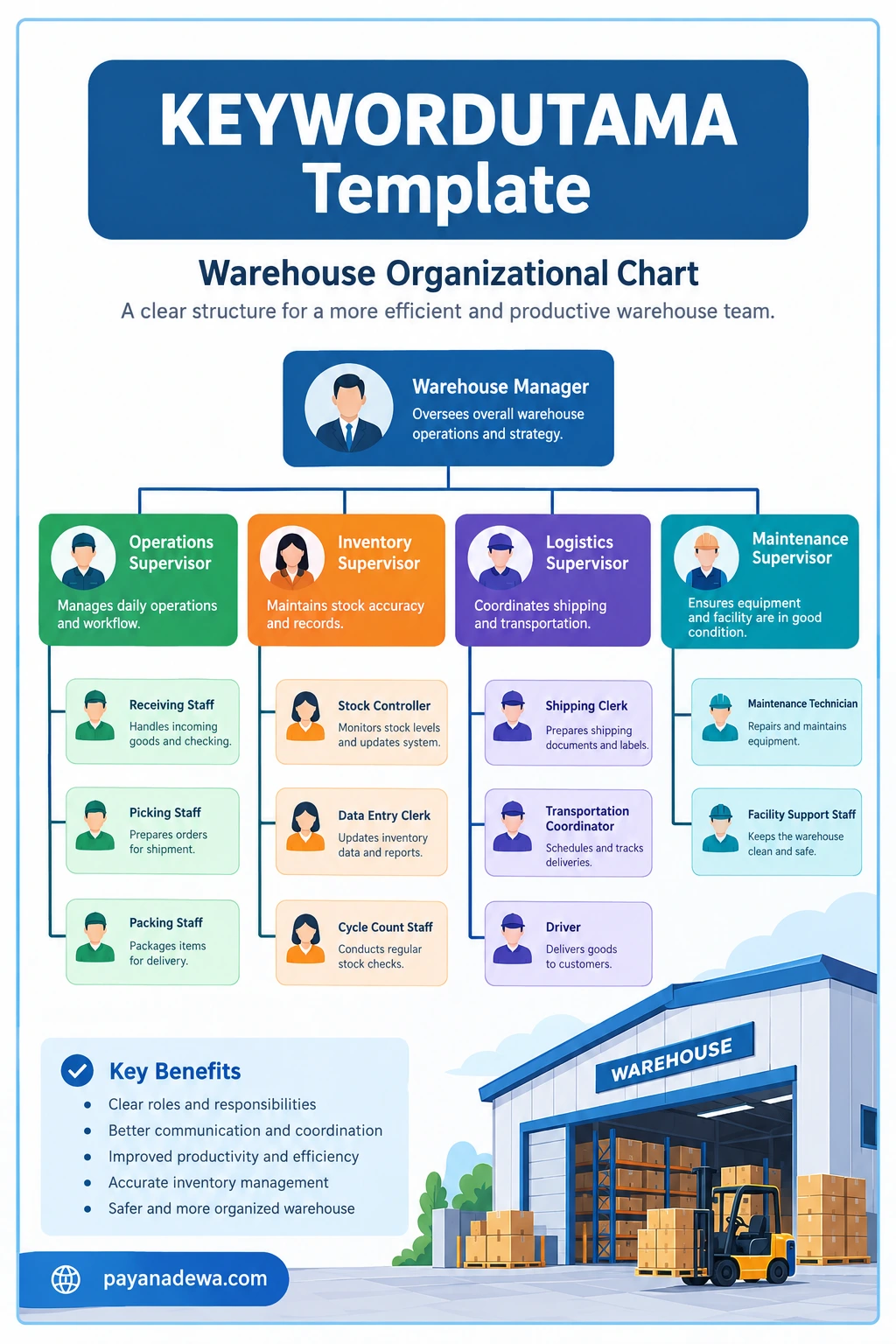
Use this structure as a reference rather than a fixed rule. You can rename departments, remove unnecessary positions, or add specialized roles according to your warehouse’s size and operational complexity.
Key Positions in a Warehouse Organizational Chart
Understanding the responsibilities of each position is essential when designing an effective warehouse hierarchy. Although job titles vary between companies, most warehouse structures include several core roles.
1. Warehouse Manager
The warehouse manager oversees the overall performance of the facility. This position typically reports to an operations manager, supply chain manager, or logistics director, depending on the company structure.
Common responsibilities include:
- Managing daily warehouse activities and workforce allocation.
- Monitoring productivity, inventory accuracy, and order fulfillment.
- Ensuring compliance with safety procedures and company policies.
- Coordinating with purchasing, sales, transportation, and customer service teams.
- Reviewing performance metrics and implementing improvements.
2. Warehouse Operations Supervisor
The operations supervisor manages routine warehouse activities and coordinates frontline employees. This role helps ensure that goods are received, stored, picked, packed, and prepared for dispatch efficiently.
Depending on the facility, the supervisor may oversee receiving staff, order pickers, packing staff, and general warehouse associates. The supervisor also monitors attendance, assigns tasks, and resolves operational issues during each shift.
3. Inventory Control Supervisor
The inventory control supervisor maintains accurate stock records and helps ensure that physical inventory matches the warehouse management system. Inventory accuracy is important because stock discrepancies can lead to delayed orders, unnecessary purchases, and customer dissatisfaction.
Typical responsibilities include cycle counting, investigating inventory discrepancies, updating stock records, monitoring storage locations, and coordinating stock adjustments with authorized personnel.
Inventory teams may include stock controllers, inventory clerks, data entry clerks, and cycle count specialists.
4. Logistics and Shipping Supervisor
The logistics supervisor coordinates the movement of goods from the warehouse to their destinations. This department often manages shipment preparation, delivery schedules, transportation documentation, and communication with carriers.
Common positions include shipping clerks, transportation coordinators, dispatchers, and drivers. In smaller warehouses, one employee may perform several of these functions.
5. Maintenance Supervisor
The maintenance supervisor helps keep warehouse equipment and facilities in safe working condition. Depending on the facility, this role may oversee equipment inspections, repair schedules, preventive maintenance, and coordination with external service providers.
Maintenance technicians and facility support staff may report to this supervisor. Their work helps reduce equipment downtime, maintain a safe working environment, and support uninterrupted warehouse operations.
Common Warehouse Organizational Structures
Not every warehouse requires the same reporting hierarchy. The best organizational structure depends on the number of employees, the volume of goods handled, the complexity of fulfillment activities, and the level of automation.
Small Warehouse Structure
A small warehouse often operates with a simple hierarchy. One warehouse manager or supervisor oversees most daily activities, while warehouse associates handle receiving, storage, picking, packing, and shipping.
This structure keeps communication direct and reduces management costs. However, it is important to assign clear responsibilities even when employees perform multiple tasks.
Medium-Sized Warehouse Structure
A medium-sized warehouse may divide operations into specialized departments. The warehouse manager supervises operations, inventory, logistics, and maintenance functions, with each department led by a supervisor or team leader.
This arrangement improves accountability because each supervisor focuses on a specific area. It also makes it easier to monitor departmental performance and identify operational bottlenecks.
Large Distribution Center Structure
A large distribution center typically requires a more detailed hierarchy. The warehouse manager may report to a distribution center manager or supply chain director and oversee several department managers, shift supervisors, team leaders, and specialized employees.
Additional functions may include quality assurance, warehouse systems administration, health and safety, automation support, and workforce planning. Larger facilities may also separate inbound logistics, outbound logistics, returns processing, and value-added services.
How to Create a Warehouse Organizational Chart
Creating a useful warehouse organizational chart begins with understanding how work flows through your facility. Follow these steps to build a structure that reflects actual responsibilities rather than simply listing job titles.
Step 1: Identify Your Warehouse Activities
Start by listing the main processes performed in your warehouse. These may include receiving deliveries, inspecting goods, storing inventory, replenishing picking locations, fulfilling orders, packing shipments, and processing returns.
Identify any additional activities that require dedicated oversight, such as hazardous materials handling, equipment maintenance, quality control, or cold storage management.
Step 2: List All Positions and Responsibilities
Document the positions required to perform each activity. For every role, define its primary responsibilities, decision-making authority, and reporting relationship.
For example, an inventory clerk may update stock records, while the inventory supervisor investigates discrepancies and approves authorized adjustments. Clearly distinguishing these responsibilities helps prevent confusion.
Step 3: Establish the Reporting Hierarchy
Place the highest warehouse leadership position at the top of the chart. Add department supervisors beneath that position, followed by team leaders and frontline employees.
Use connecting lines to indicate reporting relationships. Avoid unnecessary cross-connections, which can make the diagram difficult to understand. If employees report to more than one manager for different responsibilities, explain that arrangement separately.
Step 4: Choose a Suitable Design Tool
You can create a warehouse organizational chart using spreadsheet software, presentation applications, diagramming tools, or an editable organizational chart template.
Choose a tool that allows you to update job titles, add employees, move reporting lines, and share the chart with relevant team members. For a small facility, a simple diagram may be sufficient. Larger operations may benefit from software that integrates with employee directories or workforce management systems.
Step 5: Review and Update the Chart
Ask warehouse managers and supervisors to review the chart before distributing it. Confirm that each position has the correct reporting relationship and that no important operational function has been overlooked.
Update the chart whenever staffing changes, departments are reorganized, or new responsibilities are introduced. A practical approach is to review it during regular workforce planning meetings and whenever significant organizational changes occur.
Best Practices for an Effective Warehouse Organization Chart
A warehouse organizational chart should be easy to read, accurate, and useful in everyday operations. The following practices can help you create a diagram that employees can understand and managers can maintain.
- Keep the design simple. Use clear labels, consistent shapes, and logical reporting lines.
- Use recognizable job titles. Choose titles that reflect actual responsibilities and are familiar to employees.
- Group related functions. Separate inventory control, warehouse operations, shipping, and maintenance when the workload justifies dedicated teams.
- Define accountability. Make it clear who assigns tasks, approves decisions, and handles escalated problems.
- Reflect different shifts. If the warehouse operates around the clock, show shift supervisors or explain how shift-level reporting works.
- Avoid unnecessary complexity. Do not create additional management positions simply to make the chart look more detailed.
- Protect employee information. Share only the personal information necessary for the chart’s intended use.
- Make the chart accessible. Use readable text and provide digital or printed versions where appropriate.
How a Warehouse Organizational Chart Improves Efficiency
A well-planned warehouse hierarchy supports better performance by connecting responsibilities with operational goals. When employees understand their roles and know who can resolve problems, daily processes can run more smoothly.
Improved Communication
Clear reporting relationships help employees direct questions to the appropriate supervisor. This can reduce delays when handling receiving discrepancies, urgent orders, equipment problems, or inventory issues.
Better Inventory Management
Separating inventory control responsibilities from routine warehouse activities can strengthen stock accuracy. Dedicated ownership of cycle counts, record updates, and discrepancy investigations makes it easier to identify the source of errors.
Greater Employee Accountability
When responsibilities are documented, managers can assign tasks more effectively and evaluate performance against defined expectations. Employees also gain a clearer understanding of how their work contributes to warehouse objectives.
Stronger Safety and Compliance
A defined structure helps establish responsibility for safety briefings, equipment inspections, incident reporting, and compliance procedures. However, an organizational chart should support a complete safety management system rather than replace written procedures or required training.
More Effective Workforce Planning
Managers can use the chart to identify understaffed departments, overlapping duties, and potential training needs. This information supports better scheduling, succession planning, and decisions about whether additional employees or specialized roles are necessary.
Common Mistakes to Avoid
Even a visually attractive warehouse organization chart can be ineffective if it does not reflect how the business actually operates. Avoid these common mistakes when designing or updating your chart.
- Using outdated information: Incorrect reporting lines can create confusion when employees change roles or leave the company.
- Ignoring informal responsibilities: Important duties may be overlooked if the chart only reflects official job titles.
- Creating too many management layers: Excessive hierarchy can slow decision-making and increase administrative work.
- Combining incompatible responsibilities: Assigning conflicting duties to one role may weaken accountability or internal controls.
- Failing to communicate changes: Employees need to know when reporting relationships or responsibilities change.
- Treating the chart as a complete procedure manual: A chart shows organizational relationships, but detailed workflows and standard operating procedures must be documented separately.
Frequently Asked Questions About Warehouse Organizational Charts
What positions should be included in a warehouse organizational chart?
Most warehouse charts include a warehouse manager, operations supervisor, inventory control personnel, shipping or logistics staff, and warehouse associates. Larger facilities may also include quality assurance, maintenance, safety, automation, and shift management roles.
What is the difference between a warehouse manager and a warehouse supervisor?
A warehouse manager generally oversees the facility’s overall performance, staffing, budgets, policies, and operational objectives. A warehouse supervisor typically coordinates daily tasks, assigns work, monitors employees, and addresses immediate operational problems. The exact division of responsibilities depends on the company.
Can one employee have multiple roles in a warehouse?
Yes. Small warehouses often assign multiple responsibilities to the same employee. For example, a warehouse associate may assist with receiving, picking, packing, and inventory counts. The organizational chart should identify the employee’s primary reporting relationship and document additional responsibilities where necessary.
How often should a warehouse organizational chart be updated?
Review the chart whenever staffing, reporting relationships, or departmental responsibilities change. A periodic review, such as quarterly or during scheduled workforce planning, can also help ensure that the chart remains accurate.
What is the best software for creating a warehouse organizational chart?
The best option depends on your requirements. Spreadsheet and presentation applications work well for simple charts, while dedicated diagramming tools provide more flexible layouts. Businesses with frequent staffing changes may prefer software that supports centralized employee information and easier updates.
Conclusion
A Warehouse Organizational Chart is a practical tool for defining reporting relationships, clarifying employee responsibilities, and organizing warehouse departments. By establishing a clear hierarchy, businesses can improve communication, strengthen accountability, support inventory accuracy, and plan their workforce more effectively.
Start by identifying your warehouse activities, listing the roles needed to support them, and arranging those positions into a logical reporting structure. Then customize a warehouse organizational chart template to reflect your facility’s actual operations and update it as your business evolves.
Whether you manage a small storage facility or a large distribution center, a clear and well-maintained organizational chart can help your team work together more efficiently and support consistent warehouse performance.