A number chart is a simple yet powerful tool for learning mathematics. It helps children recognize numbers, understand counting patterns, and build essential math skills. Whether you are a parent, teacher, or homeschool educator, a printable number chart can make everyday learning easier and more enjoyable.
A number chart from 1 to 100 is especially useful for young learners. It displays numbers in an organized grid, making it easier to count forward, count backward, and identify number sequences. Children can also use it to explore addition, subtraction, skip counting, and early multiplication.
In this guide, you will discover how to use a number chart, explore its educational benefits, and find practical activities for children. You will also learn how to choose the right number chart for different ages and learning goals.
What Is a Number Chart?
A number chart is a visual learning resource that displays numbers in a structured arrangement. Most charts use rows and columns to organize numbers in numerical order. This format helps children see how numbers relate to one another.
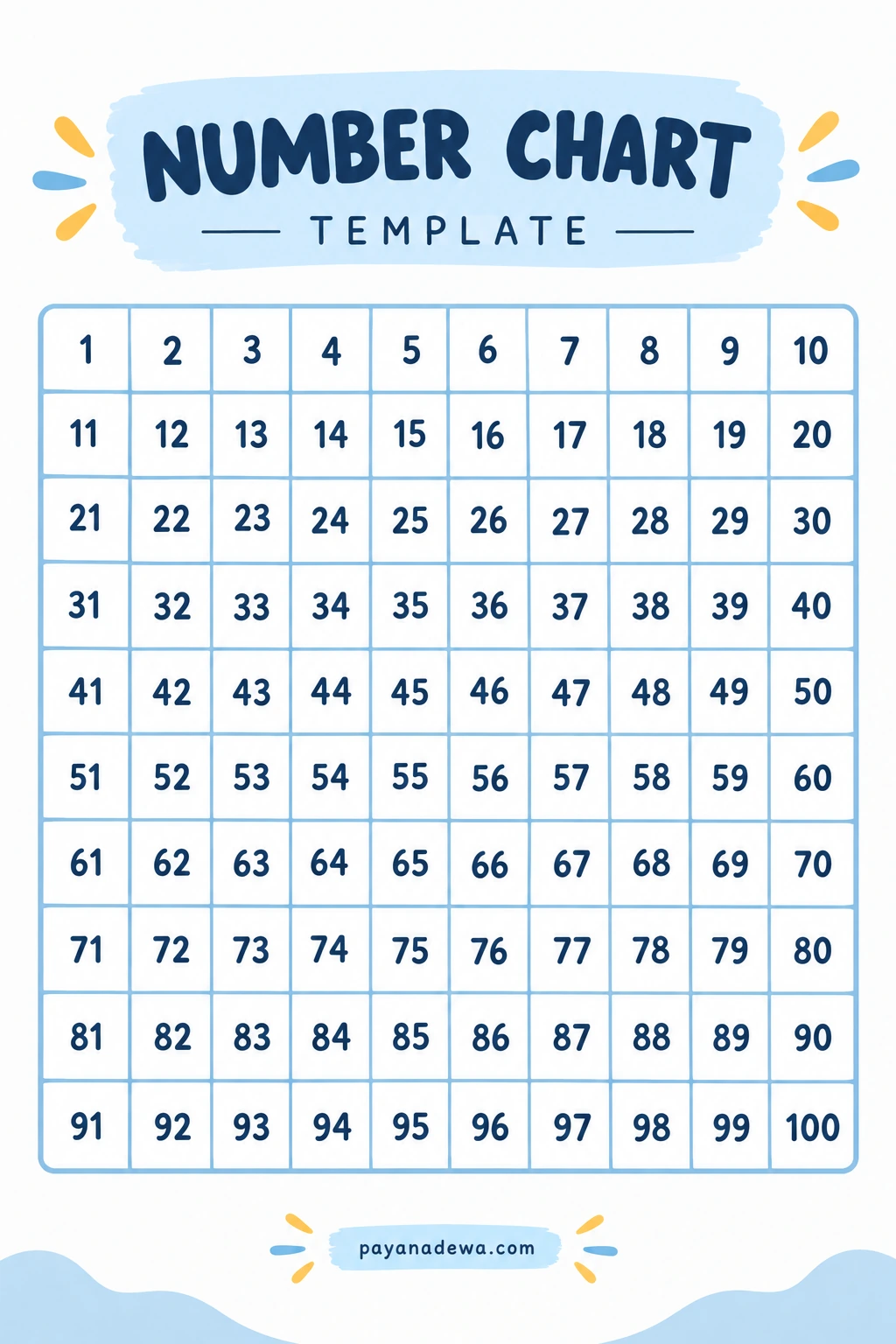
The most common version is a 1–100 number chart. It usually contains ten rows and ten columns. Each row represents a group of ten numbers, starting with 1–10 and ending with 91–100.
Teachers and parents use number charts to introduce basic math concepts. Children can refer to the chart while completing worksheets, practicing counting, or solving simple arithmetic problems.
Why Is a Number Chart Important?
Young children often learn best when they can see information clearly. A number chart provides a visual reference that supports number recognition and counting skills.
It also helps children discover patterns. For example, the numbers in the last column end in zero, while the numbers in the first column end in one. These repeated patterns introduce early mathematical reasoning without requiring complicated explanations.
Printable Number Chart 1–100
A printable number chart from 1 to 100 is a practical resource for classrooms, homework, and home learning. Its simple layout allows children to identify numbers quickly and follow sequences independently.
Use the number chart below as a reference for counting practice, number recognition, and basic math activities. You can print the worksheet and keep it near your child’s study area for easy access.
How to Use the 1–100 Number Chart
Start by asking your child to point to each number while counting aloud. Begin with the first row, then move to the next row when the child feels comfortable.
Next, introduce simple number-finding activities. Ask your child to locate numbers such as 14, 27, 50, or 83. This exercise builds familiarity with the chart and encourages independent learning.
For additional practice, try these activities:
- Circle five numbers that you call out.
- Color all numbers that end in five.
- Find the number that comes before 36.
- Identify the number that comes after 68.
- Count from 21 to 30 without skipping a number.
Benefits of Using a Number Chart
A number chart offers more than a convenient way to display numbers. It supports several foundational skills that children need as they progress in mathematics.
1. Improves Number Recognition
Repeated exposure helps children recognize written numbers more quickly. When children regularly use a number chart, they become more familiar with the shapes and positions of different numbers.
Over time, they can identify numbers without counting from the beginning. This skill supports faster calculations and greater confidence in math lessons.
2. Develops Counting Skills
A number chart gives children a clear path to follow when counting. They can practice counting forward, counting backward, and starting from different numbers.
For example, ask your child to begin at 34 and count to 45. Later, practice counting backward from 20 to 1. These exercises strengthen number sequencing and help children understand numerical order.
3. Introduces Number Patterns
Patterns are an important part of early mathematics. A number chart makes these patterns easier to see because numbers appear in consistent rows and columns.
Children can observe that moving one space to the right increases a number by one. Moving one row down in a standard 1–100 chart increases the number by ten.
These simple observations prepare children for addition, subtraction, place value, and multiplication.
4. Supports Independent Learning
A printed number chart gives children a reference they can use without constantly asking for help. They can check number sequences, correct mistakes, and complete activities at their own pace.
Parents and teachers can also use the chart to create short learning games. This approach makes math practice more interactive and encourages children to participate actively.
Different Types of Number Charts
Not every learner needs the same chart. Choosing the right format depends on a child’s age, current ability, and learning objectives.
Number Chart 1–10
A number chart from 1 to 10 is ideal for toddlers and preschool children who are beginning to recognize numbers. It introduces basic counting without overwhelming young learners with too much information.
Use this chart with counting toys, building blocks, picture cards, or everyday objects. For example, ask your child to place three blocks next to the number 3.
Number Chart 1–20
A 1–20 number chart helps children move beyond the first ten numbers. It is useful for practicing teen numbers, counting sequences, and identifying what comes before or after a particular number.
Children can also use this chart to begin simple addition and subtraction exercises with visual support.
Number Chart 1–100
A 1–100 number chart is suitable for kindergarten and early elementary learners. It provides enough numbers to explore patterns, skip counting, and basic arithmetic.
Because the chart follows a consistent ten-by-ten layout, children can quickly identify rows, columns, and groups of ten.
Hundreds Chart
A hundreds chart typically displays the numbers 1 through 100 in a ten-by-ten grid. Educators often use this format to teach place value, number relationships, and arithmetic strategies.
Some hundreds charts include color-coded sections or blank spaces. These variations are useful for differentiated instruction, number puzzles, and classroom activities.
Fun Number Chart Activities for Kids
Children are more likely to stay engaged when learning feels like play. Fortunately, a number chart can support many simple activities that require little preparation.
Number Hunt
Call out a number and ask your child to find it on the chart. For an extra challenge, provide clues instead of saying the number directly.
For example, say, “Find the number that comes after 46.” This encourages children to think about number order before pointing to the answer.
Skip Counting Practice
Skip counting means counting forward in equal steps rather than one number at a time. It prepares children for multiplication and helps them recognize numerical patterns.
Ask children to highlight every second number to practice counting by twos. Then, highlight every fifth number or every tenth number using a different color.
- Count by twos: 2, 4, 6, 8, 10.
- Count by fives: 5, 10, 15, 20, 25.
- Count by tens: 10, 20, 30, 40, 50.
Missing Number Game
Write a short number sequence and leave one space empty. Ask your child to identify the missing number by referring to the chart.
For example, use 31, 32, __, 34, 35. Children can locate the sequence on the chart and discover that 33 is missing.
As children improve, leave several numbers blank or create sequences that move backward.
Addition and Subtraction Practice
A number chart can also help children understand simple calculations. To add ten, move down one row. To subtract ten, move up one row, provided the destination remains within the chart.
For example, start at 24 and move down one row to reach 34. This visual strategy demonstrates that adding ten changes the tens value while keeping the ones digit the same.
For addition or subtraction within ten, children can move horizontally across a row or use the chart to check their answers. Encourage them to explain each step so they understand the reasoning behind the result.
Tips for Teaching with a Number Chart
Using a number chart effectively does not require long lessons or complicated materials. A few consistent habits can make practice more productive.
- Start with familiar numbers: Begin with numbers your child already recognizes before introducing more challenging sequences.
- Practice a little every day: Short sessions of five to ten minutes can help build familiarity without causing frustration.
- Use colors carefully: Highlighting selected numbers can make patterns easier to notice. Avoid using too many colors at once.
- Connect numbers to real objects: Count pencils, toys, books, or pieces of fruit alongside the chart.
- Encourage children to explain: Ask why a number belongs in a particular position or how they found an answer.
- Adjust the difficulty: Use smaller charts for beginners and introduce skip counting or arithmetic when children are ready.
Most importantly, keep the experience positive. Children learn at different rates, so allow time for practice and celebrate progress rather than expecting instant mastery.
How to Print and Use a Number Chart
A printable number chart is easy to incorporate into a home learning routine or classroom lesson. Follow these steps to get started.
- Choose the right chart: Select a number range that matches your child’s current skills.
- Print the worksheet: Use standard paper and select a readable print size. Choose portrait or landscape orientation according to the template.
- Place it somewhere accessible: Keep the chart on a desk, in a folder, or near a regular study space.
- Add interactive practice: Use pencils, crayons, counters, or removable markers to complete activities.
- Review progress: Repeat familiar tasks and gradually introduce new challenges.
If you plan to reuse the chart, consider placing it inside a clear plastic sleeve. Children can then mark numbers with a dry-erase pen and wipe the surface clean after each activity.
Frequently Asked Questions About Number Charts
What is a number chart used for?
A number chart helps children learn number recognition, counting, sequencing, skip counting, and basic arithmetic. It also makes number patterns easier to understand visually.
What age is a number chart suitable for?
Number charts can support children from preschool through the early elementary years. A chart from 1 to 10 suits beginners, while a 1–100 chart offers more opportunities for counting and arithmetic practice.
How does a number chart help with addition?
A number chart helps children visualize movement between numbers. They can move forward to add or backward to subtract. On a standard hundreds chart, moving down one row adds ten, while moving up one row subtracts ten.
Is a number chart the same as a hundreds chart?
The terms are often used interchangeably when the chart displays numbers from 1 to 100. However, a number chart can cover smaller or larger ranges, depending on its intended purpose.
Can I use a number chart for homeschooling?
Yes. A number chart is an affordable, flexible resource for homeschooling. Use it during morning math practice, counting games, worksheet activities, or lessons about number patterns.
Conclusion
A number chart is a valuable resource for helping children develop confidence in mathematics. Its organized layout makes number recognition, counting, skip counting, and basic arithmetic easier to practice.
From a simple 1–10 number chart to a complete 1–100 printable worksheet, each format offers opportunities to learn through repetition and exploration. With short daily activities and clear guidance, parents and teachers can turn a basic chart into an engaging learning tool.
Start with a number chart that matches your child’s ability, print a copy for easy reference, and introduce new activities as their skills grow. Consistent practice can help children build a strong foundation for future math learning.