A natal chart, also called a birth chart, is an astrological map of the sky at the moment and location you were born. It shows the positions of the Sun, Moon, planets, and other important points in relation to the zodiac signs and twelve astrological houses. For many people, learning how to read a natal chart is a way to reflect on personality, emotional needs, relationships, and personal goals.
You do not need to know astrology terminology before you begin. The key is to understand what each part of the chart represents and how the pieces work together. This guide explains the main components of a birth chart, how to find your chart information, and how to use a natal chart as a tool for self-reflection rather than as a fixed prediction of your future.
What Is a Natal Chart?
A natal chart is a circular diagram calculated using your birth date, birth time, and birthplace. In astrology, the chart represents the sky from a particular location at a specific moment. The exact time matters because the Ascendant and house positions can change throughout the day.
A birth chart is different from a daily horoscope, which usually focuses on a Sun sign or a general forecast. A full natal chart includes several planetary placements and chart angles, creating a more detailed symbolic picture. Astrologers interpret these placements together instead of treating any single sign as the whole story.
What Information Do You Need to Create a Birth Chart?
To calculate a natal chart, gather three pieces of information:
- Date of birth: Your day, month, and year of birth help determine the positions of the Sun and planets.
- Time of birth: The most accurate time available helps calculate your Ascendant and astrological houses.
- Place of birth: Your birth city or town helps determine the local horizon and chart angles.
If you do not know your exact birth time, you can still explore many planetary placements. However, the Ascendant and houses may be unreliable, and the Moon’s sign can sometimes be uncertain if it changed signs that day. Check a birth certificate or ask a family member if you want to improve the accuracy of the time.
The Big Three: Sun, Moon, and Rising Sign
Many beginners start with the “Big Three”: the Sun sign, Moon sign, and Rising sign. In modern astrology, these placements are often used as a simple starting point for understanding a chart.
Sun Sign: Identity and Vitality
The Sun sign is associated with identity, core motivations, and the qualities a person may be learning to express. It is the sign most people know from newspaper or online horoscopes. While it is an important chart component, it does not describe every aspect of a person’s character.
Moon Sign: Feelings and Emotional Habits
The Moon sign is commonly linked with emotional responses, comfort, instinct, and private needs. Some people use it to reflect on what helps them feel safe, how they respond under stress, or what they need to recharge. Its interpretation should be considered alongside the rest of the chart.
Rising Sign: First Impressions and Approach
The Rising sign, also called the Ascendant, is the zodiac sign rising over the eastern horizon at the time of birth. Astrologers associate it with first impressions, outward style, and the way someone approaches new situations. Because it depends strongly on birth time and location, it is one of the placements most affected by an inaccurate birth time.
Understanding Planets in a Natal Chart
In astrology, planets symbolize different drives or areas of experience, while their zodiac signs describe the style through which those themes may be expressed. The houses point to life areas where the themes may be emphasized.
- Mercury: Communication, learning, reasoning, and information.
- Venus: Affection, attraction, pleasure, values, and aesthetics.
- Mars: Initiative, desire, assertion, and how energy is directed.
- Jupiter: Growth, optimism, exploration, and beliefs.
- Saturn: Responsibility, limits, patience, and long-term effort.
- Uranus: Change, independence, innovation, and disruption.
- Neptune: Imagination, ideals, spirituality, and uncertainty.
- Pluto: Transformation, power, intensity, and deep change.
These meanings come from astrological tradition and are interpretive symbols, not scientifically established measures of personality. Use them as prompts for reflection, not as labels that define what you can or cannot do.
The 12 Astrological Houses Explained
The twelve houses divide a natal chart into life areas. House systems differ, so a chart calculator may place house boundaries differently depending on the method selected. The following descriptions are common starting points:
- 1st House: Self-presentation, identity, and beginnings.
- 2nd House: Personal resources, possessions, and values.
- 3rd House: Communication, learning, and everyday connections.
- 4th House: Home, family, roots, and private life.
- 5th House: Creativity, play, romance, and self-expression.
- 6th House: Routines, work habits, service, and daily well-being.
- 7th House: Partnerships, agreements, and one-to-one relationships.
- 8th House: Shared resources, intimacy, and personal change.
- 9th House: Higher education, travel, philosophy, and wider horizons.
- 10th House: Career, public role, reputation, and long-term aims.
- 11th House: Friends, communities, networks, and future hopes.
- 12th House: Solitude, reflection, hidden patterns, and closure.
When reading a house, look at the sign on its cusp, any planets placed inside it, and the planet traditionally associated with that sign. Beginners can keep it simple: identify the house, read its broad theme, and consider whether the theme connects with a real-life experience.
What Are Aspects in Astrology?
Aspects are the angular relationships between planets in a chart. Astrologers interpret them as symbolic links between different parts of a person’s inner life. Common aspects include:
- Conjunction: Two placements are close together and are often interpreted as blending their themes.
- Sextile: A supportive angle traditionally associated with opportunity or cooperation.
- Square: A challenging angle often read as tension that may encourage action or growth.
- Trine: A harmonious angle associated with ease or natural flow.
- Opposition: A relationship across the chart often interpreted through balance, contrast, or negotiation.
Astrologers may use an “orb,” meaning the allowed distance from an exact angle. Different astrologers and chart tools use different settings, so aspect lists may not always match perfectly.
How to Read Your Natal Chart Step by Step
A chart can look complicated at first, so avoid trying to interpret every symbol at once. Use this simple process:
- Confirm your birth details. Check your date, time, and birthplace. Note any uncertainty about the time.
- Find your Big Three. Identify the Sun, Moon, and Ascendant before exploring more technical details.
- Locate personal planets. Review Mercury, Venus, and Mars to explore communication, preferences, and motivation in astrological terms.
- Check the houses. Notice which life areas contain several planets or seem especially prominent.
- Look for major aspects. Start with a few close aspects rather than interpreting every line on the chart.
- Write down questions. Record which interpretations feel useful, which do not, and what real experiences might add context.
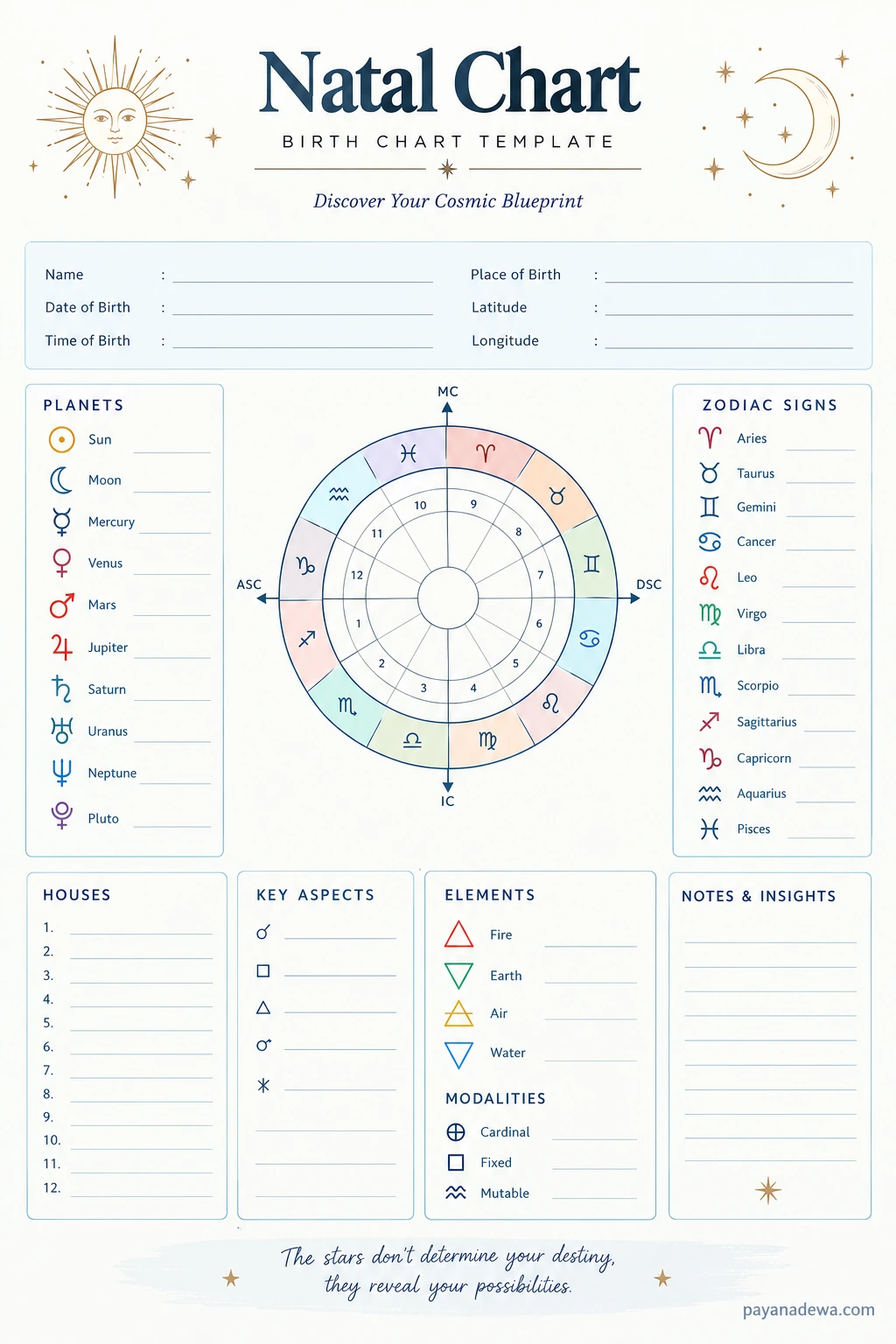
Keep a notebook or use a printable birth chart template to record placements, keywords, and questions. Comparing your notes over time can help you develop a consistent approach instead of relying on a single description.
Common Natal Chart Reading Mistakes to Avoid
- Focusing only on the Sun sign: A full chart contains multiple placements and relationships.
- Assuming one placement explains everything: Interpretations are usually considered in context, not in isolation.
- Ignoring an uncertain birth time: A small time difference can affect the Ascendant and house placements.
- Treating astrology as certainty: A chart cannot reliably prove what will happen or determine someone’s character or choices.
- Using interpretations as a substitute for expert advice: Do not base medical, legal, financial, or other high-stakes decisions solely on astrology.
Can a Natal Chart Predict Your Future?
Some astrological traditions use techniques such as transits and progressions to interpret periods of change. These techniques assign symbolic meaning to the movement of planets in relation to a birth chart. However, astrology has not been established as a scientifically reliable method for predicting individual events.
A balanced approach is to treat the chart as a reflective or cultural tool. You might use it to generate questions about your habits, goals, and relationships, then make decisions based on evidence, personal values, and the circumstances you can observe. Your choices and experiences remain more important than any chart interpretation.
Conclusion: Use Your Natal Chart as a Tool for Self-Reflection
A natal chart brings together zodiac signs, planets, houses, and aspects in one symbolic map. Start with your birth details and the Big Three, then gradually explore planetary meanings, house themes, and major aspects. A printable natal chart worksheet can help you keep your notes organized as you learn.
Most importantly, stay curious and open-minded. Astrology offers a long-standing symbolic language that some people find meaningful, but it should not be treated as a scientific diagnosis or a fixed script for life. Use what encourages thoughtful reflection, question what does not fit, and remember that a birth chart does not define your limits or determine your future.