A well-designed fire organizational chart helps fire departments establish clear leadership, define responsibilities, and coordinate emergency response activities. Whether you manage a municipal fire department, a volunteer fire brigade, or an industrial fire and safety team, an organizational chart makes it easier to understand who is responsible for each task.
During an emergency, every second matters. Therefore, firefighters and officers need to understand their reporting relationships before an incident occurs. A clear fire department organizational structure supports effective communication, improves accountability, and helps personnel work together under pressure.
In this guide, you will learn what a fire organizational chart is, how a typical fire department hierarchy works, which positions to include, and how to create a practical chart for your organization. You will also discover how to customize a printable fire organizational chart template to match your department’s needs.
What Is a Fire Organizational Chart?
A fire organizational chart is a visual diagram that shows the hierarchy, leadership positions, departments, and reporting relationships within a fire service organization. It illustrates how authority flows from senior leadership to operational personnel and support teams.
Most charts use boxes to represent positions and connecting lines to show reporting relationships. Each box may include a job title, employee name, contact information, or other essential details.
Depending on the size and purpose of the organization, a fire department organizational chart may include:
- Fire Chief and senior leadership.
- Assistant or Deputy Fire Chiefs.
- Operations and emergency response divisions.
- Fire prevention and public education personnel.
- Training and professional development officers.
- Logistics, administration, and support services.
- Battalion Chiefs, company officers, and firefighters.
However, not every fire department uses the same structure. A small volunteer brigade may have only a few leadership levels, while a large metropolitan department may have multiple divisions, battalions, stations, and specialized response units.
Why Is a Fire Department Organizational Chart Important?
An organizational chart is more than an administrative document. It provides a practical reference that helps personnel understand their roles and work together effectively.
1. Establishes a Clear Chain of Command
A defined chain of command helps employees understand who provides direction, who receives reports, and who makes decisions. This clarity becomes especially important during emergencies, when confusion can delay critical actions.
Furthermore, clear reporting relationships help prevent conflicting instructions. Personnel can identify the appropriate supervisor and follow the department’s established procedures.
2. Improves Emergency Response Coordination
Fire incidents often require cooperation between multiple teams. For example, an operational crew may need support from dispatch, logistics, medical services, and incident management personnel.
A fire organizational chart helps identify these teams and their leadership relationships. As a result, department members can coordinate resources and communicate more efficiently.
3. Defines Roles and Responsibilities
When job responsibilities are clearly documented, personnel can better understand their assignments and limits of authority. This reduces duplication of work and helps supervisors identify gaps in staffing or responsibility.
In addition, managers can use the chart when assigning personnel, planning promotions, and reviewing departmental performance.
4. Supports Training and Onboarding
New firefighters and administrative employees need to understand how their department operates. An organizational chart provides a straightforward introduction to the leadership structure and the teams they will work with.
Similarly, training officers can use the chart to explain reporting procedures, supervisory responsibilities, and the relationship between operational and support divisions.
5. Strengthens Accountability
A documented structure makes it easier to identify who oversees particular functions. It also supports internal reviews, succession planning, and administrative continuity when personnel change positions.
Nevertheless, an organizational chart should complement official operating procedures rather than replace incident command protocols, emergency plans, or written job descriptions.
Typical Fire Organizational Chart Structure
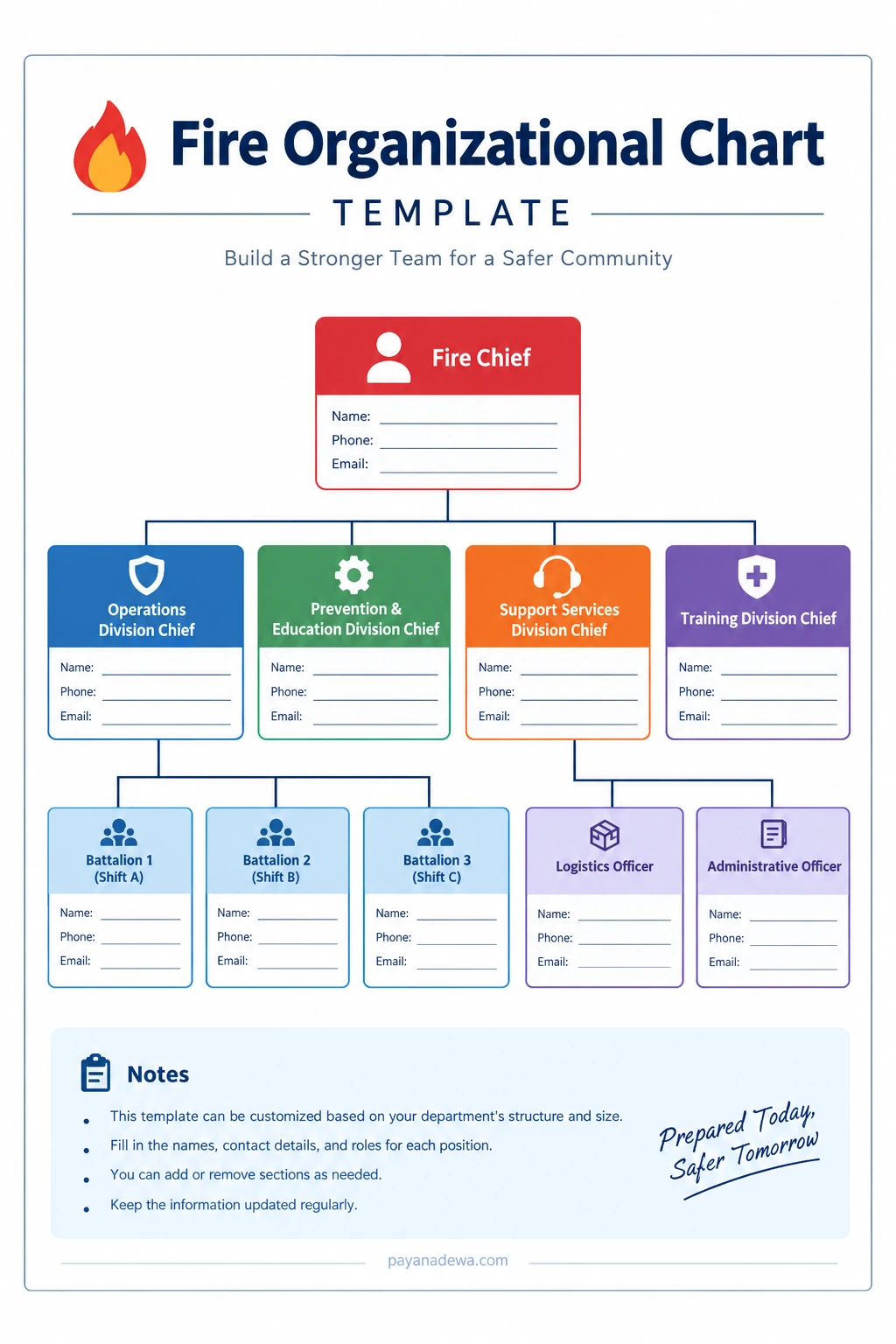
A traditional fire department organizational chart often places the Fire Chief at the top, followed by senior officers, division leaders, and operational personnel. Support departments may report through separate leadership positions, depending on the organization’s design.
The following example illustrates a possible structure. Actual titles and reporting relationships should follow the department’s approved organization.
1. Fire Chief
The Fire Chief generally serves as the department’s senior executive. This position oversees strategic planning, staffing, budgets, policies, and overall service delivery.
The Fire Chief may also coordinate with municipal leaders, emergency management agencies, community organizations, and other public safety partners.
2. Deputy Fire Chief or Assistant Fire Chief
A Deputy or Assistant Fire Chief helps manage department operations and supervises designated divisions. In larger organizations, several senior officers may oversee different functional areas.
For example, one officer might manage emergency operations while another oversees administration, prevention, or professional development.
3. Operations Division
The Operations Division typically manages frontline emergency response activities. Depending on the department, this division may include Battalion Chiefs, station officers, company officers, and firefighters.
- Battalion Chief: Supervises multiple stations or operational units within an assigned area or shift.
- Station Captain or Company Officer: Leads an assigned crew and oversees readiness, equipment checks, and daily station activities.
- Lieutenant: Provides supervision at the company or crew level where the rank exists.
- Firefighter: Performs firefighting, rescue, prevention-related duties, and other assigned emergency response tasks within their training and authorization.
Some departments use different rank structures. Therefore, the chart should reflect the actual titles and supervisory arrangements used by your organization.
4. Fire Prevention and Public Education Division
This division focuses on reducing fire risks before emergencies happen. Its responsibilities may include fire safety inspections, code enforcement, public education, risk assessments, and community outreach.
Depending on local regulations, personnel may include fire inspectors, prevention officers, public education specialists, and fire investigators.
5. Training Division
The Training Division coordinates professional development and helps maintain operational readiness. Training officers may organize firefighting exercises, equipment instruction, emergency simulations, and competency assessments.
They also help ensure that personnel maintain the qualifications required for their assigned duties and specialized response roles.
6. Support Services and Administration
Support functions help the department maintain its daily operations. Although these teams may not always respond directly to incidents, they provide essential services that keep personnel and equipment ready.
- Logistics Officer: Coordinates equipment, supplies, uniforms, and other operational resources.
- Administrative Officer: Supports records management, scheduling, documentation, and routine administrative processes.
- Fleet or Equipment Manager: Coordinates vehicle maintenance and equipment readiness where applicable.
- Finance or Human Resources Personnel: Assist with budgeting, payroll, recruitment, and employee administration.
Smaller departments may combine several support responsibilities under one position. Larger departments may establish separate units for each function.
Fire Organizational Chart Template: What Should It Include?
A printable fire organizational chart template saves time and provides a consistent format for documenting departmental roles. Before creating your chart, identify the information that personnel and administrators need to access quickly.
A useful template should include the following elements:
- Department name: Identify the fire department, brigade, company, or facility.
- Leadership positions: Place the Fire Chief and other senior leaders at the top of the hierarchy.
- Division names: Separate operational, prevention, training, and support functions where appropriate.
- Position titles: Use official job titles that match departmental policies.
- Employee names: Add current personnel names if the chart is intended for internal use.
- Contact details: Include approved work contact information when necessary.
- Reporting lines: Use connecting lines to illustrate supervisory relationships accurately.
- Revision information: Record the effective date or last update to help users identify the current version.
Keep the design simple and readable. If the chart becomes crowded, create separate charts for leadership, operations, and support services instead of squeezing every position onto one page.
For a department with multiple shifts, consider including shift assignments or creating a separate staffing chart. However, avoid displaying sensitive personal information in versions distributed publicly.
How to Create a Fire Department Organizational Chart
Creating a reliable chart begins with understanding how your department actually operates. Follow these steps to develop a practical and accurate document.
Step 1: Define the Purpose
First, determine how the chart will be used. An internal management chart may need names, reporting lines, and contact details. A public-facing chart may only need department divisions and leadership titles.
Defining the purpose early helps you choose the right level of detail.
Step 2: Gather Accurate Information
Review the approved organization structure, current job descriptions, staffing records, and relevant departmental policies. Consult department leadership if reporting relationships are unclear.
Do not rely solely on informal assumptions. An outdated or inaccurate chart can create confusion, especially when personnel changes occur.
Step 3: Establish Reporting Relationships
Identify who supervises each division, team, and position. Place senior leadership near the top and arrange subordinate roles beneath their appropriate supervisors.
Where a position reports to more than one function, explain the relationship clearly. For example, functional guidance and direct personnel supervision may follow different arrangements.
Step 4: Choose a Suitable Layout
Use a top-down hierarchy for a straightforward reporting structure. For larger departments, group related positions into divisions or battalions.
Choose consistent colors, readable fonts, and clear connecting lines. In addition, make sure the chart remains understandable when printed in black and white.
Step 5: Verify and Approve the Chart
Ask department leaders or authorized administrators to review the chart before distribution. Confirm that every position, title, and reporting relationship is correct.
Once approved, add a revision date and identify the person or office responsible for maintaining the document.
Step 6: Distribute and Maintain the Document
Share the approved version through the department’s authorized document system, staff portal, or other appropriate communication channels. Keep one clearly identified master version to prevent conflicting copies.
Finally, review the chart whenever the department restructures, creates a new position, changes supervisory responsibilities, or appoints new leaders.
Best Practices for an Effective Fire Organizational Chart
A good chart balances accuracy with simplicity. Apply the following recommendations to make it more useful for daily operations.
- Use consistent terminology: Match titles to official department policies and local rank conventions.
- Keep reporting lines clear: Avoid crossing connectors and ambiguous relationships.
- Group related functions: Separate operations, prevention, training, and administration where practical.
- Prioritize readability: Use legible text and sufficient spacing between positions.
- Update the chart regularly: Assign responsibility for reviewing and maintaining the document.
- Protect sensitive information: Limit personal contact details and internal information to authorized audiences.
- Align with emergency procedures: Make sure the chart does not conflict with incident command arrangements or official response plans.
- Adapt the structure to department size: Avoid unnecessary management levels in small brigades or volunteer organizations.
Another useful practice is to distinguish organizational hierarchy from incident command. A permanent departmental chart describes normal reporting relationships, whereas an incident command structure organizes authority and responsibilities for a specific emergency. The two may differ according to the incident and applicable procedures.
Common Mistakes to Avoid
Even a professionally designed organizational chart can be ineffective if its information is incomplete or difficult to interpret.
One common mistake is including too many details. Long descriptions, excessive contact information, and unnecessary reporting levels can make the chart hard to read.
Another problem is failing to update the document after staffing changes. When an employee moves to another position, the chart should be reviewed so that it continues to reflect the approved structure.
Departments should also avoid assuming that every fire service follows an identical hierarchy. Municipal fire departments, volunteer brigades, airport fire services, industrial emergency response teams, and specialized rescue organizations may require different arrangements.
Finally, do not treat the chart as a replacement for written policies, emergency action plans, standard operating procedures, or formal incident command guidance. Each document serves a different purpose.
Frequently Asked Questions About Fire Organizational Charts
What is the main purpose of a fire organizational chart?
Its primary purpose is to display leadership positions, departmental divisions, and reporting relationships. It helps personnel understand responsibilities, identify supervisors, and coordinate administrative and operational activities.
What position is at the top of a fire department organizational chart?
The Fire Chief commonly occupies the highest departmental leadership position. However, some organizations may use different executive titles or operate under a broader public safety management structure.
What is the difference between a fire organizational chart and an incident command chart?
A fire organizational chart shows the department’s normal management structure. An incident command chart shows the command roles and functional assignments established for a particular emergency. The incident structure can change according to operational needs.
Can a volunteer fire department use the same template?
Yes. A volunteer fire department can use a similar template while adapting the positions to its size, staffing arrangements, and governance model. Unnecessary roles can be removed, and existing responsibilities can be combined where appropriate.
How often should a fire organizational chart be updated?
Review the chart whenever leadership, staffing, departmental divisions, or reporting relationships change. A scheduled periodic review is also useful to identify outdated information before it causes problems.
Can I use a fire organizational chart template for an industrial facility?
Yes. Industrial facilities can adapt the template for their fire brigade, emergency response team, fire safety department, or site emergency management organization. The final chart should align with site procedures, applicable regulations, and the facility’s actual reporting structure.
Conclusion
A well-structured fire organizational chart provides a clear picture of departmental leadership, responsibilities, and reporting relationships. It helps fire departments improve communication, support personnel development, and maintain accountability across operational and administrative functions.
To create an effective chart, start with an accurate understanding of your department’s structure. Then organize leadership positions, group related teams, verify reporting lines, and choose a layout that remains readable in both digital and printed formats.
Most importantly, keep the document current and ensure that it complements your department’s official policies and emergency procedures. With the right structure and regular maintenance, a fire department organizational chart becomes a valuable reference for everyday management and emergency preparedness.