A football depth chart helps coaches, players, analysts, and fans understand how a team is organized at each position. It lists the first-choice players, their backups, and the options available when injuries, substitutions, tactical changes, or poor form affect the lineup. Whether you follow a professional club, manage a school team, or organize a local squad, a clear depth chart makes team planning easier.
In this guide, you will learn what a football depth chart includes, how to create one, how to rank players fairly, and how to keep the information useful throughout a season. You can also use the printable template below to start organizing your own roster.
What Is a Football Depth Chart?
A football depth chart is an organized view of the players available for each position, usually ranked by their current role or selection priority. The first name at a position is generally the preferred starter, while the next names show alternative options. The chart may also include player details, tactical notes, and rotation plans.
The exact format depends on the sport and the team. In association football (soccer), a chart commonly groups goalkeepers, defenders, midfielders, and forwards. In American football, depth charts are usually arranged by specialist positions such as quarterback, running back, wide receiver, offensive line, and defensive line. Always label the sport and use position groups that match your team.
Why a Football Depth Chart Matters
It clarifies the team hierarchy
A depth chart gives coaches and players a shared picture of the current selection order. It can reduce confusion about who is expected to start, who is the next substitute, and which players are developing toward a larger role. It should reflect current performance and tactical needs rather than act as a permanent judgment of a player’s ability.
It prepares the team for absences
Suspensions, injuries, fatigue, and scheduling congestion can change a lineup quickly. Listing reliable alternatives for every position helps a coach identify gaps before match day. It also highlights positions where the squad may be short on cover.
It supports player development
When coaches review the chart alongside training goals, they can identify what a reserve player needs to improve to compete for a higher spot. Specific feedback—such as decision-making under pressure, defensive positioning, passing range, or fitness—is more constructive than simply telling a player to move up the rankings.
What to Include in a Football Depth Chart
A useful chart should be easy to scan and simple to update. Consider including these fields:
- Player name: Use the name commonly used by the team.
- Primary position: Record the player’s main role, such as goalkeeper, centre-back, central midfielder, or striker.
- Depth rank: Mark first choice, second choice, and further alternatives.
- Secondary positions: Note other roles the player can cover competently.
- Availability: Track whether the player is available, injured, suspended, or being managed for workload.
- Assessment notes: Add concise, evidence-based observations about form, fitness, tactical fit, or development.
- Last updated: Include a date so readers know whether the information is current.
For a simple youth or amateur team, a name, position, ranking, and short note may be enough. Larger squads may benefit from separate tabs or sections for each unit, along with a formation diagram.
How to Build a Football Depth Chart Step by Step
1. List every player on the roster
Start with the current squad list and confirm that each player is included once. Add position flexibility where appropriate, but keep each player’s primary role clear. If you are managing a team across a long season, record availability separately from selection rank so a temporary injury does not erase the player’s normal place in the squad.
2. Group players by position
Use position groups that match your sport and tactical system. A soccer team might separate goalkeepers, full-backs, centre-backs, central midfielders, wide attackers, and strikers. An American football team should instead use its specialist offensive, defensive, and special-teams positions. Clear categories make gaps easier to spot.
3. Set an initial order
Rank players based on the role you need them to perform now. Consider recent performance, training standards, tactical understanding, fitness, consistency, and the opponent or match plan. Avoid relying on one statistic or a single recent performance. Use clear criteria and communicate them consistently.
4. Identify backups and positional cover
For each role, name the next available option and any emergency cover. A player may be an excellent backup in one position but less effective in another, so note the difference. If one injury would leave a position uncovered, flag it as a squad-planning priority.
5. Match the chart to your formation
Use a formation diagram to check whether the listed players can fill the roles your system requires. For example, a 4-3-3 formation needs suitable wide forwards and three midfield roles, while a 3-5-2 places different demands on centre-backs and wing-backs. A formation diagram is a planning aid, not a guarantee that every player will perform the same role in every match.
6. Review and update it regularly
Review the chart after matches, meaningful training assessments, transfer or roster changes, and changes in player availability. Add an “updated on” date and share the current version through a team-approved channel. Avoid leaving old copies in circulation, as outdated charts can create unnecessary confusion.
How to Read Starter, Backup, and Rotation Roles
The first-choice player is usually the leading option for a particular role under the current plan. The second-choice player is the next alternative, and the third-choice player may provide additional cover or a developmental option. These labels are relative to a position and a situation; they do not necessarily rank every player on the team from best to worst.
Rotation is different from a strict backup order. Coaches may rotate players to manage fatigue, respond to opponents, develop younger players, or protect players returning from injury. A chart can show likely options, but final selection still depends on the match plan and the player’s current condition.
Practical Tips for Keeping Your Chart Accurate
- Use objective criteria: Base changes on observable performance, role requirements, and training evidence.
- Separate status from rank: Show availability independently so a short-term absence does not distort the normal depth order.
- Make the layout readable: Use consistent position names, clear headings, and enough space for notes.
- Keep private information private: Share only necessary player details and avoid putting sensitive medical information on a widely distributed chart.
- Explain changes respectfully: Give players direct feedback and development goals rather than relying on a chart to communicate difficult decisions.
- Plan for multiple scenarios: Check who can cover a position if a starter is unavailable or the team changes formation.
- Review squad balance: Look for positions with several options and positions where one absence would create a major problem.
Printable Football Depth Chart Template
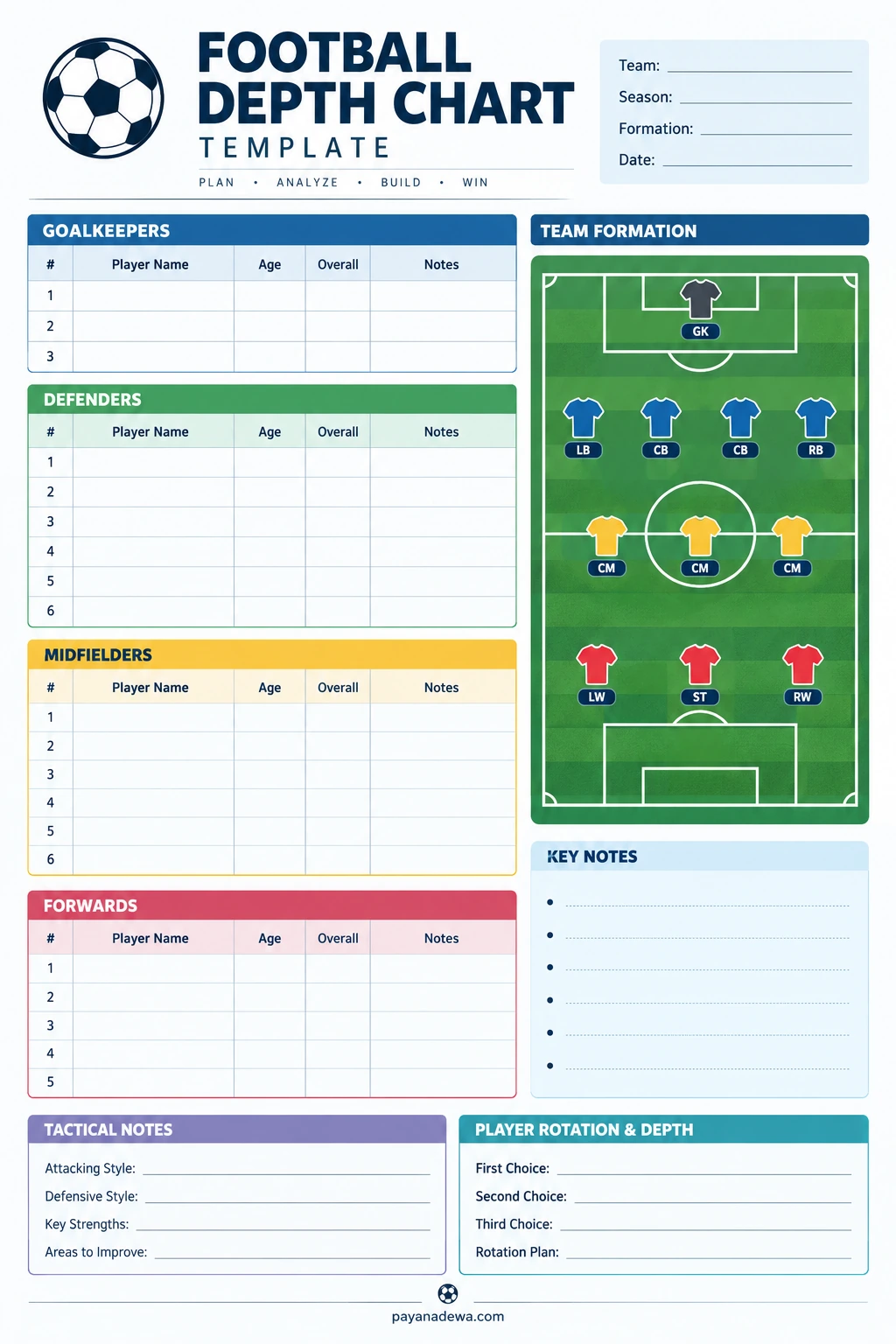
Use the template below to record your squad, compare position options, and add tactical reminders. Fill in the team name, season, formation, and date first. Then add players to each position group, rank the available options, and write concise notes about rotation or development needs. Adapt the categories to your sport and team’s system.
Common Football Depth Chart Mistakes to Avoid
Confusing a depth chart with a confirmed lineup
A depth chart shows selection options and likely order, while a match lineup names the players chosen for a particular game. Make that distinction clear so readers do not assume the chart is an official starting XI or game-day roster.
Ignoring tactical fit
A player’s overall reputation does not automatically make them the best choice for every role. Consider the demands of the position, the team’s formation, and the opponent. A player who excels in one system may need a different role in another.
Leaving the chart unchanged
Squad roles evolve over time. A chart that is not reviewed can misrepresent current form, availability, or player development. Set a regular review schedule and update it whenever a significant change occurs.
Ranking without explaining expectations
Players are more likely to understand selection decisions when coaches explain the skills and behaviors needed for each role. Use the chart as a planning tool and support it with direct, respectful conversations.
Conclusion
A well-maintained football depth chart makes roster planning clearer, helps teams prepare for absences, and supports more deliberate player development. Start with an accurate roster, group players by position, rank options using consistent criteria, and review the chart as circumstances change. Use the printable template as a practical starting point, then customize it to your formation, squad size, and coaching approach. When it is current and clearly explained, a depth chart becomes a useful guide for coaches, players, and team staff throughout the season.