A nursing care plan is an essential tool that helps nurses deliver organized, patient-centered care. It outlines a patient’s health needs, nursing diagnoses, expected outcomes, interventions, and evaluation methods. As a result, nurses can provide consistent care while monitoring progress and adjusting treatment when necessary.
Whether you are a nursing student, a registered nurse, or a healthcare professional, understanding how to create a nursing care plan can improve clinical decision-making and communication. In addition, a well-structured plan helps identify patient priorities and supports evidence-based nursing practice.
In this guide, you will learn what a nursing care plan is, how to create one step by step, and how to use a practical template. You will also discover a sample care plan and helpful tips for making your documentation clear, accurate, and effective.
What Is a Nursing Care Plan?
A nursing care plan is a written document that identifies a patient’s nursing care needs and describes how those needs will be addressed. It connects assessment findings with nursing diagnoses, measurable goals, appropriate interventions, and ongoing evaluation.
Unlike a general medical treatment plan, a nursing care plan focuses specifically on nursing responsibilities and patient responses to health conditions. It considers physical symptoms, emotional well-being, functional abilities, safety, and educational needs.
For example, a patient recovering from surgery may experience acute pain, limited mobility, and an increased risk of infection. The nurse uses assessment findings to establish priorities and select interventions that address these concerns.
A nursing care plan also supports communication among healthcare professionals. When nurses document their findings and actions consistently, the care team can better understand the patient’s progress and continuing needs.
Why Is a Nursing Care Plan Important?
A nursing care plan provides a clear framework for delivering safe and individualized care. It helps nurses move beyond routine tasks and focus on outcomes that matter to each patient.
The main benefits include:
- Individualized care: The plan reflects the patient’s specific symptoms, preferences, abilities, and health goals.
- Better organization: Nurses can prioritize interventions and manage responsibilities more effectively.
- Improved communication: Clear documentation helps team members understand the patient’s needs and current progress.
- Patient safety: Identifying risks early can support preventive measures and timely intervention.
- Measurable outcomes: Defined goals help nurses evaluate whether interventions are working.
- Continuity of care: Updated documentation supports consistent care during shift changes and transitions between healthcare settings.
- Professional development: Nursing students can strengthen clinical reasoning by connecting assessment data with appropriate interventions.
Most importantly, a nursing care plan should remain flexible. As a patient’s condition changes, the nurse must reassess priorities and revise the plan accordingly.
What Are the Five Steps of a Nursing Care Plan?
Many nursing education frameworks use the nursing process known as ADPIE. This approach includes five connected steps: assessment, diagnosis, planning, implementation, and evaluation.
1. Assessment
Assessment is the first step in developing an effective nursing care plan. During this stage, the nurse collects relevant information about the patient’s health status, symptoms, medical history, and daily functioning.
Assessment data generally fall into two categories:
- Subjective data: Information reported by the patient, such as pain, nausea, fatigue, or anxiety.
- Objective data: Observable or measurable findings, such as blood pressure, temperature, oxygen saturation, physical examination results, and laboratory values.
Accurate assessment is essential because every subsequent step depends on the quality of the collected information. Nurses should verify important findings, document relevant changes, and identify warning signs that require prompt attention.
2. Nursing Diagnosis
After collecting assessment data, the nurse identifies the patient’s nursing problems or responses to health conditions. A nursing diagnosis differs from a medical diagnosis because it focuses on the patient’s response rather than simply naming a disease.
For instance, pneumonia is a medical diagnosis. In contrast, an appropriate nursing diagnosis might address ineffective airway clearance when the patient’s assessment findings support that conclusion.
When appropriate, nurses may use standardized nursing terminology, such as NANDA International (NANDA-I), according to their institution’s policies and educational requirements.
A problem-focused nursing diagnosis commonly includes the problem, related factors, and supporting signs or symptoms. However, the exact format depends on the diagnosis type and applicable documentation standards.
3. Planning
During planning, the nurse establishes priorities and develops measurable goals. These goals describe the outcomes the patient is expected to achieve within a defined period.
Effective goals should be specific, measurable, achievable, relevant, and time-bound. This approach is commonly called SMART goal setting.
For example, instead of writing “the patient will have less pain,” a nurse might document: “Within 60 minutes of the prescribed pain-management intervention, the patient will report pain at or below the agreed target on the pain scale.”
The target and timeframe should reflect the patient’s condition, clinical judgment, and applicable care protocols.
4. Implementation
Implementation involves carrying out the nursing interventions selected during planning. These actions may include independent nursing measures, prescribed treatments, collaborative activities, and patient education.
Examples include monitoring vital signs, assisting with mobility, assessing pain, administering prescribed medication, encouraging appropriate fluid intake, and teaching the patient how to manage symptoms safely.
Nurses should document the interventions performed, the patient’s response, and any significant changes. If an intervention produces an unexpected result, the nurse should reassess the situation and follow appropriate escalation procedures.
5. Evaluation
Evaluation determines whether the nursing interventions have helped the patient achieve the expected outcomes. The nurse compares current assessment findings with the goals established during planning.
Each goal may be classified as achieved, partially achieved, or not achieved, depending on the documented results and the organization’s evaluation criteria.
If the goal has not been met, the nurse should investigate possible reasons. The assessment may need to be repeated, the intervention modified, or the expected outcome revised. This continuous process keeps the nursing care plan relevant to the patient’s changing needs.
Essential Components of a Nursing Care Plan
A complete nursing care plan should contain enough information to guide care without making documentation unnecessarily complicated. Although formats vary between healthcare organizations, most plans include the following components.
- Patient information: Relevant identification details, admission information, and documented precautions.
- Nursing assessment: Subjective complaints, objective findings, vital signs, and other relevant clinical observations.
- Nursing diagnosis: The identified problem or health response supported by assessment findings.
- Expected outcomes: Specific, measurable goals with appropriate timeframes.
- Nursing interventions: Planned actions intended to address the diagnosis and achieve the expected outcomes.
- Rationale: The clinical reasoning or evidence supporting each intervention.
- Evaluation: The patient’s response, progress toward goals, and any necessary changes to the plan.
Clear documentation is particularly important when several nurses contribute to a patient’s care. Each entry should be accurate, relevant, and consistent with professional standards.
Nursing Care Plan Example
The following example demonstrates how a nursing care plan can be organized. It is an educational illustration, not a substitute for an individualized clinical assessment.
Patient Scenario: Acute Pain After Surgery
A patient reports pain following a surgical procedure. The nurse assesses the patient’s pain score, location, characteristics, vital signs, and response to movement. The findings support a nursing diagnosis of acute pain associated with the surgical procedure.
Nursing diagnosis: Acute pain related to tissue injury from surgery, as supported by the patient’s reported pain and relevant assessment findings.
Expected outcome: Within the agreed evaluation period following appropriate pain-management measures, the patient will report pain at or below the established target and demonstrate improved comfort.
Nursing interventions:
- Assess pain intensity, location, duration, and characteristics using an appropriate pain scale.
- Monitor relevant vital signs and observe for changes in the patient’s condition.
- Administer prescribed analgesics according to the medication order and applicable safety procedures.
- Reassess pain and monitor for therapeutic effects and adverse reactions.
- Assist the patient with comfortable positioning and other appropriate nonpharmacological measures.
- Explain the pain-management plan and encourage the patient to report worsening or uncontrolled pain.
Rationale: Regular assessment establishes a baseline and helps evaluate treatment effectiveness. Appropriate medication, positioning, and patient education may improve comfort while supporting safe recovery.
Evaluation: Document the patient’s pain score after intervention, observed comfort, functional response, and any adverse effects. If the target is not achieved, reassess the patient and notify the appropriate healthcare professional when indicated.
This example illustrates how assessment findings, nursing diagnoses, outcomes, interventions, and evaluation work together. Actual decisions must reflect the patient’s condition, prescribed treatment, and local clinical protocols.
Free Nursing Care Plan Template
A printable nursing care plan template can make documentation more organized and easier to review. It provides dedicated spaces for assessment findings, nursing diagnoses, expected outcomes, interventions, and evaluation notes.
Use the template below as a starting point for educational practice or adapt it to an approved workplace format.
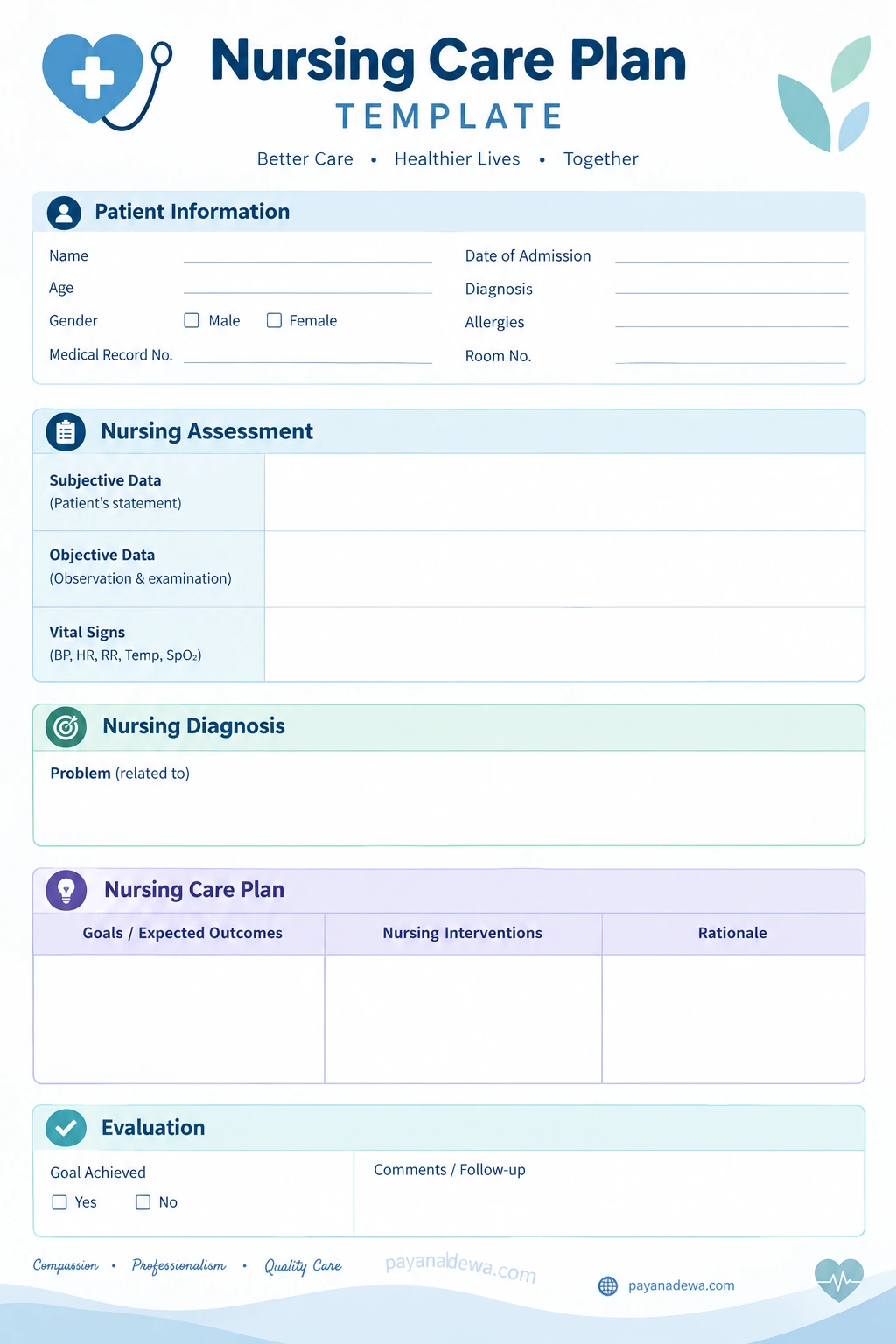
To use the template effectively, complete each section with accurate, patient-specific information. Avoid leaving important findings undocumented, and update the plan whenever reassessment identifies a meaningful change.
Tips for Writing an Effective Nursing Care Plan
A good nursing care plan should be clinically relevant, easy to understand, and practical to implement. The following tips can help nursing students and practicing nurses improve the quality of their documentation.
Prioritize the Patient’s Most Urgent Needs
Address immediate safety concerns and potentially life-threatening problems first. Use clinical judgment, assessment findings, and established prioritization frameworks to determine which nursing problems require the earliest attention.
Write Clear and Measurable Goals
Vague outcomes make evaluation difficult. Instead, specify what the patient should achieve, how progress will be measured, and when the outcome should be reviewed.
Choose Appropriate Nursing Interventions
Every intervention should relate to the nursing diagnosis and expected outcome. Consider current evidence, patient preferences, available resources, and your professional scope of practice.
Include a Rationale for Each Intervention
Explaining why an intervention is appropriate strengthens clinical reasoning. It also helps students understand the relationship between nursing actions and patient outcomes.
Review and Update the Plan Regularly
A nursing care plan is a working document, not a one-time assignment. Reassess the patient, document responses to interventions, and revise the plan when goals or clinical priorities change.
Follow Documentation and Privacy Standards
Use clear, objective language and approved abbreviations. Record information promptly and follow your organization’s policies for confidentiality, electronic records, and authorized access.
Common Nursing Care Plan Mistakes to Avoid
Even a well-organized template cannot compensate for incomplete assessment or unclear clinical reasoning. Watch for these common problems:
- Using unsupported diagnoses: Ensure that the selected nursing diagnosis matches the patient’s assessment findings.
- Writing vague goals: Replace general statements with measurable, time-specific outcomes.
- Choosing unrelated interventions: Link each nursing action to the identified problem and desired outcome.
- Ignoring patient preferences: Involve patients in goal setting and consider their needs, values, and abilities.
- Skipping evaluation: Document whether the interventions worked and whether further action is required.
- Copying plans without adaptation: Use examples for learning, but individualize every clinical plan to the patient.
Avoiding these mistakes improves clarity, strengthens continuity of care, and makes it easier to identify when a patient needs further assessment or intervention.
Frequently Asked Questions About Nursing Care Plans
What is the main purpose of a nursing care plan?
The main purpose is to organize individualized nursing care around identified patient needs. It guides interventions, establishes expected outcomes, supports communication, and provides a framework for evaluating progress.
What does ADPIE mean in nursing?
ADPIE stands for Assessment, Diagnosis, Planning, Implementation, and Evaluation. These five steps describe the nursing process used to assess patient needs, develop a plan, deliver care, and measure outcomes.
How many nursing diagnoses should a care plan include?
There is no universal number for every patient. The care plan should include the relevant nursing diagnoses identified through assessment and prioritization. The appropriate number depends on the patient’s needs, the assignment requirements, and the clinical setting.
Can nursing students use a nursing care plan template?
Yes. Templates can help students organize their clinical reasoning and documentation. However, students should follow their instructors’ requirements and ensure that each diagnosis, intervention, and expected outcome is supported by the case information.
How often should a nursing care plan be updated?
The plan should be reviewed according to clinical requirements and whenever the patient’s condition, response to treatment, or care priorities change. Follow the documentation and reassessment policies of the healthcare organization.
Conclusion
A nursing care plan is a valuable framework for delivering safe, organized, and patient-centered nursing care. By following the nursing process, nurses can connect assessment findings with appropriate diagnoses, measurable goals, practical interventions, and meaningful evaluation.
To create an effective plan, prioritize patient needs, use clear documentation, select evidence-informed interventions, and review outcomes regularly. A printable nursing care plan template can simplify this process, especially for nursing students who are learning to apply clinical reasoning.
Ultimately, the best nursing care plan is one that reflects the individual patient, supports sound clinical judgment, and adapts as care needs evolve.