Learning how to write a case brief is an essential skill for law students. A well-written case brief helps you understand court decisions, identify important legal principles, and prepare for classroom discussions. It also makes reviewing cases before exams much easier.
However, briefing a legal case can feel overwhelming at first. Court opinions often contain complicated facts, unfamiliar legal terminology, and lengthy explanations. The key is to organize the information into clear, manageable sections.
This guide explains what a case brief is, why it matters, and how to write one step by step. You will also learn what information to include, discover practical examples, and find out how a case brief template can simplify your legal studies.
What Is a Case Brief?
A case brief is a concise summary of a judicial opinion. It highlights the essential facts, legal issues, applicable rules, court decisions, and reasoning behind a judgment. Instead of repeating an entire court opinion, a case brief presents its most important information in an organized format.
Law students commonly use case briefs when studying constitutional law, contract law, criminal law, torts, and other legal subjects. Attorneys and legal researchers may also prepare them to review precedents and understand how courts interpret particular laws.
A case brief is different from a general case summary. A summary describes what happened in a case. In contrast, a case brief also explains the legal question, the governing rule, and why the court reached its conclusion.
Why Is a Case Brief Important?
Writing a case brief encourages active reading. Rather than simply reading a judicial opinion from beginning to end, you evaluate its facts, identify the central legal question, and examine the court’s analysis.
Here are several important benefits of preparing case briefs:
- Improves legal comprehension: Breaking a complicated opinion into smaller sections makes it easier to understand.
- Strengthens analytical skills: Identifying legal issues and reasoning helps you evaluate judicial decisions critically.
- Saves study time: Concise notes make it easier to review important cases before examinations.
- Supports classroom participation: Organized briefs help you answer questions and contribute to legal discussions.
- Builds legal research skills: Identifying rules and precedents helps you recognize how courts apply the law.
Moreover, a consistent briefing method helps you compare different decisions. You can quickly identify similarities, differences, and changes in legal interpretation across multiple cases.
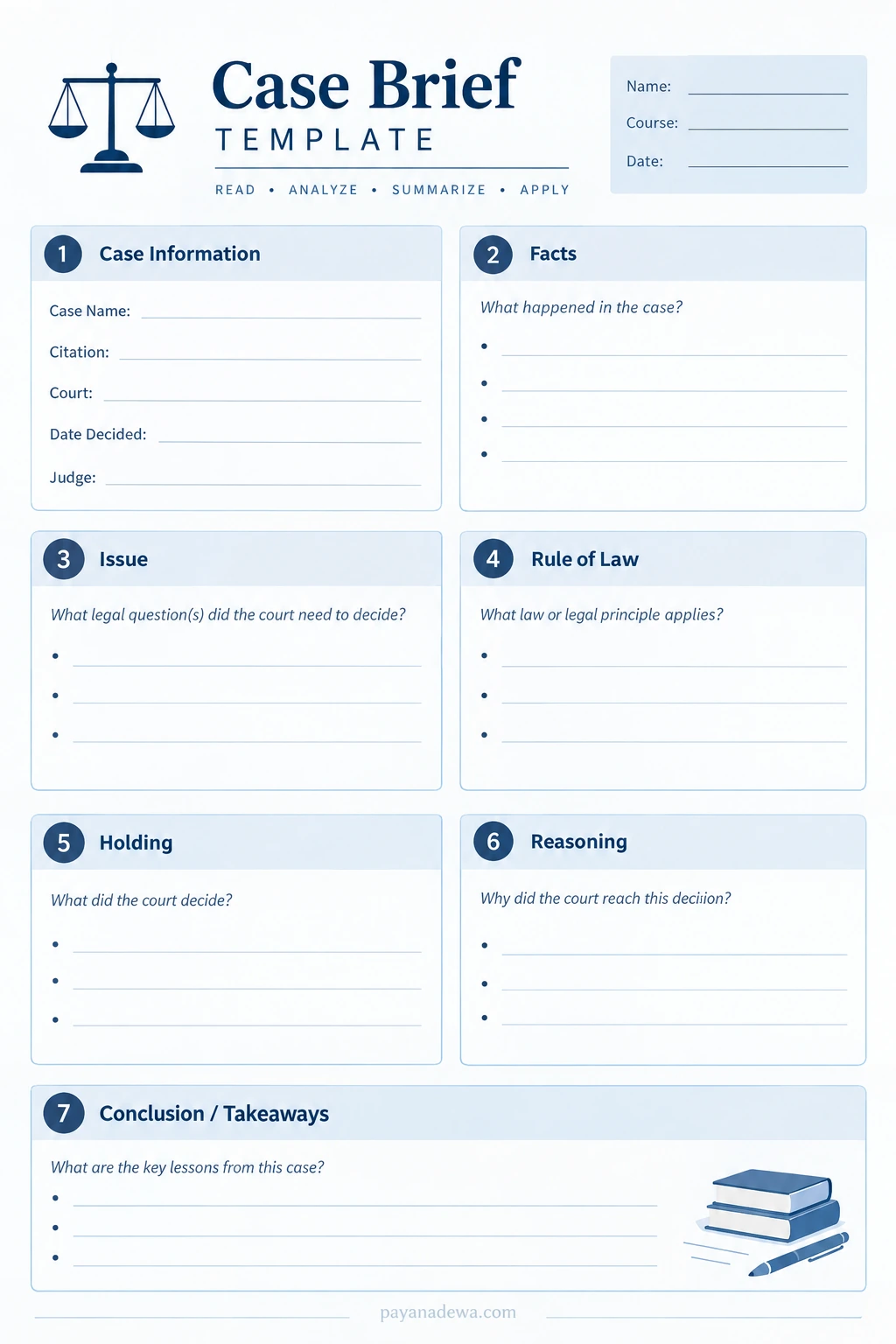
The Main Elements of a Case Brief
A useful case brief follows a logical structure. Although professors may require different formats, most briefs contain the following sections.
1. Case Name and Citation
Begin with the full case name and its legal citation. The citation allows readers to locate the original court opinion and verify the information in your brief.
Depending on the case, include the court, the date of the decision, and the judge’s name when relevant. Always use the citation format required by your course or institution.
2. Facts of the Case
Explain the important events that led to the dispute. Focus on facts that help the reader understand the legal issue and the court’s decision.
Ask yourself these questions while reviewing the opinion:
- Who are the parties involved?
- What happened before the lawsuit began?
- What actions or events caused the dispute?
- Which facts influenced the court’s analysis?
Avoid including every detail from the opinion. Instead, select the facts that directly affect the legal question.
3. Legal Issue
The legal issue identifies the question the court needed to resolve. Write it as a clear question whenever possible.
For example, a contract law case might raise this issue: Did the parties form an enforceable contract when one party accepted an offer through email?
A focused issue statement keeps your analysis on track. If a case raises several important questions, list each one separately.
4. Rule of Law
The rule of law identifies the legal principle, statute, constitutional provision, or precedent the court applied. It explains the standard used to evaluate the dispute.
State the rule accurately and in your own words when appropriate. However, preserve important legal terminology and cite the relevant authority when required.
For example, a contract dispute might involve the general principle that an enforceable contract requires an offer, acceptance, and consideration, subject to the applicable law.
5. Holding or Decision
The holding provides the court’s answer to the legal issue. It states the result reached by the court on the question presented.
Keep this section direct. Explain whether the court ruled for the plaintiff or defendant, affirmed or reversed a lower court, or reached another procedural outcome. Be precise about which issue the court actually decided.
6. Court’s Reasoning
The reasoning explains why the court reached its decision. This section is often the most important part of a case brief because it reveals how the court applied the law to the facts.
Identify the major arguments, legal authorities, and factual distinctions that influenced the outcome. Explain the connection between the governing rule and the court’s conclusion.
Do not simply repeat the holding. Instead, show how the court moved from the legal issue to its final answer.
7. Conclusion and Key Takeaways
Finish with the main lesson from the case. Explain the legal principle the decision illustrates and why it may matter in future disputes.
You can also note the case’s significance, its relationship to earlier decisions, or questions that remain unresolved. If your professor requires a separate dissent or concurrence section, include those details as well.
How to Write a Case Brief Step by Step
Once you understand the main elements, follow a consistent process to prepare an effective brief.
Step 1: Read the Entire Opinion
Start by reading the judicial opinion to understand the dispute as a whole. Do not try to complete every section immediately. First, identify the parties, the background, and the outcome.
On your first reading, pay attention to unfamiliar terms and the procedural history. Look up important terminology when necessary.
Step 2: Read Again and Take Notes
During your second reading, highlight significant facts, legal questions, rules, and explanations. Separate the court’s own reasoning from the arguments made by the parties.
Use short notes rather than copying entire paragraphs. This approach helps you identify the essential information without creating an unnecessarily long document.
Step 3: Identify the Central Legal Issue
Determine the question that the court needed to answer. The issue often connects the key facts to the applicable rule of law.
If you struggle to identify it, examine the court’s final discussion and work backward. Ask which legal question the judges were resolving.
Step 4: State the Rule and Holding
Write the governing legal principle in a concise sentence. Then state the court’s answer to the issue. Keeping these sections separate prevents confusion between the law itself and the outcome of a particular dispute.
Step 5: Explain the Court’s Reasoning
Describe how the judges applied the rule to the relevant facts. Include the strongest points in the court’s analysis and explain why they mattered.
For greater clarity, connect each important fact to the legal principle it supports or challenges.
Step 6: Review and Edit Your Brief
Read the completed brief and check its accuracy. Make sure the facts support the issue, the rule matches the opinion, and the holding reflects the court’s actual decision.
Finally, remove unnecessary details. A good case brief should be concise enough to review quickly but complete enough to preserve the essential legal analysis.
Case Brief Example
The following hypothetical example demonstrates how the main sections work together. It is an educational illustration, not a summary of an actual court decision.
Case Name
Smith v. Green, a hypothetical contract dispute.
Facts
Smith offers to sell a used laptop to Green for $500. Green replies by email that they accept the offer. Smith then refuses to complete the sale, arguing that the parties never formed a binding agreement.
Issue
Did the parties form an enforceable contract through their offer and acceptance, assuming the applicable legal requirements were satisfied?
Rule of Law
Under the general principles of contract law, an enforceable agreement typically requires an offer, acceptance, and consideration, subject to applicable legal requirements and exceptions.
Holding
For this hypothetical example, assume the court concludes that the parties formed an enforceable contract because the evidence establishes the required elements.
Reasoning
The court determines that Smith made a definite offer, Green accepted its terms, and the agreed exchange provided consideration. The court therefore finds that the parties reached an enforceable agreement under the assumed facts and applicable law.
Key Takeaway
The example illustrates how an offer, acceptance, and consideration may establish contract formation. Actual outcomes depend on the complete facts, applicable law, and any relevant defenses or exceptions.
Practical Tips for Writing Better Case Briefs
Effective case briefing is a skill that improves with practice. These strategies can help you create clearer and more useful notes.
- Use a consistent template: Follow the same headings for each case unless your assignment requires a different format.
- Prioritize relevant facts: Include information that affects the legal issue or explains the outcome.
- Write in plain English: Explain complex legal concepts clearly without sacrificing accuracy.
- Separate rules from reasoning: Identify the governing legal principle before explaining how the court applied it.
- Check the original opinion: Verify quotations, citations, and legal conclusions against the source.
- Keep briefs concise: Aim for a practical reference document rather than a rewritten court opinion.
- Follow course requirements: Use your professor’s preferred format and include any required procedural history or separate opinions.
Additionally, consider reviewing your briefs after class. Discussions may reveal important details that were difficult to recognize during your initial reading.
Common Case Briefing Mistakes to Avoid
Even a well-organized brief can be ineffective if it contains inaccurate or unnecessary information. Watch for these common problems.
- Copying too much text: Long quotations make the brief harder to review. Summarize the reasoning in your own words when appropriate.
- Confusing facts with arguments: Clearly distinguish established facts from claims made by the parties.
- Writing a vague issue statement: State the precise legal question instead of describing the entire dispute.
- Misstating the holding: Make sure your conclusion matches the court’s actual ruling and the specific issue decided.
- Ignoring procedural history: Include relevant information about how the case reached the court when it affects the decision.
- Overlooking separate opinions: Note important concurrences or dissents when they are relevant to your assignment.
One final mistake is treating every statement in an opinion as a binding legal rule. Distinguish the court’s holding from commentary that may not be necessary to decide the case. The legal effect of a decision also depends on the court, jurisdiction, and applicable precedent rules.
Frequently Asked Questions About Case Briefs
How long should a case brief be?
The ideal length depends on the complexity of the case and your instructor’s requirements. Many student briefs fit on one or two pages, although significant or complicated decisions may require more space. Focus on accuracy and relevance rather than a fixed word count.
What is the difference between a case brief and a case summary?
A case summary primarily describes the events and outcome of a case. A case brief uses a structured format to identify the facts, legal issue, rule, holding, and reasoning. It therefore provides a more focused tool for legal analysis and exam preparation.
Can I use a case brief template?
Yes. A printable case brief template can help you organize information consistently and avoid missing important sections. You should still adapt the template to the requirements of your course and the needs of the case.
Should I include citations in a case brief?
Include the case citation and any supporting legal authorities required by your assignment. Accurate citations make it easier to locate the original opinion and verify legal rules. Follow your institution’s preferred citation style.
Can a case brief help me prepare for law school exams?
Yes. Case briefs help you review important legal principles, understand judicial reasoning, and compare decisions. However, they work best alongside class notes, statutory materials, practice questions, and broader outlines of the relevant subject.
Conclusion
Writing a case brief is an effective way to understand judicial opinions and develop stronger legal reasoning skills. By identifying the facts, legal issue, rule of law, holding, and court’s reasoning, you can turn a lengthy opinion into a concise and practical study resource.
The best approach is to read carefully, focus on legally significant details, and explain the court’s analysis in clear language. With consistent practice, case briefing becomes faster and more effective.
To make the process easier, use a printable case brief template as a starting point. Organize each section, verify your legal authorities, and adapt the format to your course requirements. Over time, this simple study habit can help you approach legal cases with greater confidence and clarity.