A corporate brochure is more than a collection of company information. It is a professional marketing tool that helps businesses introduce their brand, explain their services, communicate their values, and build trust with potential customers, investors, and business partners. When designed well, a corporate brochure can turn complex information into a clear and engaging visual experience.
Whether you are a startup, established company, consulting firm, technology business, real estate company, or professional service provider, a well-structured brochure can support your sales and marketing strategy. It gives your audience a convenient way to understand who you are, what you offer, and why they should choose your company.
This guide explains what a corporate brochure is, what it should contain, how to structure the content, and how to create a professional design that communicates your brand effectively.
What Is a Corporate Brochure?
A corporate brochure is a printed or digital marketing document created to present a company’s identity, products, services, achievements, and business information. Unlike a simple flyer, a brochure usually provides more detailed information and follows a structured visual layout.
A professional company brochure commonly includes several sections, such as an introduction to the business, company values, products or services, key achievements, client testimonials, case studies, contact information, and a call to action.
Corporate brochures can be distributed at business meetings, conferences, trade shows, networking events, sales presentations, offices, and customer appointments. Digital versions can also be shared through websites, email campaigns, social media, and messaging platforms.
Why Is a Corporate Brochure Important?
A professionally designed corporate brochure can strengthen your company’s communication strategy. It gives potential customers a concise overview of your business while presenting your brand in a consistent and professional way.
1. Builds a Strong First Impression
Your brochure may be one of the first branded materials a potential client sees. A clean layout, professional typography, high-quality images, and consistent brand colors can immediately communicate credibility.
2. Explains Your Business Clearly
Some businesses offer complex products or services that are difficult to explain in a short conversation. A brochure allows you to organize information into logical sections, making your business easier to understand.
3. Supports Sales Conversations
A sales representative can use a corporate brochure as a visual reference during a presentation. Customers can review important information while discussing solutions, benefits, pricing options, or next steps.
4. Strengthens Brand Identity
Every design element contributes to brand recognition. Consistent colors, fonts, imagery, logos, messaging, and layouts can help create a unified corporate identity across your marketing materials.
5. Works in Both Print and Digital Formats
A modern brochure does not have to be limited to paper. A properly designed document can be exported as a PDF and used on websites, email campaigns, presentations, and other digital channels.
What Should a Corporate Brochure Include?
The exact content depends on your company and target audience, but most effective corporate brochure designs contain several important elements.
- Company introduction: Explain who you are and what your business does.
- Mission and vision: Communicate your long-term purpose and direction.
- Products or services: Present your main offerings in a clear and concise way.
- Key benefits: Explain how your solutions can help customers.
- Company achievements: Highlight awards, certifications, milestones, or measurable results.
- Case studies: Show how your company has helped real customers.
- Testimonials: Add social proof from satisfied clients or business partners.
- Contact information: Make it easy for readers to reach your company.
- Call to action: Tell readers what they should do next.
The most important principle is relevance. Avoid filling every page with unnecessary information. Your brochure should answer the questions your target audience is most likely to ask.
Corporate Brochure Template Example
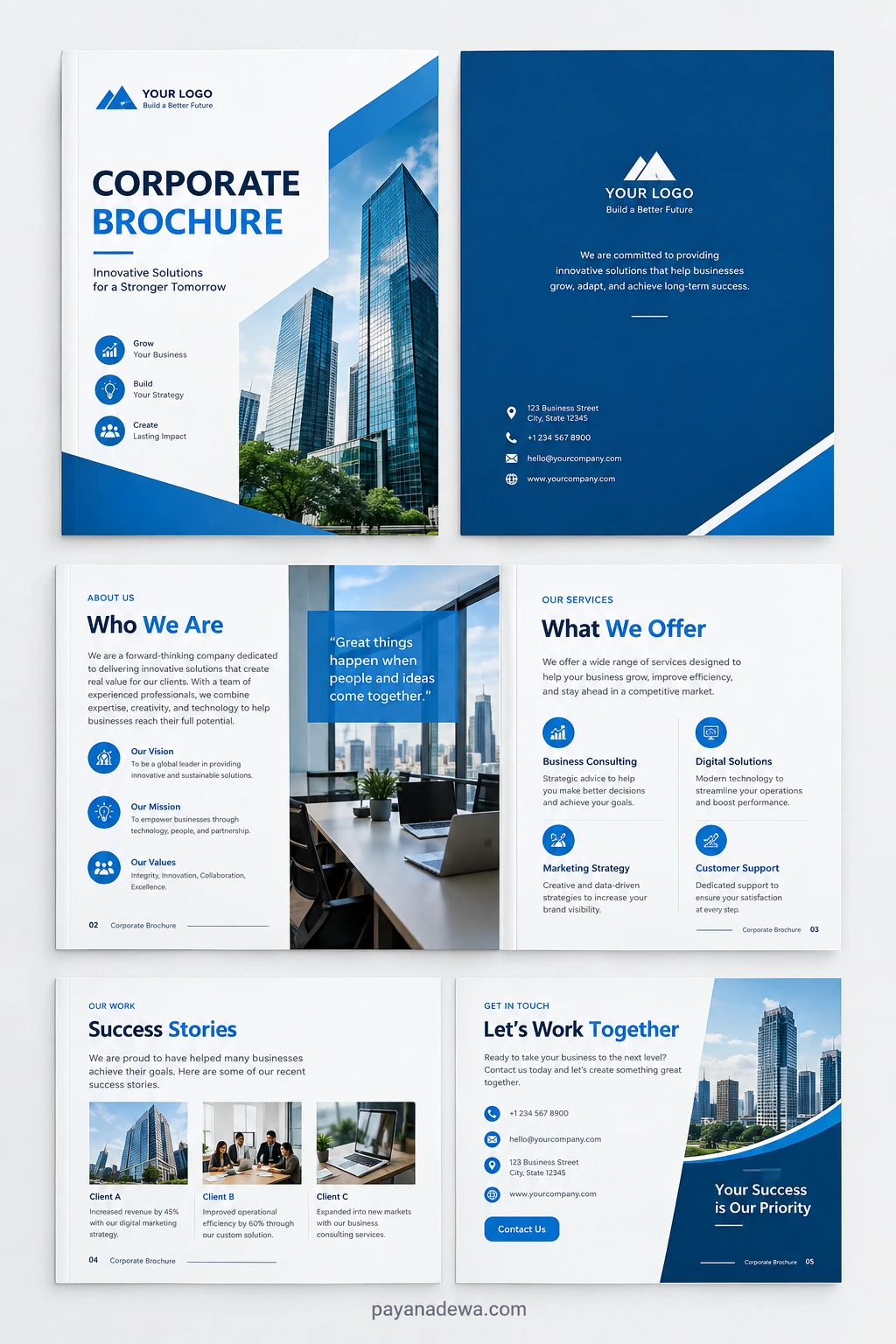
Using a corporate brochure template can make the design process faster and more organized. A template provides a visual framework that you can customize with your company logo, brand colors, photographs, services, achievements, and contact information.
A useful template should provide enough flexibility to adapt to different businesses while maintaining a professional visual hierarchy. The example below demonstrates a modern corporate brochure structure with sections for company information, services, success stories, and contact details.
How to Structure a Professional Corporate Brochure
Good brochure design starts with a logical content structure. Readers should be able to move from one section to another without confusion.
Front Cover
The front cover should immediately communicate the company’s identity. Include your logo, company name, a concise headline, and a relevant visual. Avoid adding too much text to the cover because its primary purpose is to attract attention and establish context.
About the Company
The introduction section should explain what your company does and why it exists. Keep the language straightforward and focus on information that matters to your audience.
Products or Services
Present your main offerings using short descriptions, icons, images, or feature cards. Explain the benefits rather than simply listing technical specifications.
Success Stories and Achievements
This section provides evidence that your company can deliver results. Include measurable achievements, client outcomes, project highlights, certifications, or other credibility indicators when appropriate.
Contact and Call to Action
End the brochure with a clear next step. Depending on your business, this could be a request for a consultation, product demonstration, quotation, meeting, website visit, or phone call.
Design Principles for an Effective Corporate Brochure
A brochure should look professional without becoming visually complicated. Good design makes information easier to understand and helps readers focus on the most important messages.
Use Consistent Branding
Use the same brand colors, typography, logo treatment, and visual style throughout the document. Consistency makes the brochure feel like a professional extension of your company rather than a collection of unrelated pages.
Create Strong Visual Hierarchy
Important information should stand out immediately. Use larger headings, appropriate spacing, bold text, and visual elements to guide the reader through the content.
Keep the Layout Clean
White space is an important part of professional brochure design. Avoid placing too many images, icons, paragraphs, or decorative elements on one page. A clean layout improves readability and makes the document feel more premium.
Choose High-Quality Images
Images can communicate the personality and quality of a business. Use photographs that are relevant to your industry and support the message of each section. Avoid generic images when authentic company photography is available.
Make the Text Easy to Scan
Most readers do not read marketing brochures word for word. They scan headings, short paragraphs, bullet points, numbers, and highlighted information. Break large blocks of text into smaller sections so readers can quickly find what they need.
Tips for Writing Better Corporate Brochure Content
Design is only one part of a successful brochure. The written content must also communicate value quickly and clearly.
- Know your audience: Write for the customers you want to attract, not simply for internal employees.
- Focus on benefits: Explain how your product or service solves problems and creates value.
- Use simple language: Avoid unnecessary jargon and overly complicated sentences.
- Be specific: Use facts, figures, results, and examples whenever possible.
- Keep paragraphs short: Short paragraphs improve readability, especially in digital brochures.
- Use active language: Clear and direct sentences make business communication more engaging.
- Include a strong call to action: Give readers a clear reason and method to contact you.
Print vs. Digital Corporate Brochure
Both printed and digital brochures have advantages. The best option depends on where and how your audience interacts with your company.
Printed Brochures
Printed brochures work well at conferences, trade shows, business meetings, retail locations, and face-to-face sales presentations. They provide a physical representation of your brand and can be handed directly to prospects.
Digital Brochures
Digital brochures are convenient for websites, email campaigns, online presentations, and remote sales. They are easy to distribute and can reach audiences in different locations without printing or shipping costs.
Many businesses use both formats. A single master design can often be adapted for professional printing and optimized as a digital PDF.
How to Make Your Corporate Brochure More Effective
Before publishing your brochure, review it from the perspective of your target customer. Ask whether the document clearly answers the most important questions about your company.
- Can a new reader understand what your company does within a few seconds?
- Are your main services or products easy to find?
- Does the content explain customer benefits clearly?
- Are your contact details accurate and easy to locate?
- Does the design match your existing brand identity?
- Are the images professional and relevant?
- Is the text easy to scan?
- Does the final page contain a clear call to action?
It is also useful to ask someone outside your marketing team to review the brochure. A fresh reader may notice confusing wording, missing information, or design problems that internal reviewers overlook.
Common Corporate Brochure Mistakes to Avoid
Even an attractive brochure can be ineffective if it contains too much information or lacks a clear purpose.
Too Much Text
Long paragraphs can make a brochure difficult to scan. Focus on the most useful information and move detailed explanations to your website or supporting documents.
Weak Visual Hierarchy
If every heading, image, and paragraph has equal visual importance, readers may not know where to look first. Create a clear hierarchy that guides attention.
Unclear Messaging
A brochure should communicate a specific message. Avoid vague statements that could describe almost any company. Explain what makes your business useful, different, and valuable.
Missing Call to Action
Do not assume readers automatically know what to do after reading your brochure. A simple call to action can turn interest into a measurable business opportunity.
Final Thoughts on Corporate Brochure Design
A corporate brochure combines branding, communication, design, and marketing into one practical business asset. When the content is focused and the layout is professional, a brochure can help your company make a stronger first impression, explain its services, demonstrate credibility, and encourage potential customers to take action.
The best brochure is not necessarily the one with the most pages or the most decorative elements. It is the one that communicates the right information to the right audience in a clear, attractive, and memorable way.
Whether you are creating a company profile, business brochure, service brochure, or digital corporate presentation, start with a clear structure and a strong understanding of your audience. Then combine concise content, consistent branding, useful visuals, and a compelling call to action to create a brochure that supports your broader marketing goals.