Running a food business involves more than preparing delicious meals and attracting customers. Whether you operate a restaurant, catering company, food truck, bakery, wholesale food supplier, or online food business, successful operations depend on clear agreements between everyone involved. A well-written Food Business Contract helps establish responsibilities, protect business interests, prevent misunderstandings, and create a foundation for long-term partnerships.
From agreements with suppliers and distributors to partnerships between restaurant owners and catering providers, written contracts play an important role in everyday business operations. They explain what each party must do, how payments work, what happens when problems arise, and how disagreements should be resolved.
This guide explains what a food business contract is, which essential clauses to include, how to create an effective agreement, and what to consider before signing. It also provides practical examples and a checklist to help food entrepreneurs prepare a professional business contract.
What Is a Food Business Contract?
A food business contract is a legally binding agreement between two or more parties involved in a food-related business activity. It outlines the terms, conditions, rights, and responsibilities that each party agrees to follow.
These agreements can cover different business relationships. For example, a restaurant may sign a supply agreement with a food distributor. Similarly, a catering company may enter into a service agreement with an event organizer.
The main purpose is to ensure that everyone understands the arrangement before business activities begin. Instead of relying on verbal promises, both parties have a written document they can refer to when questions or disputes occur.
A typical food business agreement may cover:
- The names and contact information of the parties.
- The products or services included in the agreement.
- Pricing, payment schedules, and additional charges.
- Product quality and food safety requirements.
- Delivery schedules and responsibilities.
- Contract duration and renewal conditions.
- Confidentiality and intellectual property rights.
- Termination procedures and dispute resolution.
Why Is a Food Business Contract Important?
Food businesses operate in an environment where quality, timing, safety, and customer satisfaction matter every day. Even a small misunderstanding can result in financial losses, delayed orders, damaged relationships, or legal problems.
A written agreement helps reduce these risks by establishing clear expectations from the beginning.
1. Protects Both Business Parties
A properly prepared contract explains what each party is responsible for. If one party fails to meet an agreed obligation, the other party can refer to the written terms to understand their available options.
For example, a restaurant that purchases fresh ingredients from a supplier can include requirements for product quality, delivery frequency, and replacement procedures for damaged goods.
2. Prevents Misunderstandings
Verbal agreements can create confusion, especially when several people manage business operations. A written contract provides a consistent reference for pricing, deadlines, responsibilities, and service expectations.
3. Establishes Payment Expectations
Money-related disagreements are common in business relationships. A contract should clearly explain the agreed price, invoice requirements, payment deadlines, accepted payment methods, and consequences of late payment.
4. Supports Professional Business Relationships
Using formal agreements demonstrates that your business takes its responsibilities seriously. Suppliers, investors, distributors, and commercial partners are more likely to trust a company that communicates its expectations clearly.
5. Helps Manage Legal and Operational Risks
A contract can address potential problems before they happen. These may include product recalls, delivery failures, food safety incidents, unexpected cost increases, and business interruptions.
Although a contract cannot eliminate every risk, it provides a framework for managing responsibilities and resolving problems.
Common Types of Food Business Contracts
Different food businesses require different agreements. The right contract depends on the products, services, and relationships involved.
1. Food Supply Agreement
A food supply agreement is used between a food supplier and a business purchasing ingredients or finished products. It establishes the conditions under which products are ordered, supplied, delivered, and paid for.
Important details include product specifications, quantities, pricing, delivery schedules, storage requirements, and quality standards.
2. Restaurant Partnership Agreement
Restaurant owners who operate a business together should consider a partnership agreement. This document explains each partner’s responsibilities, financial contributions, ownership interests, and share of profits or losses.
It should also address decision-making authority, the addition of new partners, and procedures for a partner leaving the business.
3. Catering Service Agreement
A catering service agreement is useful when a catering company provides food and services for private parties, corporate functions, weddings, or other events.
The agreement should specify the event date, location, guest count, menu, service arrangements, total price, deposit requirements, cancellation policy, and additional charges.
4. Food Distribution Agreement
This contract establishes a relationship between a food manufacturer or supplier and a distributor. It explains how products will be marketed, stored, transported, and delivered to customers or retailers.
It may also include territory restrictions, sales targets, inventory responsibilities, and distribution fees.
5. Food Manufacturing Agreement
Businesses that outsource food production may need a manufacturing agreement. This document explains production requirements, recipes or product specifications, packaging, labeling, quality control, inspection rights, and intellectual property ownership.
6. Restaurant Lease Agreement
A restaurant lease agreement is used when a business rents commercial space for food preparation and customer service. It typically covers rent, lease duration, permitted use, maintenance responsibilities, utilities, renovations, and termination conditions.
Because commercial property agreements can involve significant financial commitments, they should receive careful legal review.
Essential Clauses to Include in a Food Business Contract
A strong agreement should be detailed enough to explain the business arrangement without becoming unnecessarily complicated. The following clauses provide a useful starting point.
1. Identification of the Parties
Start by identifying everyone involved. Include the full legal names of the individuals or registered businesses, their addresses, and relevant business registration details where appropriate.
Make sure the people signing the document have the authority to represent their organizations.
2. Purpose and Scope of the Agreement
Explain why the contract exists and describe the products or services covered. Avoid vague descriptions. Instead, provide specific information about quantities, specifications, responsibilities, and expected results.
3. Pricing and Payment Terms
Clearly state the financial arrangements. Include:
- The agreed product or service price.
- Deposits and advance payments.
- Invoice submission requirements.
- Payment deadlines.
- Taxes and additional charges.
- Late payment fees, where legally permitted.
For recurring transactions, explain whether prices can change and how much advance notice is required.
4. Product Quality and Food Safety
Food safety should be a central part of any food-related agreement. Specify applicable quality standards, ingredient requirements, packaging conditions, storage temperatures, hygiene procedures, and inspection responsibilities.
Both parties should understand their responsibilities regarding applicable food safety laws, licensing, allergen information, labeling, traceability, and product recalls.
5. Delivery and Performance Requirements
Explain when and where products or services must be delivered. Include delivery frequency, transportation responsibilities, acceptance procedures, and notification requirements for delays.
For catering agreements, specify arrival times, setup requirements, serving arrangements, and cleanup responsibilities.
6. Confidentiality and Intellectual Property
Food businesses often share valuable information, including recipes, pricing strategies, supplier lists, customer information, and marketing plans.
A confidentiality clause can restrict unauthorized disclosure or use of protected business information. If a contract involves recipes, branding, or original product designs, clearly explain who owns those assets and how they may be used.
7. Contract Duration and Renewal
State the effective date, expiration date, and renewal conditions. If the agreement continues automatically, explain how either party can prevent renewal and how much notice is required.
8. Termination Conditions
Describe the situations that allow either party to end the agreement. Common reasons include repeated late payments, serious quality failures, breach of contract, insolvency, or failure to meet essential obligations.
Also explain the notice period, outstanding payment responsibilities, and procedures for returning equipment, inventory, or confidential materials.
9. Liability and Indemnification
Explain how responsibility will be handled if a party causes financial loss, property damage, personal injury, or other harm through its actions or failure to meet contractual obligations.
Any liability limitations and indemnification provisions should be drafted carefully and reviewed under the applicable law.
10. Dispute Resolution and Governing Law
Identify the law that governs the agreement and explain how disputes will be handled. Options may include negotiation, mediation, arbitration, or court proceedings, depending on the circumstances and applicable legal requirements.
How to Create a Food Business Contract Step by Step
Preparing a professional contract does not have to be difficult. Following a structured process can help you create a document that reflects your actual business needs.
Step 1: Identify the Business Relationship
Determine who will sign the agreement and what type of relationship you want to establish. A supplier contract requires different terms from a restaurant partnership or catering service agreement.
Step 2: Define Responsibilities Clearly
Write down the obligations of every party. Be specific about who provides products, manages transportation, handles payments, maintains records, and resolves operational problems.
Step 3: Agree on Financial Terms
Discuss prices, payment schedules, deposits, additional expenses, and refund conditions before preparing the final document. Put every important financial arrangement in writing.
Step 4: Include Quality and Compliance Requirements
Identify the food safety standards, licenses, permits, product specifications, and operational requirements relevant to the business arrangement.
Step 5: Establish Procedures for Unexpected Situations
Consider what happens when deliveries are delayed, ingredients become unavailable, orders are canceled, or products fail inspection. Clear procedures can reduce confusion during stressful situations.
Step 6: Review and Finalize the Agreement
Read the complete document carefully. Check names, dates, prices, responsibilities, and all supporting documents. Ask a qualified lawyer to review important agreements before signing, especially those involving substantial financial commitments or regulatory risks.
Step 7: Sign and Keep Copies
Once everyone agrees to the final terms, arrange for authorized representatives to sign the contract. Keep accessible copies and store related invoices, purchase orders, amendments, and correspondence securely.
Practical Tips for Writing a Better Food Business Agreement
A contract should be easy to understand and practical to use. These tips can help improve its quality.
- Use simple language: Write clear sentences and explain technical terms when necessary.
- Be specific: Replace general promises with measurable responsibilities and deadlines.
- Address food safety: Include relevant hygiene, storage, handling, and product quality requirements.
- Document changes: Require important amendments to be recorded in writing and approved by the parties.
- Check local regulations: Make sure the agreement complies with applicable business, food safety, employment, and consumer protection laws.
- Keep records: Maintain signed contracts, invoices, delivery records, and inspection reports.
- Review regularly: Update agreements when prices, products, regulations, or business responsibilities change.
Common Mistakes to Avoid When Signing a Food Business Contract
Even a professionally formatted agreement can create problems if important details are missing. Watch out for these common mistakes.
Using Vague Contract Language
Statements such as “deliver good-quality food regularly” are difficult to measure. Define product specifications, delivery frequency, and acceptable quality standards instead.
Ignoring Food Safety Responsibilities
Never assume that another party automatically handles every food safety requirement. Clearly allocate responsibilities for storage, transportation, hygiene, labeling, and reporting incidents.
Overlooking Cancellation and Refund Policies
Unexpected changes are common in catering and food supply operations. Explain cancellation deadlines, deposits, refunds, and compensation for non-refundable expenses.
Failing to Review the Entire Document
Do not sign an agreement simply because the other party prepared it. Read every clause and request clarification when something is unclear.
Relying Only on Verbal Promises
Important promises should appear in the written agreement. If both parties later remember a conversation differently, a documented contract provides a more reliable reference.
Food Business Contract Template: What Should It Include?
If you need a starting point, a food business contract template can help organize the essential information into a professional document. A template saves preparation time and provides a consistent structure for common business agreements.
However, a general template should always be customized to match the specific transaction. A food supplier agreement, for example, needs detailed product and delivery requirements, while a catering agreement needs event information and cancellation terms.
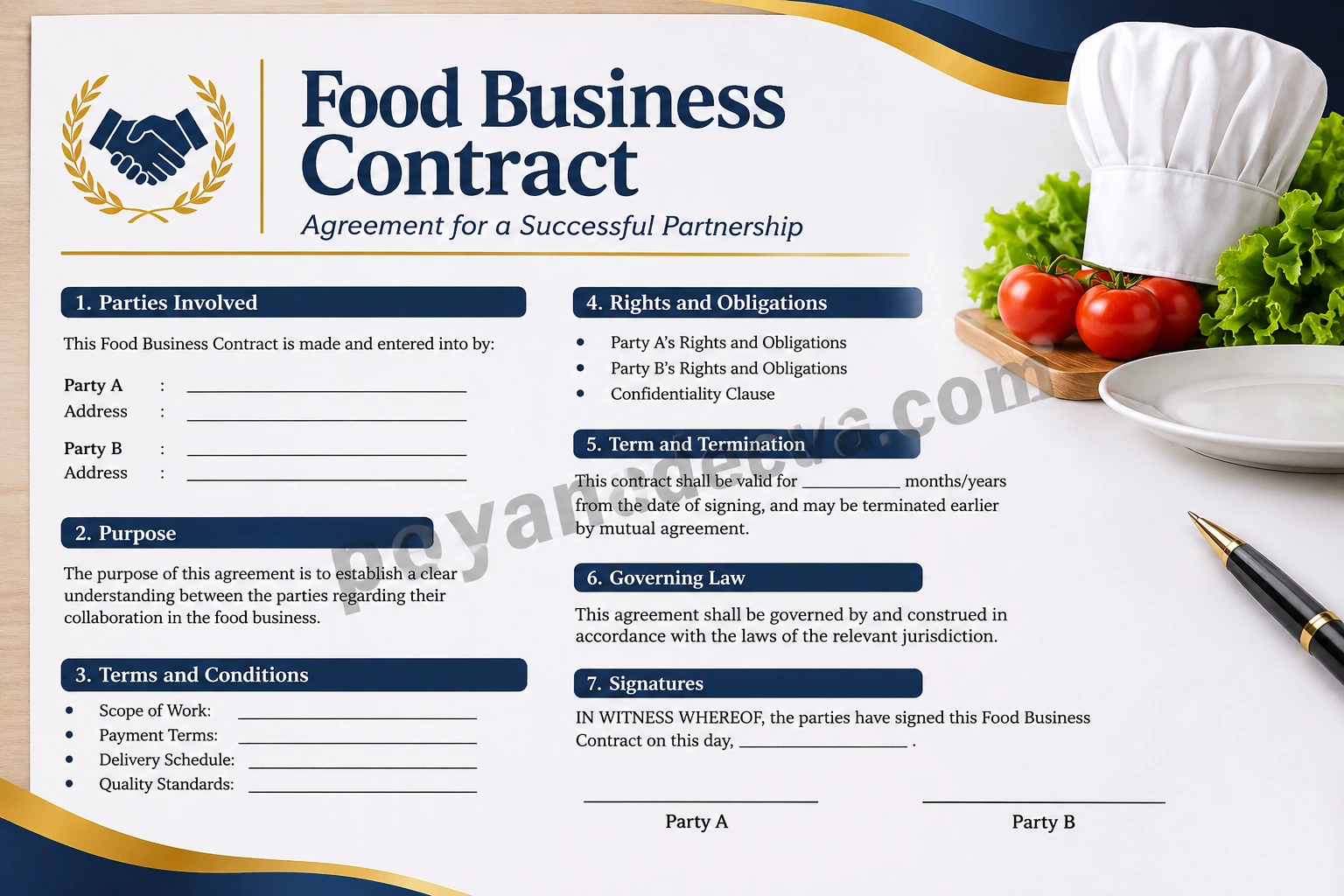
A basic food business contract template should include the following sections:
- Contract title and effective date.
- Names and addresses of the parties.
- Purpose of the agreement.
- Description of products or services.
- Roles and responsibilities.
- Pricing and payment conditions.
- Food safety and quality requirements.
- Delivery and performance schedules.
- Confidentiality provisions.
- Contract duration and termination conditions.
- Governing law and dispute resolution.
- Signature fields for all parties.
Use the printable template accompanying this article as a visual starting point for organizing an agreement. Add transaction-specific clauses and obtain legal review before relying on it as a final contract.
Frequently Asked Questions About Food Business Contracts
Is a food business contract legally binding?
A food business contract can be legally binding when it meets the applicable legal requirements. These commonly include a clear agreement, capable parties, lawful purpose, and any required consideration or formalities under the governing law. Some transactions may require additional documentation or formal execution.
Can I use a free food business contract template?
Yes. A free template can provide a useful starting point for preparing an agreement. However, it should be customized to reflect the actual business relationship, applicable laws, and specific responsibilities of each party.
Do small food businesses need written contracts?
Yes. Written agreements can benefit businesses of every size, including home-based food businesses, independent caterers, food trucks, bakeries, and small restaurants. They help clarify expectations and reduce misunderstandings.
What happens if someone breaches a food business contract?
The consequences depend on the contract terms and applicable law. Possible remedies may include payment of outstanding amounts, compensation for proven losses, contract termination, or other legally available remedies. The parties should follow the agreed dispute resolution procedure where applicable.
Should a lawyer review a food business contract?
Professional legal review is strongly recommended for agreements involving substantial investments, long-term partnerships, manufacturing, distribution rights, significant liability, or complicated regulatory obligations. A lawyer can help identify risks and ensure that the document complies with relevant laws.
Conclusion
A well-prepared Food Business Contract is an important tool for building reliable and professional relationships in the food industry. It establishes clear responsibilities, explains financial arrangements, addresses food safety requirements, and provides procedures for handling unexpected problems.
Whether you run a restaurant, catering company, food manufacturing operation, bakery, or distribution business, the right agreement can help protect your interests and support smoother daily operations.
Start by identifying your business needs, choosing the appropriate contract type, and including clear terms for payments, quality standards, delivery, confidentiality, and termination. Finally, customize your document and seek qualified legal advice before signing.
With clear written agreements and proper documentation, your food business can build stronger partnerships and create a more secure foundation for sustainable growth.