Understanding geometric principles can help you recognize shapes, explore creative patterns, and solve practical problems. Whether you are a student, designer, teacher, or simply curious about mathematics, learning about geometric concepts offers valuable knowledge that can be applied in everyday life.
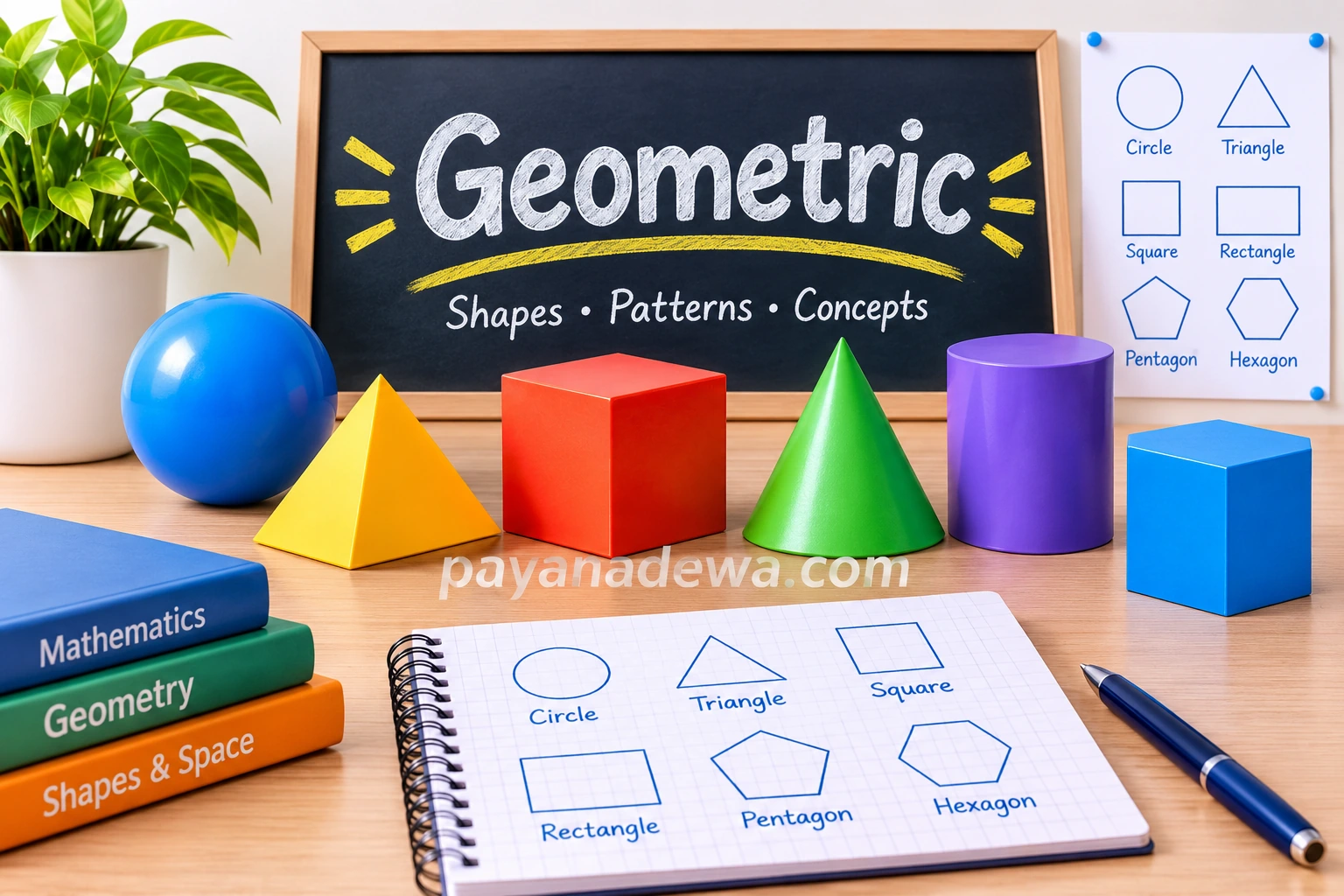
In this guide, we will explore the meaning of geometric, common geometric shapes, important mathematical principles, design applications, and practical ways to use geometric patterns creatively.
What Does Geometric Mean?
The word geometric relates to geometry, a branch of mathematics that studies shapes, sizes, positions, angles, lines, and dimensions. It describes objects, patterns, or designs that are based on mathematical forms and spatial relationships.
Geometric elements can be simple or complex. A basic circle, square, or triangle is a geometric shape. Meanwhile, an intricate repeating pattern made from polygons is an example of a more advanced geometric design.
Geometric concepts are commonly divided into two main categories:
- Two-dimensional geometry: Studies flat shapes with length and width, such as circles, triangles, squares, and rectangles.
- Three-dimensional geometry: Focuses on solid objects with length, width, and height, including cubes, spheres, cylinders, and pyramids.
These concepts provide the foundation for understanding how shapes interact with space and how mathematical structures appear in the real world.
Common Types of Geometric Shapes
Geometric shapes are among the most recognizable elements in mathematics and design. Each shape has unique properties that make it useful for different purposes.
1. Circles
A circle is a round two-dimensional shape in which every point on its boundary is equally distant from the center. Important measurements include the radius, diameter, and circumference.
Circles appear in many everyday objects, including wheels, clocks, plates, and decorative designs. Their smooth and continuous form also makes them popular in graphic design and architectural details.
2. Triangles
A triangle is a polygon with three sides and three interior angles. The total of its interior angles is always 180 degrees.
There are several types of triangles, including:
- Equilateral triangles, which have three equal sides.
- Isosceles triangles, which have two equal sides.
- Scalene triangles, which have three different side lengths.
- Right triangles, which contain one 90-degree angle.
Triangles are especially useful in construction because their structure provides stability and strength.
3. Squares and Rectangles
Squares and rectangles are four-sided geometric shapes. A square has four equal sides and four right angles. A rectangle also has four right angles, but only opposite sides need to be equal.
These shapes are frequently used in floor plans, windows, furniture, packaging, and digital layouts. Their regular proportions make them practical for organizing space.
4. Polygons
A polygon is a closed two-dimensional shape formed by straight line segments. Common examples include pentagons, hexagons, heptagons, and octagons.
Polygons are widely used in decorative patterns, architectural structures, engineering, and mathematical studies. Hexagons, for example, appear in honeycomb structures because they can cover a surface efficiently without leaving gaps.
Understanding Three-Dimensional Geometric Shapes
While two-dimensional shapes exist on flat surfaces, three-dimensional geometric objects occupy physical space. They have volume and can often be measured using surface area and other spatial properties.
Some common examples include:
- Cube: A solid shape with six equal square faces.
- Sphere: A perfectly round three-dimensional object, such as a ball.
- Cylinder: A solid with two parallel circular bases connected by a curved surface.
- Cone: A solid with a circular base and one pointed vertex.
- Pyramid: A solid with a polygonal base and triangular side faces that meet at one point.
These objects are important in product design, engineering, architecture, and manufacturing. Understanding their properties helps professionals create objects that are functional, attractive, and structurally sound.
What Is Geometric Design?
Geometric design is a creative approach that uses mathematical shapes, lines, angles, symmetry, and repeating patterns to create visual compositions. It can be minimal and simple or detailed and highly decorative.
Designers often combine basic shapes to produce visually interesting arrangements. For example, overlapping circles can create a sense of movement, while repeated triangles can form dynamic patterns.
Several characteristics make geometric design recognizable:
- Symmetry: Balanced arrangements of shapes around a central point or line.
- Repetition: Reusing shapes or patterns to establish visual consistency.
- Proportion: Maintaining relationships between different elements.
- Alignment: Organizing shapes along consistent lines or directions.
- Contrast: Combining different sizes, colors, and forms to create visual interest.
Because these principles are easy to adapt, geometric designs are popular in modern branding, interior decoration, fashion, illustration, and website layouts.
How Geometric Patterns Are Used in Everyday Life
Geometric patterns are not limited to mathematics textbooks. In fact, they are part of many objects and environments that people interact with daily.
Architecture and Construction
Architects use geometric principles to plan buildings, calculate dimensions, and create balanced structures. Triangular frameworks, rectangular floor plans, and circular architectural features are common examples.
Furthermore, geometric calculations help construction professionals estimate materials, measure distances, and improve structural accuracy.
Graphic Design and Branding
Geometric shapes are valuable tools for creating memorable visual identities. Circles can communicate unity, squares can suggest stability, and triangles can create a sense of direction or energy.
Many designers use geometric patterns in logos, posters, social media graphics, and website layouts. Simple shapes can make visual communication clearer and easier to recognize.
Interior Design and Decoration
Geometric patterns can transform ordinary spaces into visually appealing environments. Patterned tiles, decorative wall panels, geometric rugs, and modern furniture are popular examples.
For a balanced interior, consider combining simple patterns with neutral colors. This approach creates visual interest without making the room feel overwhelming.
Technology and Engineering
Geometric mathematics is essential in computer graphics, animation, engineering, and product development. Digital designers use coordinates, angles, and mathematical models to create accurate objects and realistic environments.
Similarly, engineers rely on geometric calculations when designing machines, mechanical components, and infrastructure.
Benefits of Learning Geometric Concepts
Learning geometry offers several practical and educational benefits. It develops mathematical understanding while encouraging people to observe the world more carefully.
- Improves spatial awareness: Helps you understand how objects relate to one another in space.
- Develops problem-solving skills: Encourages logical thinking and systematic approaches to challenges.
- Supports creativity: Provides a foundation for exploring patterns, illustrations, and visual compositions.
- Strengthens mathematical knowledge: Builds understanding of measurements, angles, dimensions, and calculations.
- Encourages attention to detail: Helps identify differences in proportions, symmetry, and structure.
These skills are useful in school, professional environments, and everyday activities. For example, measuring furniture, arranging decorations, and reading maps all involve basic spatial reasoning.
Practical Tips for Creating Geometric Designs
You do not need advanced mathematical knowledge to start creating geometric artwork. A few basic tools and simple techniques are enough to begin.
Start With Basic Shapes
Begin with circles, squares, triangles, and rectangles. Practice combining these forms to create simple compositions. Once you feel comfortable, experiment with polygons and more complex arrangements.
Use a Consistent Grid
A grid helps keep your design organized. It provides a visual guide for spacing, alignment, and proportions. This technique is particularly useful when creating posters, patterns, or digital illustrations.
Experiment With Symmetry
Try reflecting shapes across a horizontal or vertical line. Symmetrical designs often feel balanced and organized. You can also experiment with radial symmetry to create circular decorative patterns.
Choose Colors Carefully
Color selection can influence the overall appearance of a geometric composition. Consider using two or three complementary colors for a clean and modern result.
Explore Digital Design Tools
Digital illustration applications make it easier to create precise geometric artwork. Look for tools that provide shape libraries, alignment guides, grids, and adjustable measurements.
Most importantly, practice regularly. Small experiments with different shapes and patterns can help you develop a stronger understanding of geometric design.
Frequently Asked Questions About Geometric Concepts
What is a geometric shape?
A geometric shape is a form defined by mathematical properties such as sides, angles, curves, and dimensions. Common examples include circles, triangles, squares, rectangles, and spheres.
What is the difference between geometric and organic shapes?
Geometric shapes follow recognizable mathematical structures and often have regular edges or proportions. Organic shapes are usually irregular and resemble forms found in nature, such as leaves, clouds, and flowing water.
Why are geometric patterns popular in modern design?
Geometric patterns are popular because they offer structure, balance, and visual consistency. They can also be adapted to many styles, from minimalist branding to bold decorative artwork.
Can geometric design be used in digital artwork?
Yes. Geometric design is widely used in digital illustrations, logos, animations, website graphics, and user interface elements. Its clean shapes make it suitable for both simple and complex visual projects.
How can beginners learn geometry?
Beginners can start by identifying everyday shapes, drawing basic figures, measuring angles, and practicing simple geometric patterns. Worksheets, educational videos, and interactive exercises can also make learning easier.
Conclusion
Geometric concepts are an essential part of mathematics, creativity, and everyday life. From basic shapes and three-dimensional objects to complex patterns and modern architectural structures, geometry helps us understand how the world is organized.
Learning about geometric shapes can improve spatial awareness, strengthen problem-solving abilities, and inspire creative ideas. Whether you want to understand mathematical principles, create attractive artwork, or explore modern design, these concepts offer countless opportunities.
Start with simple shapes, experiment with patterns, and gradually explore more advanced ideas. With consistent practice, you can discover how geometric principles connect mathematics, art, technology, and the world around you.