Creating a successful event is about more than choosing a great venue, inviting the right people, and planning an engaging program. Without a clear event budget, even a well-organized event can quickly become more expensive than expected. A detailed budget helps you understand where your money is going, control spending, prepare for unexpected costs, and make better financial decisions throughout the planning process.
Whether you are organizing a corporate conference, wedding, birthday party, fundraiser, workshop, community gathering, or private celebration, an effective event budget gives you a financial roadmap. Instead of guessing how much everything will cost, you can estimate expenses, compare actual spending with your plan, and make adjustments before small problems become major budget issues.
This guide explains how to create an event budget from scratch, which expenses to include, how to allocate funds, and how to use an event budget template to keep your planning organized.
What Is an Event Budget?
An event budget is a financial plan that estimates the money an event will generate and the amount it will require to operate successfully. It typically includes expected income, planned expenses, estimated costs, actual costs, and a contingency amount for unexpected expenses.
A good event budget should provide a realistic picture of the total cost of an event before major financial commitments are made. It can also serve as a tracking tool during the planning process, allowing organizers to identify differences between estimated and actual spending.
Depending on the type and size of the event, a budget may cover venue rental, catering, entertainment, marketing, decorations, equipment, transportation, staffing, permits, technology, insurance, printing, and other operational costs.
Why Is an Event Budget Important?
Budgeting is one of the most important parts of event planning because every decision has a financial impact. A clear event budget helps organizers prioritize spending and avoid unnecessary costs.
1. Prevents Overspending
When expenses are recorded and monitored, it becomes easier to recognize when spending is approaching the financial limit. This allows you to reduce or postpone less important expenses before the budget is exceeded.
2. Helps Set Priorities
Not every event expense has the same level of importance. A budget allows you to determine which areas deserve more funding. For example, a professional conference may prioritize audio-visual equipment and speakers, while a wedding may place greater emphasis on catering, photography, and venue design.
3. Improves Decision-Making
Instead of making decisions based solely on preferences, event organizers can compare each option against the available budget. This makes it easier to choose between suppliers, venues, entertainment options, and other services.
4. Prepares You for Unexpected Costs
Unexpected expenses are common in event planning. Equipment replacements, additional guests, delivery fees, overtime, last-minute purchases, and weather-related changes can all affect the final cost. Setting aside a contingency fund helps protect the overall budget.
What Should an Event Budget Include?
A comprehensive event budget should include both income and expenses. The exact categories will vary depending on the event, but the following sections provide a useful starting point.
Event Income
If the event generates revenue, list all expected sources of income. Possible sources include:
- Ticket sales
- Sponsorships
- Registration fees
- Donations
- Vendor fees
- Merchandise sales
- Grants or funding
- Corporate contributions
Estimating income helps determine how much money is available for expenses and whether the event is expected to generate a surplus or operate within a fixed budget.
Venue Costs
The venue can represent one of the largest event expenses. Consider more than the advertised rental price. Your event budget may also need to account for deposits, cleaning fees, security, setup and teardown charges, furniture rentals, parking, utilities, and overtime.
Catering and Food
Food and beverages should be calculated according to the expected number of attendees. Ask suppliers about per-person pricing, service charges, taxes, delivery costs, staff fees, and minimum order requirements.
Marketing and Promotion
Marketing expenses may include social media advertising, printed materials, email marketing tools, promotional videos, photography, signage, website costs, and graphic design. Establishing a specific marketing allocation prevents promotional spending from gradually consuming funds intended for other event needs.
Entertainment and Speakers
Depending on the event, entertainment expenses can include musicians, DJs, performers, hosts, keynote speakers, instructors, or presenters. Remember to consider travel, accommodation, equipment, and additional technical requirements when estimating these costs.
Equipment and Technology
Events often require technology such as microphones, speakers, projectors, lighting, Wi-Fi, laptops, screens, livestreaming equipment, registration systems, or event management software. Determine whether equipment will be purchased or rented and include installation or technician fees where applicable.
Staffing and Labor
Staff-related expenses may include event coordinators, security personnel, servers, registration staff, cleaners, technicians, photographers, and temporary workers. Include overtime and additional labor requirements if they are possible.
Decorations and Supplies
Decorations can include table settings, flowers, banners, backdrops, centerpieces, furniture, linens, signs, name badges, stationery, and other supplies. Establish a spending limit for decorative items so aesthetic improvements do not unexpectedly increase the total event cost.
Transportation and Accommodation
If guests, speakers, staff, or equipment need transportation, include those costs in the budget. Depending on the event, you may need to account for vehicle rentals, fuel, parking, flights, hotels, airport transfers, or local transportation.
Contingency Fund
A contingency fund provides financial protection against unexpected expenses. The appropriate amount depends on the complexity and risk level of the event, but setting aside a dedicated reserve is generally better than planning every dollar without a safety margin.
For example, if your planned expenses total $20,000, you might reserve an additional amount specifically for unforeseen costs rather than treating the entire $20,000 as available for planned spending.
How to Create an Event Budget Step by Step
Step 1: Define the Event Scope
Start by identifying the event type, expected number of attendees, location, date, duration, and overall objectives. These factors directly affect the cost structure.
A small workshop for 30 people will have very different financial requirements from a conference for 500 attendees. Defining the scope first gives you a realistic foundation for your event budget.
Step 2: Determine the Available Budget
Identify how much money is actually available before committing to expenses. If the event is funded by multiple sources, record each source separately.
Knowing the financial limit early helps you avoid selecting services that are outside your realistic price range.
Step 3: List Every Expected Expense
Create categories for both major and minor expenses. Do not ignore small purchases because several small costs can add up quickly.
- Venue and permits
- Catering and beverages
- Marketing
- Entertainment
- Technology and equipment
- Staff and labor
- Transportation
- Decorations
- Printing and stationery
- Insurance and administrative costs
- Contingency funds
Step 4: Research Supplier Prices
Use real quotes whenever possible instead of relying entirely on assumptions. Contact multiple suppliers for significant expenses and compare what is included in each quote.
A lower headline price is not always the cheapest option. One supplier may include delivery, setup, and service fees while another may charge for each item separately.
Step 5: Separate Estimated and Actual Costs
Your event budget should distinguish between what you expect to spend and what you actually spend. This makes it easier to identify budget variances and take corrective action during the planning process.
For example, if catering was initially estimated at $5,000 but the confirmed quote is $6,200, you can adjust another category before the event instead of discovering the difference after all spending has occurred.
Step 6: Add a Contingency Amount
Once the major expenses are estimated, create a separate contingency category. Avoid using this reserve for planned purchases unless necessary. Its purpose is to provide flexibility when unexpected costs appear.
Step 7: Review the Budget Regularly
An event budget should not be created once and forgotten. Review it whenever you receive a new quote, sign a contract, change the guest count, add a service, or cancel an expense.
How to Keep an Event Budget Under Control
Track Expenses as They Happen
Record expenses immediately rather than waiting until the end of the week or month. Real-time tracking gives you a more accurate view of the remaining budget.
Use a Purchase Approval Process
For larger events, establish clear rules about who can approve spending. This reduces duplicate purchases and prevents team members from making unplanned commitments.
Compare Actual Costs With Estimates
Regularly compare your estimated event costs with confirmed and actual costs. A simple variance column can reveal which categories are above or below budget.
Prioritize High-Impact Expenses
Focus your spending on elements that directly support the event’s objectives and attendee experience. If a proposed expense has little impact, consider whether the money could be used more effectively elsewhere.
Negotiate With Vendors
Do not assume supplier prices are always fixed. Depending on the service, you may be able to negotiate package pricing, payment terms, delivery charges, minimum quantities, or bundled services.
Common Event Budgeting Mistakes to Avoid
- Forgetting hidden fees: Taxes, service charges, delivery, setup, overtime, and cleaning can significantly affect the final bill.
- Underestimating attendance: More attendees can increase food, seating, materials, staffing, and transportation costs.
- Ignoring small expenses: Printing, badges, cables, stationery, and miscellaneous supplies can accumulate quickly.
- Using the entire budget: Leaving no contingency reserve makes the event more vulnerable to unexpected costs.
- Failing to update estimates: Old estimates can become inaccurate as vendor prices and event requirements change.
- Choosing price over value: The cheapest option may not provide the quality, reliability, or support required for a successful event.
Tips for Building a More Accurate Event Budget
Accuracy improves when your budget is based on realistic assumptions rather than optimistic estimates. Use recent supplier quotes, confirmed attendance numbers, previous event data, and clearly defined requirements whenever possible.
It is also helpful to create three financial scenarios: a minimum budget, a target budget, and a higher-cost scenario. This approach shows how the event would perform if costs increase or attendance changes.
Another useful practice is to separate fixed costs from variable costs. Fixed expenses generally remain similar regardless of attendance, while variable costs often increase as more people attend. Understanding this distinction makes it easier to calculate the financial impact of changes in attendance.
Using an Event Budget Template
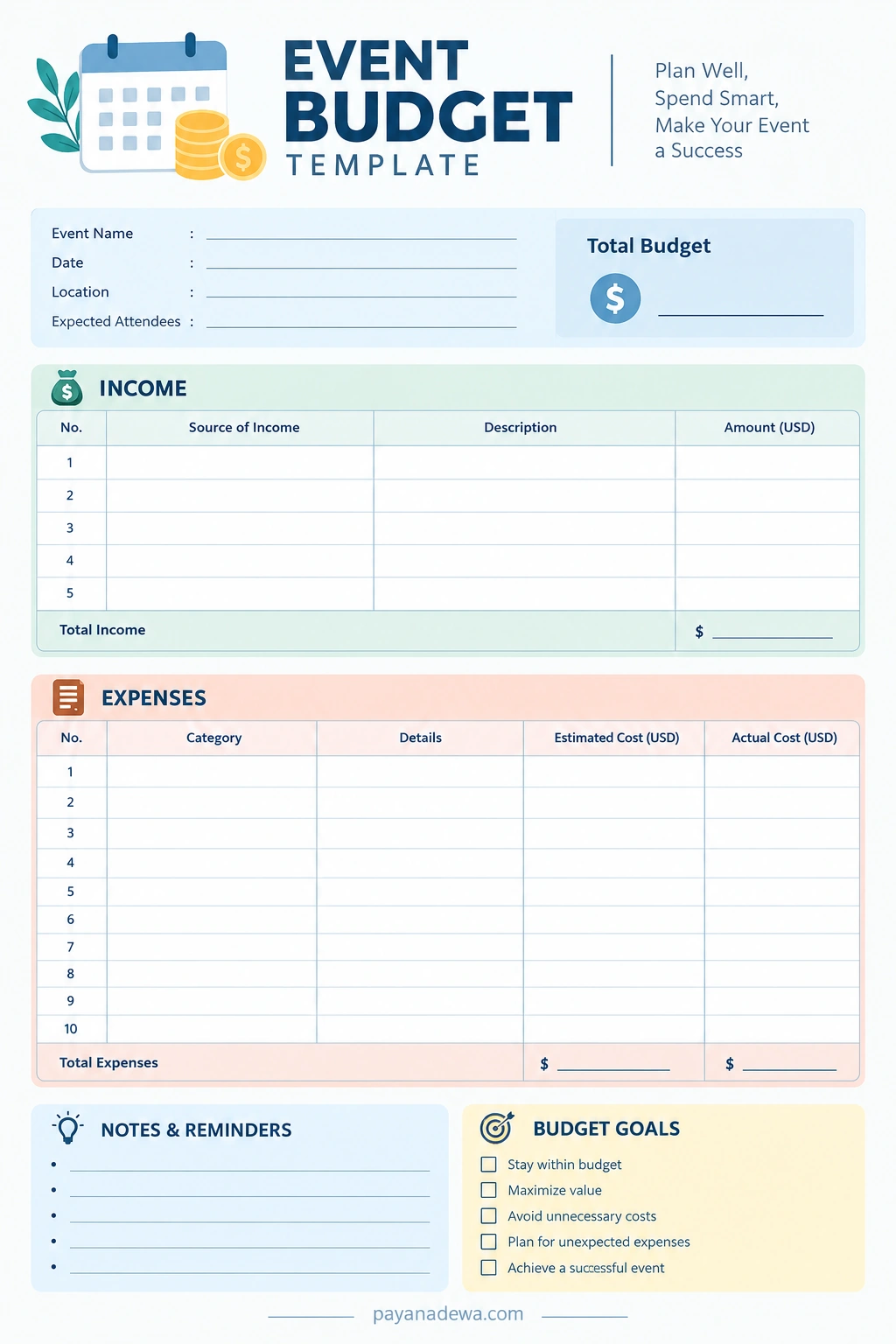
An event budget template can make financial planning much easier by providing a consistent structure for recording income and expenses. Instead of creating a budget from a blank spreadsheet or document, you can start with predefined categories and add information as your event develops.
A useful template should include the event name, date, location, expected attendance, total budget, income sources, expense categories, estimated costs, actual costs, notes, and budget goals.
For teams, a shared digital budget can provide additional benefits because multiple people can review the same information. For smaller events, a printable event budget worksheet can be a simple and practical way to organize financial information.
Event Budget Example
Imagine you are organizing a professional workshop with a total budget of $10,000. You might allocate funds across several categories such as:
- Venue: $2,000
- Catering: $2,500
- Marketing: $1,000
- Equipment and technology: $1,200
- Speakers and entertainment: $1,000
- Staff and supplies: $800
- Contingency reserve: $1,500
The exact allocation will depend on the event’s objectives. The important point is that every major category should have a defined financial limit, and spending should be reviewed as the event progresses.
Final Thoughts on Event Budget Planning
A well-designed event budget turns financial planning from a guessing exercise into a structured process. By identifying income, estimating expenses, monitoring actual costs, and reserving funds for unexpected situations, you can make more confident decisions throughout the event planning process.
The best budget is not necessarily the most complicated one. It is the budget that is clear, realistic, regularly updated, and easy for everyone involved to understand. Whether you are planning a small private gathering or a large corporate event, a practical budget can help you control costs while protecting the quality of the attendee experience.
Start by defining your event scope, list every expected expense, research realistic prices, track actual spending, and review your numbers regularly. With the right system and an organized event budget template, you can spend strategically and give your event a stronger financial foundation.