An Advertising Creative Review is a structured process for evaluating an advertisement before it reaches a wider audience. Instead of relying only on personal taste, a good review examines whether the creative communicates the right message, fits the target audience, supports the campaign objective, and gives people a clear reason to act.
Whether you are reviewing a social media ad, display banner, video, carousel, search creative, or paid campaign concept, a consistent review process can reduce weak creative decisions and make collaboration easier. The goal is not simply to make an advertisement look attractive. The goal is to make the creative clearer, more relevant, memorable, and effective.
Use the Advertising Creative Review Template below as a practical starting point for documenting feedback and turning subjective opinions into useful, actionable improvements.
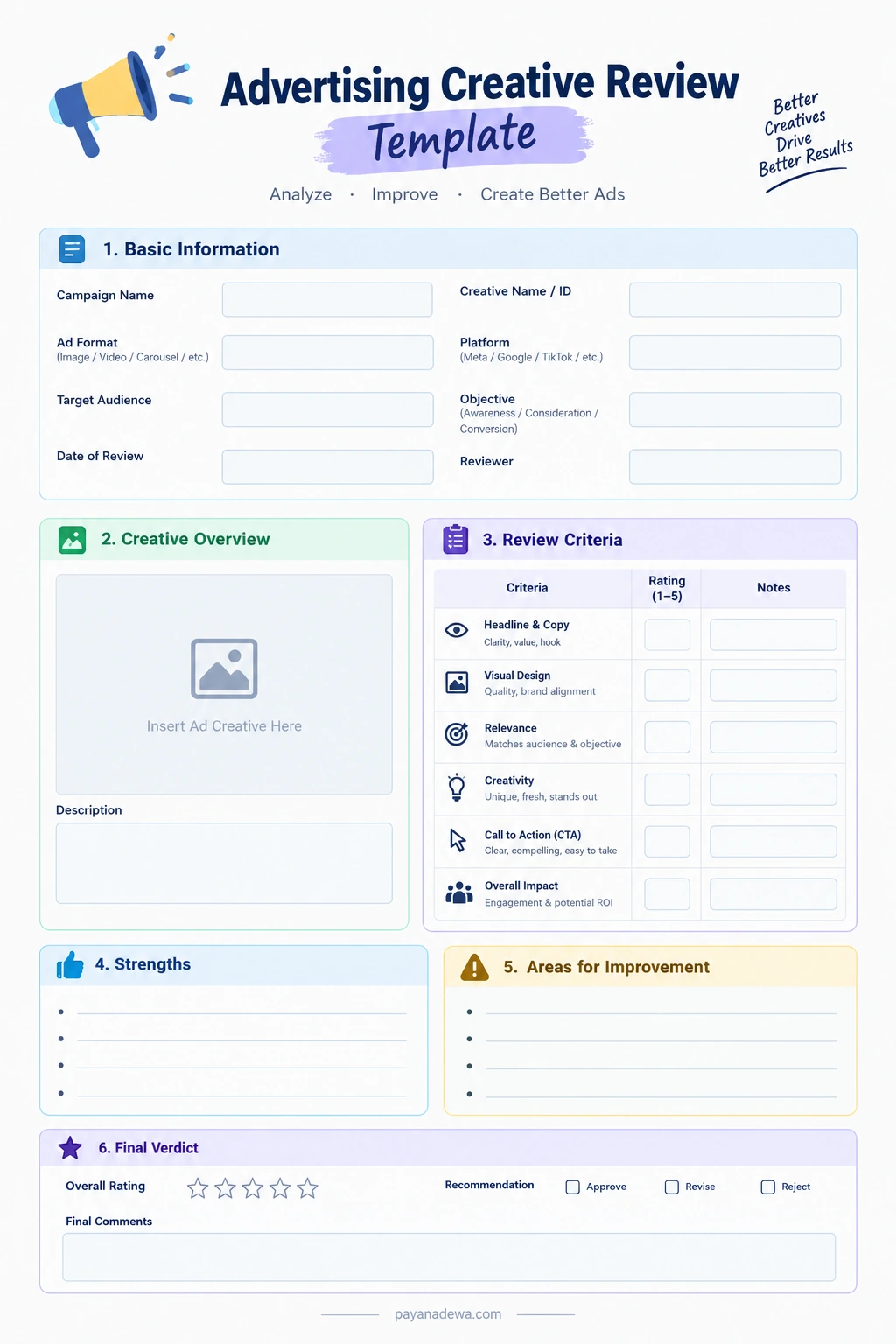
Image Title: Advertising Creative Review Template
Alt Text:
Image Caption: A clean printable Advertising Creative Review template for organizing campaign details, creative feedback, ratings, strengths, improvements, and final recommendations.
What Is an Advertising Creative Review?
An Advertising Creative Review is an organized assessment of an advertisement’s creative elements. It can be completed by a marketer, creative director, designer, copywriter, media buyer, brand manager, client, or cross-functional review team.
A useful review looks beyond whether team members personally like the ad. It asks practical questions such as: Is the message immediately understandable? Does the visual hierarchy guide attention? Is the offer relevant to the intended audience? Does the call to action make sense? Does the creative support the campaign objective?
This distinction matters because an ad can be visually polished while still communicating poorly. Conversely, a simple concept can perform well when its message, audience fit, and call to action are strong.
Why an Advertising Creative Review Matters
Creative review creates a checkpoint between production and publication. It helps teams identify problems while changes are still relatively easy and inexpensive to make.
- Improves clarity: Reviewers can identify confusing headlines, crowded layouts, weak hierarchy, or unclear offers.
- Protects brand consistency: Creative can be checked against established visual and verbal guidelines.
- Strengthens audience relevance: Feedback can reveal whether the message speaks to the intended customer.
- Improves conversion potential: Reviewers can assess whether the CTA and value proposition are easy to understand.
- Reduces subjective feedback: A repeatable framework encourages evidence-based comments instead of vague statements such as “I don’t like it.”
- Speeds up collaboration: Designers, copywriters, marketers, and stakeholders can work from the same criteria.
Key Areas to Evaluate in an Advertising Creative Review
1. Headline and Copy
Start with the words. The headline should communicate a meaningful benefit, idea, problem, or offer quickly. Supporting copy should add useful context without overwhelming the viewer.
During the review, check whether the wording is concise, understandable, audience-appropriate, and consistent with the campaign objective. Look for unnecessary jargon, ambiguous claims, awkward phrasing, and information that competes with the main message.
A helpful test is to show the creative briefly and then ask someone what they think the advertisement was about. If the answer misses the intended message, the copy or hierarchy may need revision.
2. Visual Design
Visual design determines how easily people can scan the creative and understand what deserves attention first. Review the composition, typography, imagery, spacing, contrast, branding, and visual hierarchy.
- Is the main message visually dominant?
- Can the text be read easily on the intended screen size?
- Does the imagery support the message rather than distract from it?
- Are brand colors, fonts, and visual elements used consistently?
- Does the layout leave enough breathing room?
A strong advertising design usually has a clear visual path. The viewer should not have to search for the product, benefit, offer, or next step.
3. Audience and Relevance
An advertisement should make sense for the people who are expected to see it. Review the language, imagery, offer, context, and emotional appeal against the defined target audience.
For example, an ad aimed at first-time buyers may need more educational context than an ad aimed at existing customers. A professional audience may respond to different language and proof points than a consumer audience. The creative should reflect those differences rather than trying to speak to everyone at once.
4. Creativity and Differentiation
Creativity is not simply about being unusual. A creative concept should attract attention while remaining understandable and relevant.
Ask whether the idea has a distinctive hook, memorable visual device, interesting perspective, or compelling storytelling element. Then check whether that creative device strengthens the message. If an unusual concept gets attention but leaves the audience confused about the product or offer, it may need refinement.
5. Call to Action
The call to action should tell the audience what to do next. Depending on the campaign, that could be “Shop Now,” “Learn More,” “Book a Demo,” “Download,” “Sign Up,” or another appropriate action.
Review the CTA for visibility, clarity, relevance, and consistency with the audience’s stage in the customer journey. The action should feel like a natural next step rather than an unrelated instruction.
6. Overall Campaign Fit
Finally, assess the creative in the context of the campaign. A strong individual image or headline does not automatically make a strong campaign asset.
Check whether the creative supports the campaign objective, offer, landing page, media placement, brand positioning, and broader message. Consistency across multiple ad variations can also help audiences recognize the campaign and understand its core promise.
How to Conduct an Advertising Creative Review Step by Step
Step 1: Define the Objective
Before reviewing the creative, identify what it is supposed to achieve. Awareness, consideration, lead generation, sales, app installs, and retention can require different creative approaches.
Step 2: Identify the Target Audience
Write down the intended audience and the most important customer need or motivation. This gives reviewers a reference point for judging relevance.
Step 3: Review the First Impression
Look at the ad for a few seconds without overanalyzing it. Record what stands out first and what message you understand. This helps reveal whether the hierarchy works at a glance.
Step 4: Evaluate Each Creative Element
Review copy, visuals, branding, relevance, creativity, CTA, and overall campaign fit separately. A simple rating scale from 1 to 5 can make comparisons easier, provided the rating criteria are clearly defined.
Step 5: Document Strengths and Weaknesses
Do not record only problems. Identify the elements worth protecting during revision. Then describe improvement opportunities in specific terms.
Instead of writing “make it better,” write “increase headline contrast so the primary benefit is readable on mobile” or “shorten the opening copy so the offer appears above the visual fold.” Specific feedback is easier to act on.
Step 6: Prioritize the Changes
Not every issue deserves equal attention. Separate major communication problems from minor polish. Prioritize changes that affect comprehension, audience relevance, brand accuracy, compliance, or the desired action.
Practical Advertising Creative Review Checklist
Use this checklist before approving a creative asset:
- Message: Is the main idea immediately clear?
- Value proposition: Does the ad explain why the audience should care?
- Headline: Is it concise, readable, and relevant?
- Visual hierarchy: Does attention move naturally from the main message to supporting information and CTA?
- Branding: Is the brand identifiable without overpowering the message?
- Audience fit: Does the language and imagery match the intended audience?
- CTA: Is the next action obvious and appropriate?
- Platform fit: Does the creative work in the intended placement and format?
- Accessibility: Is important information readable and understandable?
- Consistency: Does the creative align with the campaign and landing experience?
How to Give Better Creative Feedback
The quality of feedback often determines the quality of the final revision. Good feedback is specific, connected to an objective, and focused on the audience rather than personal preference.
For example, “I don’t like the headline” provides little direction. A more useful comment is: “The headline communicates the product category, but the customer benefit is unclear. Consider leading with the outcome that matters most to the target audience.”
It is also helpful to separate observation from recommendation. First explain what is happening, then explain why it matters, and finally suggest a possible change.
- Observation: The CTA has low contrast against the background.
- Impact: It may be difficult to notice on smaller screens.
- Recommendation: Increase contrast and give the CTA more visual separation.
Common Advertising Creative Review Mistakes
Reviewing Only for Aesthetics
A beautiful layout is not enough. Reviewers should consider communication, audience relevance, usability, and campaign objectives alongside visual quality.
Giving Too Much Feedback at Once
A long list of small comments can hide the most important problems. Prioritize the changes that can materially improve clarity or campaign alignment.
Using Personal Preference as the Main Standard
Creative review should not become a popularity contest. Whenever possible, connect feedback to the brief, target audience, brand requirements, placement, or measurable campaign goal.
Ignoring the Final User Experience
The advertisement is only one part of the journey. Make sure the promise made in the creative matches what users encounter after clicking, visiting, downloading, or purchasing.
Using a Template to Standardize Creative Reviews
A repeatable review template makes the process easier to scale. Instead of starting from a blank document every time, reviewers can work through the same core criteria and record consistent notes.
A useful template should include campaign information, creative identification, target audience, objective, creative preview, review criteria, strengths, improvement areas, final comments, and an approval or revision decision.
Teams can also adapt the template for different channels. A video ad review might include pacing, opening hook, sound, subtitles, and storytelling. A display ad review might emphasize readability, placement constraints, and CTA visibility. A social media creative review may include thumb-stopping potential, mobile readability, and platform-native presentation.
Final Thoughts on Advertising Creative Review
An effective Advertising Creative Review turns creative feedback into a structured decision-making process. By evaluating the message, design, audience relevance, creativity, CTA, and campaign fit, teams can identify problems earlier and make revisions with greater confidence.
The most useful review is not necessarily the one with the most comments. It is the one that identifies the most important opportunities, explains why they matter, and gives the creative team clear next steps. Use a consistent checklist or printable template, focus feedback on the audience and campaign objective, and protect the elements that are already working.
When creative review becomes a repeatable part of the advertising workflow, teams can collaborate more efficiently and produce advertising assets that are clearer, more relevant, and better aligned with the intended customer journey.