Effective advertising starts with a clear strategy, but a strong strategy only works when everyone understands the decisions, responsibilities, and next steps. That is why Brand Strategy Advertising Meeting Minutes are so valuable for marketing teams, advertising agencies, creative departments, and business leaders.
Well-written meeting minutes turn a discussion into a practical record. They capture important decisions, campaign ideas, audience insights, deadlines, and assigned tasks in one organized document. As a result, team members can stay aligned even after the meeting ends.
This guide explains how to create useful brand strategy advertising meeting minutes, what information to include, and how to use a structured template to make future meetings more productive.
What Are Brand Strategy Advertising Meeting Minutes?
Brand strategy advertising meeting minutes are a written record of a meeting focused on brand positioning, advertising campaigns, marketing goals, creative concepts, target audiences, budgets, and related business decisions.
The purpose is not to record every sentence spoken during a meeting. Instead, effective minutes summarize the information that matters most. They provide a clear reference for what was discussed, what was decided, who is responsible, and what should happen next.
A useful document may include:
- Meeting date, time, and location
- Names or teams of attendees
- Meeting objectives
- Key discussion points
- Brand strategy decisions
- Advertising campaign ideas
- Target audience insights
- Budget and timeline discussions
- Action items and assigned owners
- Deadlines and follow-up dates
- Additional notes and unresolved questions
Why Brand Strategy Meeting Minutes Matter
Brand and advertising meetings often involve several departments. Marketing teams may discuss campaign performance while creative teams develop concepts. At the same time, sales, research, and leadership teams may provide additional requirements.
Without a written record, important details can quickly become unclear. Meeting minutes solve this problem by creating one reliable source of information.
Improve Team Alignment
Clear minutes help everyone understand the same objectives and decisions. This is particularly useful when a project includes marketing managers, designers, copywriters, advertising specialists, and external agencies.
Reduce Miscommunication
A written record makes responsibilities easier to understand. Instead of relying on memory, team members can check the document for specific tasks, deadlines, and decisions.
Keep Advertising Projects Moving
Good meeting minutes connect strategy with execution. When every action item has an owner and deadline, the team can move from discussion to implementation more quickly.
Create a Historical Reference
Campaigns often evolve over several weeks or months. Previous meeting minutes can help the team understand why a particular creative direction, audience segment, message, or advertising channel was selected.
For example, a team can review earlier notes before launching a new campaign and quickly identify the original strategic goals.
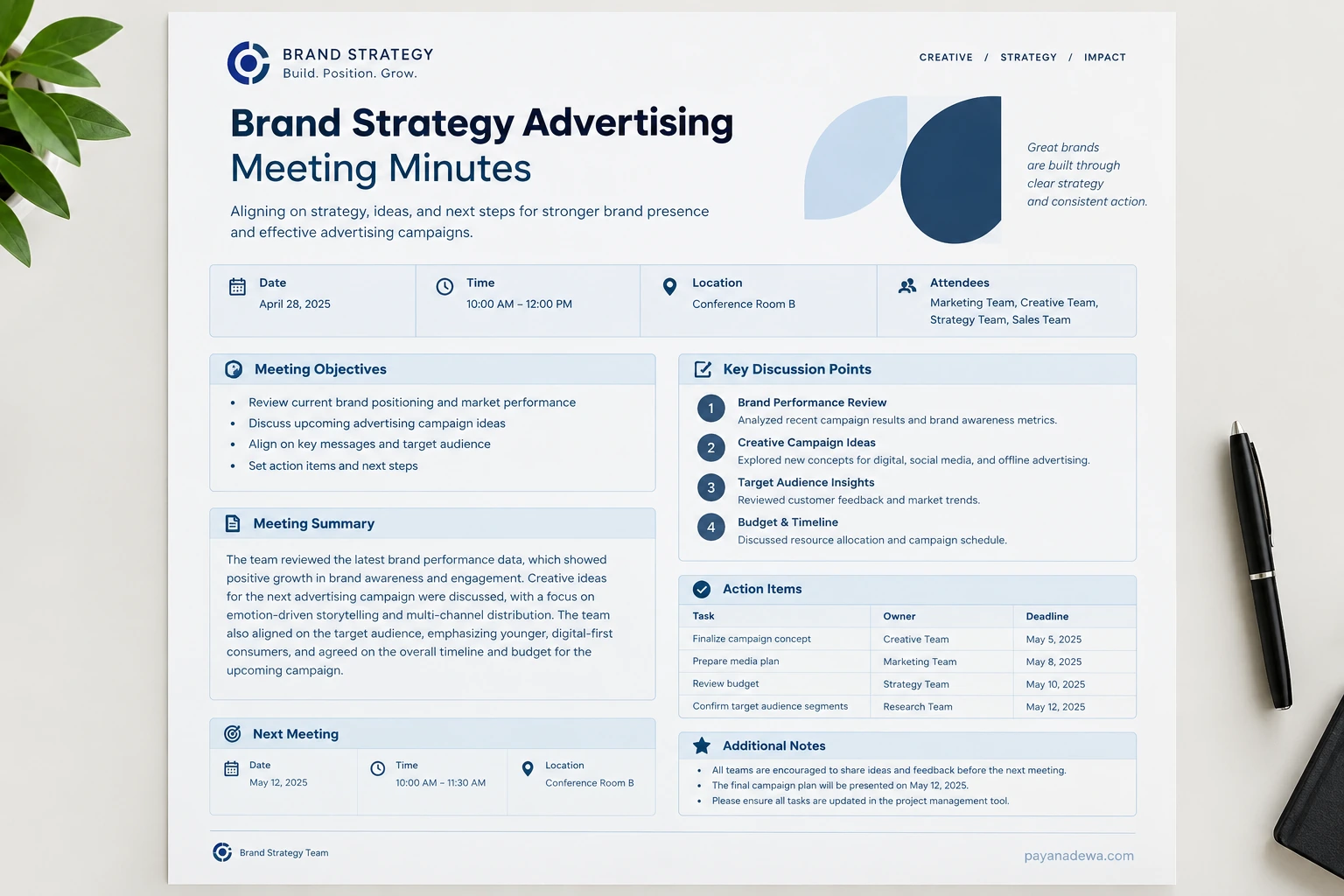
Essential Sections of Brand Strategy Advertising Meeting Minutes
A professional meeting minutes template should make important information easy to find. A consistent structure also helps teams prepare and review meetings more efficiently.
1. Meeting Information
Begin with the basic meeting details. Include the date, time, location, meeting organizer, and attendees.
This section provides context and makes the document easier to search later. If the meeting is held online, you can also include the relevant meeting platform or project reference.
2. Meeting Objectives
Clearly state why the meeting was held. Objectives should be specific and connected to the brand or advertising project.
Examples include reviewing campaign performance, defining a target audience, approving a creative direction, discussing media channels, or establishing the next campaign timeline.
3. Key Discussion Points
Summarize the most important subjects discussed during the meeting. Focus on meaningful information rather than documenting every conversation.
Common discussion topics include:
- Brand positioning and messaging
- Campaign performance
- Customer research
- Competitor observations
- Creative concepts
- Advertising channels
- Content requirements
- Media planning
- Campaign budget
- Launch schedule
4. Decisions and Approvals
Record decisions clearly. This is one of the most important parts of effective meeting documentation.
For example, instead of writing that the team “discussed social media advertising,” specify whether the team approved a particular channel, audience, creative concept, or testing approach.
Clear decisions reduce uncertainty and give the project team a firm direction.
5. Action Items
Every important follow-up task should have an owner and, when possible, a deadline.
A simple action-item structure can include:
- Task: What needs to be completed?
- Owner: Who is responsible?
- Deadline: When should it be completed?
- Status: Is it pending, in progress, or completed?
This structure turns meeting notes into an actionable project management tool.
How to Write Effective Advertising Meeting Minutes
Prepare Before the Meeting
Good minutes begin before the meeting starts. Review the agenda, previous meeting notes, campaign objectives, and relevant performance information.
Prepare a template with the major sections already in place. This allows you to focus on important decisions instead of formatting the document during the discussion.
Focus on Decisions and Outcomes
Do not attempt to capture every statement. Instead, identify the information that affects the project.
For example, if the team discusses five creative concepts but approves only one direction, the minutes should make the approved direction easy to identify.
Use Clear and Simple Language
Meeting minutes should be easy to scan. Use short paragraphs, descriptive headings, and bullet lists when appropriate.
Avoid unnecessary jargon. When technical advertising terms are necessary, use them consistently so that every department understands the meaning.
Record Responsibilities Immediately
When someone agrees to complete a task, record the responsibility during the meeting. Waiting until later can result in forgotten assignments or incorrect ownership.
Review the Minutes Afterward
Before distributing the document, check names, dates, decisions, deadlines, and action items. Remove unclear wording and correct any obvious errors.
Then share the final version with the relevant team members while the discussion is still fresh.
Brand Strategy Topics to Include in Advertising Meetings
The exact content of meeting minutes depends on the project. However, several strategic areas are commonly useful.
Brand Positioning
Document discussions about how the brand should be perceived in the market. Include important positioning statements, differentiators, and changes to the brand message.
Target Audience
Record relevant customer characteristics, audience segments, customer needs, and behavioral insights. This information can guide both creative development and media selection.
Creative Direction
Capture approved concepts, visual direction, messaging themes, content formats, and creative requirements. If an idea is rejected, record only the context needed to understand the final direction.
Advertising Channels
Document decisions involving search advertising, social media, display advertising, video, email, print, influencer marketing, or other relevant channels.
Budget and Timeline
Record important budget discussions and campaign milestones. A clear timeline helps teams coordinate creative production, media buying, approvals, and launch activities.
Tips for Better Brand Strategy Meeting Documentation
A template becomes more useful when the entire team follows a consistent process.
- Keep the format consistent: Use the same structure for recurring meetings.
- Highlight decisions: Make approvals and strategic choices easy to locate.
- Assign every important task: Avoid action items without an owner.
- Add realistic deadlines: Specific dates are easier to track than vague instructions.
- Separate decisions from ideas: Not every suggestion represents an approved strategy.
- Keep sensitive information appropriate: Only include confidential details when they are necessary and authorized.
- Share notes quickly: Send the completed minutes soon after the meeting.
- Review previous action items: Start the next meeting by checking outstanding tasks.
How to Use a Brand Strategy Advertising Meeting Minutes Template
A printable template can simplify the entire documentation process. Start by entering the meeting date, time, location, and attendees. Next, define the objectives so participants understand the intended outcome.
During the meeting, record the main discussion points and strategic decisions. Then create an action-item list with clear owners and deadlines.
After the meeting, review the document for accuracy. Share it with the appropriate team members and store it with the project files. At the next meeting, use the previous minutes to review completed and outstanding tasks.
This simple workflow creates continuity between meetings and helps prevent important decisions from being lost in email threads or informal conversations.
Common Mistakes to Avoid
Even a professional-looking meeting document can become ineffective if it contains too much unnecessary information.
Writing a Full Transcript
Meeting minutes are not transcripts. Recording every sentence can make the document difficult to read and can hide the decisions that matter.
Leaving Tasks Without Owners
An action item without a responsible person is easy to overlook. Always assign ownership when a task requires follow-up.
Using Vague Deadlines
Words such as “soon” or “later” can create confusion. Whenever possible, use a specific date.
Ignoring Unresolved Questions
If an important issue remains open, document it. This helps the team return to the subject instead of assuming that someone else will handle it.
Final Thoughts on Brand Strategy Advertising Meeting Minutes
Brand Strategy Advertising Meeting Minutes provide more than a record of a conversation. They create a practical bridge between brand strategy, advertising decisions, and project execution.
By documenting objectives, discussion points, decisions, responsibilities, and deadlines, marketing teams can work with greater clarity and consistency. A well-designed template also saves time and makes recurring meetings easier to manage.
Whether you work in an advertising agency, marketing department, creative team, or growing business, a structured meeting minutes template can help transform strategic conversations into measurable next steps. Keep the format simple, focus on meaningful outcomes, and make every important action easy to track.