When people search for APA, they are often looking for guidance on the APA format, APA style, academic writing, citations, references, or the rules used to organize a research paper. For students, researchers, educators, and professional writers, understanding APA can make academic work clearer, more consistent, and easier to verify.
The APA Style is widely associated with academic and research writing, particularly in fields such as psychology, education, social sciences, and related disciplines. It provides guidelines for presenting ideas, citing sources, formatting papers, and creating reference lists.
This guide explains what APA means in an academic context, how APA citations work, how to format references, and how you can use a simple APA template to organize your work more efficiently.
What Does APA Mean?
In academic writing, APA commonly refers to the American Psychological Association and the writing and citation style associated with its publications. APA Style provides a structured approach to documenting sources and presenting academic information.
The style is especially common in disciplines that rely heavily on research, evidence, and scholarly publications. Instead of allowing every writer to use a different citation system, APA provides consistent rules that help readers identify where information originated.
Depending on the context, someone searching for “APA” may be looking for information about APA citations, APA references, APA paper format, APA headings, in-text citations, or the latest APA style guidelines.
Why Is APA Style Important?
Using APA correctly is about more than following formatting rules. A consistent citation system helps readers understand the relationship between your ideas and the sources supporting them.
APA style can help you:
- Give credit to the original authors of ideas and research.
- Help readers locate the sources used in your work.
- Organize academic papers in a consistent way.
- Make research writing easier to read and evaluate.
- Reduce the risk of accidental plagiarism.
- Create a professional and consistent academic document.
For students, learning APA early can save time later. Once the basic structure becomes familiar, creating in-text citations and reference entries becomes much easier.
Understanding APA In-Text Citations
One of the most recognizable features of APA style is the author-date citation system. When you use information from another source, you generally provide the author’s surname and publication year within the text.
Parenthetical Citations
A parenthetical citation places the source information at the end of a relevant statement. The basic structure generally includes the author’s surname and year of publication.
For example, an academic sentence might include a citation such as (Smith, 2024).
Narrative Citations
A narrative citation incorporates the author’s name into the sentence. The publication year is then included alongside the author’s name or immediately after it, depending on the sentence structure.
For example, you might write that Smith (2024) examined a particular research topic.
The important point is that the in-text citation should allow the reader to connect the information in your paragraph with the corresponding entry in your reference list.
How Does an APA Reference List Work?
The reference list appears at the end of an academic paper. It provides more complete information about the sources cited in the text.
A typical reference entry may contain information such as:
- Author name or names.
- Publication date.
- Title of the work.
- Publication or website information.
- Publisher information when applicable.
- Digital Object Identifier (DOI) or URL when appropriate.
The exact format depends on the type of source. A journal article, book, webpage, report, and other source types can require different reference structures.
Common Types of APA References
Books
Books typically require the author’s name, publication year, book title, and publisher information. The formatting changes depending on whether you are citing an entire book, a chapter, or another part of a larger work.
Journal Articles
Journal article references generally contain the authors, publication year, article title, journal title, volume and issue information when applicable, page range, and DOI when available.
Websites
Web sources can require the author or organization, date, title of the page, website information, and URL. Because websites can vary considerably, it is important to identify what type of webpage you are citing before creating the reference.
Reports and Other Publications
Government reports, organizational publications, research reports, and similar documents may have their own citation considerations. Always check the appropriate APA guidance when a source does not fit a common reference category.
APA Paper Format Basics
APA formatting can apply to several parts of an academic document, including the page layout, headings, title page, paragraphs, citations, and reference list.
When preparing an APA paper, pay attention to the following elements:
- Page layout: Use a consistent and readable document layout.
- Typography: Follow the applicable APA guidance for acceptable fonts and sizes.
- Paragraphs: Maintain consistent paragraph formatting and indentation.
- Headings: Use heading levels to organize major sections and subsections.
- Page numbers: Include page numbers according to the requirements of your assignment or document.
- References: Present cited sources in an appropriately formatted reference list.
Always check your instructor’s requirements because an assignment may include additional instructions beyond standard APA Style.
How to Organize an APA Research Paper
A well-organized paper makes it easier for readers to follow your argument. Before writing, create a simple structure that identifies your topic, research question, evidence, analysis, and conclusion.
Start With a Clear Research Question
A focused research question gives your paper direction. Instead of choosing an extremely broad topic, narrow it down to a question that can realistically be explored within the required word count.
Plan Your Main Sections
Create headings and subheadings before writing the full paper. This allows you to see whether your argument has a logical flow and prevents important information from being placed in the wrong section.
Track Your Sources
Keep a record of every source you use while researching. Record the author, publication date, title, and other relevant information as soon as you find the source.
This simple habit can prevent a common problem: finishing an assignment and then having to search through numerous browser tabs to determine where each piece of information came from.
Practical Tips for Using APA Correctly
APA becomes easier when you develop a consistent workflow. The following habits can make academic writing more efficient.
- Cite sources as you write: Do not wait until the final editing stage to add every citation.
- Keep a source list: Record bibliographic information while researching.
- Check author names carefully: Small errors can make citations difficult to match with references.
- Review dates: Make sure publication years are accurate.
- Match citations and references: Every source cited in the paper should generally have a corresponding reference entry.
- Proofread formatting: Look for inconsistent headings, spacing, indentation, and punctuation.
- Follow assignment instructions: Your instructor’s requirements may add specifications to standard APA formatting.
APA Template for Academic Planning
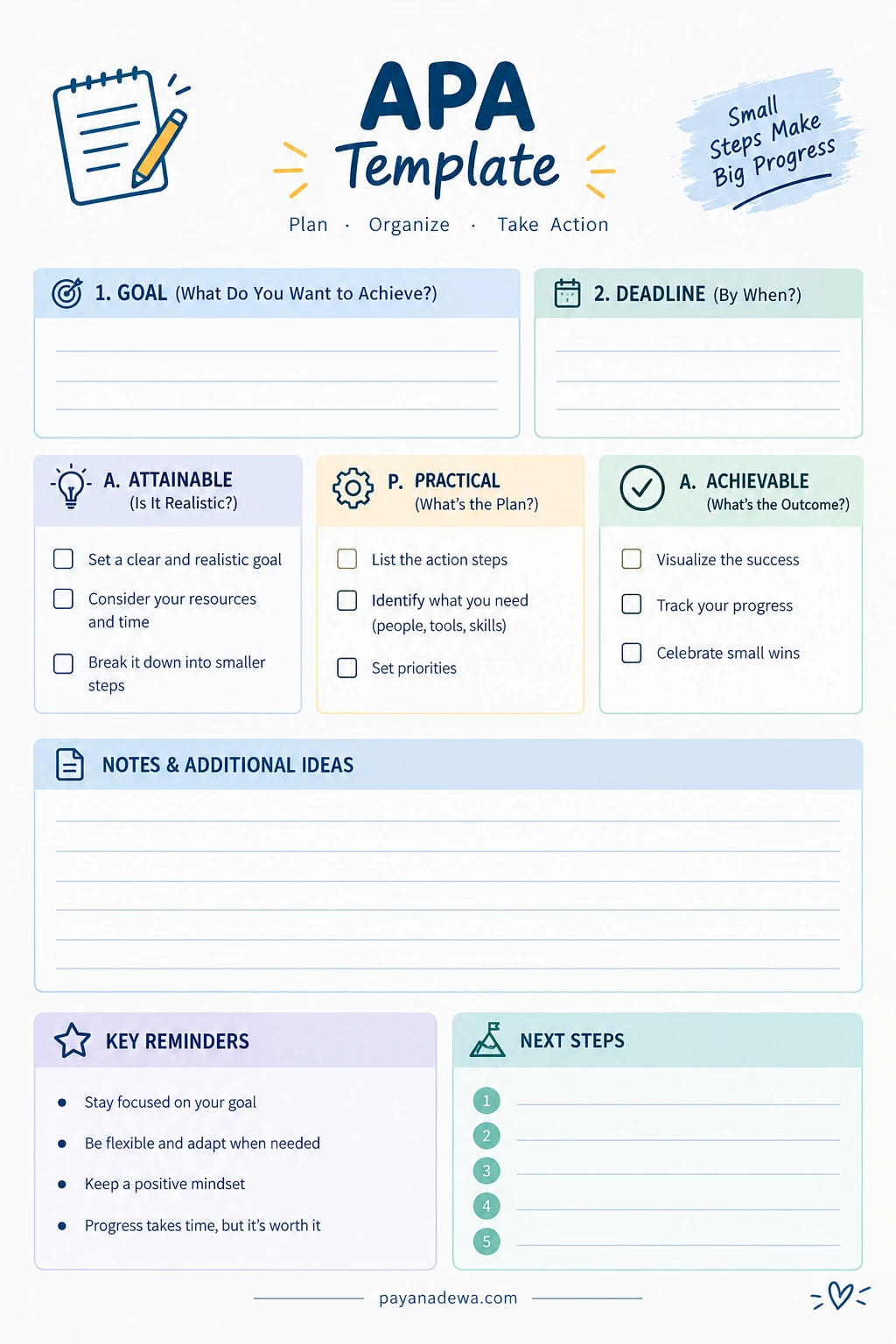
A printable APA template can be useful when you need to organize a research assignment before beginning the writing process. Rather than starting with a blank document, you can use a structured planning sheet to identify your goal, deadline, research tasks, notes, and next steps.
A useful template can include sections for the main objective, important deadlines, practical tasks, supporting resources, notes, and progress tracking. This approach is especially helpful for longer assignments where research, outlining, drafting, editing, and referencing must all be completed.
The template shown above is designed as a simple planning tool. You can print it, keep it beside your computer, or adapt the sections to match your own academic workflow.
Common APA Mistakes to Avoid
Many APA problems are caused by small inconsistencies rather than major writing issues. Checking these details before submitting your paper can improve the overall quality of your document.
- Using an inconsistent citation format.
- Leaving sources out of the reference list.
- Including references that are never cited in the paper.
- Entering incorrect publication information.
- Forgetting to format headings consistently.
- Copying source material without appropriate attribution.
- Relying on an automatic citation generator without checking its output.
Citation generators can save time, but they are not always perfect. A generated citation should be reviewed against the applicable APA requirements and the original source.
How to Make APA Writing More Efficient
The easiest way to improve your APA workflow is to treat citation and organization as part of the writing process rather than as a final task.
Begin by collecting reliable sources. Next, create a basic outline and decide which sources support each section. As you write, add citations where they belong. Finally, review the reference list and compare it with your in-text citations.
This process creates several opportunities to catch errors before submission. It also makes your research easier to manage when your project contains many sources.
APA Checklist Before Submission
Before submitting an APA-style assignment, use a quick final checklist:
- Is the main topic clearly presented?
- Are the paper sections logically organized?
- Are citations included wherever sources are used?
- Does every in-text citation correspond to a reference?
- Are reference entries complete and consistently formatted?
- Are headings used consistently?
- Have spelling and grammar errors been corrected?
- Have you followed your instructor’s specific formatting requirements?
A final review can take only a few minutes but can catch formatting problems that are easy to overlook while concentrating on the content of the paper.
Conclusion
APA provides a consistent framework for academic writing, source documentation, citations, and references. Understanding the basic principles of APA style can make research papers more organized and help readers identify the sources behind your ideas.
The most effective approach is to combine accurate citation practices with good research organization. Keep track of your sources, plan your paper before writing, use headings to create structure, and review your citations and reference list before submitting the final document.
Whether you are preparing a student assignment, research paper, or another academic project, a simple planning template can also help you break the work into manageable steps and stay focused from research through final editing.