Advertising works best when it connects with the right audience, communicates a clear message, and encourages a meaningful response. However, even a professionally designed advertisement may not perform as expected if marketers do not understand how viewers perceive it. This is where an Advertising Interactive Ad Feedback Form can make a valuable difference.
An interactive advertising feedback form gives viewers a simple way to share their opinions about an advertisement. Instead of relying only on clicks, impressions, or conversion data, businesses can collect direct feedback about an ad’s relevance, visual appeal, message, engagement, and overall effectiveness.
Whether you are running video advertising, social media campaigns, display banners, search ads, or other digital campaigns, structured feedback can help reveal what audiences like and what they believe could be improved. This guide explains how to create an effective interactive ad feedback form, what questions to include, and how to use the results to improve future advertising campaigns.
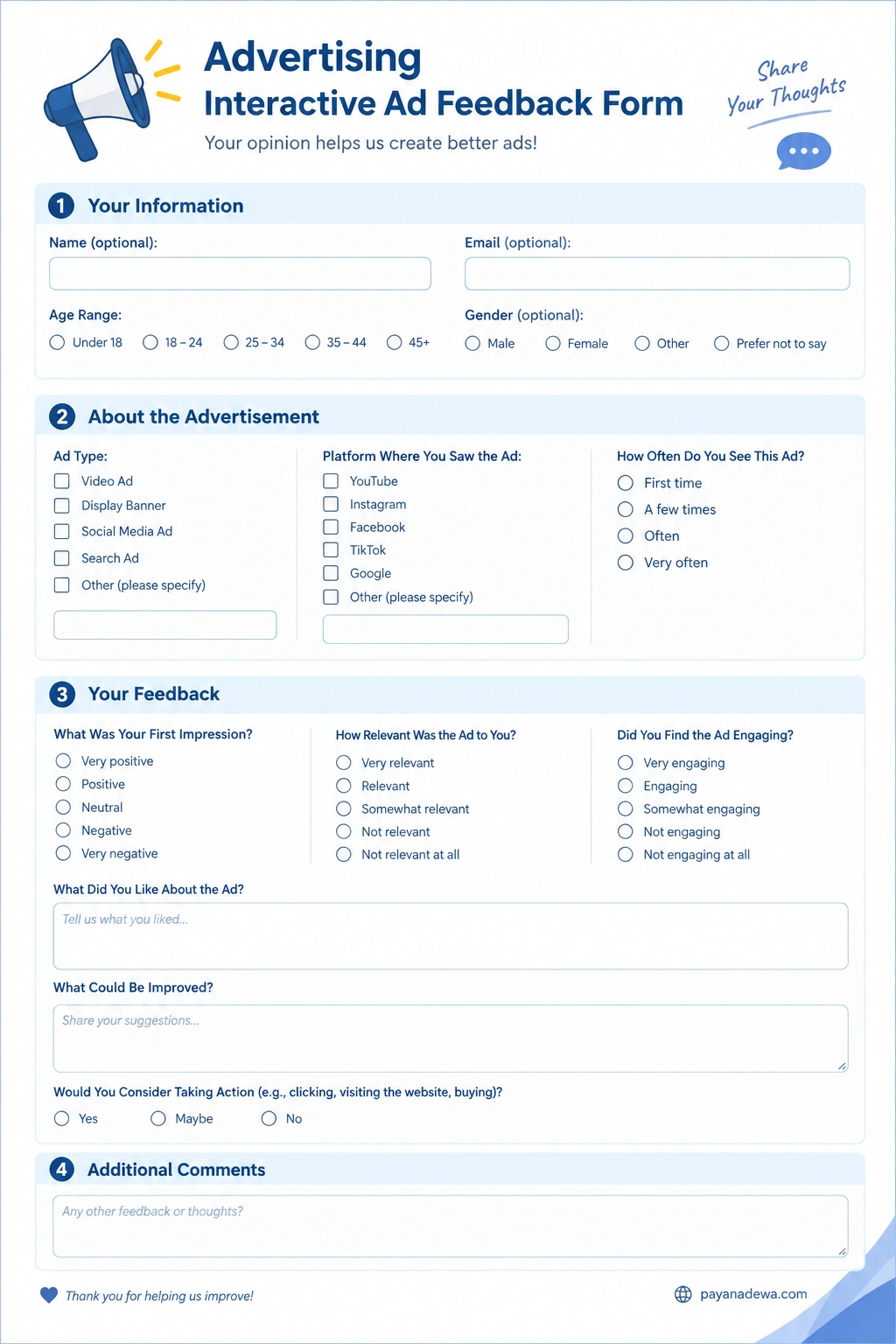
What Is an Advertising Interactive Ad Feedback Form?
An Advertising Interactive Ad Feedback Form is a digital or printable questionnaire that allows people to provide feedback after viewing an advertisement. It can include multiple-choice questions, rating scales, checkboxes, radio buttons, and open-ended text fields.
The goal is to understand the audience’s experience beyond basic advertising metrics. A campaign may receive many impressions, for example, but marketers may still want to know whether people understood the message, found the advertisement relevant, remembered the brand, or felt motivated to take action.
A well-designed feedback form turns those opinions into organized information that can be reviewed and compared across campaigns.
Why Use an Interactive Ad Feedback Form?
Traditional advertising analytics provide important information, but numerical metrics do not always explain why an audience reacted in a particular way. Direct feedback can provide additional context.
An interactive form can help marketers discover:
- Whether viewers understood the main advertising message
- How relevant the advertisement felt to the target audience
- Which creative elements attracted attention
- Whether the advertisement was memorable or engaging
- What viewers liked or disliked
- Whether the call to action was clear
- What could be improved in future advertisements
- Whether viewers would consider taking the desired action
These insights can support better creative decisions while helping advertising teams understand audience expectations more clearly.
Key Elements of an Advertising Feedback Form
A useful feedback form should be easy to understand and quick to complete. Asking too many questions can make the experience frustrating, while asking too few may produce information that is difficult to use.
1. Basic Respondent Information
Depending on the purpose of your research, you may ask for optional information such as age range, customer status, or general audience category. Personal information should only be collected when it serves a clear purpose.
For example, an organization could use broad age ranges instead of requesting an exact date of birth. Making optional fields clearly identifiable can also encourage more people to complete the form.
2. Advertisement Details
Ask respondents which type of advertisement they viewed and where they encountered it. Common options include video ads, display banners, social media ads, search advertisements, and sponsored content.
You can also ask whether the viewer saw the advertisement for the first time or had encountered it several times. This distinction can be useful when evaluating ad frequency and audience familiarity.
3. First Impression
The first impression question can help measure the immediate response to an advertisement. A simple scale such as very positive, positive, neutral, negative, and very negative can provide an easy way to collect consistent responses.
This question is particularly useful for testing different creative concepts before launching a larger advertising campaign.
4. Relevance
Ask whether the advertisement was relevant to the viewer. Relevance is important because an advertisement can be visually attractive while still failing to connect with the needs or interests of its intended audience.
A five-point relevance scale can provide more detailed information than a simple yes-or-no question.
5. Engagement
Interactive advertising feedback should also explore whether the advertisement captured attention. Questions can address the overall level of engagement or ask which specific element attracted attention.
Potential elements include the headline, imagery, video, music, product demonstration, storytelling, offer, or call to action.
Questions to Include in an Interactive Ad Feedback Form
The best questions depend on your advertising goals. However, the following question categories can create a strong foundation for most campaigns.
- What was your first impression of this advertisement?
- How relevant was this advertisement to you?
- Did you find the advertisement engaging?
- What did you like most about the advertisement?
- Was the main message easy to understand?
- Did you notice the brand or product being promoted?
- What could be improved?
- Did the advertisement make you interested in learning more?
- Would you consider clicking, visiting the website, contacting the company, or purchasing?
- Do you have any additional comments?
Combining closed-ended questions with one or two open-ended questions is often useful. Rating questions produce structured data, while written responses can reveal unexpected opinions or suggestions.
How to Make an Interactive Ad Feedback Form More Effective
Keep the Form Short
Respect the respondent’s time. A focused form with essential questions is generally easier to complete than a long questionnaire containing repetitive items.
Before publishing the form, remove questions that do not contribute to a specific research objective. Every question should have a clear reason for being included.
Use Simple and Neutral Language
Avoid complicated wording and questions that push respondents toward a particular answer. For example, instead of asking whether someone found your “excellent new advertisement” engaging, simply ask whether they found the advertisement engaging.
Neutral wording helps reduce unnecessary bias and makes the collected feedback more useful.
Use Consistent Rating Scales
When several questions use rating scales, keep the direction and number of response options consistent. A five-point scale can work well for measuring impressions, relevance, clarity, and engagement.
Consistency makes the results easier to compare and interpret.
Include Open-Ended Feedback
Multiple-choice answers are easy to analyze, but open-ended questions allow respondents to explain their opinions in their own words.
Questions such as “What did you like about the advertisement?” and “What could be improved?” can uncover details that predetermined answers may miss.
How to Use Feedback to Improve Advertising Campaigns
Collecting feedback is only the first step. The real value comes from analyzing the responses and turning useful observations into practical improvements.
Identify Common Patterns
Look for repeated comments and trends. If many respondents mention that the headline is confusing, for example, the creative team may want to test a clearer message.
Likewise, if respondents consistently mention a particular visual, benefit, or product feature, that element may deserve more attention in future creative versions.
Compare Different Ad Concepts
An interactive ad survey can be used during creative testing. Show different versions of an advertisement and ask the same core questions for each version.
This approach can help teams understand how audiences respond to different headlines, images, layouts, messages, or calls to action without relying exclusively on campaign performance data.
Combine Feedback With Advertising Analytics
Audience feedback should complement, rather than replace, standard advertising analytics. Metrics such as impressions, click-through rate, conversion rate, engagement, and view duration can provide behavioral information.
Survey responses can add another layer by explaining how people perceived the advertisement. Together, these sources can create a more complete picture of campaign performance.
Best Practices for Interactive Advertising Surveys
- Define the objective first: Know exactly what you want to learn before writing the questions.
- Ask one thing at a time: Avoid questions that combine multiple concepts.
- Make optional fields clear: Respondents should understand which information is required.
- Optimize for mobile: Many advertising audiences interact with campaigns through smartphones.
- Use readable layouts: Clear spacing, headings, and labels make forms easier to complete.
- Limit unnecessary personal data: Collect only information that is relevant to the research purpose.
- Test the form: Review every question and interaction before sharing it publicly.
- Review written feedback carefully: Open comments can reveal insights that numerical scores cannot.
Common Mistakes to Avoid
Even a simple feedback questionnaire can become less effective when it contains avoidable problems. One common mistake is asking too many questions. Respondents may abandon the form before completing it, leaving incomplete data.
Another problem is using overly promotional language inside questions. The purpose of feedback is to learn what the audience actually thinks, not to encourage a positive response.
It is also important to avoid ambiguous questions. A question such as “Was the advertisement useful and entertaining?” asks respondents to evaluate two different qualities at once. Separate questions can produce clearer results.
Finally, avoid collecting feedback without a plan for analyzing it. Decide in advance how responses will be categorized, reviewed, and used in future advertising decisions.
Printable and Digital Advertising Feedback Templates
An Advertising Interactive Ad Feedback Form template can be adapted for both digital and printed use. A printable version may be useful for events, focus groups, workshops, retail environments, or in-person research.
A digital version can include interactive fields, automated responses, conditional questions, progress indicators, and other features that make online participation easier.
The template should remain flexible enough to support different advertising formats. A social media campaign may require different questions from a television commercial, video advertisement, or display banner.
Final Tips for Creating Better Ad Feedback
Start with the most important information you need to learn from your audience. Keep the questionnaire focused, use straightforward language, and provide enough space for respondents to explain their opinions.
Most importantly, treat feedback as an ongoing part of the advertising process. Instead of collecting responses only after a campaign has ended, consider using audience feedback during concept development, creative testing, campaign optimization, and post-campaign analysis.
Conclusion
An Advertising Interactive Ad Feedback Form provides a practical way to understand how audiences perceive advertisements. By asking focused questions about first impressions, relevance, engagement, message clarity, preferences, and intended actions, marketers can collect useful qualitative and quantitative insights.
The most effective feedback forms are simple, neutral, accessible, and directly connected to a clear advertising objective. When audience responses are combined with campaign analytics, they can provide a stronger foundation for improving creative content and developing advertising experiences that communicate more clearly with the intended audience.
Whether you need a digital questionnaire, a printable advertising survey, or a customizable ad evaluation template, a well-structured feedback form can become a valuable part of the advertising research and optimization process.