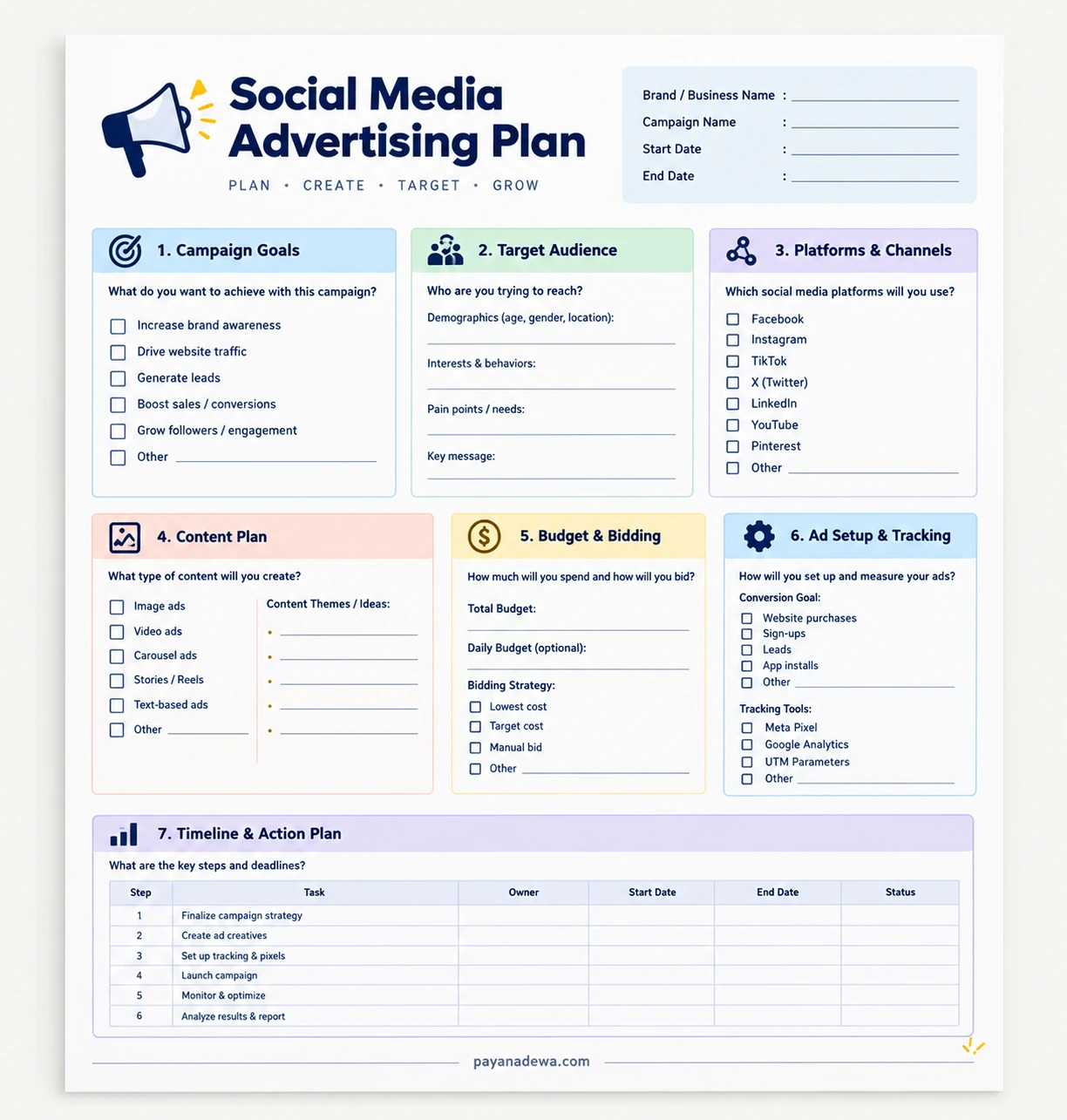
A well-structured Social Media Advertising Plan can turn social platforms from simple communication channels into powerful tools for reaching the right audience, generating leads, increasing website traffic, and driving sales. Without a clear plan, however, advertising campaigns can quickly become expensive experiments with unclear goals and inconsistent results.
A good social media advertising strategy gives every campaign a clear direction. It defines your objectives, target audience, platforms, creative approach, budget, tracking system, and optimization process before you spend money. This makes it easier to measure performance and improve your campaigns over time.
Whether you are promoting a small business, launching a product, building an online store, or managing advertising for clients, this guide will show you how to create a practical social media advertising plan from start to finish.
What Is a Social Media Advertising Plan?
A Social Media Advertising Plan is a documented strategy that explains how a business will use paid advertising on social media platforms to achieve specific marketing objectives.
It typically covers the campaign goal, target audience, advertising platforms, content formats, budget, bidding strategy, campaign schedule, key performance indicators, and tracking methods.
Instead of creating ads randomly, a social media advertising plan connects each advertising decision to a measurable business objective. For example, a campaign designed to generate leads will use different messaging, landing pages, and performance metrics than a campaign designed to increase brand awareness.
Why You Need a Social Media Advertising Strategy
Social media advertising can provide access to highly specific audiences, but successful targeting alone does not guarantee good results. Your campaign also needs a clear message, suitable creative assets, an appropriate budget, and a reliable measurement system.
A written advertising plan can help you:
- Set clear and measurable campaign objectives.
- Understand who you want to reach.
- Choose the most relevant social media platforms.
- Organize your advertising budget.
- Create consistent ad content and messaging.
- Track conversions and campaign performance.
- Identify opportunities for optimization.
- Reduce wasted advertising spend.
It also makes collaboration easier when multiple people are involved in content creation, advertising management, design, sales, or analytics.
How to Create a Social Media Advertising Plan
1. Define Your Advertising Goals
Start by deciding exactly what you want your advertising campaign to accomplish. Your goal should be specific enough to measure.
Common social media advertising goals include:
- Increasing brand awareness.
- Driving qualified traffic to a website.
- Generating leads.
- Increasing online sales.
- Promoting a new product or service.
- Increasing app installations.
- Growing registrations or sign-ups.
- Retargeting previous website visitors.
A useful approach is to connect your advertising objective to a measurable business outcome. For example, instead of simply saying “get more customers,” you could define a goal such as “generate 100 qualified leads during the campaign period.”
Clear objectives will also help you select the right campaign structure and performance indicators.
2. Identify Your Target Audience
The next step is to determine exactly who your advertising should reach. A broad audience may provide more impressions, but a clearly defined audience can make your messaging more relevant.
Consider factors such as:
- Age range and location.
- Interests and hobbies.
- Purchasing behavior.
- Professional or business characteristics.
- Problems and pain points.
- Previous interactions with your brand.
- Customer lifecycle stage.
It can also help to create separate audience groups. For example, an online store could have one audience for new prospects, another for website visitors, and another for previous customers.
Each group may need different messaging. Someone who has never heard of your brand may need educational content, while someone who has already visited your product page may respond better to a specific offer.
3. Choose the Right Social Media Platforms
You do not necessarily need to advertise on every social media platform. Focus on the channels where your target customers are most relevant and where your content can perform naturally.
Depending on your audience and campaign objectives, your social media advertising strategy may include platforms such as Facebook, Instagram, TikTok, LinkedIn, YouTube, Pinterest, or X.
Consider the strengths of each channel before allocating your budget. Visual products may benefit from highly visual platforms, while professional services may require a stronger focus on business-oriented audiences and professional content.
Start with a manageable number of platforms. Once you have reliable performance data, you can expand the campaign to additional channels.
4. Develop Your Ad Content Strategy
Creative content is one of the most visible parts of a paid social campaign. Your advertisements need to capture attention quickly while communicating a clear benefit.
Your social media ad content can include:
- Static image advertisements.
- Short-form video ads.
- Carousel advertisements.
- Stories and vertical videos.
- Product demonstrations.
- Customer testimonials.
- Educational content.
- Promotional offers.
Try different creative concepts rather than changing only small design elements. You can test different hooks, headlines, offers, images, videos, calls to action, and value propositions.
A strong advertisement usually answers three questions quickly: What is being offered? Why should the audience care? and What should they do next?
5. Set Your Advertising Budget
Your budget should be connected to your campaign objective, expected audience size, campaign duration, and available resources.
You can organize your advertising budget as a daily budget or as a total campaign budget. The best structure depends on the platform, campaign setup, and how much control you want over spending.
Before launching, determine:
- Total campaign budget.
- Daily spending limit, if applicable.
- Budget allocation by platform.
- Budget allocation by audience.
- Testing budget for new creatives.
- Budget reserved for scaling successful campaigns.
Avoid committing your entire budget to one untested creative concept. A controlled testing phase can provide useful performance data before you increase spending.
6. Select Your Key Performance Indicators
Tracking the right metrics is essential because high engagement does not always mean a campaign is producing strong business results.
Depending on your objective, useful metrics may include:
- Impressions: How many times your advertisement was displayed.
- Reach: How many unique users saw your advertisement.
- Click-through rate: The percentage of impressions that resulted in clicks.
- Cost per click: The average amount spent for each click.
- Cost per lead: The average advertising cost associated with generating a lead.
- Conversion rate: The percentage of users who completed a desired action.
- Return on ad spend: Revenue generated relative to advertising spend.
Choose metrics that reflect the actual purpose of the campaign. A brand awareness campaign and a sales campaign should not be evaluated using exactly the same criteria.
7. Set Up Tracking Before Launch
Do not wait until the campaign is running to think about measurement. Set up your tracking system before publishing your advertisements.
Depending on your website and advertising platforms, this may involve analytics tools, conversion tracking, advertising pixels, event tracking, and UTM parameters.
Make sure important actions are measurable. These could include purchases, form submissions, newsletter registrations, downloads, phone calls, or other valuable conversions.
Accurate tracking helps you understand which campaigns and advertisements are actually contributing to your business goals.
Build a Social Media Ad Testing Framework
Testing should be a regular part of your social media advertising strategy. Instead of making major changes based on assumptions, use campaign data to identify what deserves further testing.
Test One Important Variable at a Time
For example, you could compare two different headlines while keeping the audience, offer, and creative format similar. Later, you might test a different visual or call to action.
Useful testing areas include:
- Ad headlines.
- Primary text.
- Images and videos.
- Calls to action.
- Offers.
- Audience segments.
- Landing pages.
- Ad formats.
Give each test enough time and data to produce a meaningful signal. Avoid making frequent changes simply because of small daily fluctuations.
Optimize Your Campaign Based on Data
Launching an advertisement is only the beginning. A successful social media advertising plan should include a process for monitoring and optimization.
Review performance regularly and look for patterns. If an advertisement receives attention but few clicks, the message or offer may need improvement. If users click but do not convert, examine the landing page, offer, or conversion process.
You can also compare performance across audiences, platforms, creatives, and campaign objectives. Move resources toward areas that meet your predefined performance criteria while continuing to test new ideas.
Common Social Media Advertising Mistakes
Even a well-designed campaign can underperform when basic planning mistakes are overlooked.
- Starting without a clear objective: Without a defined goal, it becomes difficult to measure success.
- Targeting everyone: An audience that is too broad can make your messaging less relevant.
- Using one creative repeatedly: Audiences can become less responsive when they repeatedly see the same advertisement.
- Ignoring conversion tracking: Without reliable data, optimization becomes guesswork.
- Changing campaigns too frequently: Constant changes can make performance difficult to evaluate.
- Focusing only on clicks: Traffic is useful, but business outcomes often matter more than clicks alone.
- Sending users to a poor landing page: A strong advertisement cannot fully compensate for a confusing or slow destination page.
Social Media Advertising Plan Checklist
Before launching your next campaign, use this checklist to confirm that the important pieces are ready:
- Campaign objective is clearly defined.
- Target audience has been identified.
- Advertising platforms have been selected.
- Budget and campaign duration are established.
- Ad creative and copy are prepared.
- Call to action is clear.
- Landing page has been reviewed.
- Conversion tracking is configured.
- Key performance indicators are defined.
- Testing ideas have been documented.
- Optimization schedule has been established.
Final Thoughts on Creating a Social Media Advertising Plan
A strong Social Media Advertising Plan gives your paid campaigns structure, direction, and measurable objectives. Rather than relying on random advertisements or constantly changing tactics, you can build a repeatable process based on audience research, creative testing, budget management, and performance data.
The most useful plan is not necessarily the most complicated one. Start with a clear objective, understand your audience, choose appropriate platforms, create relevant advertisements, track meaningful results, and optimize based on evidence.
As you collect more campaign data, your advertising process can become more efficient and predictable. Use your plan as a working document that evolves with your audience, products, market, and performance insights.