Whether you are studying international commerce, managing an import-export business, or negotiating with a new business partner, understanding how a trade agreement works can help you identify important rights and obligations before a transaction begins. A well-structured agreement can reduce misunderstandings, support long-term cooperation, and provide a clear process for handling problems.
This guide explains the meaning of a trade agreement, the major types, the essential elements to include, and practical considerations for creating or reviewing one.
What Is a Trade Agreement?
A trade agreement is a written or otherwise formally established arrangement that sets out the terms under which trade will take place. Depending on its purpose, it may cover the sale of products, provision of services, distribution rights, international shipments, or broader commercial cooperation.
At the business level, a trade agreement may be signed by an importer and exporter, manufacturer and distributor, supplier and buyer, or two companies entering a strategic commercial relationship. At the government level, trade agreements can establish rules between countries and may address tariffs, quotas, customs procedures, intellectual property, investment, and market access.
The central purpose is to make expectations clear. Instead of relying only on informal discussions, the parties can document what they have agreed to do, when they must do it, and what happens if something goes wrong.
Why Are Trade Agreements Important?
Trade can involve multiple financial, operational, and legal risks. A detailed trade agreement helps the parties understand their responsibilities before goods, services, or money change hands.
Common benefits include:
- Clear responsibilities: Each party knows what it must provide and when.
- Greater predictability: Prices, delivery conditions, payment terms, and other expectations can be documented.
- Risk management: The agreement can address delays, defects, non-payment, and other potential problems.
- Better business relationships: Clear terms can reduce misunderstandings between trading partners.
- Dispute management: The parties can agree on how disagreements will be handled.
- Regulatory clarity: International transactions can identify applicable customs, trade, and compliance requirements.
Types of Trade Agreements
Trade agreements can take different forms depending on who signs them and what they are intended to accomplish. Understanding the differences is useful when selecting the right structure for a commercial relationship.
1. Bilateral Trade Agreement
A bilateral trade agreement involves two parties. In international trade, this commonly means two countries agreeing on specific rules for commerce between them. In a business context, it can also refer to an agreement between two companies.
For example, two businesses may establish agreed pricing, delivery schedules, product specifications, payment methods, and procedures for resolving disputes.
2. Multilateral Trade Agreement
A multilateral trade agreement involves three or more parties. These agreements are often broader and can establish common trading rules across multiple countries or organizations.
Because more parties are involved, negotiations can be more complex. However, a common framework can make it easier for participants to conduct trade under consistent rules.
3. Free Trade Agreement
A free trade agreement, often called an FTA, is designed to reduce or remove certain barriers to trade between participating countries. Depending on the agreement, this may involve reducing tariffs, improving market access, simplifying customs procedures, or establishing rules for specific industries.
4. Preferential Trade Agreement
A preferential trade agreement gives participating parties more favorable trading conditions for certain goods or services. The benefits may include reduced tariffs or other preferences compared with standard trading conditions.
5. Regional Trade Agreement
A regional trade agreement generally involves countries within a particular geographic region. It can establish shared rules that make trade between participating economies more predictable and efficient.
Key Elements of a Trade Agreement
A strong trade agreement should be specific enough to reduce ambiguity while remaining practical for the parties involved. The exact contents depend on the transaction, industry, and applicable laws.
Parties and Scope
The agreement should clearly identify every party involved. Legal names, business addresses, registration details, and authorized representatives may be included where appropriate.
The scope should also explain what the agreement covers. This could include specific products, services, territories, customers, or commercial activities.
Products or Services
Product descriptions should be sufficiently detailed to avoid confusion. Important information may include product names, specifications, quantities, quality standards, packaging requirements, and applicable certifications.
For services, the agreement can describe the scope of work, deliverables, performance standards, deadlines, and acceptance requirements.
Pricing and Payment Terms
The financial terms should be clear. A trade agreement may specify the price, currency, taxes, payment schedule, deposits, late-payment consequences, and accepted payment methods.
For international transactions, the parties should also consider currency fluctuations, banking requirements, and transaction costs.
Delivery and Shipping Terms
Delivery provisions explain how and when goods will be transported. They may identify delivery locations, shipping responsibilities, insurance requirements, documentation, and the point at which responsibility for the goods transfers from one party to another.
International transactions may also use standardized commercial terms, such as Incoterms, where appropriate. The selected term should be stated accurately and consistently with the transaction.
Quality and Compliance Requirements
The agreement can establish product quality standards, inspection procedures, warranties, regulatory requirements, labeling obligations, and documentation requirements.
This section is particularly important when products cross borders because different markets can have different technical, safety, labeling, and customs requirements.
Duration and Termination
A trade agreement should explain when it becomes effective and how long it remains in force. It should also describe circumstances that allow either party to terminate the relationship.
Termination provisions may address material breaches, prolonged delays, insolvency, regulatory changes, or termination without cause when permitted by the agreement.
Dispute Resolution
Even carefully negotiated agreements can lead to disagreements. A dispute resolution clause can establish a process for resolving conflicts through negotiation, mediation, arbitration, litigation, or another agreed mechanism.
The agreement should also identify the applicable law and, where relevant, the jurisdiction or location for formal proceedings.
How to Create a Trade Agreement
Creating an effective trade agreement does not simply mean filling in names and prices. The parties should first understand the commercial relationship and identify the risks that need to be addressed.
Step 1: Identify the Parties
Start by confirming the correct legal identities of all parties. Make sure the people signing the agreement have the appropriate authority to do so.
Step 2: Define the Commercial Purpose
Explain what the parties intend to accomplish. Identify the products, services, territories, and business activities covered by the agreement.
Step 3: Establish Commercial Terms
Document pricing, quantities, payment schedules, delivery requirements, warranties, quality standards, and other operational details.
Step 4: Address Potential Risks
Consider what could go wrong during the relationship. Think about delayed shipments, defective products, non-payment, regulatory changes, unexpected events, confidentiality issues, and intellectual property concerns.
Step 5: Define Dispute and Termination Procedures
Agree on what happens when a party fails to meet its obligations. A clear process can make disputes easier to manage and may reduce unnecessary costs.
Step 6: Review the Agreement Before Signing
Each party should carefully review the document before signing. For significant or international transactions, obtaining advice from a qualified legal or trade professional can help identify requirements that may not be obvious from a standard template.
Practical Tips for Reviewing a Trade Agreement
Before signing a trade agreement, check the document carefully rather than focusing only on the price. Small details can have a significant effect on the relationship.
- Confirm that all party names and business details are correct.
- Check whether product or service descriptions are specific enough.
- Review payment deadlines and consequences for late payment.
- Confirm who is responsible for shipping, insurance, customs, and taxes.
- Check quality standards, inspection rights, warranties, and return procedures.
- Review confidentiality and intellectual property provisions where relevant.
- Understand the agreement’s governing law and dispute resolution process.
- Check the effective date, renewal provisions, and termination requirements.
- Keep signed copies and supporting documents in an organized location.
Trade Agreements in International Business
International trade can involve additional layers of complexity because transactions may cross multiple legal and regulatory systems. A trade agreement should therefore be considered alongside customs rules, import and export requirements, sanctions and restrictions, taxation, product regulations, and other applicable laws.
Businesses should also verify whether a particular trade agreement provides preferential treatment for the products they are trading. Eligibility can depend on factors such as product classification, origin requirements, documentation, and the specific rules of the relevant agreement.
For this reason, businesses should not assume that an agreement automatically eliminates every trade barrier. The actual benefits and obligations depend on its wording and the rules that apply to the transaction.
Common Mistakes to Avoid
A trade agreement can become difficult to enforce or manage when important terms are vague or incomplete. Several common mistakes are worth avoiding.
- Using unclear language: Ambiguous terms can lead to different interpretations.
- Leaving responsibilities undefined: Shipping, insurance, taxes, or customs responsibilities should not be assumed.
- Ignoring local requirements: International transactions may be subject to different laws and regulations.
- Overlooking termination: Parties should know how the relationship can end and what happens afterward.
- Failing to update the agreement: Long-term commercial relationships may require amendments as prices, regulations, products, or business conditions change.
Trade Agreement Template: What Should It Include?
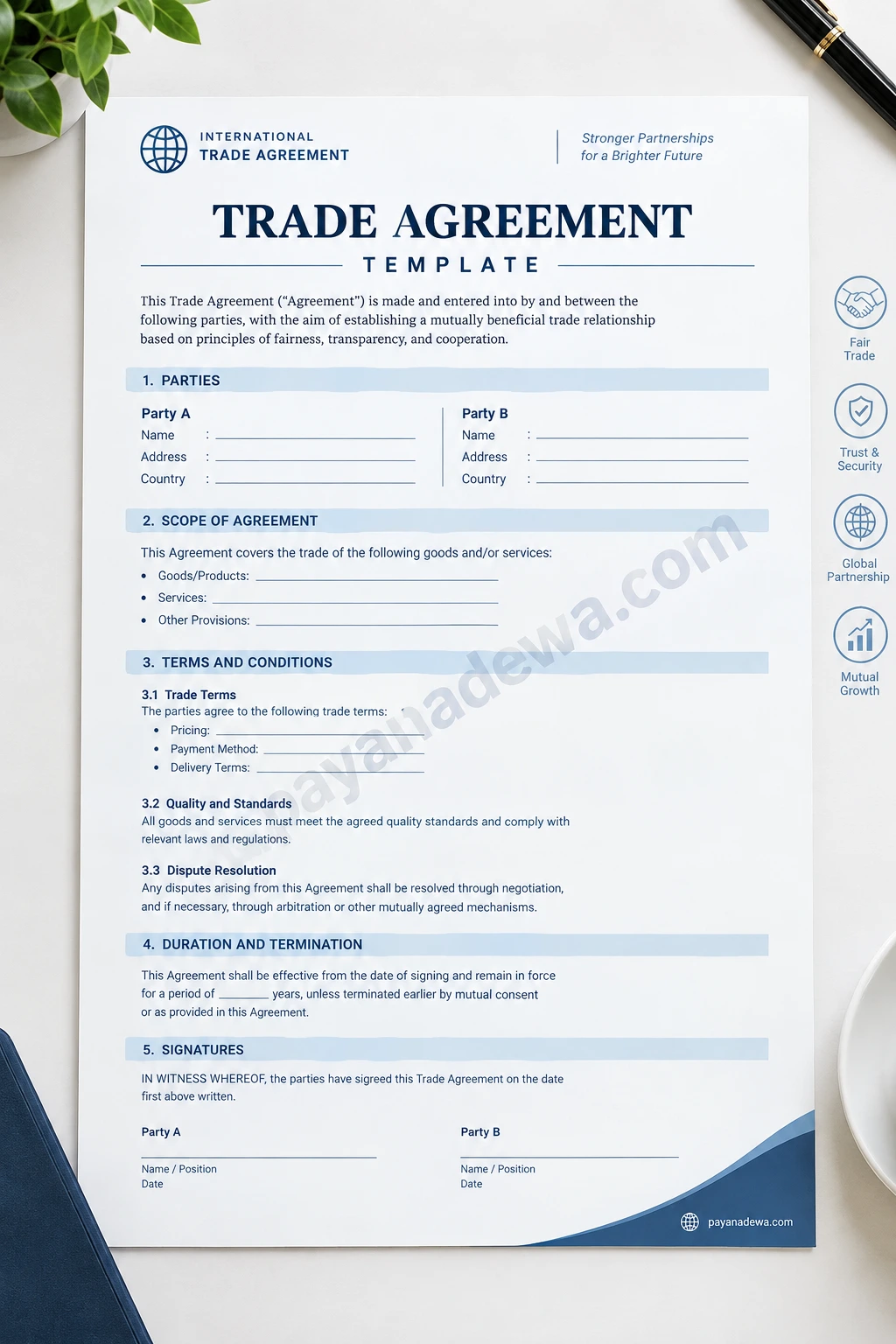
A basic trade agreement template can provide a useful starting point for organizing important information. However, a template should be adapted to the actual transaction rather than treated as a complete legal document for every situation.
A practical template may include sections for:
- Names and details of the parties
- Purpose and scope of the agreement
- Products or services
- Pricing and payment terms
- Delivery and shipping conditions
- Quality and compliance standards
- Confidentiality and intellectual property
- Warranties and liabilities
- Dispute resolution
- Duration, renewal, and termination
- Governing law
- Signatures and dates
The template shown above is designed as a clean visual reference for these core sections. It can help businesses organize the information that may need to be discussed when preparing a commercial agreement.
Final Thoughts
A trade agreement provides a structured framework for commercial cooperation by defining expectations, responsibilities, financial terms, delivery requirements, and procedures for resolving problems. Whether it is used between businesses or as part of international commerce, clarity is one of its most important qualities.
Before signing an agreement, take time to understand every major provision and confirm that the terms match the actual business arrangement. For complex, high-value, or cross-border transactions, professional legal and trade advice can be valuable. A carefully prepared agreement can help establish clearer expectations and create a stronger foundation for a long-term trading relationship.