A Security Agreement is an important legal document used to establish the rights and responsibilities of parties when certain assets, property, information, or other interests need contractual protection. It can help clearly define what is being protected, what each party must do, and what may happen if one party fails to meet its obligations.
Whether you are preparing a security agreement for a business transaction, financing arrangement, intellectual property, confidential information, or another contractual relationship, having a clear structure is essential. A well-organized agreement can reduce misunderstandings and provide a written record of the parties’ expectations.
This guide explains what a Security Agreement is, what it commonly contains, how to prepare one, and what to review before signing. It also provides practical guidance for using a template as a starting point.
What Is a Security Agreement?
A Security Agreement is a written contract that establishes specific security-related rights, obligations, or protections between two or more parties. Depending on the transaction and applicable law, the term may refer to an agreement granting a security interest in collateral or a broader contractual document dealing with the protection of assets, information, or business interests.
In secured financing, for example, a security agreement may identify collateral that secures a borrower’s obligations to a lender. The agreement can describe the property involved and establish conditions concerning possession, use, maintenance, default, and enforcement.
Because the meaning and legal effect of a Security Agreement can vary by jurisdiction and transaction type, the document should be drafted around the specific relationship and purpose involved.
Why Is a Security Agreement Important?
A properly prepared agreement provides a clear written framework for the parties. Instead of relying on informal promises or assumptions, the document records important terms in one place.
- Defines responsibilities: Each party can understand its contractual duties.
- Identifies protected interests: The agreement can describe assets, collateral, information, or other protected matters.
- Reduces misunderstandings: Clear language helps establish what the parties agreed to.
- Documents consent: Signatures demonstrate that the parties accepted the stated terms.
- Supports risk management: Specific obligations can help parties manage contractual and financial risks.
- Provides a reference point: The signed document can be consulted if questions arise during the relationship.
For more complex transactions, additional documents, filings, notices, or registrations may also be required. A Security Agreement should therefore be considered part of the overall legal structure rather than automatically treated as the only document necessary.
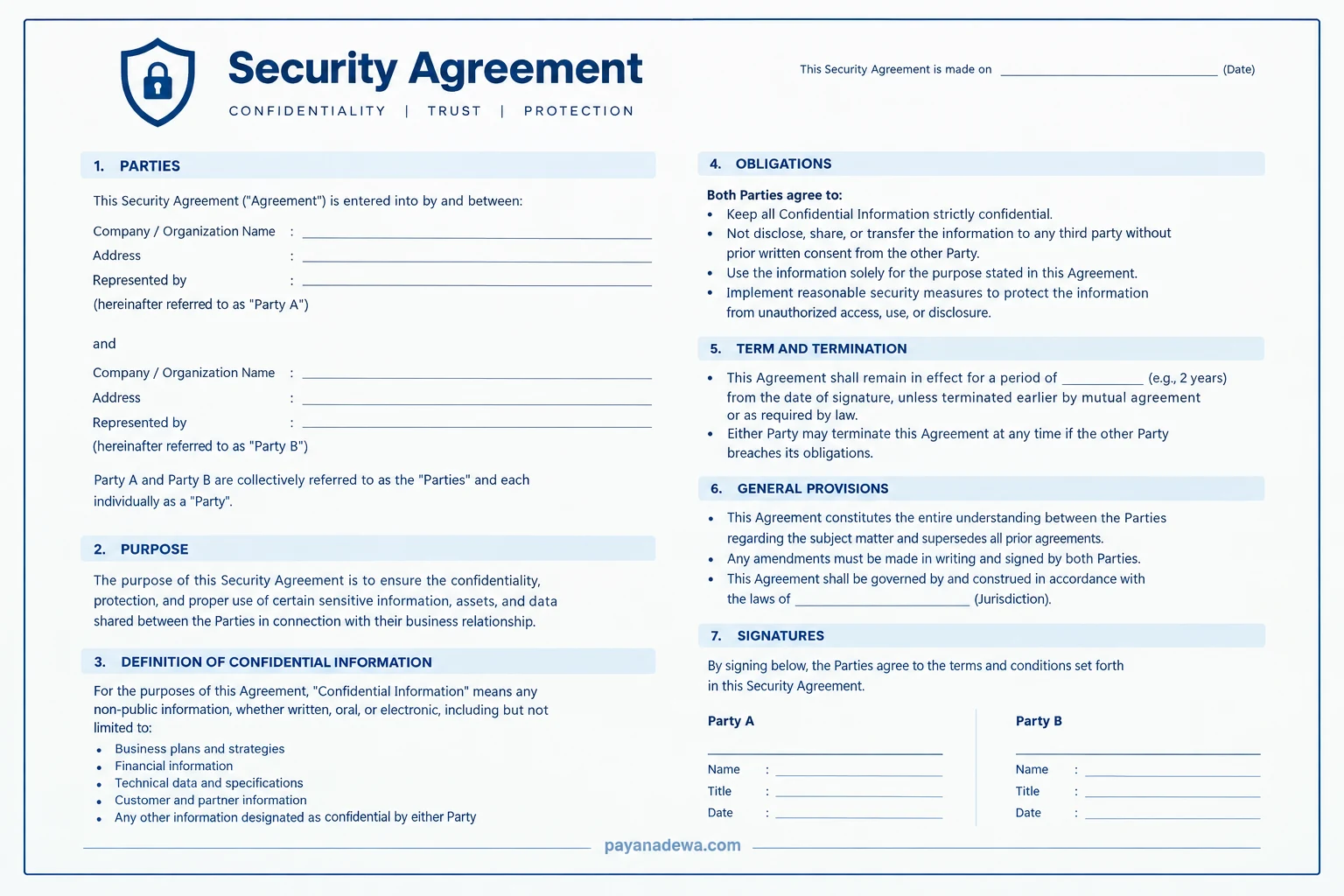
Security Agreement Template
The following template illustration shows the type of information that may commonly appear in a structured agreement. It is designed as a practical starting point rather than a substitute for legal advice or jurisdiction-specific drafting.
Key Elements of a Security Agreement
The exact contents of a Security Agreement depend on its purpose. However, several sections are commonly useful when creating a clear and comprehensive document.
1. Identification of the Parties
Start by identifying every party involved. Include the appropriate legal name, business name where applicable, address, and the role of each party in the transaction.
Accurate identification is important because the agreement should make it clear who receives rights and who assumes obligations. If a business is involved, verify the entity’s legal name rather than relying only on a brand or trading name.
2. Purpose of the Agreement
Explain why the agreement is being created. A concise purpose clause can provide useful context and help define the relationship between the parties.
For example, the agreement may relate to securing repayment of an obligation, protecting specified assets, governing access to sensitive information, or establishing security responsibilities within a business relationship.
3. Description of the Protected Property or Collateral
When the Security Agreement concerns collateral, the description should be sufficiently clear to identify what property is subject to the agreement. Depending on the transaction, this could include equipment, inventory, accounts, financial assets, intellectual property, or other property.
Vague descriptions may create uncertainty. The appropriate level of detail depends on the nature of the collateral and the requirements of the governing law.
4. Security Interest and Related Rights
Where the agreement is being used for secured financing, it may specify the security interest being granted and the obligations it secures. The document should clearly connect the collateral with the underlying obligation.
The terminology and legal requirements can differ significantly between jurisdictions. For this reason, parties should confirm the applicable rules before relying on a generic Security Agreement form.
5. Obligations of the Parties
A strong agreement explains what each party must do. Depending on the transaction, obligations may address payment, maintenance of collateral, confidentiality, security controls, insurance, reporting, access, record keeping, or restrictions on transferring property.
- Maintain and protect relevant assets.
- Provide required information or documentation.
- Comply with applicable contractual restrictions.
- Notify the other party of specified events.
- Obtain consent before taking actions restricted by the agreement.
6. Representations and Warranties
Some agreements include statements in which each party confirms particular facts or circumstances. These provisions may address authority to enter into the contract, ownership of property, absence of conflicting obligations, or other transaction-specific matters.
Representations and warranties should be tailored carefully because their legal effect can be significant.
7. Term and Termination
The agreement should explain when it becomes effective and, where relevant, when it ends. It may also specify circumstances that permit termination or trigger additional rights.
Termination provisions should be consistent with the underlying transaction. Ending a contractual relationship does not necessarily eliminate obligations that are intended to survive termination.
8. Default and Remedies
For secured transactions, the agreement may describe events of default and the rights available after a default occurs. These provisions can be particularly important because enforcement rights may be regulated by applicable law.
Rather than copying generic enforcement language, parties should ensure that the provisions match the transaction and comply with the law governing the agreement.
9. Signatures and Dates
Finally, provide appropriate signature blocks for the parties. Include names, titles where relevant, signatures, and dates.
Before signing, each party should confirm that the final version contains the agreed terms and that all referenced schedules or attachments are included.
How to Create a Security Agreement
Creating an effective agreement does not simply mean filling in blank spaces on a template. The document should reflect the actual transaction.
Step 1: Define the Transaction
Identify what the parties are trying to accomplish. Determine whether the agreement concerns collateral, financing, confidential information, assets, security responsibilities, or another contractual interest.
Step 2: Identify the Parties and Assets
Collect accurate legal names and relevant identifying information. If property or collateral is involved, prepare a sufficiently precise description of the relevant assets.
Step 3: Establish the Rights and Responsibilities
Write down what each party is required or permitted to do. Address important operational details instead of leaving major expectations implied.
Step 4: Review Default and Termination Provisions
Consider what happens if a party breaches the agreement. Define applicable notice requirements, cure periods, termination rights, and other remedies where appropriate and legally permitted.
Step 5: Check Governing Law
Specify the governing law and jurisdiction when appropriate. However, selecting a jurisdiction in a contract does not necessarily override mandatory legal requirements that apply to the transaction.
Step 6: Review Before Signing
Check names, dates, amounts, asset descriptions, attachments, signature blocks, and cross-references. Errors in these details can cause unnecessary confusion later.
Common Mistakes to Avoid
Several avoidable problems can weaken the clarity of a Security Agreement.
- Using vague descriptions: Important assets or obligations should be identified clearly.
- Leaving blanks unresolved: Do not sign a document containing unexplained placeholders.
- Ignoring applicable law: A generic online template may not satisfy local legal requirements.
- Overlooking related documents: A Security Agreement may need to work together with loan agreements, guarantees, schedules, notices, or filings.
- Failing to update the agreement: Changes to parties, collateral, obligations, or the underlying transaction may require amendments.
- Using inconsistent terminology: Important terms should be defined and used consistently throughout the document.
Tips for Using a Security Agreement Template
A template can save time by providing a logical structure, but it should be treated as a starting point. Begin by identifying which provisions actually apply to your transaction.
Remove sections that are irrelevant rather than leaving contradictory or unnecessary language. At the same time, add transaction-specific provisions where the circumstances require them.
Pay particular attention to the description of collateral, secured obligations, default provisions, governing law, notices, and signature requirements. These details can have practical consequences beyond the appearance of the document.
When Should You Seek Legal Review?
Professional legal review can be especially useful when significant financial interests, valuable collateral, intellectual property, multiple parties, cross-border transactions, or complicated enforcement provisions are involved.
A lawyer can help determine whether the agreement is suitable for the applicable jurisdiction and whether additional documents, registrations, notices, or filings are required.
Even when using a professionally designed template, legal review may be appropriate before signing a document that creates substantial contractual or financial obligations.
Security Agreement Checklist
Before finalizing the document, use this checklist as a practical review tool:
- Confirm the full legal names of all parties.
- Confirm addresses and contact information.
- Define the purpose of the agreement.
- Identify the secured obligations or protected interests.
- Describe collateral or protected property accurately, if applicable.
- Review each party’s obligations.
- Check representations and warranties.
- Review default and remedy provisions.
- Confirm the term and termination provisions.
- Check governing law and jurisdiction clauses.
- Attach referenced schedules and supporting documents.
- Complete all signature and date fields.
- Obtain professional legal review when appropriate.
Frequently Asked Questions About Security Agreements
Is a Security Agreement legally binding?
A properly executed contract can create legally enforceable obligations, but enforceability depends on factors such as the agreement’s terms, applicable law, execution requirements, and circumstances surrounding the transaction. A template alone does not guarantee enforceability.
Can I use a Security Agreement template?
Yes, a template can provide a useful structure and help organize important provisions. However, it should be customized to the transaction and reviewed for applicable legal requirements before it is relied upon.
What is the difference between a Security Agreement and a loan agreement?
A loan agreement generally establishes the terms of borrowing, such as the amount, interest, repayment schedule, and borrower obligations. A Security Agreement may establish rights in collateral that secure those obligations. The two documents can therefore serve different but related purposes.
Does every Security Agreement involve collateral?
No. The meaning of the term can depend on the context in which it is used. In secured lending, collateral is typically central to the agreement, while other security-related contracts may focus on different protected interests or obligations.
Conclusion
A Security Agreement provides a structured way to document important rights, responsibilities, and protections between parties. Whether it is used in a secured financing transaction or another contractual relationship, clarity is one of the most important characteristics of an effective document.
A template can make the drafting process easier by organizing common sections such as the parties, purpose, protected property, obligations, default provisions, termination, governing law, and signatures. However, the final agreement should always reflect the specific transaction and applicable legal requirements.
Use the template as a starting point, verify every important detail, and consider professional legal review when the agreement involves substantial assets, complex obligations, or significant legal consequences.