A SaaS Agreement is a legal contract that defines how a software-as-a-service provider delivers an online application to a customer. It explains important matters such as access rights, subscription fees, user responsibilities, data protection, confidentiality, service limitations, termination, and liability.
Because SaaS products are delivered online rather than installed permanently on a customer’s computer, the agreement needs to address more than a traditional software license. A well-structured SaaS contract helps both parties understand their rights and responsibilities before the service begins.
Whether you operate a SaaS startup, purchase cloud software for your business, or need a starting point for a software service contract, understanding the essential provisions can make the drafting process much easier.
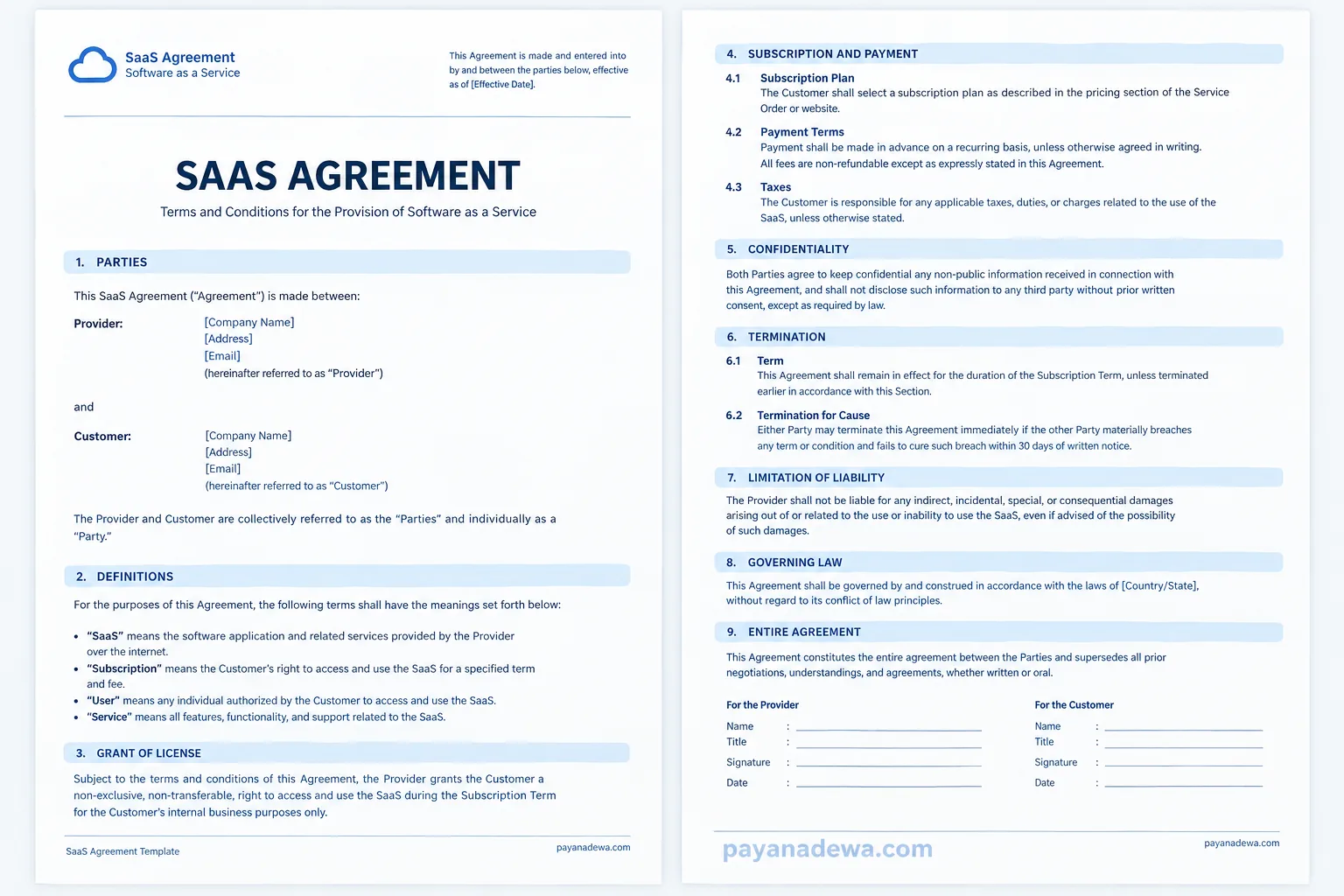
What Is a SaaS Agreement?
A SaaS Agreement is a contract between a software provider and a customer that governs access to and use of an online software service. SaaS stands for “Software as a Service,” meaning the provider typically hosts and maintains the application while customers access it through the internet.
Unlike a traditional software license, the customer usually does not purchase ownership of the underlying software. Instead, the customer receives a limited right to use the service during a specified subscription period.
A typical SaaS contract may cover:
- Software access and permitted use
- Subscription plans and pricing
- Payment and renewal terms
- Customer and user responsibilities
- Data handling and security
- Confidentiality obligations
- Intellectual property rights
- Service availability and support
- Termination and account cancellation
- Limitation of liability
- Governing law and dispute provisions
Why Is a SaaS Agreement Important?
A SaaS agreement provides a clear framework for the relationship between a service provider and its customer. Without written terms, misunderstandings can arise over pricing, access, data ownership, acceptable use, cancellation, or responsibility for losses.
For SaaS businesses, a clear contract can help establish consistent commercial terms across customers. For customers, it provides an opportunity to understand what they are paying for and what obligations apply to their use of the platform.
Benefits for SaaS Providers
- Defines the scope of the service and customer access.
- Explains subscription fees and payment requirements.
- Protects intellectual property and proprietary information.
- Sets rules for acceptable software use.
- Establishes procedures for suspension or termination.
- Clarifies limitations of liability and other contractual protections.
Benefits for Customers
- Clarifies what software and features are included.
- Explains subscription pricing and renewal conditions.
- Identifies responsibilities concerning users and account security.
- Provides information about data handling and confidentiality.
- Explains how cancellation and termination work.
Key Sections of a SaaS Agreement
A strong SaaS contract should be organized in a way that makes important commercial and legal terms easy to locate. The exact provisions depend on the service, industry, jurisdiction, and relationship between the parties.
1. Parties and Effective Date
The agreement should identify the software provider and customer. It should also state when the contract becomes effective. For companies, the legal business name and relevant address should generally be included.
2. Definitions
Definitions help prevent ambiguity. Common terms include “SaaS,” “Service,” “Subscription Term,” “User,” “Customer Data,” and “Confidential Information.” Clearly defined terms can make the rest of the agreement easier to understand.
3. License or Access Rights
A SaaS provider generally grants the customer a limited right to access and use the service. The agreement should explain who may use the platform, whether access can be transferred, and whether use is limited to internal business purposes.
It is also useful to identify prohibited activities. Depending on the service, these may include unauthorized access, reverse engineering, unlawful activity, abuse of system resources, or attempts to interfere with the platform.
4. Subscription and Payment Terms
The payment section explains how much the customer must pay and when payment is due. It can also address recurring billing, taxes, upgrades, downgrades, refunds, late payments, and automatic renewal.
For subscription-based services, the agreement should make the billing cycle clear. For example, the parties may agree to monthly, annual, or another defined subscription period.
5. Data Protection and Security
Data handling is one of the most important parts of a modern SaaS contract. Customers may provide personal information, business records, documents, financial information, or other sensitive data through the platform.
The agreement should explain the provider’s responsibilities regarding customer data and identify any applicable privacy or data-processing terms. Depending on the service and jurisdiction, a separate data processing agreement may also be appropriate.
6. Confidentiality
A confidentiality clause can protect non-public business, technical, financial, and commercial information exchanged between the parties.
Well-drafted confidentiality provisions commonly explain what qualifies as confidential information, permitted disclosures, exceptions, and how confidential information must be handled.
7. Intellectual Property
The SaaS provider generally retains ownership of its software, platform, trademarks, documentation, and related intellectual property unless the parties agree otherwise.
The agreement should distinguish between the provider’s intellectual property and customer data. This distinction helps both parties understand what they own and what rights are being granted.
8. Service Availability and Support
Some SaaS providers include service-level commitments covering uptime, support response times, maintenance, or service credits. These terms are particularly important for business-critical applications.
If the provider offers a separate Service Level Agreement, the SaaS contract can reference that document and explain how the documents interact.
9. Termination
The termination section explains when and how either party can end the relationship. It may address termination for convenience, material breach, non-payment, insolvency, or other specified circumstances.
The contract should also explain what happens after termination. For example, customers may need a defined period to retrieve their data, while user access may be disabled after the subscription ends.
10. Limitation of Liability
Limitation of liability provisions define the extent to which each party may be responsible for certain losses. SaaS agreements often address direct and indirect damages, liability caps, and specific exceptions.
Because enforceability can vary by jurisdiction and circumstances, liability provisions should be reviewed carefully when preparing a contract for actual use.
11. Governing Law
A governing law clause identifies the legal system that will generally apply to interpretation of the agreement. The contract may also include provisions concerning jurisdiction, venue, arbitration, mediation, or other dispute-resolution procedures.
What Should You Check Before Using a SaaS Agreement Template?
A template is useful as a starting point, but it should be adapted to the actual SaaS product and business relationship. Before using a contract, review the following areas:
- Business details: Confirm that all legal names and addresses are correct.
- Service description: Make sure the agreement accurately describes the software.
- Pricing: Verify subscription fees, billing periods, taxes, and renewal terms.
- Users: Define who can access the service and under what conditions.
- Customer data: Explain relevant data handling responsibilities.
- Security: Address appropriate security commitments for the service.
- Termination: Confirm cancellation rights and post-termination procedures.
- Jurisdiction: Use appropriate governing-law and dispute provisions.
Practical Tips for Creating a SaaS Contract
Keep the Agreement Specific
Avoid vague descriptions of the service. Identify the platform, subscription scope, included features, and relevant service documents where appropriate.
Separate Commercial and Technical Terms When Useful
A master SaaS agreement can contain the primary legal terms while order forms, pricing schedules, service-level agreements, or data-processing agreements contain more detailed information.
Make Renewal Terms Easy to Understand
Customers should be able to determine when the subscription renews, how renewal works, and what happens if they do not want to continue the service.
Review Data Responsibilities Carefully
Determine whether the provider processes personal data and identify the privacy requirements that may apply. The contract should align with the provider’s actual data practices.
Use Plain and Consistent Language
Clear drafting reduces confusion. Use defined terms consistently and organize complex provisions with headings and short paragraphs. This makes the agreement easier for business users to review.
SaaS Agreement vs. Software License Agreement
A SaaS agreement and a traditional software license agreement can both provide rights to use software, but their structures are often different.
A traditional software license may involve software installed on the customer’s infrastructure. A SaaS model generally involves provider-hosted software that customers access remotely through an internet connection.
As a result, SaaS contracts commonly place greater emphasis on subscriptions, hosting, data processing, service availability, online access, maintenance, support, and account management.
Is a SaaS Agreement Legally Binding?
A SaaS agreement can form a legally binding contract when the applicable requirements for contract formation are satisfied. However, the enforceability of particular provisions depends on factors such as jurisdiction, applicable law, contract language, and the circumstances of the transaction.
For that reason, a template should not automatically be treated as a substitute for legal advice. Businesses with significant commercial, regulatory, privacy, or intellectual property concerns should consider having the agreement reviewed by a qualified legal professional in the relevant jurisdiction.
Conclusion
A well-prepared SaaS Agreement gives software providers and customers a clear framework for using an online service. It can address access rights, subscription payments, data protection, confidentiality, intellectual property, support, termination, liability, and governing law.
Using a SaaS Agreement template can save time during the drafting process, especially when establishing a consistent starting structure. However, the document should be customized to match the actual software service, business model, customer relationship, and applicable legal requirements.
The most effective approach is to keep the contract clear, specific, and aligned with the way the SaaS product actually operates. When the agreement reflects real business practices, both providers and customers can better understand their responsibilities from the beginning.