A retainer agreement is a written contract between a client and a professional service provider. It creates an ongoing working relationship. The client pays a recurring fee in exchange for agreed services, support, or availability.
Many professionals use retainer agreements. These include lawyers, consultants, accountants, marketing agencies, designers, developers, and freelancers. A clear agreement helps both sides understand their responsibilities.
It also makes payments, services, deadlines, and communication easier to manage. Therefore, a well-written retainer contract can reduce confusion and prevent many common misunderstandings.
What Is a Retainer Agreement?
A retainer agreement is a contract for ongoing professional services. It explains what the provider will do for the client. It also explains how much the client will pay and when payment is due.
Unlike a one-time service contract, a retainer agreement usually covers an ongoing relationship. The agreement may last for one month, several months, or one year.
For example, a business may hire a marketing consultant for a monthly fee. The consultant may provide strategy sessions, reports, and marketing advice each month.
The exact terms depend on the type of service. However, every agreement should clearly explain the main responsibilities of both parties.
How Does a Retainer Agreement Work?
First, the client and provider discuss the services they need. Next, they agree on the price, schedule, and contract terms. They then put those terms into a written agreement.
The client normally pays the retainer fee on a recurring schedule. In return, the provider delivers the agreed services or remains available for the client.
For instance, a company might pay $2,000 per month for consulting services. The agreement could include up to 20 hours of consulting each month.
Work outside that limit may require an additional fee. The contract should explain this point clearly before the work begins.
Common Types of Retainer Agreements
Retainer agreements can use different pricing and service models. Common examples include:
- Time-based retainer: The client receives a set number of service hours each month.
- Service-based retainer: The provider delivers a specific group of services on a recurring basis.
- Availability retainer: The client pays for ongoing or priority access to the provider.
- Hybrid retainer: The agreement combines recurring services, hours, and additional billing.
Choosing the right model depends on the type of work. More importantly, the agreement should explain exactly what the client receives.
What Should a Retainer Agreement Include?
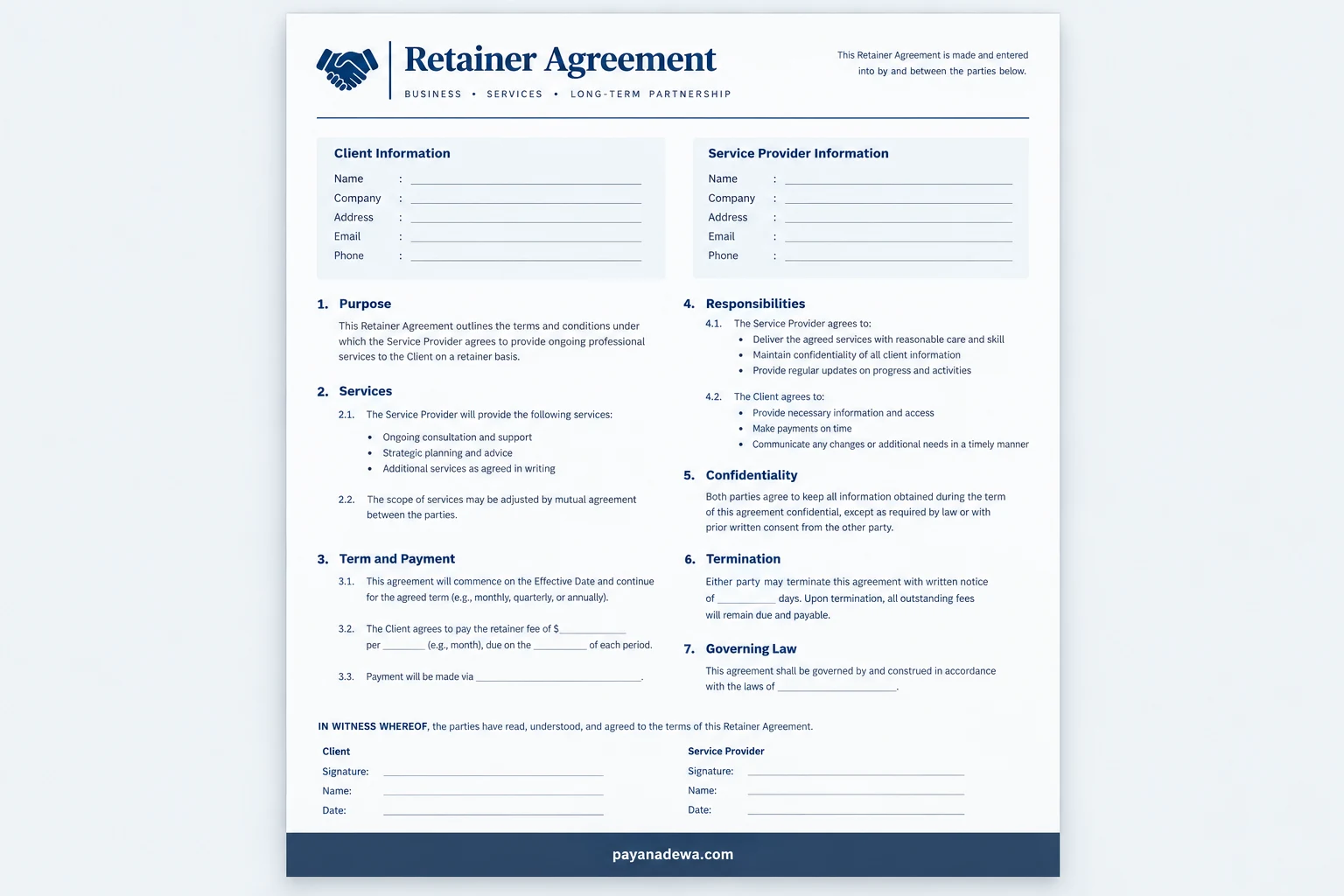
A good retainer agreement should cover the main parts of the working relationship. The following sections can help create a clear and practical contract.
1. Client and Provider Information
Start by identifying both parties. Include the legal name or business name of the client and service provider.
You can also include addresses, email addresses, and other relevant contact details. This information helps establish who is entering the agreement.
2. Scope of Services
The scope of services explains what the provider will do. Try to make this section specific and easy to understand.
For example, marketing services might include content planning, social media management, and monthly reports. Legal services might include consultations and document reviews.
It is also helpful to explain what is not included. This creates clear boundaries and reduces the risk of scope disputes.
3. Retainer Fee and Payment Terms
The agreement should clearly state the retainer fee. It should also explain when and how the client must pay.
Important payment details may include:
- Monthly, quarterly, or annual payment frequency
- Payment due dates
- Accepted payment methods
- Late payment terms
- Taxes and applicable fees
- Reimbursable expenses
Clear payment terms help both parties manage their budgets. They also reduce uncertainty about invoices and payment deadlines.
4. Hours, Deliverables, or Availability
This section explains what the recurring fee covers. The agreement may provide a certain number of hours, specific deliverables, or ongoing access to the provider.
For example, a consultant may provide 15 hours of work each month. A marketing agency may provide four articles and eight social media posts.
If additional work costs extra, state the additional rate in the contract. This simple step can prevent many disagreements later.
5. Contract Term and Renewal
Next, explain when the agreement starts and how long it lasts. Some retainer agreements have a fixed end date. Others renew automatically.
If the contract renews automatically, explain the renewal process. Also state how much notice either party must provide to stop the renewal.
Clear renewal terms make the relationship easier to manage.
6. Termination Terms
Every retainer contract should explain how either party can end the agreement.
For example, the contract may require 30 days’ written notice. It can also explain how the parties will handle unpaid invoices, unfinished work, or remaining services.
A clear termination clause gives both sides a predictable process.
7. Confidentiality
Clients often share private business information with service providers. Therefore, a confidentiality clause can be useful.
This section can explain what information is confidential. It can also describe when information may be shared.
Depending on the relationship, the agreement may need more detailed confidentiality terms.
8. Intellectual Property
Some professional services involve creating original work. This may include websites, graphics, software, articles, reports, or marketing materials.
The agreement should explain who owns that work. It should also explain when ownership transfers, if applicable.
Clear intellectual property terms can prevent disputes about ownership later.
9. Additional Work and Expenses
A client may request work outside the original scope. The agreement should explain what happens in this situation.
For example, additional work may use an hourly rate. Alternatively, the provider may charge a separate project fee.
The contract can also explain which expenses the client must reimburse. Examples include travel costs, software fees, advertising costs, and third-party services.
Benefits of a Retainer Agreement
A retainer agreement can provide several practical benefits for both parties.
- Predictable payments: Recurring fees make budgeting easier.
- Clear expectations: Both parties know which services are included.
- Ongoing support: Clients can maintain access to professional expertise.
- Better planning: Providers can plan their time and resources.
- Fewer misunderstandings: Written terms create a shared reference point.
- Professional structure: The contract defines responsibilities and procedures.
In addition, recurring agreements can make long-term client relationships easier to manage.
Retainer Agreement vs. Service Agreement
A service agreement can cover a single project or a defined service. A retainer agreement usually focuses on ongoing services.
For example, a company may hire a designer to create one website. That project could use a standard service agreement.
Later, the same company may need monthly design support. In that case, a retainer agreement could cover the ongoing work.
However, the two contract types can overlap. The right structure depends on the actual business relationship.
Tips for Creating a Clear Retainer Contract
Define the Scope Clearly
Avoid vague terms such as “general support.” Instead, describe the services in practical terms.
Explain what the provider will deliver. Also explain how often the services will be provided.
Set Clear Boundaries
Define working hours, communication methods, response times, and service limits.
These details help the client understand how the provider will work.
Explain Extra Charges
If additional work costs extra, explain the pricing method in advance.
This may be an hourly rate, fixed project fee, or another agreed pricing method.
Review the Agreement Regularly
Business needs can change over time. Therefore, review the agreement when the scope or pricing changes.
Put important changes in writing. Do not rely only on informal conversations or verbal promises.
Use Simple Language
A contract should be precise but readable. Clear language makes important terms easier to understand.
If a provision is complex, consider getting professional legal advice before signing.
Common Retainer Agreement Mistakes
Even a simple retainer contract can cause problems when important details are missing.
Here are several mistakes to avoid:
- Not defining the services included in the retainer.
- Failing to explain additional work.
- Leaving payment deadlines unclear.
- Not explaining how unused hours are handled.
- Using unclear renewal terms.
- Leaving termination requirements undefined.
- Ignoring intellectual property ownership.
- Making important changes without written documentation.
Fortunately, most of these issues can be avoided with careful planning.
When Should You Use a Retainer Agreement?
A retainer agreement can work well when a client needs professional services on a recurring basis.
Common examples include:
- Legal services
- Accounting and bookkeeping
- Business consulting
- Marketing services
- Public relations
- Website maintenance
- IT support
- Graphic design
- Content creation
- Ongoing technical consulting
However, a retainer may not be necessary for every project. A one-time project with a clear start and finish may work better with a standard service agreement.
Retainer Agreement Checklist
Before signing a retainer agreement, review the following points:
- Are both parties correctly identified?
- Are the services clearly described?
- Is the retainer fee clearly stated?
- Are payment dates and methods included?
- Are service hours or deliverables defined?
- Are additional services addressed?
- Are expenses explained?
- Are renewal terms clear?
- Are termination requirements included?
- Are confidentiality terms appropriate?
- Is intellectual property ownership addressed?
- Are the governing law and signatures included?
Reviewing this checklist can help identify missing terms before the agreement is signed.
Conclusion
A retainer agreement creates a clear structure for an ongoing professional relationship. It explains the services, fees, responsibilities, and expectations of both parties.
A useful retainer contract should cover the scope of work, payment terms, service limits, additional charges, renewal, termination, confidentiality, and intellectual property.
Most importantly, the agreement should reflect the actual relationship between the client and provider. Clear terms can make communication easier and reduce avoidable misunderstandings.
Finally, remember that contract laws vary by location and industry. If you plan to use a retainer agreement for a specific legal or business situation, consider having the document reviewed by a qualified professional in the relevant jurisdiction.