A Retail Agreement is an important business document that sets out the terms between a seller, supplier, manufacturer, distributor, or other business and a retailer. It helps both parties understand their responsibilities, payment obligations, product requirements, delivery arrangements, and rights before commercial transactions begin.
Whether you operate a small retail store, an online shop, a wholesale business, or a growing product brand, having clear written terms can reduce misunderstandings and make business relationships easier to manage. A well-structured retail contract can also provide a useful reference when questions arise about pricing, delivery, returns, payment deadlines, or termination.
This guide explains what a Retail Agreement should contain, how to structure one, what clauses deserve attention, and how to use a template as a practical starting point.
What Is a Retail Agreement?
A Retail Agreement is a written contract that defines the commercial relationship between two or more parties involved in the sale or distribution of products through a retail channel. Depending on the business arrangement, one party may act as a supplier or seller while the other operates as the retailer or buyer.
The agreement can cover individual purchases, recurring orders, an ongoing supplier relationship, or a specific distribution arrangement. Its exact content depends on the products, business model, location, and commercial terms agreed by the parties.
A retail contract is useful because verbal arrangements can be difficult to verify later. Written terms give both parties a shared understanding of what was agreed and provide a clear framework for handling routine business transactions.
Why Use a Retail Agreement?
A properly prepared retail agreement can provide several practical benefits for a business relationship.
- Clarifies responsibilities: Each party can see what it is expected to provide or perform.
- Defines payment terms: Prices, payment methods, due dates, deposits, and late-payment provisions can be documented.
- Reduces misunderstandings: Important commercial details are recorded rather than relying on informal conversations.
- Establishes delivery expectations: The agreement can specify delivery locations, schedules, shipping responsibilities, and costs.
- Creates a reference point: Both parties can return to the document when questions arise.
- Supports business consistency: A reusable agreement template can make onboarding new retail partners more efficient.
However, a template should be treated as a starting point rather than a substitute for professional legal advice. Local laws and the specific circumstances of a transaction may require additional provisions.
Essential Sections of a Retail Agreement
The strongest retail agreements are clear, specific, and organized. While requirements vary by transaction, several sections are commonly useful.
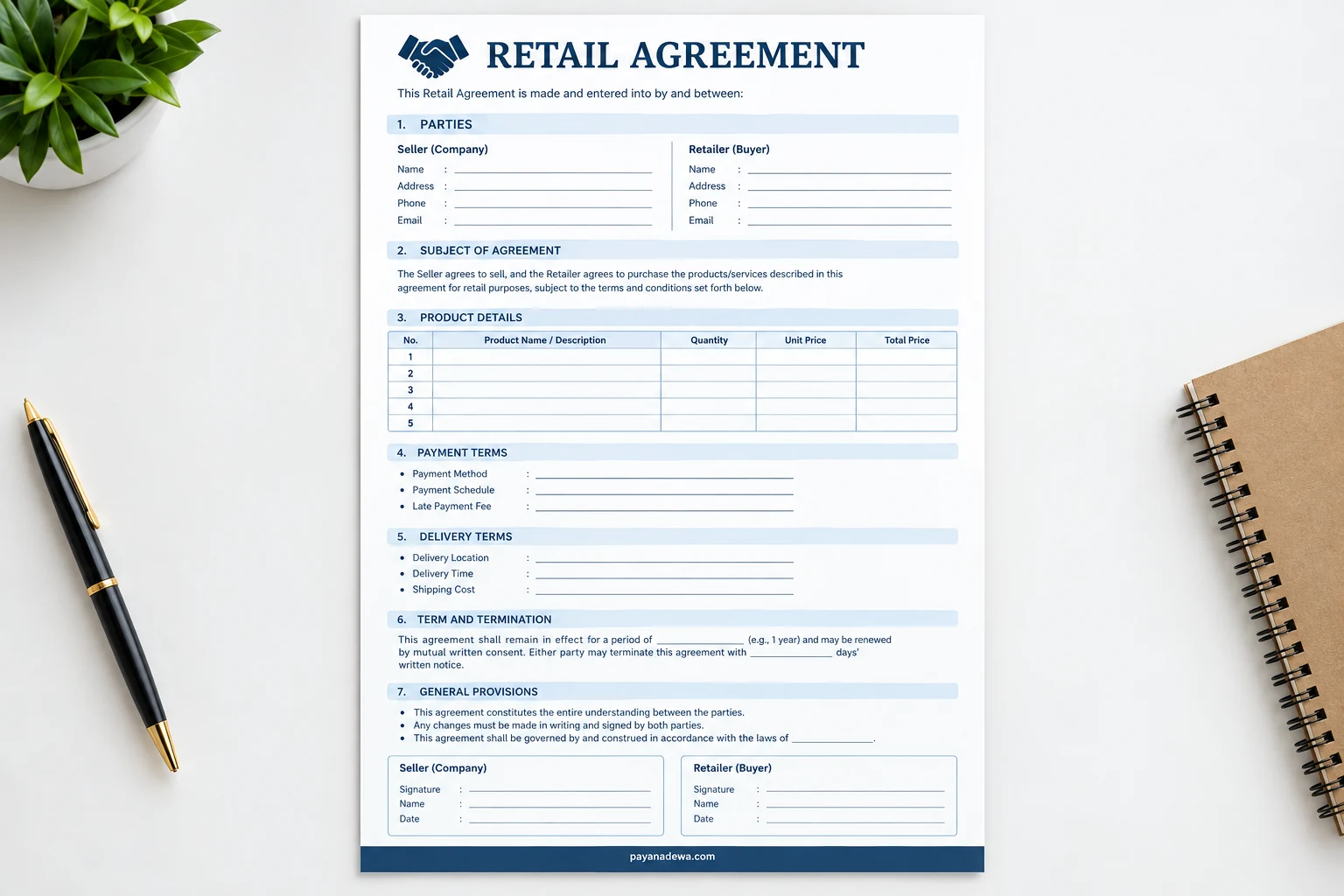
1. Identification of the Parties
Start by identifying every party entering into the agreement. Include the legal business name, address, contact information, and the appropriate representative where applicable.
Clearly identifying the parties helps avoid confusion about which company or individual is responsible for the contractual obligations. If a business operates under a trading name, consider including both its legal name and business name where appropriate.
2. Products or Services Covered
The agreement should describe the products or services being sold. Product descriptions can include names, models, specifications, quantities, quality standards, packaging requirements, or other identifying information.
For larger product ranges, the agreement can refer to an attached product schedule, price list, purchase order, or other document that forms part of the commercial arrangement.
3. Pricing and Payment Terms
Payment provisions are among the most important parts of a retail contract. The document should make it clear how much the retailer must pay and when payment is due.
- Product or wholesale prices
- Applicable taxes or charges
- Payment method
- Deposit requirements, if any
- Payment deadlines
- Credit terms
- Late-payment charges, where legally permitted
- Currency used for transactions
If prices may change, explain how and when price adjustments will be communicated. This can help prevent disputes when a supplier updates its pricing structure.
4. Delivery and Shipping Terms
A retail agreement should also explain how products reach the retailer. Include the expected delivery location, estimated delivery schedule, shipping arrangements, and responsibility for transportation costs.
Where relevant, the parties should also address what happens if products are delayed, damaged during transit, incorrectly delivered, or unavailable.
5. Product Quality, Inspection, and Returns
Product-related responsibilities deserve careful attention. The agreement can establish reasonable standards for product quality and explain how the retailer should inspect goods after delivery.
Return procedures can cover defective products, incorrect quantities, damaged shipments, or products that do not meet agreed specifications. The document should explain notification deadlines and the process for requesting replacement products, refunds, credits, or other remedies.
6. Term and Termination
The term section states how long the Retail Agreement remains effective. It may apply for a fixed period or continue until one party ends it according to the agreed termination procedure.
Termination provisions can specify the required written notice period and identify circumstances that may justify earlier termination. For example, the agreement may address material breach, non-payment, insolvency, or failure to meet important contractual obligations.
7. Confidentiality and Business Information
Retail relationships may involve commercially sensitive information such as pricing, product plans, customer information, supplier details, or marketing strategies. Where appropriate, the agreement can include confidentiality obligations governing how such information may be used or disclosed.
8. Intellectual Property and Branding
If a retailer is permitted to use a supplier’s trademarks, logos, product images, or promotional materials, the agreement should explain the scope of that permission.
Clear intellectual property terms can help define whether marketing materials may be modified, where brand assets may be displayed, and what happens to those materials after the relationship ends.
9. Governing Law and Dispute Resolution
A commercial agreement commonly identifies the law that will govern the contract and may describe how disputes should be handled. Depending on the transaction, the parties may agree to negotiation, mediation, arbitration, or court proceedings.
Because legal requirements differ between jurisdictions, this section should be reviewed carefully when preparing a contract for actual use.
How to Customize a Retail Agreement Template
A template can save time, but it should be customized to reflect the actual commercial relationship. Before signing, review every field and remove provisions that do not apply.
- Replace placeholder information with the correct legal names and addresses.
- Describe the products precisely enough to avoid ambiguity.
- Confirm all prices, quantities, taxes, and payment deadlines.
- Specify who handles shipping and related costs.
- Document the procedure for damaged or defective products.
- Review the agreement’s renewal and termination provisions.
- Confirm the governing law and dispute-resolution terms.
- Make sure authorized representatives sign and date the document.
It is also helpful to keep a signed copy in an organized business record system. If amendments are made later, retain the relevant versions and ensure both parties understand which version is currently effective.
Common Mistakes to Avoid
Even a simple retail contract can become problematic when important details are left unclear. Avoid these common mistakes:
- Using vague product descriptions: Unclear specifications can create disagreements about what was ordered.
- Leaving payment terms incomplete: A contract should clearly identify when and how payment is expected.
- Ignoring delivery responsibilities: Specify who arranges shipping and who bears relevant costs.
- Failing to explain returns: A clear return procedure can reduce disputes involving damaged or defective goods.
- Using outdated information: Review business names, addresses, prices, and contact details before signing.
- Signing without reviewing local requirements: Contract rules can vary by jurisdiction and transaction type.
Retail Agreement vs. Purchase Order
A Retail Agreement and a purchase order can work together, but they serve different purposes. A Retail Agreement generally establishes the broader terms of an ongoing commercial relationship, while a purchase order typically identifies the products, quantities, prices, and delivery details for a particular order.
For example, a supplier and retailer might sign a long-term agreement covering payment rules, returns, warranties, confidentiality, and termination. Individual purchase orders can then be issued under those established terms.
This structure can make recurring transactions more efficient while maintaining consistent commercial conditions.
Practical Tips for a Clear Retail Contract
Good contracts do not need unnecessarily complicated language. The most useful documents are usually specific, organized, and easy for the parties to understand.
- Use clear headings for each major topic.
- Define important terms consistently throughout the document.
- Use specific dates, amounts, quantities, and deadlines whenever possible.
- Separate recurring agreement terms from individual order information.
- Make sure amendments are documented in writing.
- Give both parties a complete signed copy.
- Seek qualified legal advice when the transaction involves significant financial, regulatory, or legal risk.
Frequently Considered Questions
Can a Retail Agreement be used for an online store?
Yes. An online retailer can use a Retail Agreement when establishing a supplier, wholesale, distribution, or product-purchasing relationship. The agreement should be adapted to the specific online business model and applicable laws.
Can a Retail Agreement cover multiple products?
Yes. A single agreement can cover multiple products, especially when the parties have an ongoing relationship. A separate product schedule or purchase order can be used when the product list changes frequently.
Does every Retail Agreement need signatures?
For practical purposes, having authorized representatives sign and date the agreement provides clear evidence that the parties accepted the written terms. Specific legal requirements can vary, so professional advice may be appropriate for important transactions.
Conclusion
A well-prepared Retail Agreement gives sellers and retailers a structured way to define their commercial relationship. By documenting the parties, products, pricing, payment terms, delivery responsibilities, returns, termination procedures, and other important conditions, businesses can create clearer expectations from the beginning.
A Retail Agreement template can provide a convenient starting point, particularly for businesses that regularly work with retail partners. However, the template should always be reviewed and customized for the specific transaction, products, jurisdiction, and business requirements.