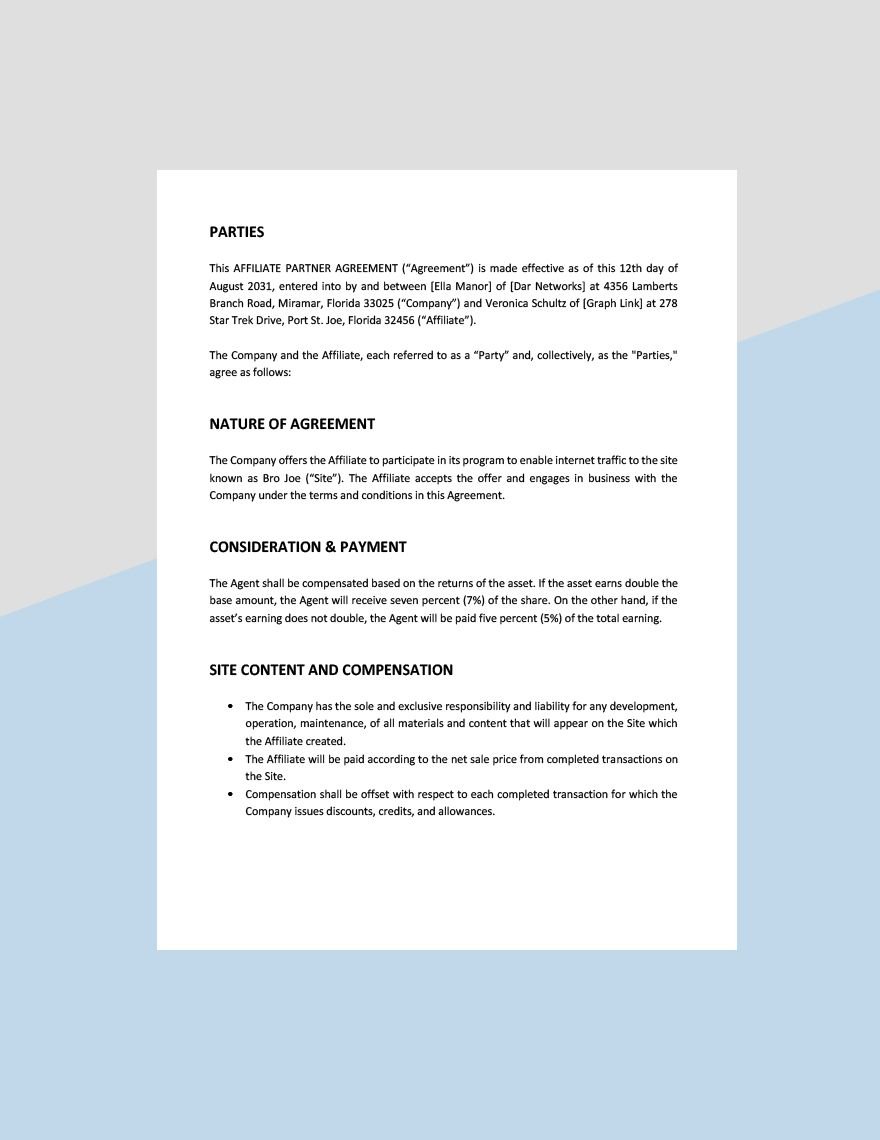
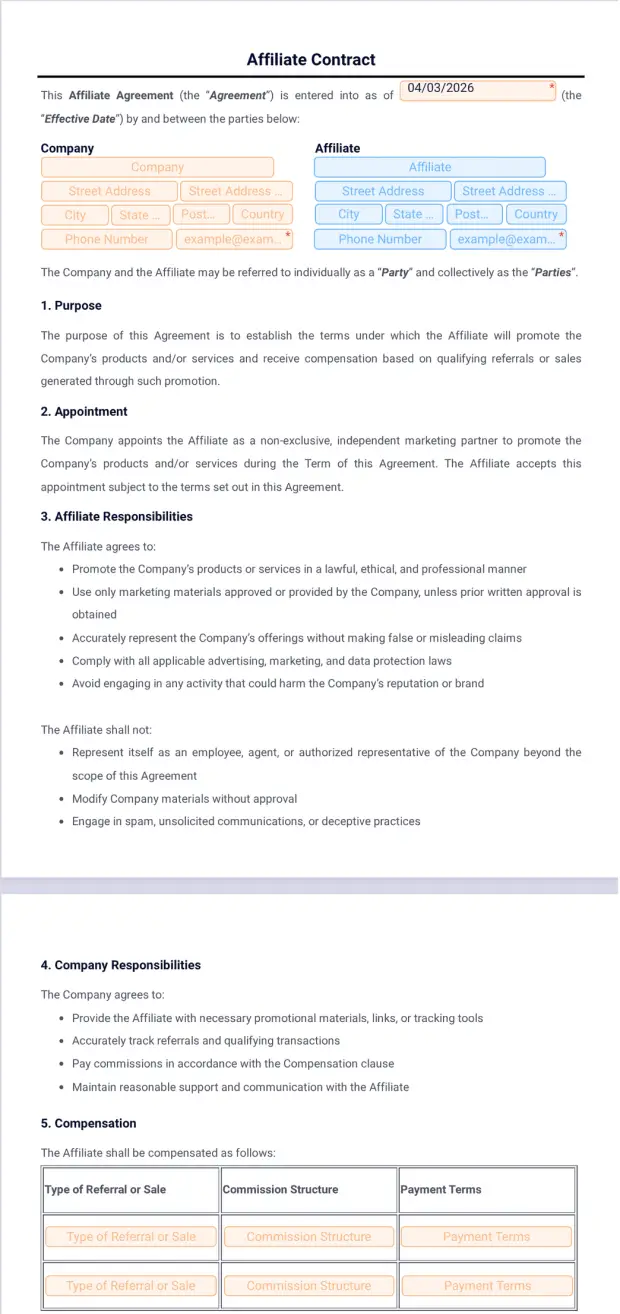
Affiliate Agreement Templates help businesses and affiliate partners create clear working terms from the start. A good agreement explains how referrals work, when commissions are earned, which marketing methods are allowed, and what each party must do.

Affiliate marketing can grow a business, but unclear terms can create problems. For example, partners may disagree about commission rates, tracking periods, refunds, or promotional rules. A well-structured agreement gives both sides one clear reference point.
This guide explains how to build and customize an affiliate agreement. It also covers agreements for small businesses, bloggers, software companies, online stores, and product-based brands.
What Are Affiliate Agreement Templates?
Affiliate agreement templates are structured documents that define the relationship between a business and an affiliate partner. They provide a practical framework for important terms such as commissions, referrals, marketing rules, payment schedules, and termination.

Instead of creating every section from the beginning, a business can start with an organized structure. The document can then be adjusted to match the company’s products, services, audience, and affiliate program.
A template should not be treated as a universal legal solution. Each business has different needs. The final document should reflect the actual relationship between the parties.
Why Affiliate Agreements Matter
A written agreement removes uncertainty. It tells the affiliate what is expected and tells the business what it must provide.

For example, imagine that an affiliate sends a customer to an online store. The customer buys a product, then requests a refund two weeks later. Without clear terms, both parties may have different ideas about the commission.
A good agreement answers this question before a dispute occurs. It can state whether refunded orders qualify for commission and how previous payments are adjusted.
- Defines the relationship between the business and affiliate.
- Explains how referrals are tracked.
- Sets commission rates and payment rules.
- Describes approved marketing methods.
- Protects trademarks and brand materials.
- Explains refunds, cancellations, and chargebacks.
- Defines termination procedures.
Key Sections in Affiliate Agreement Templates
A useful agreement should be easy to understand. It should also cover the situations that are most likely to affect the partnership.

1. Parties and Definitions
Begin by identifying both parties. Include the legal business name, affiliate name, contact details, and effective date.
Next, define important terms. These may include affiliate, referral, qualifying sale, commission, tracking link, customer, promotional materials, and net revenue.
Clear definitions make later sections easier to understand. They also reduce the risk of different interpretations.
2. Program Scope
Explain what the affiliate is allowed to promote. The scope may cover specific products, services, subscription plans, websites, or regions.
If your company sells many products, decide whether every product is part of the program. You can also create separate commission schedules for different product groups.
3. Commission Terms
Commission terms should be precise. State whether the affiliate earns a percentage, a fixed amount, or recurring payments.
Also explain how the commission is calculated. For example, the commission may be based on net sales after approved discounts and refunds.

Do not assume that a percentage alone is enough. A rate of 10 percent can mean very different things if the agreement does not define the revenue base.
4. Tracking and Attribution
Affiliate marketing depends on accurate tracking. The agreement should explain how referrals are connected to affiliates.

Describe the tracking link, referral code, attribution period, and tracking platform. If the program uses last-click attribution, state that clearly.
Also consider situations where several affiliates interact with the same customer. A clear attribution rule can prevent later disagreements.
5. Payment Terms
Payment terms should explain when commissions become payable. Include the payment schedule, payment method, minimum threshold, and possible adjustments.

Refunds and chargebacks also matter. State whether the business can deduct commissions linked to refunded or fraudulent transactions.
6. Marketing Rules
Affiliates need clear promotional boundaries. State which marketing methods are allowed and which methods are restricted.

Possible topics include paid search, social media, email marketing, coupon sites, review content, influencer campaigns, and promotional codes.
The agreement should also prohibit misleading claims. Affiliates should describe products accurately and avoid promises that the business cannot support.
7. Intellectual Property
Explain how affiliates can use company logos, product images, trademarks, videos, screenshots, and other materials.
It is useful to state whether affiliates can edit these materials. You should also explain what happens to those materials after the partnership ends.
8. Compliance Requirements
Affiliate content should follow applicable advertising and consumer protection rules. The agreement can require affiliates to disclose commercial relationships when required.

Businesses should also consider privacy requirements when affiliate tracking involves customer information or tracking technologies.
9. Confidentiality
Some affiliate programs involve private business information. This may include campaign plans, commission data, customer information, product launches, or internal pricing.
The agreement should explain how confidential information must be protected. It should also identify information that may be shared publicly.
10. Termination
Every affiliate agreement should explain how the relationship can end.

State whether either party can terminate the agreement with notice. Also explain what happens to unpaid commissions, affiliate links, promotional materials, and confidential information after termination.
Affiliate Agreement Templates for Small Business
Affiliate agreement templates for small business should focus on clarity. A small company does not always need a complex contract. However, it still needs clear rules.
Start with the core commercial terms. Define the products, commission structure, tracking method, payment schedule, promotional rules, and termination process.
As the affiliate program grows, the agreement can become more detailed. New sections may address international affiliates, multiple commission tiers, paid advertising, recurring subscriptions, or special campaigns.
Affiliate Agreement Template for Bloggers
An affiliate agreement template for bloggers should address content publishing and affiliate disclosures.

Bloggers may create product reviews, comparison articles, tutorials, buying guides, or social media posts. The agreement should explain how affiliate links may be used in those materials.
It should also explain how the blogger can use company images and product information. If the company requires approval before publication, that requirement should be stated clearly.
Affiliate Agreement Template for Software
An affiliate agreement template for software may need more detailed payment and attribution rules.

Software businesses often use trials, subscriptions, upgrades, and renewals. Each event can affect affiliate compensation.
For example, decide whether an affiliate earns commission on the first subscription only or on recurring payments. You should also explain what happens when a trial converts into a paid plan.
Affiliate Agreement Template for E-Commerce
An affiliate agreement template for e-commerce should address physical product sales. Returns, refunds, discounts, canceled orders, and chargebacks are especially important.
Consider defining the commission base. If commission is calculated from net sales, specify which deductions are included.
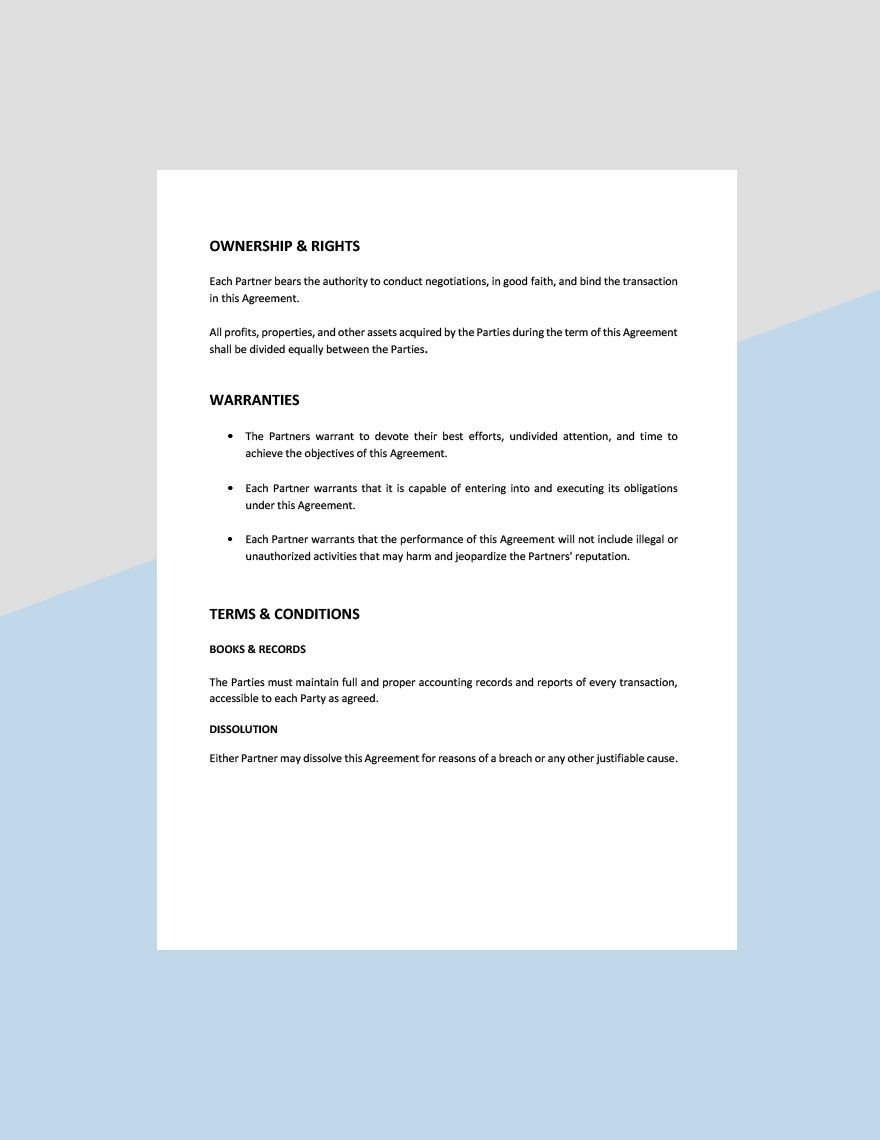
Product claims also matter. Affiliates should not make claims that differ from the information supplied by the merchant.
Affiliate Agreement Templates for Products
Affiliate agreement templates for products can help merchants organize partnerships around physical or digital products.
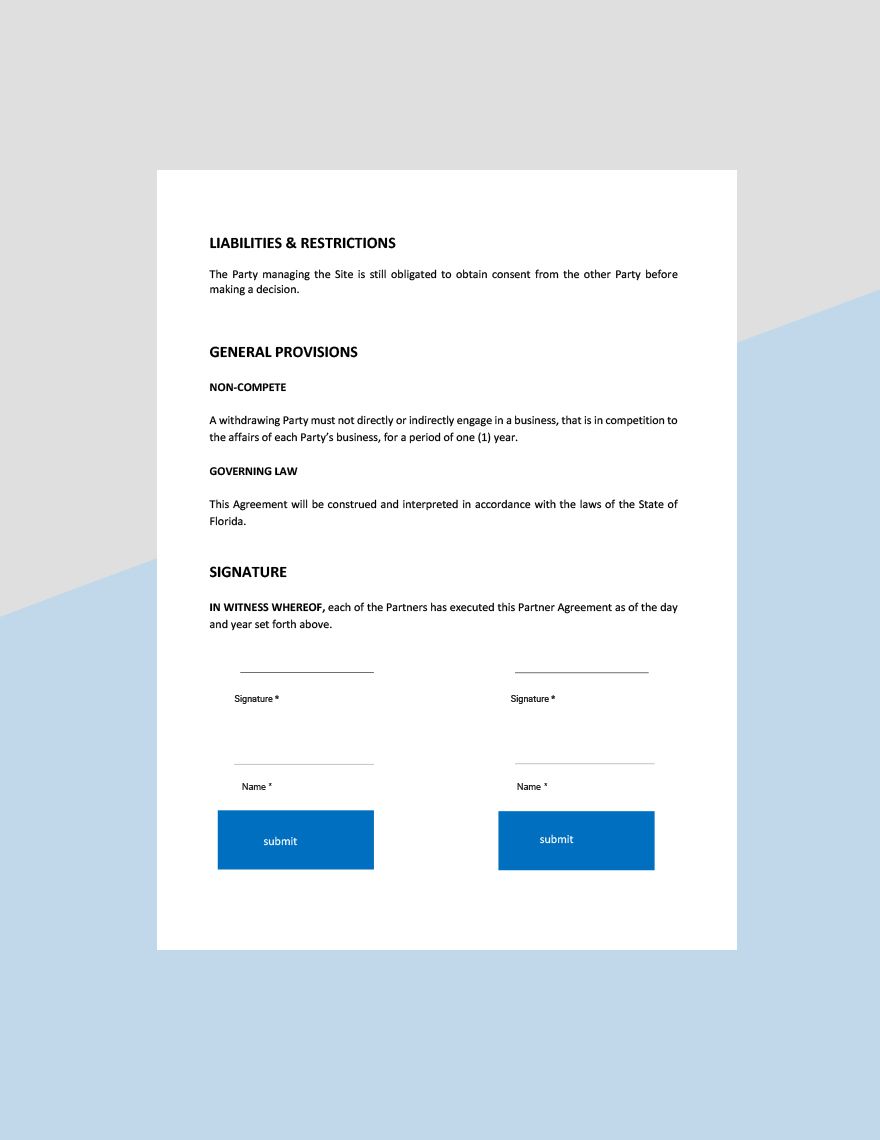
If commission rates vary by product, include a clear schedule. This makes the agreement easier to update when prices or product categories change.
You can also specify which products are excluded. This is useful when certain products have very low margins or special sales conditions.
Choosing the Right Document Format
Businesses often consider affiliate agreement templates word when they expect to edit the document often. An editable format makes it easier to change names, rates, product lists, and other details.

The phrase affiliate agreement template word is useful when a company needs a working master document. Keep one approved version so that different affiliates do not receive conflicting terms.
Affiliate agreement templates pdf can be useful when the document has reached its final review stage. A fixed-layout version helps preserve the appearance of the approved agreement.

Choose the format based on your workflow. Editing and version control are usually easier in an editable document. Final presentation is often easier with a fixed-layout document.
Basic Affiliate Agreement Template: Essential Elements
A basic affiliate agreement template can remain concise while still covering important business terms.

- Names and contact details of both parties.
- Effective date of the agreement.
- Description of the affiliate program.
- Products or services covered.
- Commission calculation method.
- Referral tracking rules.
- Payment schedule.
- Refund and chargeback treatment.
- Approved marketing channels.
- Restricted promotional activities.
- Trademark and brand usage rules.
- Confidentiality requirements.
- Termination procedures.
- Dispute and governing-law provisions.
The document does not need to be long. It needs to be specific. A short agreement with clear terms is often more useful than a long agreement filled with vague language.

How to Customize an Affiliate Agreement
Start with your actual affiliate program. Do not simply replace the company name in a standard document.
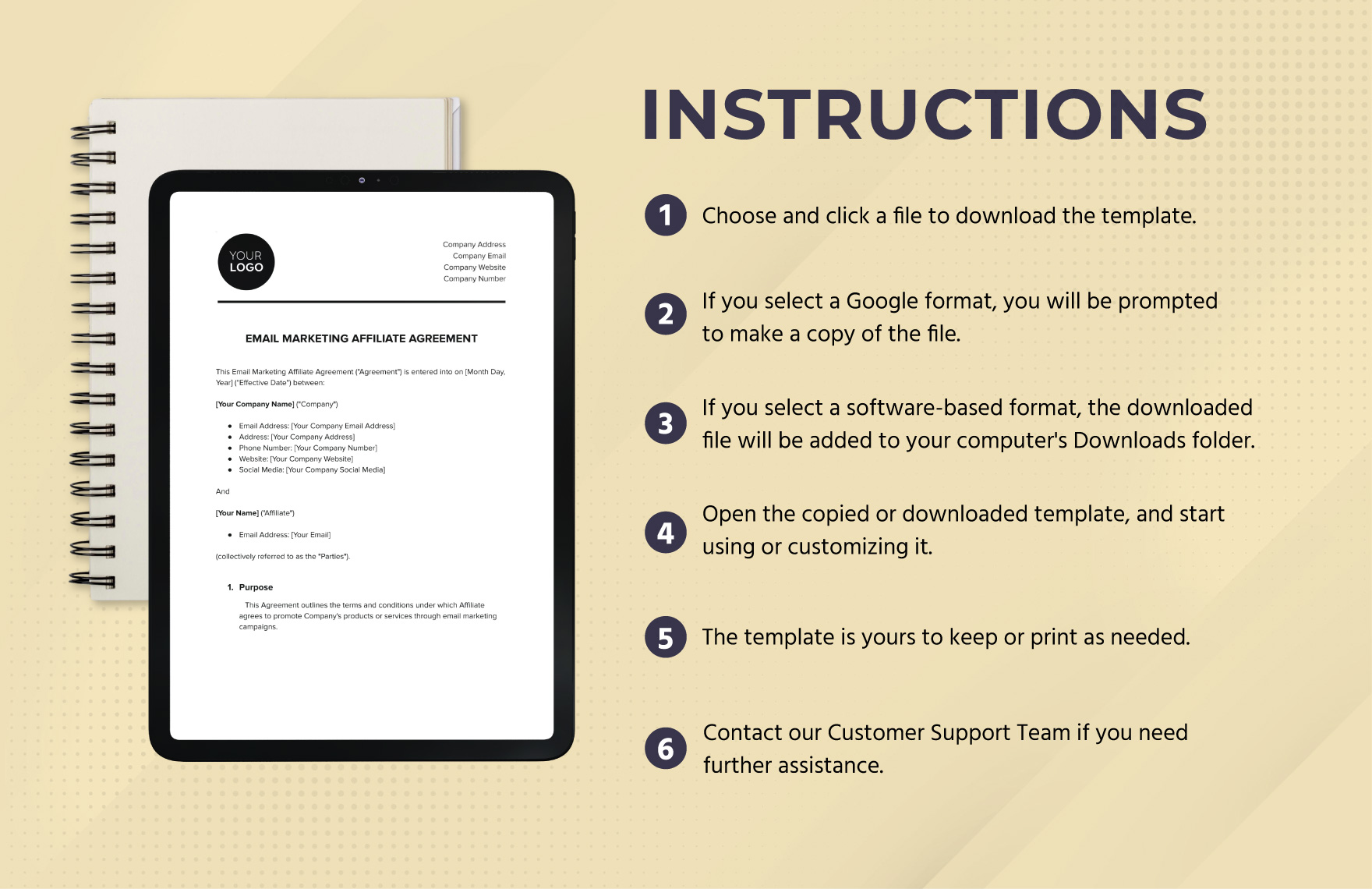
Step 1: Define the Relationship
Identify who sells the product, who promotes it, and which event creates a commission. Use simple language whenever possible.
Step 2: Define Attribution
Explain how the business identifies an affiliate referral. Include tracking links, referral codes, attribution periods, and rules for overlapping referrals.
Step 3: Set Marketing Rules
List the channels affiliates may use. Then identify restricted tactics. Think about paid search, email campaigns, social media, coupon websites, and influencer content.
Step 4: Review Payment Scenarios
Consider refunds, cancellations, chargebacks, duplicate orders, and fraudulent transactions. Give each situation a clear treatment.
Step 5: Check the Final Agreement
Review company details, rates, product names, payment terms, tracking rules, and termination provisions. For a significant affiliate program, professional legal review is a sensible step.

Common Mistakes to Avoid
Many affiliate agreements fail because they leave important details open to interpretation.

One common mistake is stating a commission rate without explaining how the rate is calculated. Another is describing tracking without explaining the attribution period.
Businesses should also avoid using identical terms for very different affiliate models. A software subscription program can have different needs from a physical product store.

- Do not leave commission calculations unclear.
- Do not ignore refunds and chargebacks.
- Do not give unlimited rights to trademarks.
- Do not overlook promotional restrictions.
- Do not omit termination procedures.
- Do not ignore advertising disclosure requirements.
- Do not use outdated business terms.
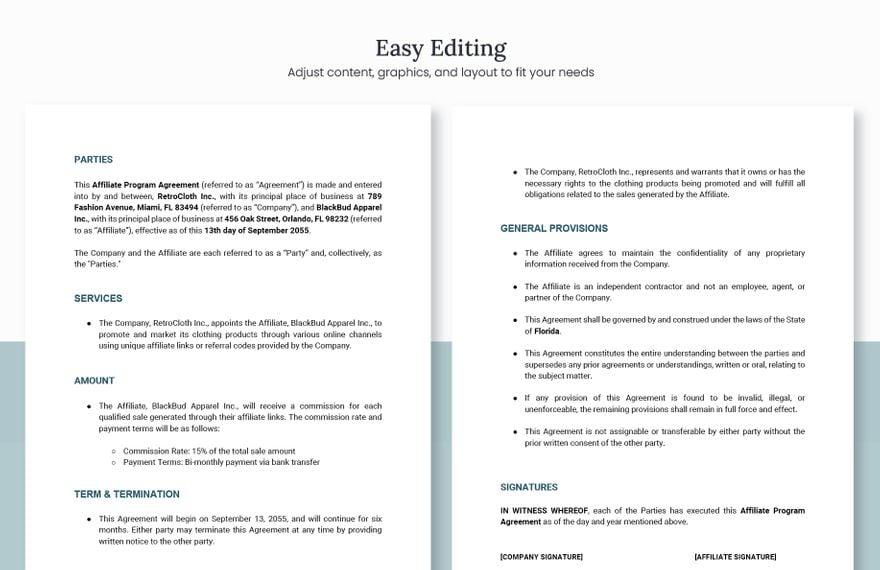
Advanced Considerations for Growing Programs
Large affiliate programs often require more detailed rules. For example, a business may use different commission rates for new customers, returning customers, or specific product categories.

Some programs also use performance tiers. Affiliates who generate more qualifying sales may move into a different commission level.
Another important issue is version control. When commission rates change, state when the new terms become effective. Keep records of which version applies to each affiliate.
How to Select the Right Affiliate Agreement Structure
The right structure depends on the affiliate model. A blogger may need strong content and disclosure provisions. A software company may need detailed subscription rules. An e-commerce business may need stronger refund and product provisions.

When reviewing a template, ask whether it reflects your real business process. Check the commission model, tracking method, promotional rules, intellectual property terms, and termination provisions.
Also consider how easy the document will be to maintain. A good structure should remain useful when your affiliate program expands.
Frequently Asked Questions About Affiliate Agreement Templates
What is the purpose of an affiliate agreement?
An affiliate agreement defines the working relationship between a business and its affiliate. It explains commissions, referrals, marketing responsibilities, brand usage, payment rules, and termination.
Can a small business use a basic agreement?
Yes. A small business can use a concise structure if it covers the important commercial terms. The agreement should still match the actual affiliate program.
What should bloggers look for in an affiliate agreement?
Bloggers should review commission rules, content requirements, disclosure responsibilities, link usage, trademark rules, and payment terms.
Why does software need special affiliate terms?
Software programs may involve trials, subscriptions, upgrades, and renewals. These events can affect attribution and commission payments.
What should an e-commerce agreement include?
An e-commerce agreement should address qualifying purchases, refunds, returns, discounts, chargebacks, promotional rules, and commission calculations.
Should an agreement be reviewed by a lawyer?
Professional review can be useful when the program involves substantial revenue, international partners, regulated products, complex commissions, or significant intellectual property rights.

The best affiliate agreement templates provide clear expectations for both sides. Choose a structure that matches your business model, define commissions and tracking carefully, explain promotional rules, and address refunds and termination before the partnership begins. A clear agreement creates a stronger foundation for affiliate relationships and makes the program easier to manage as it grows.
Affiliate Agreement Templates: A Clear Guide for Better Affiliate Partnerships
Affiliate Agreement Templates help businesses and affiliate partners create clear working terms from the start. A good agreement explains how referrals work, when commissions are earned, which marketing methods are allowed, and what each party must do.
Affiliate marketing can grow a business, but unclear terms can create problems. For example, partners may disagree about commission rates, tracking periods, refunds, or promotional rules. A well-structured agreement gives both sides one clear reference point.
This guide explains how to build and customize an affiliate agreement. It also covers agreements for small businesses, bloggers, software companies, online stores, and product-based brands.
What Are Affiliate Agreement Templates?
Affiliate agreement templates are structured documents that define the relationship between a business and an affiliate partner. They provide a practical framework for important terms such as commissions, referrals, marketing rules, payment schedules, and termination.
Instead of creating every section from the beginning, a business can start with an organized structure. The document can then be adjusted to match the company’s products, services, audience, and affiliate program.
A template should not be treated as a universal legal solution. Each business has different needs. The final document should reflect the actual relationship between the parties.
Why Affiliate Agreements Matter
A written agreement removes uncertainty. It tells the affiliate what is expected and tells the business what it must provide.
For example, imagine that an affiliate sends a customer to an online store. The customer buys a product, then requests a refund two weeks later. Without clear terms, both parties may have different ideas about the commission.
A good agreement answers this question before a dispute occurs. It can state whether refunded orders qualify for commission and how previous payments are adjusted.
- Defines the relationship between the business and affiliate.
- Explains how referrals are tracked.
- Sets commission rates and payment rules.
- Describes approved marketing methods.
- Protects trademarks and brand materials.
- Explains refunds, cancellations, and chargebacks.
- Defines termination procedures.
Key Sections in Affiliate Agreement Templates
A useful agreement should be easy to understand. It should also cover the situations that are most likely to affect the partnership.
1. Parties and Definitions
Begin by identifying both parties. Include the legal business name, affiliate name, contact details, and effective date.
Next, define important terms. These may include affiliate, referral, qualifying sale, commission, tracking link, customer, promotional materials, and net revenue.
Clear definitions make later sections easier to understand. They also reduce the risk of different interpretations.
2. Program Scope
Explain what the affiliate is allowed to promote. The scope may cover specific products, services, subscription plans, websites, or regions.
If your company sells many products, decide whether every product is part of the program. You can also create separate commission schedules for different product groups.
3. Commission Terms
Commission terms should be precise. State whether the affiliate earns a percentage, a fixed amount, or recurring payments.
Also explain how the commission is calculated. For example, the commission may be based on net sales after approved discounts and refunds.
Do not assume that a percentage alone is enough. A rate of 10 percent can mean very different things if the agreement does not define the revenue base.
4. Tracking and Attribution
Affiliate marketing depends on accurate tracking. The agreement should explain how referrals are connected to affiliates.
Describe the tracking link, referral code, attribution period, and tracking platform. If the program uses last-click attribution, state that clearly.
Also consider situations where several affiliates interact with the same customer. A clear attribution rule can prevent later disagreements.
5. Payment Terms
Payment terms should explain when commissions become payable. Include the payment schedule, payment method, minimum threshold, and possible adjustments.
Refunds and chargebacks also matter. State whether the business can deduct commissions linked to refunded or fraudulent transactions.
6. Marketing Rules
Affiliates need clear promotional boundaries. State which marketing methods are allowed and which methods are restricted.
Possible topics include paid search, social media, email marketing, coupon sites, review content, influencer campaigns, and promotional codes.
The agreement should also prohibit misleading claims. Affiliates should describe products accurately and avoid promises that the business cannot support.
7. Intellectual Property
Explain how affiliates can use company logos, product images, trademarks, videos, screenshots, and other materials.
It is useful to state whether affiliates can edit these materials. You should also explain what happens to those materials after the partnership ends.
8. Compliance Requirements
Affiliate content should follow applicable advertising and consumer protection rules. The agreement can require affiliates to disclose commercial relationships when required.
Businesses should also consider privacy requirements when affiliate tracking involves customer information or tracking technologies.
9. Confidentiality
Some affiliate programs involve private business information. This may include campaign plans, commission data, customer information, product launches, or internal pricing.
The agreement should explain how confidential information must be protected. It should also identify information that may be shared publicly.
10. Termination
Every affiliate agreement should explain how the relationship can end.
State whether either party can terminate the agreement with notice. Also explain what happens to unpaid commissions, affiliate links, promotional materials, and confidential information after termination.
Affiliate Agreement Templates for Small Business
Affiliate agreement templates for small business should focus on clarity. A small company does not always need a complex contract. However, it still needs clear rules.
Start with the core commercial terms. Define the products, commission structure, tracking method, payment schedule, promotional rules, and termination process.
As the affiliate program grows, the agreement can become more detailed. New sections may address international affiliates, multiple commission tiers, paid advertising, recurring subscriptions, or special campaigns.
Affiliate Agreement Template for Bloggers
An affiliate agreement template for bloggers should address content publishing and affiliate disclosures.
Bloggers may create product reviews, comparison articles, tutorials, buying guides, or social media posts. The agreement should explain how affiliate links may be used in those materials.
It should also explain how the blogger can use company images and product information. If the company requires approval before publication, that requirement should be stated clearly.
Affiliate Agreement Template for Software
An affiliate agreement template for software may need more detailed payment and attribution rules.
Software businesses often use trials, subscriptions, upgrades, and renewals. Each event can affect affiliate compensation.
For example, decide whether an affiliate earns commission on the first subscription only or on recurring payments. You should also explain what happens when a trial converts into a paid plan.
Affiliate Agreement Template for E-Commerce
An affiliate agreement template for e-commerce should address physical product sales. Returns, refunds, discounts, canceled orders, and chargebacks are especially important.
Consider defining the commission base. If commission is calculated from net sales, specify which deductions are included.
Product claims also matter. Affiliates should not make claims that differ from the information supplied by the merchant.
Affiliate Agreement Templates for Products
Affiliate agreement templates for products can help merchants organize partnerships around physical or digital products.
If commission rates vary by product, include a clear schedule. This makes the agreement easier to update when prices or product categories change.
You can also specify which products are excluded. This is useful when certain products have very low margins or special sales conditions.
Choosing the Right Document Format
Businesses often consider affiliate agreement templates word when they expect to edit the document often. An editable format makes it easier to change names, rates, product lists, and other details.
The phrase affiliate agreement template word is useful when a company needs a working master document. Keep one approved version so that different affiliates do not receive conflicting terms.
Affiliate agreement templates pdf can be useful when the document has reached its final review stage. A fixed-layout version helps preserve the appearance of the approved agreement.
Choose the format based on your workflow. Editing and version control are usually easier in an editable document. Final presentation is often easier with a fixed-layout document.
Basic Affiliate Agreement Template: Essential Elements
A basic affiliate agreement template can remain concise while still covering important business terms.
- Names and contact details of both parties.
- Effective date of the agreement.
- Description of the affiliate program.
- Products or services covered.
- Commission calculation method.
- Referral tracking rules.
- Payment schedule.
- Refund and chargeback treatment.
- Approved marketing channels.
- Restricted promotional activities.
- Trademark and brand usage rules.
- Confidentiality requirements.
- Termination procedures.
- Dispute and governing-law provisions.
The document does not need to be long. It needs to be specific. A short agreement with clear terms is often more useful than a long agreement filled with vague language.
How to Customize an Affiliate Agreement
Start with your actual affiliate program. Do not simply replace the company name in a standard document.
Step 1: Define the Relationship
Identify who sells the product, who promotes it, and which event creates a commission. Use simple language whenever possible.
Step 2: Define Attribution
Explain how the business identifies an affiliate referral. Include tracking links, referral codes, attribution periods, and rules for overlapping referrals.
Step 3: Set Marketing Rules
List the channels affiliates may use. Then identify restricted tactics. Think about paid search, email campaigns, social media, coupon websites, and influencer content.
Step 4: Review Payment Scenarios
Consider refunds, cancellations, chargebacks, duplicate orders, and fraudulent transactions. Give each situation a clear treatment.
Step 5: Check the Final Agreement
Review company details, rates, product names, payment terms, tracking rules, and termination provisions. For a significant affiliate program, professional legal review is a sensible step.
Common Mistakes to Avoid
Many affiliate agreements fail because they leave important details open to interpretation.
One common mistake is stating a commission rate without explaining how the rate is calculated. Another is describing tracking without explaining the attribution period.
Businesses should also avoid using identical terms for very different affiliate models. A software subscription program can have different needs from a physical product store.
- Do not leave commission calculations unclear.
- Do not ignore refunds and chargebacks.
- Do not give unlimited rights to trademarks.
- Do not overlook promotional restrictions.
- Do not omit termination procedures.
- Do not ignore advertising disclosure requirements.
- Do not use outdated business terms.
Advanced Considerations for Growing Programs
Large affiliate programs often require more detailed rules. For example, a business may use different commission rates for new customers, returning customers, or specific product categories.
Some programs also use performance tiers. Affiliates who generate more qualifying sales may move into a different commission level.
Another important issue is version control. When commission rates change, state when the new terms become effective. Keep records of which version applies to each affiliate.
How to Select the Right Affiliate Agreement Structure
The right structure depends on the affiliate model. A blogger may need strong content and disclosure provisions. A software company may need detailed subscription rules. An e-commerce business may need stronger refund and product provisions.
When reviewing a template, ask whether it reflects your real business process. Check the commission model, tracking method, promotional rules, intellectual property terms, and termination provisions.
Also consider how easy the document will be to maintain. A good structure should remain useful when your affiliate program expands.
Frequently Asked Questions About Affiliate Agreement Templates
What is the purpose of an affiliate agreement?
An affiliate agreement defines the working relationship between a business and its affiliate. It explains commissions, referrals, marketing responsibilities, brand usage, payment rules, and termination.
Can a small business use a basic agreement?
Yes. A small business can use a concise structure if it covers the important commercial terms. The agreement should still match the actual affiliate program.
What should bloggers look for in an affiliate agreement?
Bloggers should review commission rules, content requirements, disclosure responsibilities, link usage, trademark rules, and payment terms.
Why does software need special affiliate terms?
Software programs may involve trials, subscriptions, upgrades, and renewals. These events can affect attribution and commission payments.
What should an e-commerce agreement include?
An e-commerce agreement should address qualifying purchases, refunds, returns, discounts, chargebacks, promotional rules, and commission calculations.
Should an agreement be reviewed by a lawyer?
Professional review can be useful when the program involves substantial revenue, international partners, regulated products, complex commissions, or significant intellectual property rights.
The best affiliate agreement templates provide clear expectations for both sides. Choose a structure that matches your business model, define commissions and tracking carefully, explain promotional rules, and address refunds and termination before the partnership begins. A clear agreement creates a stronger foundation for affiliate relationships and makes the program easier to manage as it grows.