A well-designed construction business plan template gives contractors, builders, and construction entrepreneurs a structured way to define their services, target customers, operations, finances, and growth strategy. Construction businesses face unique challenges, including fluctuating material costs, project delays, labor management, equipment expenses, subcontractor coordination, licensing, insurance, and cash-flow timing. A strong business plan brings these moving parts together into one practical roadmap.
Whether you are launching a residential building company, expanding into commercial projects, or improving an established contracting business, the right plan helps transform ideas into measurable actions. This guide explains the essential sections, compares popular document formats, provides practical examples, and shows how to customize a plan for your specific construction business.
What Is a Construction Business Plan Template?
A construction business plan template is a structured document framework used to organize the most important information about a construction company. Instead of beginning with a blank page, the template provides sections for your company overview, services, market research, operations, management, marketing strategy, and financial planning.
The document should not simply describe what your company hopes to do. A useful plan explains how the company will operate. For example, it should identify who estimates projects, how bids are reviewed, how subcontractors are selected, how materials are purchased, how schedules are monitored, and how project profitability is measured.
A construction company business plan template is especially valuable because construction companies usually depend on project-based revenue. Winning work does not automatically guarantee profit. A project can create substantial revenue while still producing weak margins if estimating, purchasing, labor productivity, or change management is poorly controlled.
Why a Business Plan Matters in Construction
Construction involves long project cycles and significant financial commitments. Before accepting a major contract, a company may need to commit labor, equipment, insurance, materials, subcontractors, and management time. A business plan helps owners understand whether the company has the capacity to support that work.
- Clarifies the company’s services and ideal project types.
- Defines the target market and customer segments.
- Creates a framework for estimating revenue and expenses.
- Improves decisions about staffing and equipment.
- Supports discussions with lenders, investors, and business partners.
- Establishes measurable goals and operational priorities.
- Helps management identify financial and operational risks early.
The strongest plans are treated as working documents. They should be reviewed when the company enters a new market, changes its service mix, adds equipment, hires key staff, or experiences significant changes in project demand.
Choosing the Right Format for Your Business Plan
Different software formats serve different purposes. The best choice depends on who will use the document and how often it needs updating.
construction business plan template word
A construction business plan template word is useful when the plan is primarily narrative. Word-processing software works well for executive summaries, company descriptions, market analysis, management biographies, and detailed operating procedures. It is also practical when several stakeholders need to review and edit written content.
construction business plan template excel
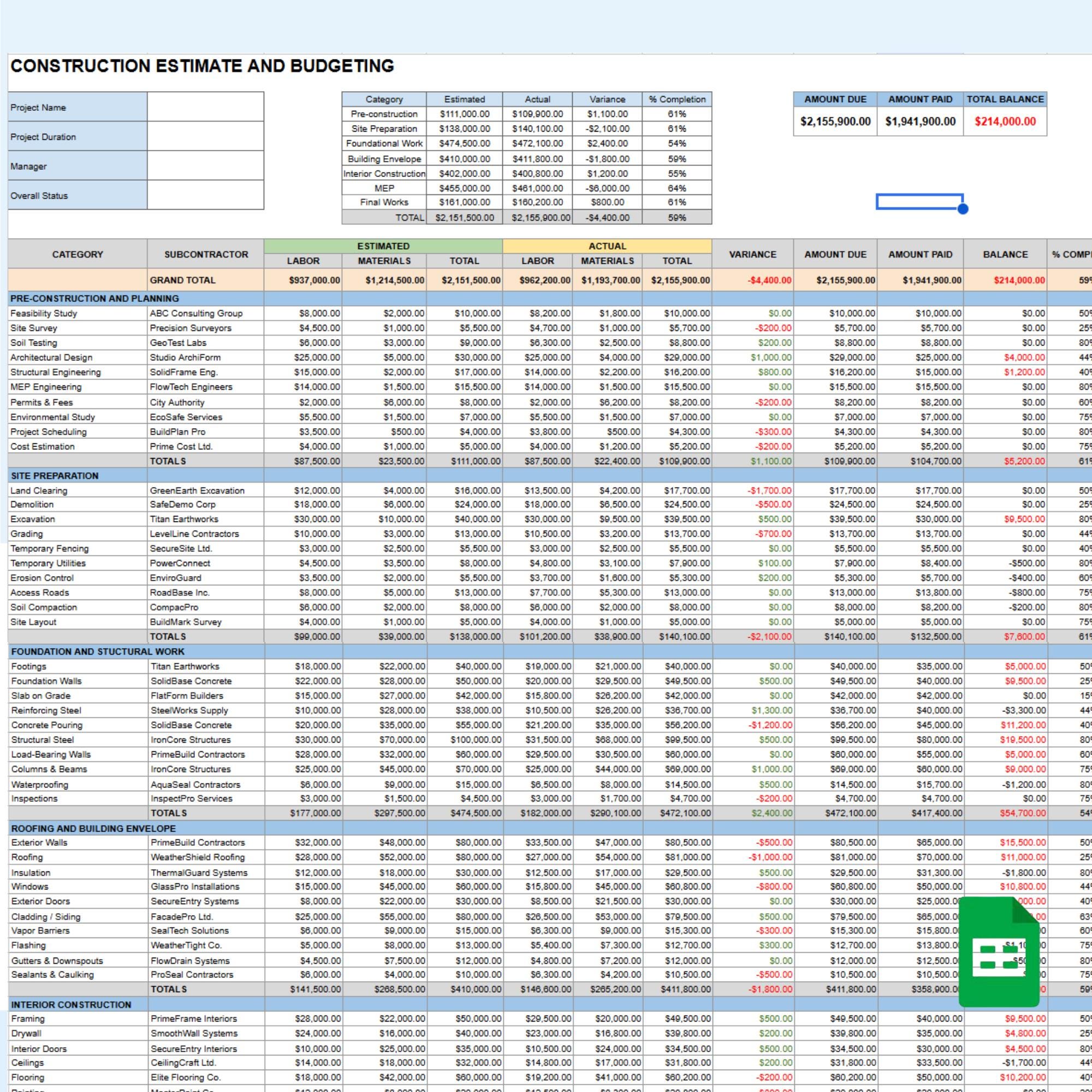
A construction business plan template excel is particularly useful for financial projections. Construction companies often need detailed calculations involving labor, materials, equipment, overhead, project margins, accounts receivable, and cash-flow timing. Spreadsheet formulas make assumptions easier to update and compare.
construction business plan template pdf
A construction business plan template pdf is suitable when the content is finalized and needs to maintain a consistent presentation. This format is often useful for sharing a completed plan with external reviewers because page structure and formatting remain stable.
construction business plan template google docs
A construction business plan template google docs can be helpful for collaborative planning. Owners, estimators, accountants, project managers, and marketing staff can contribute to the same document while maintaining one current version.
construction business plan template ppt
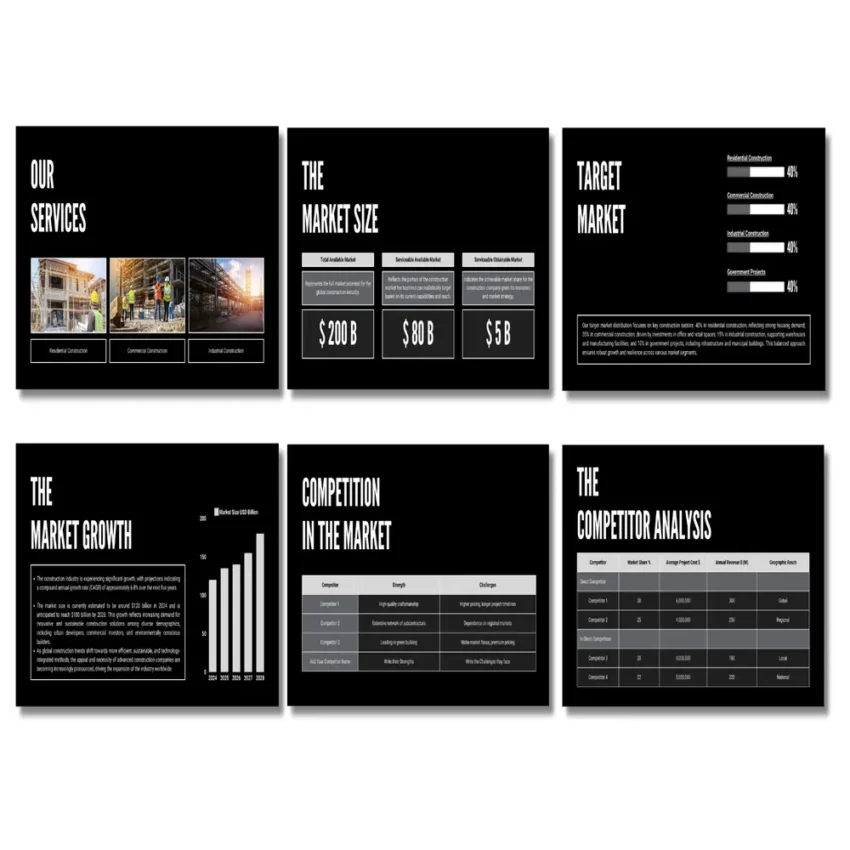
A construction business plan template ppt is useful when the objective is presentation rather than detailed documentation. A slide-based format can summarize the business opportunity, services, market position, management team, and projected growth for meetings with stakeholders.

The Core Sections Every Construction Business Plan Should Include
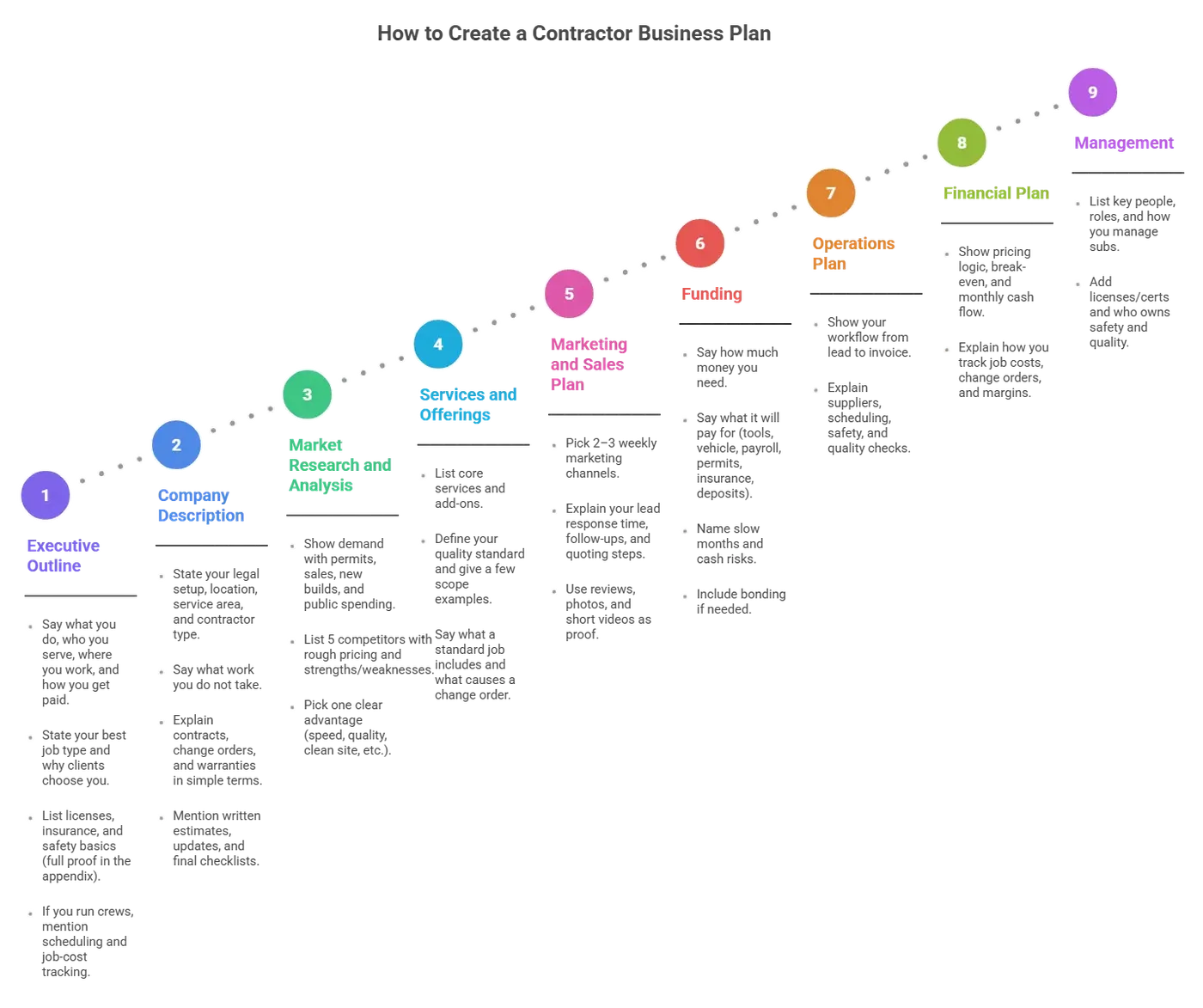
1. Executive Summary
The executive summary provides a concise introduction to the entire company. Although it appears first, it is often easier to write after the other sections are complete.
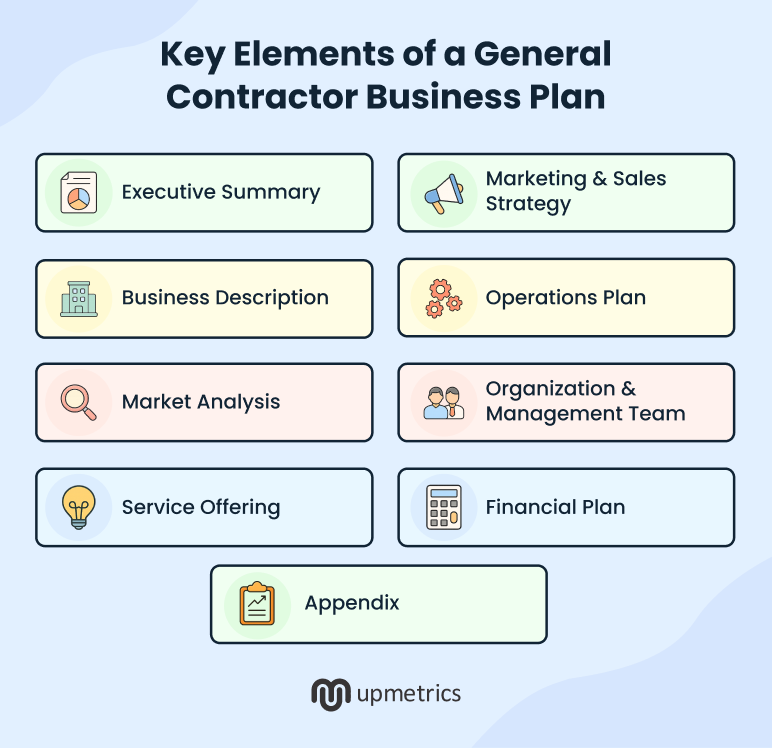
Include the company’s name, location, primary services, customer focus, competitive advantage, management experience, business goals, and major financial requirements. A reader should understand the company’s purpose within a few paragraphs.
2. Company Description
Explain the legal structure, ownership, service territory, company history, and current stage of development. Describe whether the company operates as a general contractor, specialty contractor, residential builder, commercial contractor, renovation company, or infrastructure business.
Also explain why customers should choose your company. Your advantage might come from estimating expertise, specialized technical skills, local relationships, rapid project delivery, strong safety systems, renovation experience, or a particular construction niche.

3. Services and Revenue Model
List the services that generate revenue and explain how each service is priced. Examples may include general contracting, remodeling, design-build services, concrete work, roofing, electrical work, plumbing, excavation, or project management.
For each service, consider the typical contract size, expected project duration, required labor, subcontractor involvement, equipment requirements, and expected margin. This prevents the business plan from presenting all revenue as if every project has the same financial profile.

Market Research and Competitive Analysis
A construction company should define its market geographically and commercially. A small residential contractor may serve homeowners within a limited area, while a commercial contractor may pursue projects across several cities.
Identify customer groups such as homeowners, developers, property managers, architects, manufacturers, government organizations, and commercial property owners. Then examine what these customers value most. Some prioritize price, while others focus on reliability, technical expertise, schedule certainty, communication, or quality.

Competitive analysis should go beyond naming competing companies. Compare their service areas, project specialization, pricing approach, reputation, customer relationships, workforce capacity, and apparent strengths. Your goal is to identify a position your company can defend rather than attempting to compete in every possible market.
How to Build an Effective Operations Plan
The operations section explains how the company delivers projects consistently. This is where many construction plans become more valuable than generic business plans because construction success depends heavily on repeatable systems.
- Lead generation and project qualification.
- Site visits and estimating procedures.
- Bid approval and contract review.
- Labor scheduling and subcontractor coordination.
- Material purchasing and supplier management.
- Equipment maintenance and utilization.
- Quality control and project reporting.
- Safety management and risk prevention.
- Client communication and change-order procedures.

For an advanced company, this section should also identify key performance indicators. Examples include bid conversion rate, backlog, gross margin by project type, labor productivity, schedule variance, equipment utilization, outstanding receivables, and repeat-client percentage.

Financial Planning: The Section That Requires the Most Discipline
Construction financial planning should connect directly to operations. A projected revenue figure is not useful unless management understands how many projects, employees, subcontractors, and resources are required to achieve it.
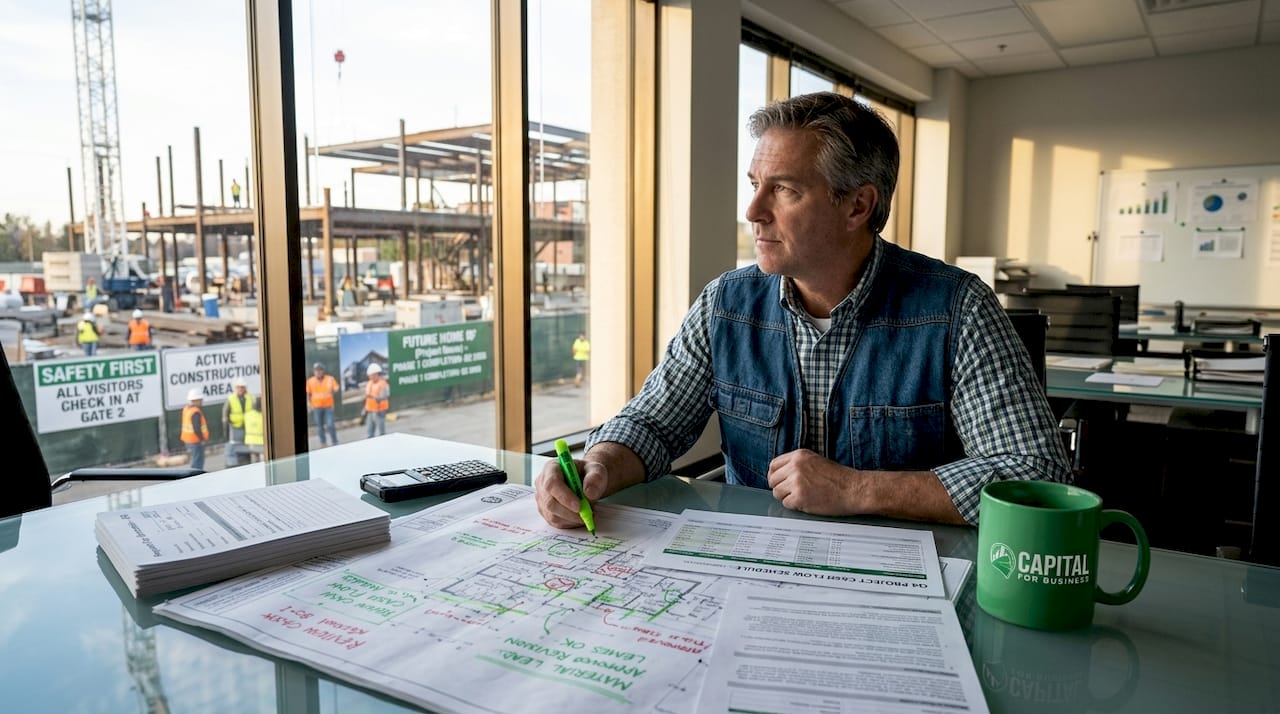
Your financial plan should normally address startup or expansion costs, monthly overhead, project revenue, direct labor, materials, subcontractors, equipment costs, insurance, administrative expenses, taxes, debt obligations, and working-capital requirements.

Cash flow deserves special attention. A company may complete work long before it receives payment. Retainage, delayed approvals, customer payment schedules, and supplier obligations can create pressure even when the company is technically profitable.

Using a Construction Business Plan Sample Template Effectively
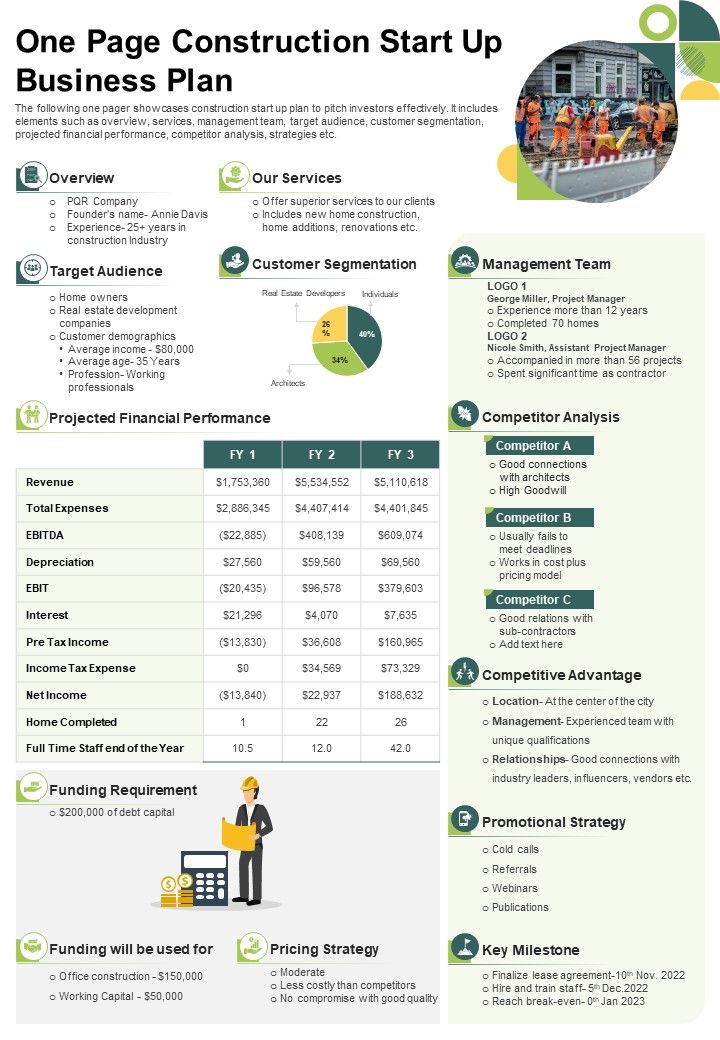
A construction business plan sample template can help you understand the expected structure, but it should never become a substitute for your own research. Replace generic assumptions with information about your local market, service capacity, pricing approach, and operational reality.
For example, imagine a company specializing in residential remodeling. Instead of simply writing that it serves homeowners, define the customer more precisely: homeowners seeking kitchen renovations, bathroom upgrades, additions, or whole-home improvements within a specific service area.

Then connect the customer definition to your marketing and operations. Explain how leads are generated, who performs estimates, how proposals are prepared, what typical project values look like, and how crews are scheduled.
Construction Business Plan Examples: What Practical Plans Have in Common
Useful construction business plan examples are specific. They do not claim that a company will provide excellent service without explaining what creates that quality.
A strong example might state that a commercial contractor focuses on tenant improvements because its management team has established relationships with architects and property managers. It might describe a review process requiring the estimator and project manager to approve bids above a certain value before submission.

Specificity makes a plan operational. It gives management something that can later be measured, reviewed, and improved.
When to Use a general construction business plan pdf
A general construction business plan pdf can be useful when a company offers multiple construction services and needs a broad, consistent business document. General contractors often require a plan that explains how they coordinate clients, designers, suppliers, subcontractors, site personnel, and project schedules.

The broader the service range, the more important it becomes to define project selection criteria. Not every available contract should be pursued. A disciplined company considers whether the project fits its expertise, available staff, financial capacity, risk tolerance, and strategic direction.
Practical Steps for Customizing Your Plan
Begin with facts rather than ambitious statements. Gather historical project data if your company already operates. Review previous bids, completed project margins, recurring expenses, client sources, and cash collection patterns.

- Step 1: Define your ideal project types.
- Step 2: Identify your target customers and service territory.
- Step 3: Document your competitive advantage.
- Step 4: Build a realistic operations workflow.
- Step 5: Calculate fixed and project-based costs.
- Step 6: Create revenue and cash-flow projections.
- Step 7: Establish measurable milestones.
- Step 8: Review assumptions with experienced advisers.
Common Mistakes to Avoid
One common mistake is creating overly optimistic revenue projections without linking them to bidding capacity and available labor. If a company plans to double revenue, the plan should explain where additional projects will come from and whether the company can manage them.
Another mistake is underestimating overhead. Office expenses, insurance, estimating time, software, vehicles, equipment maintenance, training, supervision, and administration can significantly affect profitability.

A third mistake is treating safety and risk management as separate from business planning. Construction risks affect schedules, costs, insurance, employee availability, and company reputation. Safety procedures should therefore support the larger operating strategy.
Understanding construction business plan template word document Options
A construction business plan template word document is best when you need detailed written explanations and frequent revisions. Use clear headings and concise paragraphs. Supporting calculations can remain in a separate spreadsheet while the main document explains what the numbers mean.

This approach can make complex planning easier to manage: narrative information stays readable, while detailed financial models remain flexible.
How construction business plan template free Resources Fit Into Planning
The phrase construction business plan template free is commonly associated with basic starting formats intended to help entrepreneurs organize their first draft. When using any introductory template, evaluate whether it includes construction-specific concerns such as estimating, project scheduling, subcontractor management, equipment, insurance, and cash flow.

How construction business plan template free download Searches Reflect User Needs
Searches for construction business plan template free download usually indicate that the reader wants a ready-to-edit structure rather than general theory. The most important consideration is not the format alone, but whether the framework helps convert your own business information into clear decisions.

FAQ About Construction Business Planning
What should be included in a construction business plan?
A complete plan should include an executive summary, company description, services, market analysis, marketing strategy, operations plan, management structure, financial projections, goals, and supporting information relevant to the business.
How detailed should the financial section be?
The financial section should be detailed enough to explain how revenue is generated, what projects cost to deliver, how overhead is covered, and how the company manages cash timing.

Can an existing construction company use the same plan structure as a startup?
Yes, but an established company should add historical performance, current backlog, existing equipment, employee capacity, customer relationships, and operational results. A startup focuses more heavily on market entry and initial resource requirements.
How often should a construction business plan be reviewed?
Review the plan regularly and update it when major assumptions change. New service lines, equipment purchases, staffing changes, economic conditions, or significant project opportunities may all justify a revision.
Is construction business plan template ppt useful for lenders?
A presentation can provide a concise overview, but lenders may require a more detailed written plan and supporting financial information. A presentation works best as a summary that complements deeper documentation.

Should a construction business plan focus on growth?
Growth should be included only when it can be supported operationally and financially. Sustainable growth requires enough qualified staff, working capital, project management capacity, and reliable systems to handle additional work.
Final Recommendations
A strong construction business plan is more than a document created for a meeting. It is a practical decision-making system for choosing projects, allocating resources, managing risk, and measuring progress. Start with a structure that fits your preferred working format, then customize every section around your actual company rather than generic assumptions.

The most useful plan is specific enough to guide daily decisions while remaining flexible enough to evolve with the business. Define your ideal projects, understand your customers, document your operating process, test your financial assumptions, and review performance regularly. When built around real operational information, a construction business plan becomes a practical roadmap for disciplined and sustainable growth.