A money chart is a practical way to see where your money comes from, where it goes, and how much you can set aside for future goals. Whether you are managing a household budget, organizing your personal finances, teaching children about money, or saving for a major purchase, a clear chart can turn confusing numbers into useful information. Instead of guessing how much you spend each month, you can record transactions, compare totals, and make decisions based on what your finances actually look like.
You do not need complicated software to get started. A printable money chart, spreadsheet, or simple table can help you track income, expenses, savings, and your remaining balance. The most effective system is one you can update consistently. This guide explains what a money chart is, how to use one, what to include, and how to make it part of a realistic money-management routine.
What Is a Money Chart?
A money chart is a visual record of financial activity. It organizes information such as earnings, bills, everyday spending, savings contributions, and financial goals in one place. Depending on your needs, it might be a monthly budget chart, an income and expense tracker, a savings chart, or a chart that combines all three.
The main purpose is clarity. A well-organized chart helps you notice patterns, identify unnecessary costs, and measure progress toward a goal. For example, you might discover that food delivery costs more than expected or that a small weekly transfer adds up to meaningful savings over a year.
Who Can Benefit from a Money Chart?
- Individuals: Monitor paychecks, bills, subscriptions, and personal spending.
- Families: Coordinate household expenses and shared savings goals.
- Students: Manage allowances, part-time income, school costs, and spending money.
- Small business owners: Keep a simple overview of money received and routine expenses while maintaining appropriate business records separately.
- Savers: Track progress toward an emergency fund, a holiday, education, or a large purchase.
What to Include in a Money Chart
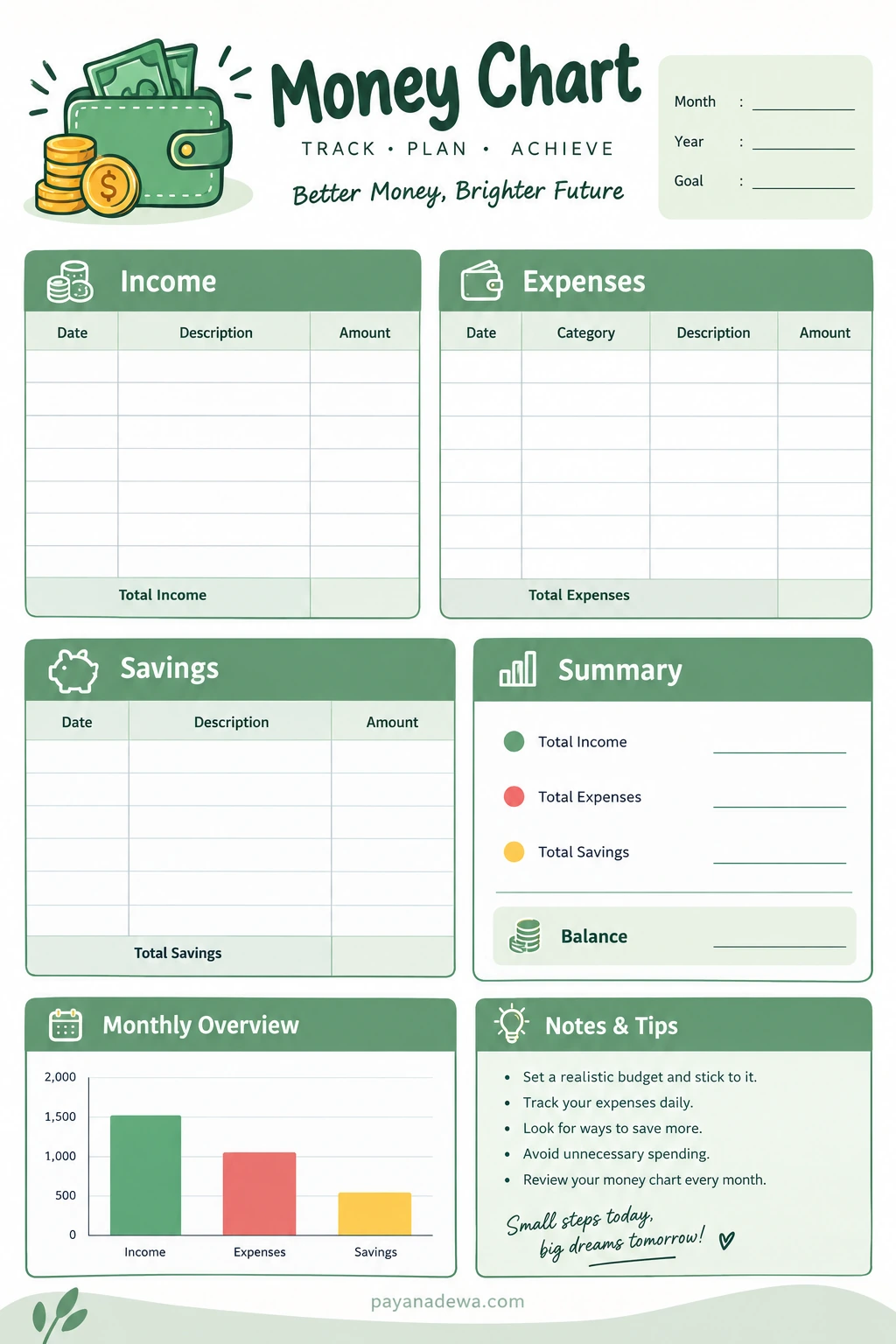
Your chart should match your financial situation, but a useful monthly money chart usually includes four core sections: income, expenses, savings, and a summary. These categories make it easier to understand both your day-to-day cash flow and your longer-term progress.
1. Income
Record money you receive during the month. This may include salary, freelance payments, business income, allowances, or other regular sources. Add the date, a short description, and the amount. If your income varies, use the amount you actually receive rather than relying only on an optimistic estimate.
2. Expenses
List the money you spend and group transactions into categories. Common examples include housing, utilities, groceries, transportation, healthcare, education, debt payments, entertainment, and subscriptions. Categorizing expenses makes it easier to see which costs are essential and which may be flexible.
3. Savings
Track money transferred toward savings goals. You can create separate targets for an emergency fund, travel, a new device, education, or another planned expense. Treat savings as a planned part of your budget rather than waiting to see what remains at the end of the month.
4. Monthly Summary
At the end of the period, calculate total income, total expenses, total savings, and the remaining balance. Use consistent definitions so you do not count the same money twice. For example, if you record a transfer to savings as a savings contribution, do not also treat that transfer as an ordinary purchase in a way that distorts your totals.
How to Use a Money Chart Step by Step
A chart works best when it becomes a simple routine. Follow these steps to set up a system you can maintain without spending too much time on it.
- Step 1: Choose a time period. A monthly chart is a helpful starting point because many bills and pay schedules follow a monthly cycle. If you receive money weekly, you can also review it each week.
- Step 2: Write down your starting balance. Record the amount available at the beginning of the period if your chart is designed to track cash flow.
- Step 3: Record every source of income. Enter each payment with its date and amount. Keep estimated income clearly separate from money already received.
- Step 4: Log expenses regularly. Update the chart daily or several times a week. Save receipts or review bank transactions so small purchases are not forgotten.
- Step 5: Set a savings target. Choose an amount that fits your income and essential costs. A modest, consistent target is often more practical than a goal that leaves you short before payday.
- Step 6: Calculate the totals. Add income and expenses, then compare your results with your plan. Check the arithmetic before making decisions.
- Step 7: Review and adjust. Identify one or two changes for the next month, such as reducing an unused subscription or planning meals before shopping.
Simple calculation: Money left after expenses equals total income minus total expenses. If you also track savings separately, decide whether savings transfers are already included in expenses before calculating your final available balance. Clear rules prevent double-counting.
Example of a Monthly Money Chart
Imagine that your take-home income for one month is 3,000 units of your local currency. You spend 1,900 on essential and flexible costs and set aside 400 for savings. The remaining 700 is available for other planned needs or as a buffer, assuming the savings contribution has not already been included in the expense total.
- Total income: 3,000
- Total expenses: 1,900
- Savings contribution: 400
- Remaining amount after expenses and savings: 700
This example is only an illustration, not a recommended budget for everyone. Your housing costs, household size, income stability, debts, and local cost of living will affect what is realistic. The point of a money chart is to make those trade-offs visible so you can plan with your own numbers.
Printable Money Chart Template
A printable money chart is useful if you prefer writing by hand, want a paper copy near your desk, or are teaching basic budgeting. Choose a layout with enough space to write dates, descriptions, categories, and amounts. A summary area should make totals easy to find at a glance.
Use the template below as a starting point. Fill in the month, year, and goal, then record income, expenses, and savings in the appropriate sections. At the end of the month, review the summary and note one improvement you want to make next month.
Tips for Making Your Money Chart More Effective
Keep the Categories Simple
Too many categories can make tracking feel like a chore. Start with a handful of broad groups, then add detail only when it helps you make a decision. For example, you might begin with housing, food, transportation, bills, personal spending, and savings.
Be Honest About Small Purchases
Snacks, app purchases, coffee, and other low-cost items can add up over time. Record them without judgment. The goal is not to criticize every purchase; it is to understand your habits and decide which spending genuinely matters to you.
Use a Routine You Can Maintain
Choose a regular time to update your chart, such as after dinner on Sunday or when you review your bank account. A short, consistent check-in is usually more sustainable than trying to reconstruct a whole month from memory.
Make Goals Specific and Measurable
Instead of writing “save more,” choose a clear target and a time frame. For example, you might aim to save 600 over six months, provided that amount fits your budget. Divide the target into smaller contributions and track each one as you go.
Review Patterns, Not Just Totals
A monthly total tells you what happened; comparing several months can help explain your habits. Look for recurring increases, seasonal costs, and categories that regularly exceed your plan. Use what you learn to set a more realistic budget rather than assuming every month will be identical.
Common Money Chart Mistakes to Avoid
- Recording transactions too late: Waiting until month-end makes it easier to forget cash purchases and small payments.
- Mixing estimates with actual amounts: Label estimates clearly and update them when the real figures arrive.
- Forgetting irregular expenses: Include annual fees, school costs, repairs, gifts, and other expenses that do not occur every month.
- Setting an unrealistic savings goal: Leave room for essentials and unexpected costs so the plan remains workable.
- Counting the same money twice: Decide how transfers, debt payments, and savings contributions will be categorized before calculating totals.
- Giving up after one difficult month: A chart is a learning tool. Use an unexpected expense or missed target as information for your next plan.
Money Chart vs. Budget Spreadsheet
A money chart and a budget spreadsheet serve similar purposes, but they suit different preferences. A printable chart is quick to understand, easy to display, and convenient for handwritten notes. A spreadsheet can automatically calculate totals, compare months, and create graphs, making it helpful when your finances involve many transactions.
You can also combine both methods. Keep a spreadsheet for detailed records and print a one-page money chart for a monthly overview. The best option is the one that helps you make informed decisions and that you will continue using.
Conclusion: Build Better Habits with a Money Chart
A money chart offers a clear, practical way to track income, understand expenses, monitor savings, and check your financial progress. By keeping categories simple, recording transactions consistently, and reviewing your totals each month, you can make budgeting feel more manageable and identify changes that support your goals.
Start with a basic monthly chart and improve it as your needs change. You do not need perfect records on day one. Consistent tracking, realistic targets, and regular reviews can help you build stronger money habits one month at a time.